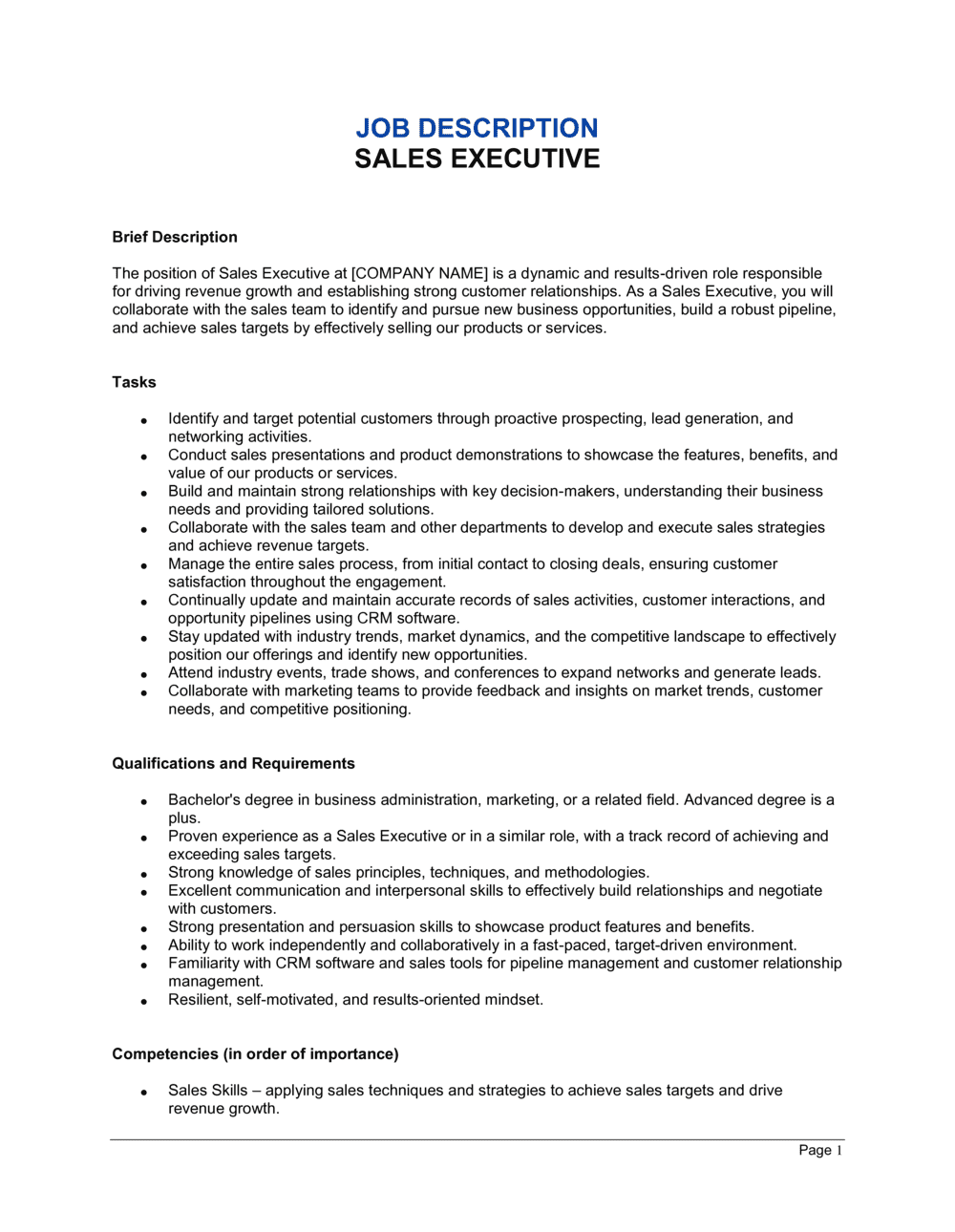
Sales Executive Job Description Template

Free Word download β€’ Edit online β€’ Save & share with Drive β€’ Export to PDF

2 pagesβ€’20–30 min to fillβ€’Difficulty: Standardβ€’Signature requiredβ€’Legal review recommended
Learn more ↓
FreeSales Executive Job Description Template

At a glance

What it is
A Sales Executive Job Description is a formal document that defines the scope, responsibilities, qualifications, compensation structure, and performance expectations for a sales executive role within an organization. This free Word download gives you a structured, legally grounded starting point you can edit online and attach to an employment contract or offer letter before your next hire.
When you need it
Use it when posting a sales executive opening, onboarding a new hire, or restructuring an existing sales role to reflect updated targets, reporting lines, or compensation models. It also serves as the Schedule A attachment to an employment agreement.
What's inside
Role title and reporting structure, a detailed duties and responsibilities section, required qualifications and preferred experience, compensation and commission structure, performance metrics and targets, and terms governing territory assignment and non-solicitation obligations.

What is a Sales Executive Job Description?

A Sales Executive Job Description is a formal document that defines the full scope of a sales executive role β€” including duties, territory, quota, compensation structure, performance expectations, and behavioral obligations such as confidentiality and non-solicitation. Beyond its function as a recruiting tool, it serves as the operational Schedule A attached to an employment agreement, giving both employer and employee a clear, written record of what was agreed before work began. A well-drafted description translates broad commercial goals into specific, measurable expectations and creates the factual foundation needed for performance management, commission disputes, and β€” when necessary β€” disciplinary action or termination.

Why You Need This Document

Without a written sales executive job description, you are exposed in three ways simultaneously. First, there is no documented basis for managing underperformance β€” a rep who misses quota can dispute whether the target was ever formally communicated. Second, non-solicitation and confidentiality obligations that are only discussed verbally during onboarding are nearly impossible to enforce when a departing executive calls your top ten accounts from their new employer. Third, commission disputes over territory overlap or deal ownership become credibility contests rather than contract interpretation exercises. A signed job description, executed before the employee's first day and attached to their employment agreement, closes all three gaps. This template gives you a legally grounded, recruiter-tested starting point that you can tailor to your sales model β€” SaaS, field sales, or channel β€” in under an hour.

Which variant fits your situation?

If your situation is…Use this template
Hiring a senior individual contributor with a large enterprise portfolioSenior Sales Executive Job Description
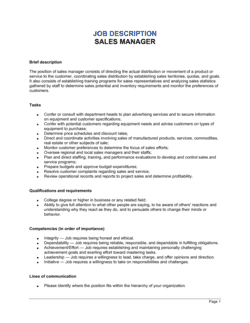
Recruiting a manager who also carries a personal quotaSales Manager Job Description
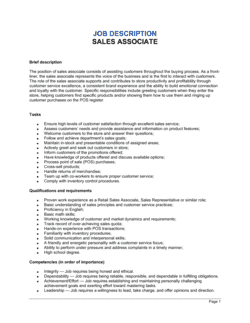
Defining an inside sales or SDR role focused on outbound prospectingSales Representative Job Description
Hiring a territory-based field rep with travel requirementsField Sales Representative Job Description
Bringing on a channel or partner sales executiveBusiness Development Executive Job Description
Engaging an independent sales rep on commission onlyIndependent Contractor Agreement
Attaching duties to a formal employment contractEmployment Contract (At-Will)

Common mistakes to avoid

❌ Omitting the ramp schedule

Why it matters: A new hire without a documented ramp is judged against full quota from day one. Terminating an employee who missed 100% of quota in Month 1 β€” when that was never realistic β€” exposes the employer to wrongful dismissal claims.

Fix: Add a ramp table with percentage targets for months 1–6. A common structure is 25% / 50% / 75% / 100% across the first four quarters.

❌ Embedding the full commission plan in the job description

Why it matters: Commission structures change with every fiscal year. An embedded plan creates a contractual obligation to honor outdated rates β€” or triggers an amendment obligation with every update.

Fix: Reference the Company's Sales Commission Plan by name and state it is 'as amended from time to time.' Attach the current plan separately at onboarding.

❌ No disclaimer that the document is not an employment contract

Why it matters: A detailed job description with duties, compensation, and performance terms can be read by a court as a standalone employment contract, creating obligations the employer never intended.

Fix: Add an explicit clause: 'This Job Description does not constitute an employment contract and does not alter the at-will nature of the employment relationship.'

❌ Using an identical non-compete clause for all sales roles regardless of seniority

Why it matters: A 12-month non-compete barring competition within 500 miles applied to a junior inside sales rep faces significant enforceability risk. Courts apply a reasonableness standard β€” a clause calibrated to a VP and applied to an SDR will likely be struck down entirely.

Fix: Calibrate non-compete scope β€” duration, geography, and restricted activities β€” to the employee's actual access to customer relationships and competitive intelligence.

❌ Stating territory without clarifying exclusivity

Why it matters: Overlapping or ambiguously defined territories generate commission disputes, damage morale, and can result in constructive dismissal claims when a rep's accounts are reassigned without notice.

Fix: State explicitly whether the territory is exclusive. If shared, define the tie-breaking rule β€” typically, the rep who first documented the opportunity in the CRM owns the commission.

❌ Listing degree requirements without a documented business justification

Why it matters: In several US states, the UK, and EU member states, blanket educational requirements that cannot be linked to job performance are subject to discrimination challenges, particularly on the basis of race and socioeconomic background.

Fix: Replace 'bachelor's degree required' with 'bachelor's degree or equivalent experience in B2B sales.' If a degree is genuinely necessary, document the business justification before publishing.

The 10 key clauses, explained

Role title, level, and reporting structure

In plain language: States the formal job title, classification level (e.g., mid-level, senior), and who the role reports to directly and functionally.

Sample language
Position: Sales Executive | Level: [MID / SENIOR] | Reports to: [TITLE β€” e.g., VP of Sales] | Department: [SALES / REVENUE OPERATIONS]

Common mistake: Using a generic title like 'Sales' without specifying level or function. Ambiguous titles make it harder to set pay bands, assign authority, and enforce non-compete scope tied to seniority.

Position summary

In plain language: A 3–5 sentence overview of the role's primary purpose, the customer segment served, and the expected business impact.

Sample language
The Sales Executive is responsible for driving net-new revenue within the [GEOGRAPHIC / VERTICAL] territory, managing a pipeline of [SMB / MID-MARKET / ENTERPRISE] prospects, and consistently achieving a quarterly quota of $[AMOUNT].

Common mistake: Writing a position summary so broad it could describe any commercial role. A summary that omits quota size, customer segment, or deal type gives candidates β€” and courts β€” no clear basis for evaluating scope.

Core duties and responsibilities

In plain language: An itemized list of the primary activities the employee is expected to perform, written with enough specificity to support performance management.

Sample language
Responsibilities include: (a) prospecting and qualifying [X] new accounts per month within the assigned territory; (b) managing a pipeline of at least [X] opportunities at all times; (c) conducting product demonstrations and closing contracts valued at $[X]–$[X]; (d) maintaining accurate records in [CRM PLATFORM].

Common mistake: Listing duties so narrowly that any evolution of the role requires a contract amendment. Include a catch-all: 'and such other duties as reasonably assigned by [TITLE]'.

Required qualifications and experience

In plain language: Minimum education, years of experience, industry background, and any required certifications or licenses the candidate must hold before starting.

Sample language
Requirements: [X]+ years of B2B sales experience, with at least [Y] years selling [PRODUCT TYPE / INDUSTRY]; demonstrable track record of achieving or exceeding quota of $[AMOUNT]+ annually; proficiency in [CRM / TOOL].

Common mistake: Setting education requirements (e.g., 'bachelor's degree required') without a documented business justification. In several jurisdictions, blanket degree requirements have been challenged as discriminatory barriers without evidence of job-relatedness.

Preferred qualifications

In plain language: Experience, skills, or credentials that are advantageous but not mandatory β€” used to differentiate strong candidates without making requirements impractical.

Sample language
Preferred: experience selling into [VERTICAL]; familiarity with [METHODOLOGY β€” e.g., MEDDIC, Challenger]; existing relationships with [BUYER TYPE β€” e.g., CFOs, Procurement Directors] in [REGION].

Common mistake: Including every desirable trait as 'preferred,' making the job description so specific that qualified candidates self-select out. Limit preferred qualifications to the three or four that genuinely differentiate top performers.

Compensation, commission, and OTE

In plain language: States base salary, OTE, commission structure reference, variable pay trigger conditions, and whether commission is recoverable (clawback) if a deal reverses.

Sample language
Base Salary: $[AMOUNT]/year. OTE: $[AMOUNT] at 100% quota attainment. Commission is governed by the Company's Sales Commission Plan, as amended from time to time. Clawback applies to commissions paid on contracts cancelled within [90] days of close.

Common mistake: Detailing the full commission plan inside the job description rather than referencing a separate commission plan document. Commission plans change frequently β€” embedding them creates amendment obligations or contractual rigidity.

Performance expectations and quota

In plain language: Defines quantitative targets β€” annual quota, ramp schedule, activity KPIs β€” and the review cadence used to evaluate performance.

Sample language
Annual quota: $[AMOUNT] in net-new ARR. Ramp schedule: [X]% of quota in Month 1–3, [Y]% in Month 4–6, 100% from Month 7. Performance reviewed [monthly / quarterly] against quota attainment, pipeline coverage ratio ([X]Γ—), and activity KPIs.

Common mistake: Omitting a ramp schedule. Without one, a new hire who misses quota in Month 2 may face disciplinary action on unrealistic grounds, creating legal exposure and morale damage.

Territory and account assignment

In plain language: Defines the employee's territory (geographic, named-account, or vertical), states exclusivity terms, and covers the process for re-assignment.

Sample language
Employee is assigned to the [GEOGRAPHIC / VERTICAL / NAMED-ACCOUNT] territory as detailed in Schedule B. Territory may be adjusted by the Company with [30] days written notice. Named accounts take precedence over geographic overlap claims.

Common mistake: Stating a territory without clarifying whether it is exclusive. Overlapping territory assignments β€” even unintentional ones β€” generate disputes, commission conflicts, and costly departures.

Confidentiality and non-solicitation

In plain language: Restricts the employee from disclosing pipeline data, pricing, and customer information, and from soliciting customers or colleagues after departure.

Sample language
Employee agrees not to disclose any Confidential Information, including customer lists, pricing, and pipeline data, during or after employment. For [12] months following separation, Employee shall not solicit any customer or employee of the Company.

Common mistake: Including a full non-compete in the job description without calibrating it to the specific role's market exposure. A junior SDR facing the same non-compete as a VP of Sales invites enforceability challenges and candidate attrition.

At-will or notice-based termination reference

In plain language: Clarifies that the job description does not create a contract of employment and that termination is governed by the applicable employment agreement or statutory default.

Sample language
This Job Description does not constitute an employment contract. Employment is [at-will / subject to [X] weeks' notice as set out in the Employment Agreement] and may be modified or terminated in accordance with applicable law and the terms of any signed employment agreement.

Common mistake: Omitting this clause entirely. Without it, a well-drafted job description with detailed duties, quotas, and compensation can be read by a court as a standalone employment contract β€” binding the employer to terms they intended as internal guidelines.

How to fill it out

  1. 1

    Define the role title and reporting line

    Enter the formal job title, seniority level, and direct reporting manager. Confirm the department and whether the role has any indirect reporting relationships.

    πŸ’‘ Align the title to your internal compensation bands before posting β€” mismatched titles and pay grades trigger candidate drop-off and internal equity complaints.

  2. 2

    Write the position summary with quota and segment

    Draft a 3–5 sentence overview that names the customer segment (SMB, mid-market, enterprise), the territory type, and the expected revenue impact. Include the annual quota or OTE range.

    πŸ’‘ Including OTE in the summary increases qualified applicant volume by 30–40% compared to descriptions that omit compensation.

  3. 3

    List core duties with measurable specificity

    Write each duty as an action-oriented statement with a concrete output or metric where possible. Aim for 7–10 line items covering prospecting, pipeline management, demos, closing, and CRM hygiene.

    πŸ’‘ End the duties list with 'and such other duties as reasonably assigned' to preserve flexibility without a contract amendment.

  4. 4

    Set required and preferred qualifications separately

    Identify the minimum years of experience, deal size, and tools proficiency the role genuinely requires. List preferred qualifications separately and limit them to three or four truly differentiating traits.

    πŸ’‘ Review any degree requirements against your jurisdiction's employment discrimination guidelines before publishing β€” several states and countries now restrict blanket degree mandates.

  5. 5

    Reference compensation and commission by document, not detail

    State base salary, OTE, and a reference to the Company's Sales Commission Plan. Do not embed commission rates or tier structures in the job description β€” those belong in a separate, updatable plan document.

    πŸ’‘ Include the clawback period (typically 60–90 days) in the compensation clause so candidates understand the recovery policy before signing.

  6. 6

    Define territory scope and exclusivity

    Enter the assigned territory β€” geography, named accounts, or vertical β€” and state clearly whether it is exclusive or shared. Add a re-assignment notice period (typically 30 days).

    πŸ’‘ Attach a named-account list as Schedule B rather than embedding it in the body. Lists change; a schedule is easier to amend without affecting the main document.

  7. 7

    Add the disclaimer and attach to the employment agreement

    Confirm the at-will or notice-based termination clause is present, then attach this document as Schedule A to the signed employment agreement before the employee's first day.

    πŸ’‘ Have the employee initial each page and sign the final page of Schedule A separately to confirm they reviewed the full scope of duties and expectations.

Frequently asked questions

What is a sales executive job description?

A sales executive job description is a formal document that defines the duties, qualifications, compensation structure, territory, and performance expectations for a sales executive role. It functions as both a recruiting tool and a binding operational document when attached as a schedule to an employment agreement. A well-drafted description sets measurable expectations from day one and reduces the ambiguity that leads to performance disputes.

What should a sales executive job description include?

At minimum: role title and reporting structure, a position summary with customer segment and territory type, core duties and responsibilities, required and preferred qualifications, compensation and OTE with a commission plan reference, quota and ramp schedule, territory and account assignment terms, confidentiality and non-solicitation clauses, and a disclaimer confirming the document is not a standalone employment contract. Missing any of these creates gaps that complicate hiring, performance management, and termination.

Is a job description a legally binding document?

A job description is not typically a standalone contract, but it can become binding when it is attached as a schedule to a signed employment agreement or when its language is sufficiently detailed to create enforceable expectations. Courts in several jurisdictions have found that job descriptions with specific compensation, quota, and duty terms constitute contractual commitments. Including an explicit disclaimer β€” stating the document does not create an employment contract β€” significantly reduces this risk.

Does a sales executive job description need to be signed?

Yes, when attached as Schedule A to an employment agreement. The employee should initial each page and sign the final page to confirm they reviewed the full scope of duties, territory, and performance expectations before starting. Post-start-date signatures create fresh-consideration problems in common-law jurisdictions, potentially voiding restrictive covenants.

How should commission be referenced in a job description?

Reference the Company's Sales Commission Plan by name and state it is subject to change from time to time. Do not embed commission rates, tiers, or accelerators in the job description itself. Commission plans change annually β€” embedding them creates a contractual obligation to honor outdated structures or triggers an amendment obligation with every fiscal-year update.

What is a ramp schedule and why does it matter?

A ramp schedule defines graduated quota targets for a new hire's first three to six months β€” for example, 25% of full quota in Month 1, growing to 100% by Month 7. Without a ramp, a new hire is judged against full-quota expectations from day one, which is unrealistic and creates legal exposure if the employer takes disciplinary action for early underperformance. Most companies target 100% quota attainment starting in the employee's second or third full quarter.

How specific should the territory clause be?

Specific enough to eliminate overlap disputes. State whether the territory is defined by geography, named accounts, or vertical market, whether it is exclusive or shared, and what happens when two reps claim the same opportunity. Attaching a named-account list as a separate schedule β€” rather than embedding it β€” makes future updates easier without amending the main document.

Are non-solicitation clauses in job descriptions enforceable?

Generally yes, when the restriction is reasonable in scope and duration and when the employee signs the document before or on their start date. Non-solicitation clauses covering customers and colleagues for 12 months post-departure are broadly enforced in the US, Canada, and the UK. Customer non-solicitation is nearly always upheld; employee non-solicitation is increasingly scrutinized in California and several EU jurisdictions.

What is the difference between a job description and an offer letter?

An offer letter confirms the role, compensation, and start date to secure a candidate's acceptance. A job description defines the detailed scope of duties, performance expectations, territory, and behavioral obligations that govern the ongoing employment relationship. Together, they form the foundation of a complete onboarding package β€” but neither replaces a signed employment agreement for enforceable restrictive covenants.

How this compares to alternatives

vs Employment Contract

An employment contract is the binding legal agreement governing the full employment relationship β€” compensation, IP assignment, termination, and severance. A job description defines the operational scope of the role and is most effective when attached as a schedule to that contract. The job description answers 'what will you do'; the employment contract answers 'on what legal terms.'

vs Sales Manager Job Description

A sales manager job description emphasizes team leadership, coaching, hiring, and forecasting responsibilities alongside a personal quota. A sales executive description focuses on individual contributor activities β€” prospecting, pipeline management, and closing β€” without direct reports. The seniority threshold and non-compete scope typically differ between the two.

vs Sales Representative Job Description

A sales representative description typically targets inbound or outbound lead-handling and shorter sales cycles at lower deal values. A sales executive description involves larger deal sizes, longer cycles, strategic account management, and greater territory autonomy. Quota expectations, OTE levels, and non-solicitation scope should reflect these distinctions.

vs Independent Contractor Agreement

An independent contractor agreement engages a self-employed sales professional with no employment entitlements β€” no benefits, no tax withholding, and no employer-side payroll obligations. Misclassifying an employee as a contractor triggers back taxes, penalties, and benefit liability. The key distinction is the degree of behavioral control the company exercises over how the sales work is performed.

Industry-specific considerations

Technology / SaaS

ARR-based quotas, named-account and territory splits, CRM hygiene requirements, and post-departure customer non-solicitation are standard features of SaaS sales executive descriptions.

Financial Services

Licensing prerequisites (Series 7, Series 65, FCA-approved person status), product-suitability obligations, and enhanced confidentiality covering client financial data distinguish these roles.

Healthcare and Life Sciences

FDA promotional compliance requirements, HCP interaction rules, and PhRMA or AdvaMed code adherence must be referenced in duties to limit employer liability for off-label promotion.

Manufacturing and Industrial

Territory-based field roles with travel requirements, distributor and dealer management duties, and technical product certification prerequisites are characteristic of this sector.

Professional Services

Client non-solicitation clauses carry the highest stakes given fee-based relationships; billing targets and cross-sell expectations are standard duty line items.

Retail and Consumer Goods

Channel and key-account management duties, sell-in versus sell-through quota structures, and trade-spend authority limits are typical components of retail sales executive descriptions.

Jurisdictional notes

United States

At-will employment is the default in 49 states, but a detailed job description with specific quota and compensation terms can be read as modifying at-will status without an explicit disclaimer. Non-solicitation clauses are broadly enforced but vary by state β€” California courts scrutinize customer non-solicitation clauses closely. FLSA outside-sales exemption criteria must be met to classify a sales executive as exempt from overtime. The FTC's proposed ban on non-competes (blocked in court as of 2025) warrants monitoring before including post-employment competition restrictions.

Canada

Job descriptions attached to employment agreements are binding and must meet provincial Employment Standards Act minimums. In Ontario, any terms that conflict with the ESA β€” including commission clawbacks that reduce pay below minimum wage β€” are void. Quebec employers must provide the document in French. Non-solicitation clauses are enforceable if reasonable in scope and duration; non-competes for non-executive roles face heightened scrutiny.

United Kingdom

UK employers must provide a written statement of employment particulars β€” including job title and duties β€” on or before the first day of employment. A job description attached to this statement carries contractual weight. Post-termination restrictions (non-solicitation, non-dealing) are enforceable only if they go no further than necessary to protect a legitimate business interest, such as established customer relationships. Garden leave during notice periods is standard practice for senior sales roles.

European Union

The EU Transparent and Predictable Working Conditions Directive requires written terms β€” including a description of duties β€” within 7 days of hire. Post-employment non-solicitation and non-compete clauses typically require financial compensation to the employee to be enforceable, ranging from 25–100% of salary depending on the member state. France, Germany, and the Netherlands each impose specific requirements on the form and content of compensation for restrictive covenants.

Template vs lawyer β€” what fits your deal?

PathBest forCostTime
Use the templateStandard domestic sales executive hires at individual-contributor level in a single US state or Canadian provinceFree30–45 minutes
Template + legal reviewRoles with large named-account lists, cross-border territory, or material non-solicitation clauses in regulated industries$200–$5001–2 days
Custom draftedSenior or VP-level sales executives with equity, complex commission structures, or multi-jurisdiction territory spanning the US, Canada, UK, and EU$1,000–$3,500+1–2 weeks

Glossary

Quota
A specific revenue or activity target assigned to a salesperson for a defined period β€” typically monthly, quarterly, or annually.
Territory
The defined geographic area, named accounts, or vertical segment a sales executive is exclusively or primarily responsible for developing.
OTE (On-Target Earnings)
The total expected compensation β€” base salary plus full commission β€” when a sales executive achieves 100% of their quota.
Commission Plan
A documented schedule specifying how and when commission is earned, calculated, and paid based on closed revenue or other sales metrics.
Clawback Provision
A clause requiring a salesperson to return previously paid commission if a customer cancels, defaults, or is refunded within a defined period.
Non-Solicitation Clause
A restriction preventing a departing employee from poaching the employer's customers or colleagues for a defined period after leaving.
Pipeline
A structured list of active sales opportunities at various stages of the buying process, used to forecast future revenue.
KPI (Key Performance Indicator)
A measurable metric used to evaluate whether a sales executive is performing in line with role expectations β€” such as calls made, meetings booked, or revenue closed.
CRM (Customer Relationship Management)
Software used to track customer interactions, manage pipeline, log activities, and report sales performance.
FLSA Exempt
A US classification for employees not entitled to overtime pay, typically applied to salaried outside sales roles that meet specific Department of Labor criteria.
Draw Against Commission
An advance on anticipated commission paid during ramp-up periods, which the employee must repay if subsequent earnings do not cover the amount drawn.

Part of your Business Operating System

This document is one of 3,000+ business & legal templates included in Business in a Box.

  • Fill-in-the-blanks β€” ready in minutes
  • 100% customizable Word document
  • Compatible with all office suites
  • Export to PDF and share electronically

Create your document in 3 simple steps.

From template to signed document β€” all inside one Business Operating System.
1
Download or open template

Access over 3,000+ business and legal templates for any business task, project or initiative.

2
Edit and fill in the blanks with AI

Customize your ready-made business document template and save it in the cloud.

3
Save, Share, Send, Sign

Share your files and folders with your team. Create a space of seamless collaboration.

Save time, save money, and create top-quality documents.

β˜…β˜…β˜…β˜…β˜…

"Fantastic value! I'm not sure how I'd do without it. It's worth its weight in gold and paid back for itself many times."

Managing Director Β· Mall Farm
Robert Whalley
Managing Director, Mall Farm Proprietary Limited
β˜…β˜…β˜…β˜…β˜…

"I have been using Business in a Box for years. It has been the most useful source of templates I have encountered. I recommend it to anyone."

Business Owner Β· 4+ years
Dr Michael John Freestone
Business Owner
β˜…β˜…β˜…β˜…β˜…

"It has been a life saver so many times I have lost count. Business in a Box has saved me so much time and as you know, time is money."

Owner Β· Upstate Web
David G. Moore Jr.
Owner, Upstate Web

Run your business with a system β€” not scattered tools

Stop downloading documents. Start operating with clarity. Business in a Box gives you the Business Operating System used by over 250,000 companies worldwide to structure, run, and grow their business.

Start freeΒ Β·Β No credit card required