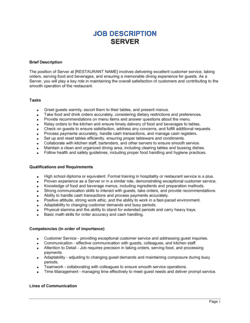
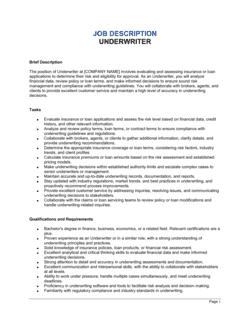
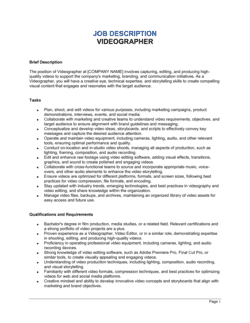
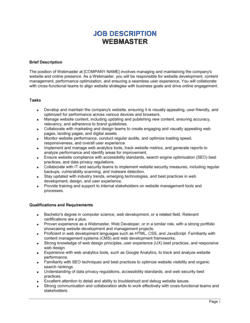
Barista Job Description Template

Free Word download • Edit online • Save & share with Drive • Export to PDF

2 pages20–30 min to fillDifficulty: StandardSignature requiredLegal review recommended
Learn more ↓
FreeBarista Job Description Template

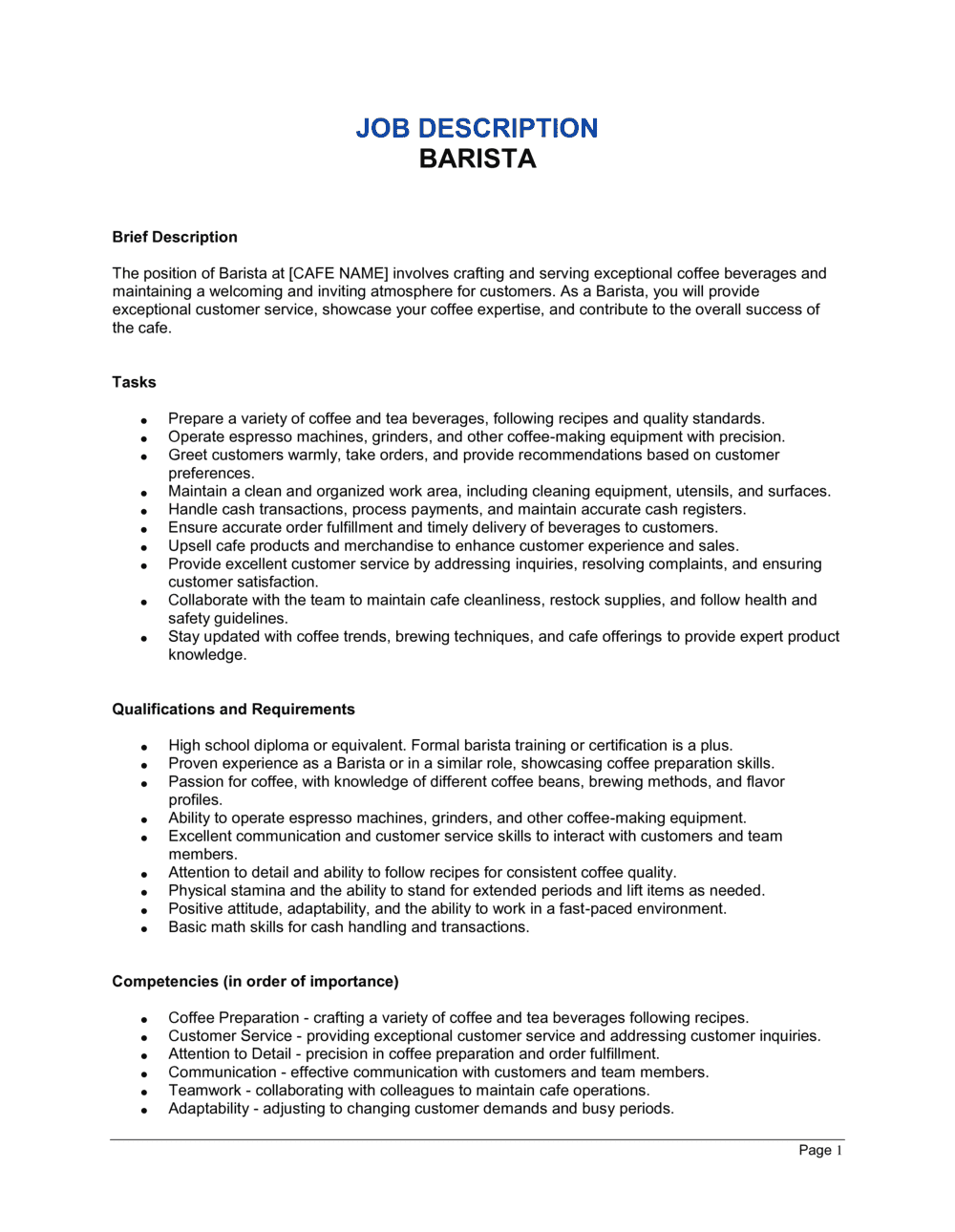
At a glance

What it is
A Barista Job Description is a formal employment document that defines the duties, qualifications, compensation, reporting structure, and working conditions for a barista role. This free Word download gives coffee shops, cafés, and hospitality operators a structured, legally grounded starting point they can edit online and export as PDF to post publicly or include as an exhibit to an employment contract.
When you need it
Use it when opening a new café, backfilling a barista position, expanding your team, or standardizing your hiring documentation across multiple locations. It is also attached to employment contracts to give enforceable specificity to the employee's duties.
What's inside
Position summary, core duties and responsibilities, required and preferred qualifications, physical requirements, compensation and benefits, schedule and availability expectations, reporting structure, and an acknowledgment block for the employee to sign confirming they have read and understood the role requirements.

What is a Barista Job Description?

A Barista Job Description is a formal employment document that defines the duties, qualifications, physical requirements, compensation, and working conditions for a barista role at a café, coffee shop, or hospitality operation. Beyond its use as a hiring tool, a signed barista job description functions as a legal record of the expectations communicated to the employee before their first shift — making it an essential component of performance management, accommodation requests, and termination proceedings. This free Word download gives coffee shop owners, café managers, and HR teams a structured, legally grounded starting point they can edit online and export as PDF to attach to an employment contract or post as a public job listing.

Why You Need This Document

Hiring a barista without a written, signed job description creates compounding risk at every stage of the employment relationship. Without documented essential functions, performance management disputes become credibility contests rather than straightforward comparisons to written standards. Without a physical requirements clause, accommodation requests under the ADA or provincial human rights codes lack the baseline documentation needed to assess what is genuinely essential. Without a signed acknowledgment, a departing employee can claim they were never told what the role required — a claim that is difficult and expensive to disprove in a tribunal. In jurisdictions with pay transparency laws, failing to include a wage range in the posting also triggers direct legal exposure. This template closes every one of those gaps in under 30 minutes, giving you a document that works as a hiring filter, an onboarding anchor, and a line of defense if the relationship ends badly.

Which variant fits your situation?

If your situation is…Use this template
Hiring a full-time permanent barista with benefitsBarista Job Description (Full-Time)
Bringing on a part-time or weekend-only baristaPart-Time Employee Job Description
Engaging a barista for a short-term event or pop-upIndependent Contractor Agreement
Hiring a head barista or shift supervisor with added authorityShift Supervisor Job Description
Onboarding a trainee barista under a probationary arrangementProbationary Employment Contract
Formalizing the role within a full employment agreementEmployment Contract (At-Will)
Posting the position publicly on a job boardJob Posting Template

Common mistakes to avoid

❌ Omitting a signed acknowledgment block

Why it matters: Without documented proof that an employee received and understood their job description, disciplinary action for failing to meet duty expectations becomes much harder to defend — especially in wrongful-termination disputes.

Fix: Include a signature block at the bottom of every job description and collect a signed copy before or on the employee's first day. Store it with the personnel file.

❌ Using identical job descriptions across all locations without local customization

Why it matters: Wage rates, certification requirements, and scheduling obligations differ by state, province, and city. A description drafted for Texas may violate predictive-scheduling laws in Seattle or minimum-wage requirements in San Francisco.

Fix: Maintain a base template and create jurisdiction-specific addenda that override the compensation, schedule, and certification fields for each location.

❌ Listing 'other duties as assigned' without any limiting scope

Why it matters: An unlimited catch-all clause can be used to assign duties well outside the barista role — cleaning restrooms, unloading deliveries, or covering a cashier position — potentially triggering wage reclassification or constructive dismissal claims.

Fix: Qualify the catch-all: 'other duties reasonably related to café operations as assigned by the Shift Supervisor or Café Manager.' The word 'reasonably' is the limiting term courts apply.

❌ Setting education requirements not justified by job requirements

Why it matters: Requiring a high school diploma for a barista role that does not genuinely need it can disproportionately screen out protected groups, exposing the employer to disparate-impact discrimination claims under Title VII or provincial human rights codes.

Fix: Replace credential-based requirements with skill-based ones: 'ability to accurately count change and process POS transactions' instead of 'high school diploma required.'

❌ Omitting the compensation range to preserve negotiating flexibility

Why it matters: Several US states and Canadian provinces now mandate wage ranges in job postings. Omitting the range also reduces applicant volume, creates internal pay-equity exposure, and signals opacity that competitive candidates increasingly avoid.

Fix: Post the full hourly range — minimum to maximum — and update it annually against your local minimum wage adjustments and market benchmarks.

❌ Failing to update the job description after role changes

Why it matters: An outdated job description that no longer reflects actual duties cannot be used to support discipline for failing to perform new responsibilities — and can be used by the employee to argue their role was unilaterally changed.

Fix: Review and re-execute the job description whenever material duties, hours, or supervisory structure change. Have the employee sign the amended version with a date.

The 10 key clauses, explained

Position Summary

In plain language: A 2–4 sentence overview of the role, its purpose within the business, and the primary customer or operational outcome it drives.

Sample language
The Barista is responsible for preparing and serving high-quality espresso beverages and food items at [CAFÉ NAME], delivering a consistent guest experience in alignment with our brand standards. This role reports to the [SHIFT SUPERVISOR / CAFÉ MANAGER] and operates primarily during [HOURS / SHIFTS].

Common mistake: Writing a position summary that reads like a marketing tagline rather than a functional description. Courts and HR tribunals use the summary to interpret what the employee was actually hired to do.

Core Duties and Responsibilities

In plain language: A numbered or bulleted list of the essential functions the barista is expected to perform on a regular basis, including beverage preparation, cash handling, equipment maintenance, and customer service.

Sample language
Prepare espresso-based beverages — including lattes, cappuccinos, and cold brew — to recipe specifications; process customer orders accurately using the [POS SYSTEM NAME]; clean and maintain espresso equipment following manufacturer guidelines; restock bar supplies at the start and end of each shift.

Common mistake: Listing duties so broadly that any task can be assigned without boundary. Including a catch-all 'other duties as assigned by management' line without any limiting language creates scope-creep disputes and can undermine wage classification.

Required Qualifications

In plain language: The minimum education, experience, certifications, and skills a candidate must have to be considered for the role.

Sample language
Minimum [X] months of barista or food-service experience; valid [State/Province] Food Handler Certificate or equivalent; ability to stand for up to [8] hours per shift; basic math skills for cash handling; strong verbal communication in English [and/or other languages as required].

Common mistake: Setting education requirements — such as a high school diploma — that are not genuinely necessary for the role. Blanket credential requirements that screen out protected classes without job-related justification expose employers to discrimination claims.

Preferred Qualifications

In plain language: Additional skills, certifications, or experience that are desirable but not required — used to differentiate candidates without excluding otherwise qualified applicants.

Sample language
Specialty coffee certification (e.g., SCA Barista Skills); latte art proficiency; experience with [POS SYSTEM NAME]; conversational proficiency in [SECOND LANGUAGE]; prior experience in a high-volume café environment (100+ transactions per hour).

Common mistake: Blending preferred and required qualifications into a single list. When requirements and preferences are indistinguishable, hiring managers may disqualify candidates who meet all mandatory criteria and could perform the role well.

Physical Requirements

In plain language: Documents the physical demands of the position — standing duration, lifting limits, repetitive motions — required to demonstrate the role's essential functions and support ADA-compliant hiring.

Sample language
Must be able to stand and walk continuously for up to [8] hours per shift; lift and carry items up to [30] lbs; perform repetitive wrist and hand motions (tamping, steaming, pouring) for extended periods; work in a hot, humid environment near commercial espresso equipment.

Common mistake: Omitting physical requirements entirely to avoid seeming exclusionary. The opposite is true — documented physical requirements are what allow employers to apply them consistently and defend hiring decisions against disability discrimination claims.

Compensation and Benefits

In plain language: States the hourly wage or salary range, tip eligibility, and any benefits included — health, dental, employee discounts, or retirement contribution.

Sample language
Hourly rate: $[MIN]–$[MAX], commensurate with experience. Eligible for tips distributed via [tip pool / individual tips]. Benefits: [employee beverage discount / health insurance after 90 days / PTO accrual at X hours per pay period].

Common mistake: Omitting the compensation range entirely to preserve negotiating flexibility. Several US states and Canadian provinces now legally require salary or wage ranges in job postings; omitting them also reduces application volume and creates pay-equity exposure.

Schedule and Availability Requirements

In plain language: Defines the expected work schedule — days, hours, shift types — and any flexibility or availability requirements such as weekend, early-morning, or holiday availability.

Sample language
This position requires availability [Monday–Sunday], including early morning shifts starting as early as [5:00 AM], weekend availability required, and availability on [major holidays]. Anticipated hours: [25–40] hours per week based on business volume.

Common mistake: Leaving schedule expectations vague in the job description and then citing attendance failures during discipline proceedings. Without a written schedule expectation acknowledged by the employee, attendance-related terminations are harder to defend.

Reporting Structure and Authority

In plain language: Identifies the employee's direct supervisor, any roles that report to them, and the scope of their authority — for example, whether they may authorize refunds or close the register.

Sample language
This position reports directly to the [Café Manager / Shift Supervisor]. The Barista has no direct reports. The Barista is authorized to process customer refunds up to $[X] without manager approval and may initiate [specific action] in the event of equipment failure.

Common mistake: Granting authority verbally but not documenting it in the job description. When a barista acts within verbally granted authority — approving a refund, sending a customer complaint to corporate — and it creates a liability, the undocumented authority complicates the employer's legal position.

Workplace Policies and Conduct Standards

In plain language: References the employer's code of conduct, dress code, hygiene standards, and health and safety obligations applicable to the barista role.

Sample language
The Barista must adhere to [COMPANY NAME]'s uniform and grooming standards as outlined in the Employee Handbook, comply with all applicable food safety regulations, and complete mandatory [ServSafe / Food Handler] recertification every [X] months.

Common mistake: Incorporating policy details directly into the job description instead of referencing the Employee Handbook. Policies change frequently — embedding specifics creates an obligation to amend the job description every time a policy updates.

Acknowledgment and Signature

In plain language: A signed confirmation that the employee has received, read, and understood the job description — creating a record that the expectations were communicated before employment began.

Sample language
I, [EMPLOYEE FULL NAME], acknowledge that I have read and understood this job description and that it accurately reflects the requirements of my position as Barista at [COMPANY NAME]. Signed: _______________ Date: _______________

Common mistake: Treating the acknowledgment as optional paperwork. Without a signed acknowledgment, an employee can claim they were unaware of specific duties or policies — weakening the employer's position in performance management and wrongful termination disputes.

How to fill it out

  1. 1

    Enter the employer and location details

    Add your café or company's legal name, the specific location or venue, and the name of the hiring manager or HR contact who owns this role.

    💡 Use the registered legal entity name — not a trade name — so the document aligns with payroll records and any employment contract it is attached to.

  2. 2

    Write the position summary in functional terms

    Describe what the barista does, who they serve, and what a successful outcome looks like in 2–4 sentences. Anchor it to the specific business context — high-volume commuter café versus specialty slow-bar environment.

    💡 A position summary written for a 200-transaction-per-hour drive-through differs materially from one for a 40-seat specialty café — the duties, pace, and skill demands are not interchangeable.

  3. 3

    List essential functions with enough specificity to manage performance

    Write each core duty as an action-oriented statement: 'Prepare espresso beverages to recipe specification' rather than 'make coffee.' Include frequency indicators — daily, per shift, as needed.

    💡 Limit the list to 8–12 genuinely essential functions. A list of 25 duties signals that the description was never reviewed for accuracy and undermines its use in performance management.

  4. 4

    Set qualification requirements that are genuinely job-related

    List only the qualifications a candidate must have to perform the essential functions safely and competently. Separate required from preferred so hiring managers apply them correctly.

    💡 Check your state or provincial human rights code before adding language requirements — requiring fluency in a language beyond what the job genuinely demands can constitute discrimination.

  5. 5

    Document physical requirements accurately

    List the physical demands in measurable terms: hours of standing, maximum lift weight, types of repetitive motion. These are used in accommodation requests and ADA or human rights compliance.

    💡 Base physical requirements on what the role actually demands today — not an exaggerated version designed to exclude candidates. Inaccurate physical requirements create more legal risk than they prevent.

  6. 6

    State the compensation range and tip policy

    Enter the hourly wage range, confirm whether the role is tip-eligible, and describe the tip distribution method (individual, pooled, or tip-credit). Reference the applicable minimum wage for your jurisdiction.

    💡 In jurisdictions with pay transparency laws — including California, Colorado, New York, and Ontario — posting a wage range is legally required for any external job listing.

  7. 7

    Define schedule and availability expectations

    Specify the days and hours required, earliest possible start times, and any mandatory weekend or holiday availability. State the expected weekly hour range.

    💡 For roles subject to predictive scheduling laws — Chicago, New York City, Seattle, and Oregon, among others — the schedule clause should reference your advance-notice obligations.

  8. 8

    Obtain a signed acknowledgment before the first shift

    Have the employee sign the acknowledgment block confirming they received and reviewed the job description. File the signed copy with the employment record.

    💡 Obtain the signature on or before day one — not during the first week. Post-start signatures raise the same fresh-consideration issue as late employment contracts.

Frequently asked questions

What is a barista job description?

A barista job description is a formal employment document that defines the duties, qualifications, physical requirements, compensation, and working conditions for a barista role. It serves as both a hiring tool — attracting and filtering candidates — and a legal anchor for performance management, accommodation requests, and termination proceedings. A signed copy is typically filed with the employment record and may be attached as a schedule to the full employment contract.

Is a job description legally binding?

A job description is generally not a standalone binding contract, but it carries significant legal weight. When signed by the employee and attached to an employment contract, it defines the scope of the role and can be used in disputes over duty changes, performance standards, and accommodation obligations. Courts in the US, Canada, and the UK have relied on signed job descriptions to assess whether an employer's expectations were clearly communicated.

What should a barista job description include?

At minimum: a position summary, list of essential functions, required and preferred qualifications, physical requirements, compensation and tip policy, schedule and availability expectations, reporting structure, applicable workplace policies, and a signed acknowledgment block. Missing physical requirements or the acknowledgment block are the two omissions most likely to create legal exposure during a dispute.

Do I need to include a wage range in the job description?

In a growing number of jurisdictions, yes. California, Colorado, New York, Washington, and Ontario (Canada) require employers to disclose pay ranges in job postings. Even where not legally required, including a range increases applicant quality, reduces time-to-hire, and supports internal pay-equity compliance. For hourly barista roles, the range should reflect your local minimum wage floor and the maximum you pay experienced hires.

Can I use the same job description for part-time and full-time baristas?

The duties and qualifications sections can be identical, but the compensation, benefits, and schedule sections must reflect the actual terms for each employment type. Part-time employees in many jurisdictions have different benefit eligibility thresholds and may be subject to different overtime rules than full-time staff. Maintain separate versions or use a clear addendum to document the material differences.

What are essential functions and why do they matter?

Essential functions are the core duties of the role that an employee must be able to perform, with or without reasonable accommodation. Under the Americans with Disabilities Act in the US, and equivalent human rights legislation in Canada, the UK, and the EU, employers may only deny accommodation if it would prevent the employee from performing essential functions. Clearly labeling which duties are essential — and maintaining evidence that they are genuinely essential, not peripheral — is a foundational step in ADA and human rights compliance.

How often should a barista job description be updated?

Review it at least annually and immediately after any material change to the role — new equipment, expanded duties, a change in supervisory structure, or a new location. Each time the description changes materially, have the employee sign and date the updated version. Outdated job descriptions that no longer match actual duties are routinely used by employees in constructive dismissal and wrongful termination claims.

Do baristas need to sign their job description?

Yes. A signed acknowledgment creates a documented record that the employee received and understood the role's expectations before starting work. Without it, an employee can credibly claim they were unaware of specific duties or standards when facing disciplinary action. The signature should be obtained on or before the first day of employment — post-start signatures can raise fresh-consideration issues under common-law employment doctrine.

What is the difference between a job description and a job posting?

A job posting is an external-facing advertisement designed to attract candidates — it typically includes a condensed version of duties, the compensation range, and a call to apply. A job description is the internal, legally grounded document that is signed by the employee, filed with the personnel record, and used in performance management and legal proceedings. The posting is derived from the description, but the two documents serve distinct purposes and audiences.

How this compares to alternatives

vs Employment Contract

An employment contract is the overarching binding agreement covering compensation, IP, confidentiality, termination, and severance. A job description defines the specific scope of duties within that contract. The two documents work together — the employment contract governs the relationship, while the job description governs the role. Attaching a signed job description as a schedule to the employment contract gives both documents maximum legal force.

vs Job Offer Letter

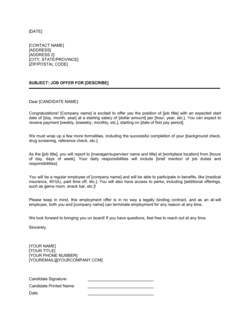
An offer letter summarizes the role and compensation to secure the candidate's acceptance. It does not detail essential functions, physical requirements, or acknowledgment obligations. A job description is a separate, more granular document that is issued alongside or after the offer letter and is the document signed to confirm duty expectations — not just employment terms.

vs Employee Handbook

An employee handbook sets company-wide policies — conduct standards, leave policies, benefits, and safety rules — that apply to all employees. A job description is role-specific and defines what this particular position requires. The two complement each other: the job description references the handbook for policy detail rather than duplicating it.

vs Independent Contractor Agreement

An independent contractor agreement engages a self-employed individual for defined project-based work with no employment entitlements. A barista job description is used exclusively for employees — not contractors. Using a job description format to engage a contract barista can be used as evidence of misclassification, triggering back taxes, benefit liability, and labor-code penalties.

Industry-specific considerations

Coffee shops and specialty cafés

Specialty drink recipes, latte art standards, single-origin coffee knowledge, and slow-bar versus high-volume workflow distinctions are often incorporated as addenda.

Hotel and resort food and beverage

Barista roles within hotel F&B departments report into a broader service hierarchy and often require cross-training on room-service and banquet beverage setups.

Quick-service restaurant chains

High transaction volumes, standardized recipes, and corporate brand compliance requirements drive more prescriptive duty lists and mandatory corporate certification steps.

Corporate and office café operations

Baristas in corporate café settings often operate under a facilities management or catering contract, requiring dual compliance with both the operator's and the client employer's conduct standards.

Jurisdictional notes

United States

Barista roles are almost universally classified as non-exempt under the FLSA, entitling employees to overtime pay at 1.5× their regular rate for hours over 40 per week. Tip credit rules vary by state — some states (California, Minnesota, Montana, Nevada) prohibit tip credits entirely and require full minimum wage regardless of tips. Several cities including Seattle, Chicago, and New York City have enacted predictive scheduling ordinances requiring advance notice of schedules and premium pay for last-minute changes. California, Colorado, New York, and Washington require wage ranges in job postings.

Canada

Employment standards for barista roles are set at the provincial level. Minimum wage and overtime thresholds vary — Ontario's minimum wage is reviewed annually, and British Columbia and Alberta each maintain distinct rates. Quebec requires that job postings and employment documents be provided in French for provincially regulated employers. Tip pooling arrangements in Ontario are governed by the Employment Standards Act, which restricts employer involvement in tip distribution. Accommodation obligations under provincial human rights codes require documented physical requirements in the job description.

United Kingdom

Barista roles in the UK are typically engaged under a written statement of employment particulars, which must be provided on or before day one under the Employment Rights Act 1996. The National Living Wage and National Minimum Wage rates are updated each April and must be reflected in any compensation clause. Tip allocation is regulated by the Employment (Allocation of Tips) Act 2023, which requires employers to pass tips to workers fairly and transparently. Working Time Regulations limit average weekly hours to 48 unless the worker has opted out in writing.

European Union

The EU Transparent and Predictable Working Conditions Directive requires employers to provide a written statement of employment conditions within seven days of the start date, covering hours, pay, location, and duties — making a comprehensive job description effectively mandatory. Minimum wage levels and tip regulation vary significantly by member state: France, Germany, and Spain each set distinct floor rates and have different rules on service charges. GDPR applies to any personal data collected during the recruitment process, including candidate CV storage and reference checks. Working-time directives limit hours and mandate rest periods applicable to café and hospitality workers.

Template vs lawyer — what fits your deal?

PathBest forCostTime
Use the templateIndependent café owners and small hospitality operators hiring standard barista staff in a single US state or Canadian provinceFree15–30 minutes
Template + legal reviewMulti-location operators, franchise owners, or employers in jurisdictions with pay transparency, predictive scheduling, or mandatory accommodation documentation requirements$200–$500 for an HR advisor or employment lawyer review1–3 days
Custom draftedCorporate café operations, unionized workplaces, or businesses operating across multiple states or provinces with materially different employment standards$500–$2,000+1–2 weeks

Glossary

Job Description
A written document that defines a position's duties, required qualifications, compensation range, and reporting relationships — used for hiring, performance management, and legal compliance.
Essential Functions
The core duties of a role that an employee must be able to perform, with or without reasonable accommodation — a legally significant designation under disability law.
At-Will Employment
An employment arrangement in which either the employer or employee may end the relationship at any time, for any lawful reason, without advance notice — recognized in most US states.
Probationary Period
A defined initial period — typically 30 to 90 days — during which the employer evaluates a new hire's performance before confirming full employment status.
FLSA (Fair Labor Standards Act)
US federal law setting minimum wage, overtime pay, and child labor standards — directly relevant to hourly barista compensation and tip credit rules.
Tip Credit
A provision in US law allowing employers to pay tipped employees a lower direct wage, provided tips bring total hourly earnings to at least the federal or state minimum.
Reasonable Accommodation
A modification to a job's duties, schedule, or environment that allows a qualified person with a disability to perform the essential functions of the role.
Reporting Structure
The chain of supervision defining which manager or role a barista reports to directly, and who (if anyone) reports to them.
Non-Exempt Employee
An employee classified under the FLSA as entitled to overtime pay at 1.5× their regular rate for hours worked beyond 40 in a workweek — the default classification for most barista roles.
Acknowledgment Clause
A section at the end of the job description that the employee signs to confirm they have read, understood, and received a copy of the document.
Physical Requirements
Documented physical demands of the role — standing duration, lifting weight, repetitive motions — legally required in job descriptions to support ADA-compliant hiring decisions.

Part of your Business Operating System

This document is one of 3,000+ business & legal templates included in Business in a Box.

  • Fill-in-the-blanks — ready in minutes
  • 100% customizable Word document
  • Compatible with all office suites
  • Export to PDF and share electronically

Create your document in 3 simple steps.

From template to signed document — all inside one Business Operating System.
1
Download or open template

Access over 3,000+ business and legal templates for any business task, project or initiative.

2
Edit and fill in the blanks with AI

Customize your ready-made business document template and save it in the cloud.

3
Save, Share, Send, Sign

Share your files and folders with your team. Create a space of seamless collaboration.

Save time, save money, and create top-quality documents.

★★★★★

"Fantastic value! I'm not sure how I'd do without it. It's worth its weight in gold and paid back for itself many times."

Managing Director · Mall Farm
Robert Whalley
Managing Director, Mall Farm Proprietary Limited
★★★★★

"I have been using Business in a Box for years. It has been the most useful source of templates I have encountered. I recommend it to anyone."

Business Owner · 4+ years
Dr Michael John Freestone
Business Owner
★★★★★

"It has been a life saver so many times I have lost count. Business in a Box has saved me so much time and as you know, time is money."

Owner · Upstate Web
David G. Moore Jr.
Owner, Upstate Web

Run your business with a system — not scattered tools

Stop downloading documents. Start operating with clarity. Business in a Box gives you the Business Operating System used by over 250,000 companies worldwide to structure, run, and grow their business.

Start free · No credit card required