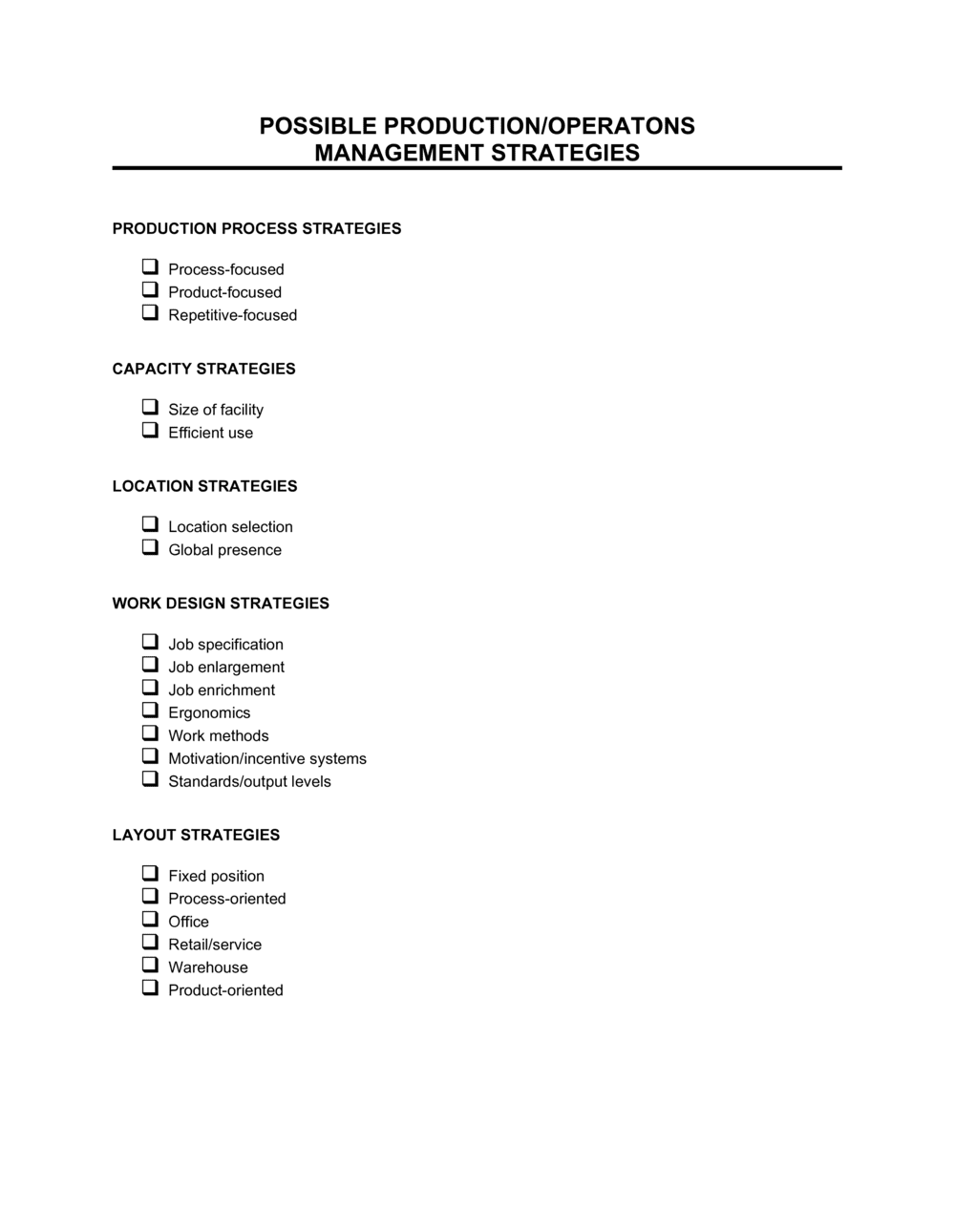
Possible Production & Operations Management Strategies

Free Word download β€’ Edit online β€’ Save & share with Drive β€’ Export to PDF

2 pagesβ€’20–25 min to fillβ€’Difficulty: Standard
Learn more ↓
FreePossible Production & Operations Management Strategies Template

At a glance

What it is
A Possible Production Operations Management Strategies document is a structured operational report that maps the range of strategic options available to a production or manufacturing unit β€” covering capacity planning, scheduling approaches, quality systems, supply chain configuration, and continuous improvement methodologies. This free Word download gives managers and operations leaders a ready-made framework they can edit online and export as PDF to share with executives, plant managers, or operations teams.
When you need it
Use it when launching a new production facility, restructuring an existing manufacturing operation, evaluating competing process improvement approaches, or preparing a strategic operations review for senior leadership or a board.
What's inside
Strategic context and objectives, capacity and scheduling options, quality control frameworks, supply chain and procurement strategies, workforce and lean operations approaches, technology integration options, performance metrics, and an implementation roadmap with evaluation criteria for selecting among alternatives.

What is a Production Operations Management Strategies Document?

A Production Operations Management Strategies document is a structured operational analysis that maps the range of strategic options available to a production or manufacturing unit across every major operational dimension β€” capacity planning, production scheduling, quality management, supply chain configuration, workforce design, and technology investment. Unlike a single-path operations plan, it presents two or more viable alternatives per dimension, quantifies the cost, timeline, and performance trade-offs of each, and provides a weighted evaluation framework for selecting the approach best aligned with the business's objectives. It is available as a free Word download that operations leaders can edit online and export as PDF for executive review.

Why You Need This Document

Production operations decisions made without a structured alternatives analysis lock in assumptions that were never tested β€” and the cost of getting them wrong is measured in capital write-offs, missed throughput targets, and quality failures that take years to correct. A facility that commits to a make-to-stock model without evaluating make-to-order against its actual SKU variability will carry excess inventory indefinitely. A lean program launched without a current-state baseline produces activity without measurable improvement. This template forces the analysis before the commitment: it surfaces the options, attaches numbers to the trade-offs, and produces a documented rationale that leadership can interrogate and approve. The result is a faster decision, a clearer implementation mandate, and a record of the reasoning that makes post-implementation reviews productive rather than contentious.

Which variant fits your situation?

If your situation is…Use this template
Defining a full annual production plan with output targets and budgetsProduction Plan
Documenting standard operating procedures for a specific production lineStandard Operating Procedure (SOP)
Evaluating and selecting a specific quality management approachQuality Management Plan
Mapping the end-to-end supply chain strategySupply Chain Strategy Plan
Planning a lean or Six Sigma process improvement initiativeProcess Improvement Plan
Presenting a high-level operations roadmap to the boardOperations Strategic Plan
Tracking production KPIs and output against targetsOperations Report

Common mistakes to avoid

❌ Presenting a single strategy instead of genuine alternatives

Why it matters: A document that offers only one path gives leadership no basis for decision-making and reads as a justification document rather than a strategic analysis. It also fails if the preferred option is rejected.

Fix: Develop at least two substantively different options per dimension. The alternatives do not need to be equally attractive β€” one can be the clear recommendation β€” but they must be real choices with honest trade-off analysis.

❌ Framing objectives as activities rather than outcomes

Why it matters: Objectives like 'implement lean' or 'upgrade the ERP' cannot be measured as successes. When the activity is complete, there is no way to know whether the business is better off.

Fix: Rewrite every objective as a measurable outcome: 'reduce per-unit labor cost by 12% by Q3' or 'increase OEE from 68% to 80% within 6 months of implementation.'

❌ Setting KPIs without assigning owners or data sources

Why it matters: KPIs with no owner and no data source are consistently ignored after the document is approved. Post-implementation reviews find the metrics were never tracked and the strategy results are unknown.

Fix: For every KPI, name the specific role responsible, state the system or process that generates the data, and specify the measurement and reporting frequency.

❌ Ignoring implementation risk in the roadmap

Why it matters: Operations strategies that look sound on paper stall at execution when key risks β€” supplier readiness, staff training time, equipment lead times β€” are not accounted for upfront.

Fix: Add a risk register with at least three identified risks per phase, a likelihood and impact rating for each, and a named mitigation action. A one-page risk table is sufficient.

The 10 key sections, explained

Strategic context and production objectives

Capacity planning options

Production scheduling strategies

Quality control frameworks

Supply chain and procurement strategy

Workforce and lean operations strategy

Technology and automation options

Performance metrics and monitoring framework

Strategy evaluation criteria and recommendation

Implementation roadmap and resource requirements

How to fill it out

  1. 1

    Define the strategic context and measurable objectives

    Open the document by stating the business trigger for this review β€” cost pressure, capacity gap, quality issues, or a growth target. Express each objective as a measurable outcome with a target number and a date.

    πŸ’‘ Limit yourself to three to five primary objectives. More than five creates conflicting priorities that make the strategy evaluation section impossible to resolve clearly.

  2. 2

    Identify two to four viable strategic options per dimension

    For each section β€” capacity, scheduling, quality, supply chain, workforce, and technology β€” develop at least two distinct options. Options that differ only in degree (e.g., 'add one shift' vs. 'add two shifts') are variations, not alternatives.

    πŸ’‘ Include at least one low-capital option in every section. Leadership teams often need a credible baseline-plus-improvement alternative to benchmark against capital-intensive proposals.

  3. 3

    Quantify each option with cost, time, and performance estimates

    For every strategic option listed, enter a cost estimate, an implementation timeline, and the expected impact on the primary KPIs. Use ranges where precision is not possible β€” $200K–$350K is more credible than a false-precision single number.

    πŸ’‘ Source your estimates from at least two reference points β€” vendor quotes, industry benchmarks, or internal historical data. Single-source estimates are routinely challenged in leadership reviews.

  4. 4

    Build the weighted evaluation matrix

    In the strategy evaluation section, list your top four to six decision criteria, assign weights that sum to 100%, and score each option against each criterion. The weighted totals drive the recommendation.

    πŸ’‘ Set the criteria weights before scoring any options. Assigning weights after scoring is a common bias trap that produces a recommendation first and a justification second.

  5. 5

    Complete the performance metrics framework

    For each KPI in the monitoring section, confirm the data source, the measurement frequency, and the person responsible. A KPI without a named owner and a data source is a wish, not a metric.

    πŸ’‘ Cross-check that every strategic objective from Step 1 maps to at least one KPI in this section. Gaps between objectives and metrics are the most common cause of post-implementation drift.

  6. 6

    Build the phased implementation roadmap

    Translate the recommended strategy into phases of no more than 90 days each. For each phase, list the specific initiatives, the single accountable owner, the budget required, and the measurable milestone that closes the phase.

    πŸ’‘ Identify the two or three highest-risk dependencies in the roadmap and add explicit mitigation steps for each. Reviewers who find no risks in an operations roadmap assume the author did not look hard enough.

Frequently asked questions

What is a production operations management strategy document?

A production operations management strategy document is a structured analysis that presents the range of strategic options available to a manufacturing or production operation β€” covering capacity, scheduling, quality, supply chain, workforce, and technology β€” and provides a framework for selecting among them. It differs from an operating plan in that it evaluates alternatives rather than describing a single committed course of action.

Who should be involved in preparing this document?

The primary author is typically the operations manager or plant manager, but effective strategy documents incorporate input from supply chain, finance, quality, HR, and β€” for technology sections β€” IT or engineering. Finance should validate cost estimates; supply chain should confirm sourcing assumptions. Documents prepared by a single function without cross-functional input routinely miss constraints that become visible only at implementation.

What is the difference between a production strategy and an operations plan?

A production strategy document evaluates options and recommends a direction; it is a decision-support tool. An operations plan documents the committed course of action after the decision is made β€” specific targets, budgets, schedules, and owners. The strategy document comes first and feeds directly into the operations plan. Skipping the strategy phase and going straight to an operations plan locks in assumptions that were never tested against alternatives.

How do I choose between make-to-order and make-to-stock strategies?

The primary variables are demand variability, acceptable customer lead time, and finished-goods carrying cost. Make-to-stock is appropriate when demand is predictable, lead times must be very short (same-day to 2 days), and carrying cost is low relative to the cost of lost sales. Make-to-order is appropriate when SKU variety is high, demand is variable, and customers accept a lead time of several days or weeks. Most operations use a hybrid: MTS for high-volume stable SKUs and MTO for low-volume or custom items.

How does lean manufacturing differ from Six Sigma?

Lean targets the elimination of waste β€” unnecessary motion, waiting, overproduction, excess inventory, and defects β€” through visual management, standard work, and pull systems. Six Sigma targets defect reduction specifically, using statistical analysis and the DMAIC methodology to find and remove root causes of variation. The two are complementary: lean improves flow and removes obvious waste; Six Sigma addresses the harder-to-find sources of quality variation. Many operations use Lean Six Sigma, which combines both.

What KPIs should a production operations strategy document specify?

The four most universally applicable production KPIs are Overall Equipment Effectiveness (OEE), on-time delivery rate, defect or first-pass yield rate, and cost per unit produced. For capacity-focused strategies, add throughput and capacity utilization. For supply chain strategies, add supplier on-time delivery and inventory days on hand. Limit primary KPIs to four to six; tracking more creates noise that obscures actionable signals.

How often should a production operations strategy be reviewed?

A full strategy review is appropriate annually, aligned with the business planning cycle, or whenever a significant disruption occurs β€” a major demand shift, a new product line, a key supplier failure, or a significant quality event. Tactical adjustments within the current strategy (schedule changes, capacity tweaks) do not require a full strategy review, but any change that modifies a primary KPI target or requires capital above a defined threshold should trigger a targeted review of the affected section.

Can this template be used for non-manufacturing production operations?

Yes. The framework applies equally to any operation with repeatable processes, capacity constraints, quality standards, and throughput targets β€” including food processing, pharmaceutical production, software development sprints, logistics operations, and service delivery centers. The terminology in the scheduling and quality sections may need adjustment (cycle time becomes handle time, defect rate becomes error rate), but the strategic logic is identical.

How detailed should the implementation roadmap be in this document?

The roadmap in a strategy document should be phased at a 30–90 day granularity with named owners, budget allocations, and milestone criteria per phase. It is not a project plan β€” it does not need task- level detail. That level of detail belongs in the subsequent operations plan or project charter. The strategy document roadmap should answer three questions: what happens in each phase, who is accountable, and how will we know the phase is complete.

How this compares to alternatives

vs Operations Strategic Plan

An operations strategic plan commits the organization to a single defined direction with budgets, milestones, and accountabilities. A production operations management strategies document evaluates multiple options before that commitment is made. Use the strategies document during the analysis phase, then use the strategic plan to document and execute the chosen direction.

vs Process Improvement Plan

A process improvement plan targets a specific, identified inefficiency in an existing process β€” it assumes the production model is set and focuses on making it work better. A production operations management strategies document evaluates the production model itself β€” whether the current approach is the right one at all. The strategies document is broader in scope and precedes process-level improvement work.

vs Standard Operating Procedure (SOP)

An SOP documents exactly how a single process is executed once the method has been decided. A production operations management strategies document determines which methods and systems to adopt in the first place. SOPs are outputs of a strategy decision, not inputs to one.

vs Operations Report

An operations report measures current performance against established targets β€” it is backward-looking. A production operations management strategies document is forward-looking, evaluating options to improve future performance. Operations reports feed strategy reviews by providing the performance baseline against which options are evaluated.

Industry-specific considerations

Manufacturing

Capacity utilization, equipment OEE, shift scheduling, and make-to-order vs. make-to-stock decisions are central to every manufacturing strategy review.

Food and Beverage

Perishable inventory constraints, regulatory compliance for sanitation and traceability, and seasonal demand variability require strategy options specific to shelf-life and throughput windows.

Pharmaceutical and Life Sciences

GMP compliance, batch record requirements, and validation timelines for new equipment or processes create significant constraints that must be reflected in any strategy option evaluated.

Logistics and Distribution

Warehouse throughput, pick-and-pack cycle time, carrier mix strategy, and last-mile cost per delivery are the primary operational levers evaluated in a distribution strategy review.

Template vs pro β€” what fits your needs?

PathBest forCostTime
Use the templateOperations managers and plant managers structuring an internal strategy review for a single facility or product lineFree2–5 days (8–20 hours of analysis and writing)
Template + professional reviewMulti-site operations, capital investment decisions above $500K, or strategy reviews being presented to a board or private equity owner$1,000–$5,000 for an operations consultant or industrial engineer review1–2 weeks
Custom draftedComplex turnaround situations, new facility design, or operations strategy embedded in a due diligence or M&A process$8,000–$30,000+ for a management consulting engagement4–12 weeks

Glossary

Capacity Planning
The process of determining the production volume a facility can achieve given its equipment, labor, and time constraints.
Just-in-Time (JIT)
A production scheduling strategy that synchronizes raw material deliveries with production demand to minimize inventory holding costs.
Lean Manufacturing
A systematic methodology focused on eliminating waste β€” defined as any activity that consumes resources without adding customer value β€” from production processes.
Six Sigma
A data-driven quality improvement framework that targets reducing process defects to fewer than 3.4 per million opportunities using DMAIC (Define, Measure, Analyze, Improve, Control).
Make-to-Order (MTO)
A production strategy in which manufacturing begins only after a confirmed customer order is received, minimizing finished-goods inventory.
Make-to-Stock (MTS)
A production strategy in which goods are manufactured in advance based on demand forecasts and held in inventory for immediate fulfillment.
Overall Equipment Effectiveness (OEE)
A composite metric measuring productive manufacturing time as a percentage of planned production time, combining availability, performance, and quality rates.
Throughput
The rate at which a production system generates finished goods or completes work in a defined time period.
Bottleneck
The single process step or resource that constrains the overall output rate of a production system.
Continuous Improvement (Kaizen)
An operational philosophy of making frequent, incremental improvements to processes rather than relying on periodic large-scale overhauls.
Total Productive Maintenance (TPM)
A proactive equipment maintenance strategy that involves all employees in keeping machines operational to prevent unplanned downtime.

Part of your Business Operating System

This document is one of 3,000+ business & legal templates included in Business in a Box.

  • Fill-in-the-blanks β€” ready in minutes
  • 100% customizable Word document
  • Compatible with all office suites
  • Export to PDF and share electronically

Create your document in 3 simple steps.

From template to signed document β€” all inside one Business Operating System.
1
Download or open template

Access over 3,000+ business and legal templates for any business task, project or initiative.

2
Edit and fill in the blanks with AI

Customize your ready-made business document template and save it in the cloud.

3
Save, Share, Send, Sign

Share your files and folders with your team. Create a space of seamless collaboration.

Save time, save money, and create top-quality documents.

β˜…β˜…β˜…β˜…β˜…

"Fantastic value! I'm not sure how I'd do without it. It's worth its weight in gold and paid back for itself many times."

Managing Director Β· Mall Farm
Robert Whalley
Managing Director, Mall Farm Proprietary Limited
β˜…β˜…β˜…β˜…β˜…

"I have been using Business in a Box for years. It has been the most useful source of templates I have encountered. I recommend it to anyone."

Business Owner Β· 4+ years
Dr Michael John Freestone
Business Owner
β˜…β˜…β˜…β˜…β˜…

"It has been a life saver so many times I have lost count. Business in a Box has saved me so much time and as you know, time is money."

Owner Β· Upstate Web
David G. Moore Jr.
Owner, Upstate Web

Run your business with a system β€” not scattered tools

Stop downloading documents. Start operating with clarity. Business in a Box gives you the Business Operating System used by over 250,000 companies worldwide to structure, run, and grow their business.

Start freeΒ Β·Β No credit card required