1
Complete the situational overview
Summarize your current marketing position in 3–5 bullet points: primary acquisition channel, approximate CAC, what has been tested and failed, and any relevant competitive or market shifts.
💡 Pull numbers from your analytics platform before writing — a section filled with estimates rather than actuals signals weak strategic grounding to stakeholders.
2
Define your target audience segments
Write a profile for each segment you want this strategy to reach. Include role or demographic, primary pain point, where they consume information, and what motivates a purchase decision.
💡 Two to three well-defined segments produce better channel choices than six vague ones. If you cannot describe the segment's specific pain point in one sentence, narrow it further.
3
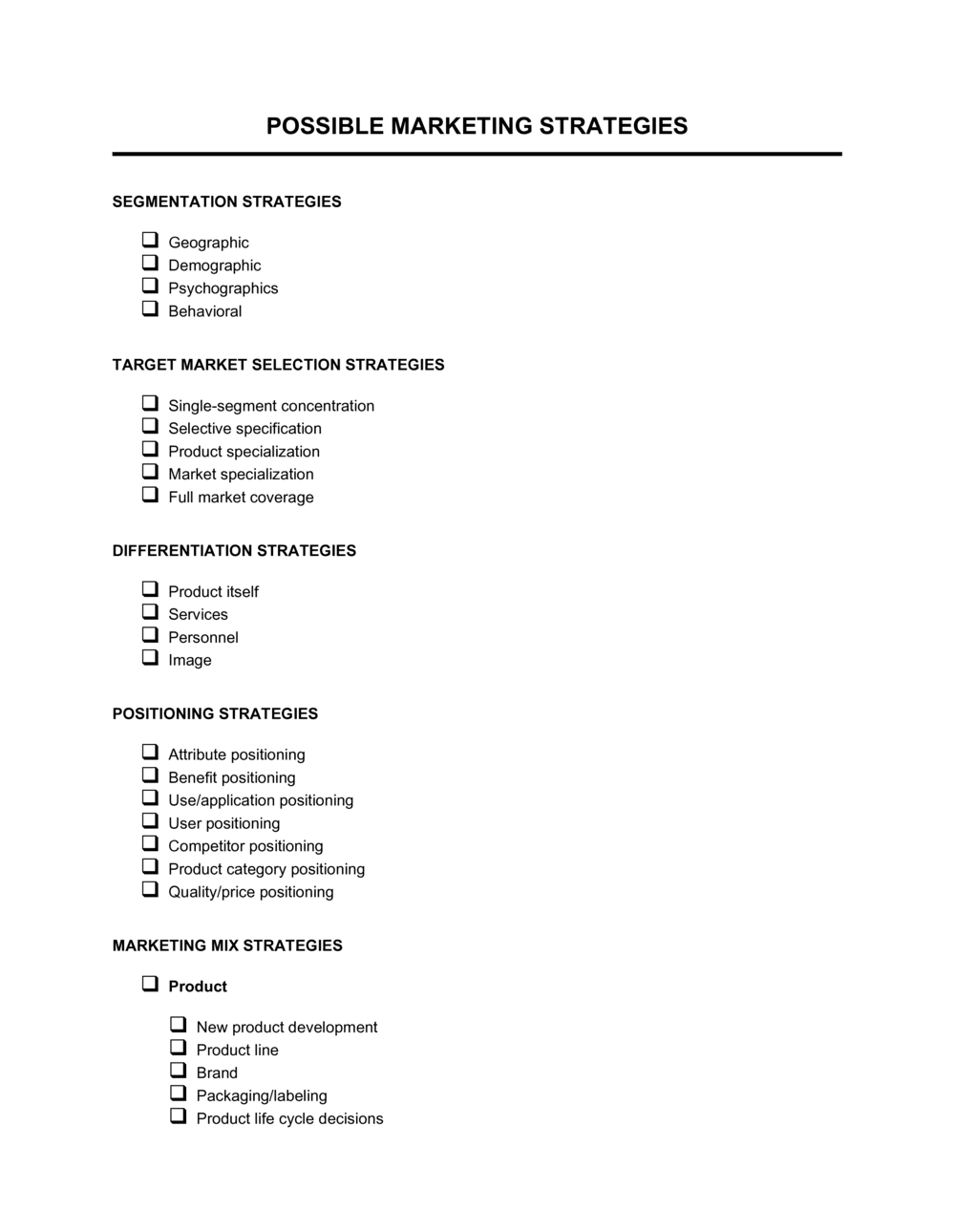
Generate a long list of channel options
List every viable channel without filtering yet — paid search, organic SEO, email, content, LinkedIn, events, partnerships, influencer, PR, and referral. Note which funnel stage each primarily serves.
💡 Include at least one channel you have not tried before. Familiarity bias causes most teams to recycle the same two or three channels regardless of performance.
4
Score each channel against your evaluation criteria
Apply your five criteria (CAC, time to result, audience fit, competitive saturation, internal capability) and score each channel 1–5. Calculate a composite score for each option.
💡 Weight 'internal execution capability' heavily for small teams — a theoretically strong channel you cannot staff is worse than a moderate channel you can execute well.
5
Select two to four priority strategies
Choose the highest-scoring options that together cover at least two funnel stages. Document why each was selected and briefly explain the top two channels that were excluded.
💡 Selecting fewer strategies than you want to run is a discipline, not a constraint — it is the single most common differentiator between marketing plans that produce results and those that do not.
6
Allocate budget with full cost accounting
Assign a dollar amount to each strategy, including media spend, creative production, platform fees, and staff time (at a loaded hourly rate). Sum to confirm you are within total budget.
💡 Reserve 10–15% of the total budget as an unallocated test fund — new opportunities and in-flight optimizations always surface after launch.
7
Build the implementation timeline with staggered starts
Assign an owner and a launch date to each strategy, staggering starts by at least two weeks to allow clean attribution and to prevent execution overload.
💡 Name a specific person — not a team — as the owner of each strategy. Shared ownership consistently produces missed deadlines.
8
Set KPIs and schedule a formal review
Define at least two leading KPIs per strategy (e.g., CPL and click-through rate) and one lagging KPI (pipeline contribution or revenue). Schedule a formal mid-period review date in the document.
💡 Set a reallocation trigger — for example, 'if CPL exceeds $[X] after 30 days, shift [Y]% of spend to the next-ranked channel' — so the review produces decisions, not just analysis.