Possible Business Growth Strategies

Free Word download β€’ Edit online β€’ Save & share with Drive β€’ Export to PDF

2 pagesβ€’20–30 min to fillβ€’Difficulty: Standard
Learn more ↓
FreePossible Business Growth Strategies Template

At a glance

What it is
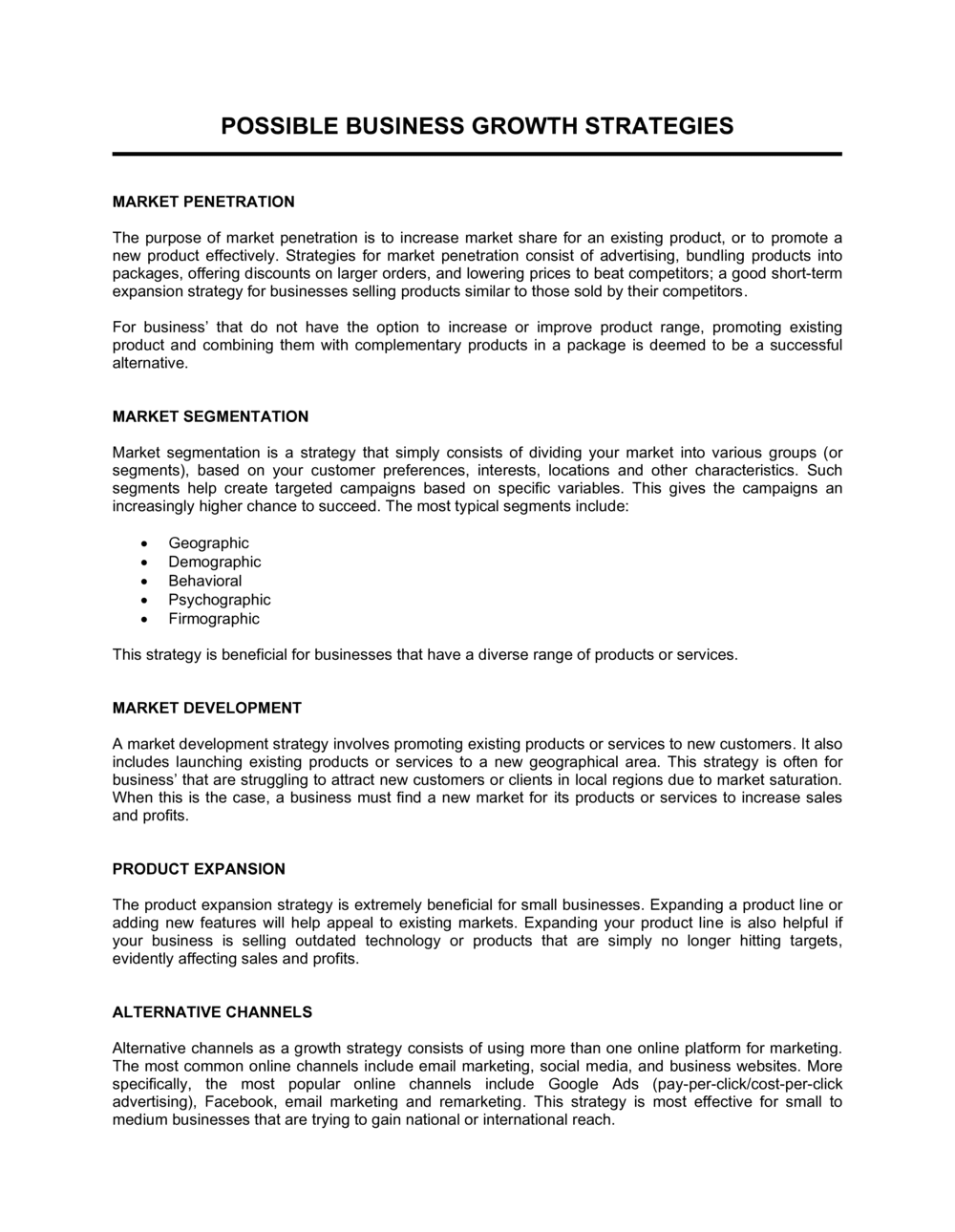
A Possible Business Growth Strategies document is a structured planning report that identifies, evaluates, and prioritizes specific pathways a business can pursue to increase revenue, expand its market presence, or diversify its operations. This free Word download gives you a ready-made framework to analyze growth options β€” from market penetration and product development to partnerships and acquisitions β€” and document your strategic rationale in a format suitable for leadership teams, boards, and investors.
When you need it
Use it when your business is preparing for a new planning cycle, seeking capital to fund expansion, or when leadership needs to evaluate competing growth priorities against available resources and market conditions.
What's inside
Executive summary, current business position, growth opportunity analysis, evaluation of strategic options using frameworks like Ansoff Matrix, recommended growth paths, resource and capability assessment, risk analysis, implementation roadmap, and success metrics.

What is a Possible Business Growth Strategies document?

A Possible Business Growth Strategies document is a structured planning report that identifies and evaluates the specific pathways a business can pursue to grow revenue, expand its customer base, or enter new markets. Drawing on frameworks like the Ansoff Matrix, it organizes growth options into clearly defined categories β€” market penetration, market development, product development, and diversification β€” scores each against weighted criteria such as investment required, revenue potential, and execution risk, and culminates in a documented recommendation with a phased implementation roadmap. Unlike a full business plan, which covers the entire company, this document stays focused on the growth decision itself: what options exist, which one fits best given current capabilities, and how to execute it.

Why You Need This Document

Without a structured growth strategies document, expansion decisions default to whoever argues loudest in a planning meeting β€” and the capital, headcount, and opportunity cost committed to the wrong direction can take 12 to 24 months to recover. Companies that skip the written evaluation step routinely pursue the most visible growth option rather than the highest-value one, launch into new markets without auditing whether the team has the capability to execute, and set revenue targets with no leading indicators to warn them early when the strategy is off track. A completed growth strategies document forces the explicit trade-offs β€” between organic and inorganic paths, between speed and capital efficiency, between adjacency and diversification β€” before commitments are made. This template gives you the framework to conduct that analysis in a format your board, investors, and leadership team can review, challenge, and hold you accountable to.

Which variant fits your situation?

If your situation is…Use this template
Comprehensive multi-year strategic planning for an established businessStrategic Plan
Entering a new geographic market or customer segmentMarket Entry Strategy
Launching a new product or service line to drive growthNew Product Launch Plan
Evaluating an acquisition or partnership as a growth vehicleBusiness Acquisition Plan
Quick one-page growth hypothesis for early-stage ideationOne-Page Business Plan
Seeking capital to fund a specific growth initiativeBusiness Plan
Expanding franchise operations into new territoriesFranchise Business Plan

Common mistakes to avoid

❌ Evaluating only one or two growth options

Why it matters: A document that presents fewer than three options signals that the analysis was built to justify a predetermined conclusion, which erodes stakeholder trust and skips potentially better paths.

Fix: Generate at least three meaningfully different options before evaluating any of them. Include one option that challenges the team's current assumptions, even if it is ultimately rejected.

❌ Omitting the resource and capability gap analysis

Why it matters: A growth strategy that assumes talent, budget, or partnerships the company does not have will stall at the first execution milestone, wasting the planning investment.

Fix: List every resource the recommended strategy requires, compare it against what currently exists, and document a specific plan to close each gap before committing to the strategy.

❌ Using unweighted or unexplained scoring criteria

Why it matters: Without stated weights and rationale, different stakeholders interpret scores differently β€” meetings designed to align on a decision become debates about methodology instead.

Fix: Agree on evaluation criteria weights before scoring, document the weighting rationale in the template, and publish the final scores alongside the weights so reviewers can audit the logic.

❌ Setting only output metrics with no leading indicators

Why it matters: Revenue and customer-count targets measured quarterly give teams no early warning that execution is off track β€” by the time the miss is visible, the planning period is half over.

Fix: Pair every output KPI with at least one leading indicator (pipeline value, trial sign-ups, partnership conversations in progress) and review leading indicators monthly.

❌ Creating a roadmap without named individual owners

Why it matters: Milestones assigned to a team or department diffuse accountability β€” when no single person is responsible, the milestone consistently slips without escalation.

Fix: Assign a single named person (not a role or team) as accountable for each milestone. That person may delegate tasks but owns the outcome.

❌ Not scheduling the first strategy review before the document is finalized

Why it matters: Growth strategy documents that have no committed review date are filed away after the planning meeting and consulted only when something has already gone wrong.

Fix: Before circulating the final document, add the first quarterly review date to the calendars of every stakeholder named in the roadmap.

The 10 key sections, explained

Executive Summary

Current Business Position

Market and Competitive Context

Growth Strategy Options

Evaluation Criteria and Scoring

Recommended Growth Path

Resource and Capability Assessment

Risk Analysis

Implementation Roadmap

Success Metrics and Review Cadence

How to fill it out

  1. 1

    Document the current business position

    Start by writing a concise snapshot of current revenue, customer count, core competencies, and the key constraints shaping your growth decision. Pull from your most recent financial statements and any existing market research.

    πŸ’‘ Limit this section to one page β€” its purpose is to anchor the analysis, not restate the entire business history.

  2. 2

    Gather market and competitive data

    Research market growth rates, competitor activity, and customer trends from at least two independent sources. Note the publication date of every data point β€” anything older than 24 months should be flagged or replaced.

    πŸ’‘ A single customer survey or 5 exploratory customer interviews will often surface more actionable insight than a purchased market report.

  3. 3

    Generate at least three distinct growth options

    Use the Ansoff Matrix or a simple 2x2 (existing vs. new, products vs. markets) to structure your options. Include at least one option that challenges current assumptions β€” even if you expect to reject it.

    πŸ’‘ Run a 60-minute workshop with your leadership team to generate options before evaluating any of them. Mixing generation and evaluation in the same session kills creative options early.

  4. 4

    Define and weight your evaluation criteria

    Choose 4–6 criteria that reflect your current strategic priorities β€” revenue potential, capital required, time to first revenue, strategic fit, and execution risk are the most common. Assign a percentage weight to each that totals 100%.

    πŸ’‘ Agree on the weights before scoring. Teams that set weights after scoring unconsciously inflate criteria that favor their preferred option.

  5. 5

    Score each option and select the recommended path

    Score each growth option 1–5 against every criterion, apply the weights, and calculate a total. Document the recommended path and explicitly state if the team's decision deviates from the top-scoring option and why.

    πŸ’‘ If two options score within 10% of each other, consider a phased approach β€” launch the lower-risk option first and re-evaluate after 6 months of data.

  6. 6

    Complete the resource and capability gap analysis

    For the recommended option, list every resource required (budget, headcount, technology, partnerships) and map each against what the business currently has. For each gap, specify how and by when it will be closed.

    πŸ’‘ Involve the functional leaders responsible for closing each gap in this step β€” estimates they produce themselves are far more reliable than top-down allocations.

  7. 7

    Build the implementation roadmap with named owners

    Break execution into phases of no more than 90 days each. Assign a single named owner (not a department) to every milestone and set a go/no-go decision point with explicit trigger criteria.

    πŸ’‘ 90-day phases force a natural review rhythm and prevent 18-month plans from drifting without accountability checkpoints.

  8. 8

    Define KPIs and set the review cadence

    Identify 3–5 KPIs for the growth strategy β€” at least one leading indicator per major milestone. Set target values, baseline measurements, and a regular review schedule so the team can course-correct before missing annual targets.

    πŸ’‘ Put the first KPI review date in every relevant leader's calendar before you finalize the document β€” a strategy with no scheduled review date rarely gets reviewed.

Frequently asked questions

What is a business growth strategies document?

A business growth strategies document is a structured planning report that identifies, evaluates, and prioritizes specific pathways a company can pursue to increase revenue, expand market presence, or diversify operations. It combines market analysis, competitive context, a structured evaluation of strategic options, a recommended path, and an implementation roadmap into a single reference document for leadership, boards, and investors.

What are the main types of business growth strategies?

The four classic growth pathways from the Ansoff Matrix are market penetration (more sales to existing customers), market development (existing products in new markets or geographies), product development (new offerings for existing customers), and diversification (new products in new markets). Most businesses pursue a combination of the first two before attempting diversification, which carries the highest execution risk.

Who should be involved in creating a business growth strategy?

At minimum, the CEO or general manager, the heads of sales and marketing, and the finance lead. For growth options involving product development or operations, include those functional leaders as well. Involving the people responsible for execution in the planning process produces more realistic estimates and stronger ownership of the final recommendation.

How is a growth strategies document different from a business plan?

A business plan is a comprehensive external document covering the entire business β€” history, market, team, financials, and capital structure β€” used to raise funding or apply for loans. A growth strategies document is a focused internal planning tool that evaluates specific expansion options and recommends a path. It is often an input to a business plan rather than a replacement for one.

How often should a business growth strategy be updated?

Review it quarterly against KPIs and update it fully at least once per year, aligned to the annual planning cycle. Update it immediately if a significant market change occurs β€” a new competitor entrant, a major customer loss, or a shift in available capital β€” that materially changes the attractiveness of the options evaluated.

What financial information should be included in the document?

Each growth option should include an estimated investment required, projected revenue impact (with a timeframe), and an expected payback period or ROI. The recommended path should also include a monthly cash requirement for the first 12 months so leadership can confirm the strategy is fundable within current or planned capital constraints.

Can a small business use this template, or is it only for large companies?

This template is designed to scale down as well as up. A small business owner can complete a focused version in a few hours by limiting the options to two or three realistic pathways and keeping the financial estimates at a high level. The structure β€” evaluate options, pick one, assign owners, set metrics β€” is equally valuable for a 5-person company as for a 500-person one.

What is the difference between organic and inorganic growth strategies?

Organic growth strategies β€” market penetration, product development, and market development β€” use the company's own operations, sales effort, and product investment to generate new revenue. Inorganic strategies involve acquisitions, mergers, or joint ventures to accelerate growth by combining assets. Organic strategies are lower risk and lower cost; inorganic strategies can compress timelines but require integration capability and capital.

How specific should the implementation roadmap be?

Specific enough that a new team member reading it would know what to do in their first week. Each phase should have a named owner, a target completion date, and a defined deliverable or milestone. Roadmaps covering more than 18 months should include explicit go/no-go decision points where leadership confirms whether to continue, pivot, or stop based on measured progress.

How this compares to alternatives

vs Strategic Plan

A strategic plan is a comprehensive multi-year operational document covering goals, initiatives, KPIs, and resource allocation across the entire business. A growth strategies document is a focused analytical report evaluating specific expansion options. The growth strategies document is typically an input to the broader strategic plan, not a substitute for it.

vs Business Plan

A business plan is an external-facing document covering the full company β€” history, market, team, and financials β€” used to raise capital or apply for loans. A growth strategies document is an internal planning tool that evaluates and recommends specific growth pathways. Founders often complete the growth strategies analysis first, then incorporate the recommended path into a full business plan.

vs Marketing Plan

A marketing plan defines the tactics, channels, campaigns, and budget used to acquire and retain customers within an already-chosen growth direction. A growth strategies document makes the higher-level decision about which direction to pursue. The marketing plan executes the strategy; the growth strategies document chooses it.

vs SWOT Analysis

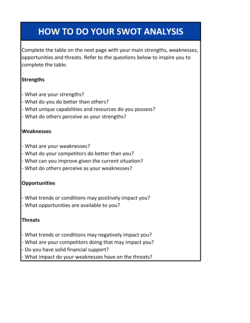
A SWOT analysis is a diagnostic tool that maps strengths, weaknesses, opportunities, and threats β€” it describes the current situation but does not evaluate or recommend specific growth paths. A growth strategies document uses SWOT findings (and other inputs) as evidence to compare and score defined strategic options. The SWOT is typically completed first and referenced inside the growth strategies document.

Industry-specific considerations

SaaS / Technology

Growth options center on PLG (product-led growth) expansion, new vertical markets, international localization, and strategic integrations with adjacent platforms.

Retail / E-commerce

Typical growth vectors include new sales channels (marketplace, wholesale, DTC), geographic expansion, and private-label product development to improve margin.

Professional Services

Growth strategies often focus on service line expansion, geographic office openings, strategic alliances with complementary firms, and moving from project-based to retainer revenue models.

Manufacturing

Key options include adding contract manufacturing capacity, entering adjacent industry verticals, developing proprietary branded products, and pursuing vertical integration of supply chain.

Template vs pro β€” what fits your needs?

PathBest forCostTime
Use the templateSmall business owners and founders conducting annual planning or preparing for a capital conversationFree1–2 weeks (10–20 hours)
Template + professional reviewGrowth-stage companies preparing a strategy for board approval or a funding round$500–$2,500 for a strategy advisor or fractional CFO review session2–3 weeks
Custom draftedBusinesses evaluating acquisitions, international expansion, or major capital allocation decisions above $1M$5,000–$20,000+ for a management consulting engagement4–8 weeks

Glossary

Ansoff Matrix
A strategic framework that maps four growth options β€” market penetration, market development, product development, and diversification β€” against existing and new products and markets.
Market Penetration
A growth strategy focused on selling more of an existing product to existing customers, typically through pricing, promotion, or increased sales effort.
Market Development
Expanding into new customer segments, geographies, or channels with an existing product or service.
Product Development
Creating new products or services to sell to an existing customer base as a means of growing revenue.
Diversification
Entering new markets with new products β€” the highest-risk Ansoff quadrant, pursued when existing markets are saturated or declining.
Organic Growth
Revenue and customer growth generated from the company's own operations β€” sales, marketing, and product improvement β€” without acquisitions or mergers.
Inorganic Growth
Growth achieved through mergers, acquisitions, joint ventures, or strategic partnerships rather than internal operations.
TAM Expansion
Increasing the total addressable market available to the business by moving into adjacent segments, geographies, or use cases.
Strategic Alliance
A formal agreement between two companies to share resources, channels, or capabilities to pursue a growth objective neither could achieve as efficiently alone.
Growth Lever
A specific, actionable driver β€” pricing, distribution, product feature, or partnership β€” that, when pulled, produces a measurable increase in revenue or customer count.

Part of your Business Operating System

This document is one of 3,000+ business & legal templates included in Business in a Box.

  • Fill-in-the-blanks β€” ready in minutes
  • 100% customizable Word document
  • Compatible with all office suites
  • Export to PDF and share electronically

Create your document in 3 simple steps.

From template to signed document β€” all inside one Business Operating System.
1
Download or open template

Access over 3,000+ business and legal templates for any business task, project or initiative.

2
Edit and fill in the blanks with AI

Customize your ready-made business document template and save it in the cloud.

3
Save, Share, Send, Sign

Share your files and folders with your team. Create a space of seamless collaboration.

Save time, save money, and create top-quality documents.

β˜…β˜…β˜…β˜…β˜…

"Fantastic value! I'm not sure how I'd do without it. It's worth its weight in gold and paid back for itself many times."

Managing Director Β· Mall Farm
Robert Whalley
Managing Director, Mall Farm Proprietary Limited
β˜…β˜…β˜…β˜…β˜…

"I have been using Business in a Box for years. It has been the most useful source of templates I have encountered. I recommend it to anyone."

Business Owner Β· 4+ years
Dr Michael John Freestone
Business Owner
β˜…β˜…β˜…β˜…β˜…

"It has been a life saver so many times I have lost count. Business in a Box has saved me so much time and as you know, time is money."

Owner Β· Upstate Web
David G. Moore Jr.
Owner, Upstate Web

Run your business with a system β€” not scattered tools

Stop downloading documents. Start operating with clarity. Business in a Box gives you the Business Operating System used by over 250,000 companies worldwide to structure, run, and grow their business.

Start freeΒ Β·Β No credit card required