Possible Research and Development Strategies

Free Word download β€’ Edit online β€’ Save & share with Drive β€’ Export to PDF

1 pageβ€’15–25 min to fillβ€’Difficulty: Standard
Learn more ↓
FreePossible Research and Development Strategies Template

At a glance

What it is
A Possible Research and Development Strategies document is a structured operational plan that outlines the strategic options, priorities, and resource commitments a company is considering for its R&D program. This free Word download gives you a ready-made framework you can edit online and export as PDF to share with leadership, boards, or investors.
When you need it
Use it when planning a new product cycle, responding to a competitive threat, allocating an annual R&D budget, or presenting strategic options to stakeholders who need to choose a direction before committing capital.
What's inside
Strategic objectives, current-state assessment, candidate R&D strategies with rationale, resource and budget requirements, risk analysis, success metrics, and an implementation roadmap β€” all in a single cohesive document.

What is a Possible Research and Development Strategies Document?

A Possible Research and Development Strategies document is an operational planning tool that presents, compares, and evaluates the strategic options available to a company for its R&D investment over a defined planning period. It documents the current-state baseline, articulates two to four distinct candidate strategies with their resource requirements and risk profiles, and concludes with a clear recommendation and implementation roadmap. Unlike a product roadmap β€” which assumes a direction has already been chosen β€” this document is a decision instrument: it structures the analysis that precedes commitment, giving leadership the information they need to allocate R&D budget with confidence.

Why You Need This Document

Without a structured R&D strategy document, investment decisions default to whoever advocates loudest in a budget meeting, projects proliferate without a coherent rationale, and the connection between technical spend and business outcomes becomes invisible. The consequences are concrete: R&D budgets spread too thin across too many initiatives produce incremental improvements rather than the step-change capabilities that generate competitive advantage. When a funding round, board review, or government grant application arrives, an organization that cannot demonstrate a disciplined, evidence-based approach to innovation consistently receives less favorable terms β€” or no funding at all. This template gives R&D leaders a structured starting point that transforms an unstructured strategy conversation into a documented, reviewable decision that can be tracked, measured, and held accountable over time.

Which variant fits your situation?

If your situation is…Use this template
Planning a 12-month product development cycle with a defined budgetR&D Project Plan
Presenting technology investment options to a board for approvalTechnology Strategy Report
Mapping a multi-year innovation pipeline with milestonesInnovation Roadmap
Applying for government or institutional R&D fundingResearch Grant Proposal
Evaluating a third-party technology acquisition or licensing dealTechnology Acquisition Analysis
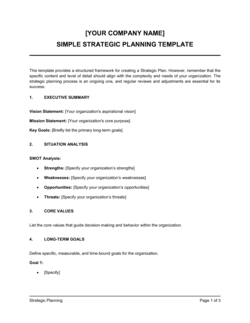
Aligning R&D spending to a broader corporate strategic planStrategic Plan
Launching a new product line with defined research requirementsNew Product Launch Plan

Common mistakes to avoid

❌ Presenting only one strategy as a fait accompli

Why it matters: Stakeholders who feel the decision has already been made disengage from the review process, and critical risks go unexamined because no genuine alternatives are on the table.

Fix: Present at least two substantively different options β€” even if you have a clear preference β€” and evaluate them against the same criteria so the recommendation is visibly evidence-based.

❌ Using activity metrics as the primary KPIs

Why it matters: Tracking inputs like hours spent or patents filed tells you what the team did, not whether the R&D investment generated business value β€” and it makes it impossible to hold the strategy accountable to outcomes.

Fix: Anchor KPIs to output or outcome measures: revenue from new products, reduction in production cost, or time from concept to working prototype.

❌ No go/no-go gates in the implementation roadmap

Why it matters: Without explicit checkpoints, underperforming projects continue consuming budget long after the evidence has indicated the strategy is not working, because no one has the formal trigger to stop.

Fix: Assign a measurable gate criterion to each phase boundary β€” for example, 'prototype achieves [SPECIFICATION] by [DATE] or strategy is reviewed' β€” and name the decision authority.

❌ Omitting the current-state assessment

Why it matters: Strategies evaluated without a baseline appear disconnected from reality, making it impossible for budget holders to assess what each option actually requires in incremental investment.

Fix: Include at minimum the current R&D headcount, annual spend, active project list, and a one-paragraph capability gap assessment before presenting any strategy options.

The 9 key sections, explained

Executive Summary

Strategic Context and Objectives

Current-State Assessment

Candidate R&D Strategies

Resource and Budget Requirements

Risk Analysis

Success Metrics and KPIs

Implementation Roadmap

Recommendation and Next Steps

How to fill it out

  1. 1

    Define the strategic context and decision trigger

    Open the document by stating what business need or opportunity is driving the R&D strategy review, and what decision must be made by whom and by when.

    πŸ’‘ A one-sentence problem statement β€” 'We need to decide how to close the [CAPABILITY] gap before [COMPETITOR / DEADLINE]' β€” sharpens the entire document.

  2. 2

    Document the current-state baseline

    Record existing R&D headcount, active projects, annual spend, and any assessed capability gaps. Use actual numbers β€” estimated figures undermine the credibility of the options analysis.

    πŸ’‘ Pull R&D intensity benchmarks from your industry association or a public company peer set to anchor the baseline in external context.

  3. 3

    Identify two to four distinct candidate strategies

    Each candidate should represent a genuinely different approach β€” for example, internal development versus open innovation partnership versus acquisition. Avoid presenting minor variations as separate strategies.

    πŸ’‘ A build-partner-buy framework is a reliable starting point for generating meaningfully distinct options.

  4. 4

    Build the resource and cost model for each option

    Estimate headcount, capital expenditure, external spend, and total cost for each strategy over the planning period. Break costs into at least three categories so reviewers can probe assumptions.

    πŸ’‘ Apply a 20% contingency buffer to each cost estimate β€” R&D projects routinely run over initial estimates due to technical unknowns.

  5. 5

    Complete the risk analysis with mitigations and owners

    For each candidate strategy, list the top three to five risks with likelihood, impact, mitigation action, and a named owner. Link mitigations back to the budget where they require funding.

    πŸ’‘ Technical risk and commercial risk are distinct categories β€” treat them separately to avoid conflating a viable technology with an unproven market.

  6. 6

    Set outcome-based KPIs for the preferred strategy

    Choose three to five KPIs that measure outputs or outcomes β€” revenue attributable to new products, time-to-prototype, or cost reduction achieved β€” rather than activity metrics.

    πŸ’‘ Each KPI needs a baseline, a target, a measurement method, and a reporting cadence to be actionable.

  7. 7

    Draft the implementation roadmap with decision gates

    Divide the recommended strategy into two to four phases. Assign a milestone and a go/no-go gate to each phase, with explicit criteria the team must meet to proceed.

    πŸ’‘ Keep each phase to six months or less β€” shorter phases force earlier validation and reduce the cost of changing course.

  8. 8

    Write the executive summary and recommendation last

    Pull one key data point from each section and compress the whole document into a 1–2 page summary. State the recommendation explicitly and specify the decision and timeline required.

    πŸ’‘ If you cannot summarize the recommendation in two sentences, the strategy has not been sufficiently defined β€” go back and sharpen it before circulating the document.

Frequently asked questions

What is a research and development strategy?

A research and development strategy is a structured plan that defines how a company will invest in innovation to achieve specific business objectives β€” whether developing new products, improving existing processes, or building proprietary technology. It identifies strategic options, allocates resources across those options, and sets measurable milestones to track progress. A well-crafted R&D strategy connects technical investment decisions directly to commercial outcomes.

What are the main types of R&D strategies a company can pursue?

The four most common approaches are internal development (building capabilities entirely in-house), open innovation (combining internal research with external partners, universities, or startups), technology licensing (acquiring rights to use another organization's IP rather than developing it), and acquisition (purchasing a company that already possesses the target capability). Most organizations use a blend, with the mix determined by time pressure, budget, and competitive risk.

How much should a company spend on R&D?

R&D intensity β€” spending as a percentage of revenue β€” varies widely by industry. Software and pharmaceuticals typically run 10–20%; industrial manufacturers run 3–6%; consumer goods companies average 1–3%. The right level depends on competitive dynamics, margin structure, and growth targets. Rather than benchmarking to an industry average, start from the specific outcomes the business needs R&D to produce and work backward to the required investment.

What is the difference between basic research and applied research?

Basic research generates new knowledge without a specific commercial application in mind β€” it is primarily conducted by universities and large corporate research labs. Applied research uses that knowledge to solve a defined problem or create a specific product. Most business R&D strategies focus on applied research and development, occasionally supplemented by partnerships with universities for more exploratory work.

How do you measure the success of an R&D strategy?

Effective R&D measurement combines leading indicators β€” such as technology readiness level progression, prototype completion dates, and patent applications β€” with lagging outcome metrics like revenue from products launched in the last three years, cost savings from process improvements, and return on R&D investment. A common benchmark is that new products introduced in the past three years should account for at least 25–30% of current revenue in innovation-driven industries.

What is a stage-gate process and should it be included in an R&D strategy?

A stage-gate process divides the R&D lifecycle into discrete phases β€” ideation, concept development, prototyping, validation, and launch β€” with a formal decision review at each gate. Including it in the strategy document ensures that resource commitments are incremental rather than front-loaded, that underperforming projects are stopped early, and that leadership has structured checkpoints to reallocate budget. It is especially useful for companies running multiple concurrent R&D streams.

How is an R&D strategy document different from a product roadmap?

An R&D strategy document evaluates strategic options and selects the direction for investment β€” it is primarily a decision document. A product roadmap translates the chosen direction into a sequenced timeline of specific features, releases, and milestones. The strategy document precedes and informs the roadmap. You need the strategy to decide where to go before the roadmap can credibly map how to get there.

Can a small business or startup benefit from a formal R&D strategy?

Yes β€” even for early-stage companies, a structured strategy document prevents ad hoc investment decisions, helps secure funding by demonstrating disciplined resource planning, and creates a baseline against which the team can measure whether the approach is working. For startups, a streamlined two to three strategy-option analysis is sufficient; the discipline of comparing options matters more than the length of the document.

What role does IP management play in an R&D strategy?

IP strategy should be integrated into R&D planning from the outset. Decisions about what to patent, what to keep as a trade secret, and what to publish as open research affect competitive defensibility, licensing revenue potential, and freedom to operate. An R&D strategy that ignores IP creates the risk of developing capabilities that cannot be protected or that inadvertently infringe on existing third-party patents.

How this compares to alternatives

vs Strategic Plan

A strategic plan covers the full scope of a company's direction β€” market positioning, operations, finance, and people. An R&D strategies document focuses specifically on innovation investment options and how technical resources should be allocated. The strategic plan sets the goals; the R&D document identifies how technology and research will contribute to reaching them.

vs New Product Launch Plan

A product launch plan begins where R&D ends β€” it defines the go-to-market activities, pricing, and channel strategy for a product that has already been developed. An R&D strategies document precedes this, focusing on which development path to pursue before the product exists. You need the R&D strategy to decide what to build before the launch plan can specify how to sell it.

vs Business Plan

A business plan presents a company's full commercial model β€” market, competition, team, and financials β€” to external audiences such as investors or lenders. An R&D strategies document is an internal operational document focused on technical investment decisions. The business plan may summarize R&D direction in a few paragraphs; the R&D strategies document provides the detailed analysis behind that summary.

vs Marketing Plan

A marketing plan defines how a company will acquire customers and grow revenue from existing and new products. An R&D strategies document defines which new products or capabilities will exist in the first place. The two documents should be developed in parallel β€” market demand signals from the marketing team should directly inform which R&D strategies are prioritized.

Industry-specific considerations

Pharmaceuticals and Life Sciences

R&D strategy must account for clinical trial phase-gates, regulatory approval timelines (FDA, EMA), patent cliffs, and the 10–15 year development cycle typical for new drug candidates.

Technology and SaaS

Strategy options typically center on build-vs-buy-vs-partner for new features, with success metrics tied to developer velocity, time-to-prototype, and new ARR attributable to R&D-derived capabilities.

Manufacturing and Industrial

R&D priorities focus on process improvement, materials science, and automation β€” with ROI measured in cost-per-unit reduction, yield improvement, and capital expenditure avoidance.

Consumer Goods and Retail

Short product development cycles require R&D strategies tied to consumer trend data, with success measured by new SKU contribution to revenue and speed from concept to shelf.

Template vs pro β€” what fits your needs?

PathBest forCostTime
Use the templateR&D managers and CTOs at small to mid-size companies preparing an annual strategy review for internal leadershipFree1–2 weeks (20–40 hours of analysis and writing)
Template + professional reviewCompanies preparing an R&D strategy to support a funding round, board presentation, or government grant application$500–$2,500 for a strategy consultant or innovation advisor review2–4 weeks
Custom draftedLarge enterprises, heavily regulated industries (pharma, defense, medical devices), or R&D programs requiring independent technical due diligence$5,000–$25,000+ for a specialized R&D strategy consultancy4–10 weeks

Glossary

Basic Research
Experimental or theoretical work undertaken primarily to acquire new knowledge without a specific application in mind.
Applied Research
Original investigation directed toward a specific practical aim or objective, such as developing a new product or process.
Technology Readiness Level (TRL)
A nine-point scale measuring how mature a technology is, from basic principles observed (TRL 1) to proven in operational environments (TRL 9).
R&D Intensity
R&D expenditure expressed as a percentage of revenue β€” a standard benchmark for comparing investment levels across companies or industries.
Stage-Gate Process
A project management method that divides R&D from concept to launch into discrete stages separated by decision checkpoints called gates.
Open Innovation
A strategy where a company deliberately uses external ideas, partnerships, and licensing alongside internal R&D to advance its technology.
IP Portfolio
The collection of patents, trade secrets, copyrights, and trademarks owned or licensed by a company, representing its accumulated innovation assets.
Make-vs-Buy Decision
The strategic choice between developing a capability in-house through R&D versus acquiring it externally through purchase, licensing, or partnership.
Innovation Funnel
A model representing the progressive screening of many early-stage ideas down to the few that receive full development resources and reach market.
R&D Tax Credit
A government incentive that allows qualifying businesses to reduce their tax liability by a percentage of eligible research and development expenses.

Part of your Business Operating System

This document is one of 3,000+ business & legal templates included in Business in a Box.

  • Fill-in-the-blanks β€” ready in minutes
  • 100% customizable Word document
  • Compatible with all office suites
  • Export to PDF and share electronically

Create your document in 3 simple steps.

From template to signed document β€” all inside one Business Operating System.
1
Download or open template

Access over 3,000+ business and legal templates for any business task, project or initiative.

2
Edit and fill in the blanks with AI

Customize your ready-made business document template and save it in the cloud.

3
Save, Share, Send, Sign

Share your files and folders with your team. Create a space of seamless collaboration.

Save time, save money, and create top-quality documents.

β˜…β˜…β˜…β˜…β˜…

"Fantastic value! I'm not sure how I'd do without it. It's worth its weight in gold and paid back for itself many times."

Managing Director Β· Mall Farm
Robert Whalley
Managing Director, Mall Farm Proprietary Limited
β˜…β˜…β˜…β˜…β˜…

"I have been using Business in a Box for years. It has been the most useful source of templates I have encountered. I recommend it to anyone."

Business Owner Β· 4+ years
Dr Michael John Freestone
Business Owner
β˜…β˜…β˜…β˜…β˜…

"It has been a life saver so many times I have lost count. Business in a Box has saved me so much time and as you know, time is money."

Owner Β· Upstate Web
David G. Moore Jr.
Owner, Upstate Web

Run your business with a system β€” not scattered tools

Stop downloading documents. Start operating with clarity. Business in a Box gives you the Business Operating System used by over 250,000 companies worldwide to structure, run, and grow their business.

Free Forever PlanΒ Β·Β No credit card required