Product Management Marketing Strategies

Free Word download β€’ Edit online β€’ Save & share with Drive β€’ Export to PDF

3 pagesβ€’20–30 min to fillβ€’Difficulty: Standard
Learn more ↓
FreeProduct Management Marketing Strategies Template

At a glance

What it is
A Product Management Marketing Strategies document is a structured plan that connects a product's development roadmap to its market positioning, target customer segments, launch tactics, and revenue objectives. This free Word download gives product managers and marketing teams a single editable framework they can adapt, export as PDF, and present to leadership or cross-functional stakeholders.
When you need it
Use it when planning a new product launch, repositioning an existing product for a new market, or aligning product and marketing teams around shared goals for an upcoming release cycle or fiscal year.
What's inside
Product overview and strategic objectives, target customer personas, market and competitive analysis, positioning and messaging framework, go-to-market channel strategy, pricing model, launch plan with milestones, and success metrics with KPIs.

What is a Product Management Marketing Strategies Document?

A Product Management Marketing Strategies document is a structured operational plan that bridges a product team's roadmap decisions with the market-facing activities required to acquire, convert, and retain customers. It defines the target customer personas, competitive positioning, pricing model, go-to-market channel mix, launch milestones, and success metrics that product and marketing teams need to execute a coordinated product launch or market expansion. Unlike a general marketing plan, this document is scoped to a specific product or product line and is built from product-level customer insight rather than brand-level strategy.

Why You Need This Document

Without a written product marketing strategy, product and marketing teams execute against different assumptions about who the customer is, what message will resonate, and which channels to prioritize β€” producing launches that are tactically busy but strategically incoherent. Sales teams inherit positioning they don't believe in, campaigns run on channels the ICP doesn't use, and post-launch performance reviews have no baseline to measure against. The compounded cost is real: misaligned launches extend time-to-first-revenue, inflate CAC, and accelerate early churn. This template gives product managers and marketing directors a single shared document that forces alignment on customer, positioning, pricing, and metrics before a dollar of launch budget is spent β€” turning a cross-functional coordination problem into a structured, auditable plan.

Which variant fits your situation?

If your situation is…Use this template
Launching a new SaaS product to a defined ICPGo-to-Market Strategy Plan
Repositioning an existing product after a pivot or rebrandBrand Positioning Statement
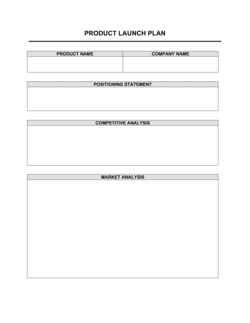
Planning a physical product launch with retail and e-commerce channelsProduct Launch Plan
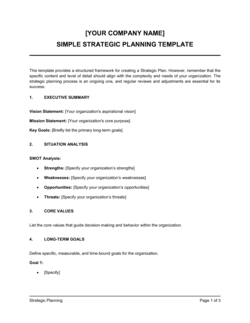
Documenting a high-level multi-year product strategy for the boardStrategic Planning Template
Aligning marketing spend to product tiers and pricingMarketing Budget Template
Tracking feature releases and market rollout against a timelineProduct Roadmap Template
Scoping the competitive landscape before defining positioningCompetitive Analysis Template

Common mistakes to avoid

❌ Treating positioning as a marketing exercise, not a product decision

Why it matters: If positioning doesn't reflect what the product actually delivers today, sales teams over-promise and customer success inherits the churn that follows.

Fix: Validate every positioning claim against the current product's capabilities before publishing. Flag any aspiration claims as a roadmap dependency with an expected date.

❌ Selecting channels based on team familiarity rather than customer behavior

Why it matters: Teams that default to the channels they already know β€” often email and social β€” miss the channels where their ICP actually makes buying decisions, wasting budget with predictable underperformance.

Fix: Map each persona's information and buying journey before selecting channels. Ask in customer interviews: 'How did you find the last solution you bought in this category?'

❌ Launching without a defined post-launch optimization phase

Why it matters: Most launches underperform initial projections. Teams with no structured post-launch review period run the same tactics for 90 days without adjusting, compounding early underperformance.

Fix: Schedule a 30-day post-launch review on the day the plan is approved. Define in advance which KPIs will trigger a pivot in channel mix or messaging.

❌ Setting KPIs that are not connected to revenue outcomes

Why it matters: Tracking impressions, follower counts, and email open rates feels like progress but provides no signal on whether the strategy is generating pipeline or customers.

Fix: For each KPI in the plan, trace a direct line to a revenue outcome β€” if you can't draw that line, replace the metric with one you can.

❌ Writing the strategy without sales team input

Why it matters: Product marketing strategies that are built without frontline sales perspective consistently miss the actual objections buyers raise, producing messaging that works in decks but not in deals.

Fix: Run a 60-minute structured interview with two to three salespeople before finalizing positioning and messaging. Ask for the top three objections they hear in the first meeting.

❌ Using a single static document for a 12-month period without scheduled reviews

Why it matters: Markets, competitors, and pricing shift faster than annual planning cycles. A strategy that isn't reviewed quarterly becomes a liability β€” teams execute an outdated plan while the market moves.

Fix: Add a quarterly review checkpoint to the document with explicit triggers for revision: a competitor pricing change, a shift in CAC above 20%, or a NPS drop of more than 10 points.

The 9 key sections, explained

Product Overview and Strategic Objectives

Target Customer Personas

Market and Competitive Analysis

Positioning and Messaging Framework

Pricing Strategy

Go-to-Market Channel Strategy

Launch Plan and Milestones

Success Metrics and KPIs

Budget and Resource Allocation

How to fill it out

  1. 1

    Define the product and set measurable strategic objectives

    Write a two-sentence product description, then list 3–5 specific, time-bound objectives the strategy must achieve β€” expressed as outcomes, not activities.

    πŸ’‘ Use the OKR format (Objective + Key Results) to make objectives auditable: each key result should have a number and a date.

  2. 2

    Build target personas from real customer data

    Interview at least five current or prospective customers before completing the persona section. Capture their exact language around pain points and buying triggers β€” use their words, not marketing jargon.

    πŸ’‘ If you have a CRM, segment your top 20% of customers by revenue and look for shared attributes β€” that cluster is your ICP.

  3. 3

    Complete the market and competitive analysis

    Source TAM from at least two independent reports, then build a bottom-up SAM by counting reachable buyers and multiplying by average contract value. Profile at least four competitors with their pricing, key strengths, and weaknesses.

    πŸ’‘ Run a quick win/loss analysis on your last 10 deals β€” the objections you lost on reveal the competitive gaps your positioning must address.

  4. 4

    Write the positioning statement and messaging pillars

    Use the structure: 'For [CUSTOMER] who [NEED], [PRODUCT] is a [CATEGORY] that [KEY BENEFIT]. Unlike [ALTERNATIVE], [DIFFERENTIATOR].' Then write 3–4 proof-point pillars with supporting evidence for each.

    πŸ’‘ Test your positioning statement with three customers who don't work in marketing β€” if they can't repeat the core idea back in one sentence, simplify it.

  5. 5

    Set pricing with a willingness-to-pay test

    Before finalizing price points, ask 10–15 target customers the Van Westendorp four-price questions to identify acceptable price ranges. Benchmark against 3–5 competitors and choose your price position intentionally.

    πŸ’‘ Document the pricing rationale in this section β€” future teams will change prices without context if the original logic isn't recorded.

  6. 6

    Select and prioritize 2–3 GTM channels

    Choose channels based on where your ICP actually spends attention, not where your team has historical comfort. Assign a CAC estimate and a 90-day test budget to each selected channel.

    πŸ’‘ For each channel, define the specific metric that will tell you at 60 days whether to scale or cut β€” don't wait until the end of the quarter.

  7. 7

    Build the launch timeline with single owners

    List every pre-launch, launch-day, and post-launch milestone with a due date and one named owner per milestone. Review the timeline for dependencies β€” identify which milestones block others.

    πŸ’‘ Add a 10% buffer to your critical-path milestones. Legal, design, and engineering reviews almost always take longer than planned.

  8. 8

    Define KPIs and set a reporting cadence

    Choose 5–8 metrics directly tied to revenue, conversion, or retention. Set a baseline from historical data, a target for each metric, and a weekly or monthly review cadence.

    πŸ’‘ Build a one-page dashboard in your analytics tool before launch so the team is looking at the same numbers from day one β€” not debating which report is correct.

Frequently asked questions

What is a product management marketing strategies document?

A product management marketing strategies document is a structured plan that connects a product's development priorities to its market positioning, target customer segments, channel tactics, and revenue objectives. It serves as the operational bridge between what the product team is building and how the marketing team brings it to market β€” ensuring both functions are working from the same customer insight, competitive context, and success metrics.

Who owns the product marketing strategy β€” product management or marketing?

In most organizations, product marketing is the shared responsibility of the product manager and the marketing team, with the product manager owning positioning and roadmap alignment and the marketing team owning channel execution and campaign delivery. In companies without a dedicated product marketing function, the product manager typically owns the full document and partners with marketing leadership to execute the launch plan. Clear ownership of each section β€” documented in the plan itself β€” prevents gaps at launch.

How is a product marketing strategy different from a marketing plan?

A marketing plan covers all marketing activities across the business β€” brand, demand generation, content, events, and PR β€” usually for a full fiscal year. A product marketing strategy is scoped specifically to a single product or product line, covering its positioning, target persona, pricing, and launch tactics. The product marketing strategy feeds the marketing plan, not the reverse: positioning decisions made in the product strategy define the messaging used in all broader marketing campaigns.

What is a go-to-market strategy and how does it fit into this document?

A go-to-market (GTM) strategy defines how a product will reach its target customers β€” which channels, at what price, with what message, and in what sequence. It is one of the core sections of a product marketing strategy document, sitting between the positioning framework and the launch plan. A complete product marketing strategy includes the GTM plan rather than treating it as a separate document, ensuring channel choices are grounded in the same customer insight that drives positioning.

How long should a product management marketing strategies document be?

For a single product launch, 10–20 pages plus a financial model or budget appendix is the standard range. Internal operating documents for a product line covering multiple features or market segments can run 25–35 pages. The depth should match the stakes: a major launch with a six-figure budget warrants a complete document; a small feature release may need only the positioning, channel, and KPI sections filled out.

What metrics should be included in a product marketing strategy?

Include 5–8 metrics directly tied to revenue, conversion, or retention β€” typically: number of qualified leads generated, pipeline influenced, trial or freemium conversion rate, CAC by channel, average deal size, time to first value, and NPS at 30 and 90 days post-purchase. Avoid tracking metrics like total impressions or email list size unless they have a documented relationship to a downstream revenue outcome in your specific business model.

How often should a product marketing strategy be updated?

Review the strategy at a minimum once per quarter against actuals. Trigger an unscheduled revision when a primary competitor changes pricing by more than 15%, when CAC rises above 20% of target for two consecutive months, or when NPS drops more than 10 points. A strategy document that is not revisited at least quarterly becomes a planning artifact rather than an operational tool.

Can a startup use this template before achieving product-market fit?

Yes, with the right expectations. Pre-PMF, the strategy document functions as a hypothesis β€” a structured set of assumptions about customer, positioning, and channel to be tested rather than executed at scale. Fill in every section with your current best thinking, label key assumptions explicitly, and define the specific signals that would cause you to revise each one. The discipline of writing the strategy forces hypothesis clarity even when answers are uncertain.

What is the difference between a positioning statement and a value proposition?

A positioning statement is an internal strategic declaration β€” it defines the product's category, target customer, key benefit, and differentiator for use by product, marketing, and sales teams. A value proposition is the customer-facing expression of that positioning β€” the specific outcome the product delivers, written in the language the buyer uses. The positioning statement is written once and used to derive all value propositions across different segments, channels, and formats.

How this compares to alternatives

vs Marketing Plan

A marketing plan covers all marketing activities across the business for a full year β€” brand, demand generation, content, events, and PR. A product marketing strategy is scoped to a single product, covering its specific positioning, persona, pricing, and launch tactics. The product strategy feeds the marketing plan's messaging and channel priorities, not the reverse. Use both for a complete annual marketing operation.

vs Product Launch Plan

A product launch plan is an execution checklist for the launch event itself β€” tasks, owners, dates, and assets required to go live. A product marketing strategy is the strategic document that defines why certain channels and messages are chosen before any execution begins. Write the strategy first; the launch plan implements it. Using a launch plan without a strategy produces tactically complete but strategically misaligned launches.

vs Strategic Planning Template

A strategic plan covers the full business β€” vision, goals, initiatives, and resource allocation across all functions for 3–5 years. A product marketing strategy is scoped to a single product and a single planning period, focused entirely on market positioning and acquisition. Growth-stage companies typically need both: the strategic plan for enterprise alignment and the product marketing strategy for execution-level clarity on each product.

vs Business Plan

A business plan is a capital-raising and company-level strategy document covering market sizing, financials, team, and funding structure. A product marketing strategy assumes the business already exists and focuses on bringing a specific product to market through defined channels and messaging. Founders raising capital need a business plan; product teams launching within an operating business need a product marketing strategy.

Industry-specific considerations

SaaS / Technology

MRR-tied KPIs, freemium-to-paid conversion metrics, product-led growth channel strategy, and feature-tier pricing aligned to ICP segment size.

Consumer Goods / Retail

Shelf placement and retail partner channel strategy, seasonal launch timing, packaging messaging alignment, and DTC vs. wholesale pricing differentiation.

Healthcare / MedTech

Regulatory approval milestones as launch gates, reimbursement code inclusion in pricing rationale, and clinician vs. administrator persona differentiation.

Professional Services

Service productization with fixed-scope pricing tiers, case study and referral channel strategy, and NPS as the primary retention KPI for repeat engagement.

Template vs pro β€” what fits your needs?

PathBest forCostTime
Use the templateProduct managers and marketing leads launching a single product in a known market with an existing teamFree1–2 weeks (20–40 hours)
Template + professional reviewTeams entering a new market segment, launching a major product revision, or preparing for a board or investor review$500–$2,500 for a product marketing consultant review session2–4 weeks
Custom draftedEnterprise product launches, regulated industries, or companies without an internal product marketing function$5,000–$20,000+ for a fractional PMM or agency engagement4–8 weeks

Glossary

Ideal Customer Profile (ICP)
A detailed description of the type of company or individual most likely to buy, retain, and derive value from a product β€” used to focus acquisition and positioning efforts.
Positioning Statement
A concise internal declaration that defines what a product does, for whom, and why it is different from alternatives β€” the foundation of all outward messaging.
Go-to-Market (GTM) Strategy
The specific plan for how a company will bring a product to its target customers, covering channels, pricing, messaging, and launch sequencing.
Value Proposition
A clear statement of the specific benefit a product delivers to a target customer and why it is preferable to the next-best alternative.
Product-Market Fit (PMF)
The point at which a product satisfies a strong market demand β€” measured by retention, referral rates, and willingness to pay rather than launch metrics.
Competitive Differentiation
The specific features, outcomes, or experiences that distinguish a product from direct and indirect competitors in the minds of target buyers.
Pricing Model
The structure by which a company charges for its product β€” such as subscription, usage-based, tiered, freemium, or one-time purchase.
Launch Milestone
A predefined event or checkpoint in a product launch timeline β€” such as beta release, general availability, or first 100 customers β€” used to track execution progress.
Net Promoter Score (NPS)
A customer satisfaction metric that measures the likelihood of customers recommending a product, scored on a scale of -100 to +100.
Customer Acquisition Cost (CAC)
Total sales and marketing spend divided by the number of new customers acquired in the same period β€” a key input for evaluating channel efficiency.

Part of your Business Operating System

This document is one of 3,000+ business & legal templates included in Business in a Box.

  • Fill-in-the-blanks β€” ready in minutes
  • 100% customizable Word document
  • Compatible with all office suites
  • Export to PDF and share electronically

Create your document in 3 simple steps.

From template to signed document β€” all inside one Business Operating System.
1
Download or open template

Access over 3,000+ business and legal templates for any business task, project or initiative.

2
Edit and fill in the blanks with AI

Customize your ready-made business document template and save it in the cloud.

3
Save, Share, Send, Sign

Share your files and folders with your team. Create a space of seamless collaboration.

Save time, save money, and create top-quality documents.

β˜…β˜…β˜…β˜…β˜…

"Fantastic value! I'm not sure how I'd do without it. It's worth its weight in gold and paid back for itself many times."

Managing Director Β· Mall Farm
Robert Whalley
Managing Director, Mall Farm Proprietary Limited
β˜…β˜…β˜…β˜…β˜…

"I have been using Business in a Box for years. It has been the most useful source of templates I have encountered. I recommend it to anyone."

Business Owner Β· 4+ years
Dr Michael John Freestone
Business Owner
β˜…β˜…β˜…β˜…β˜…

"It has been a life saver so many times I have lost count. Business in a Box has saved me so much time and as you know, time is money."

Owner Β· Upstate Web
David G. Moore Jr.
Owner, Upstate Web

Run your business with a system β€” not scattered tools

Stop downloading documents. Start operating with clarity. Business in a Box gives you the Business Operating System used by over 250,000 companies worldwide to structure, run, and grow their business.

Start freeΒ Β·Β No credit card required