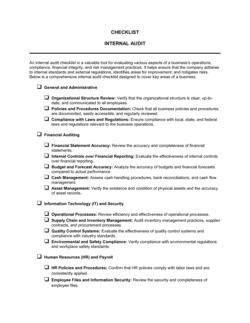
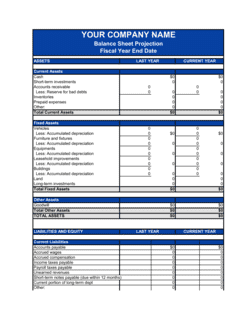
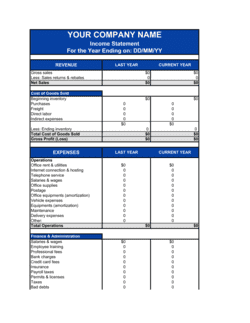
Possible Financial & Accounting Strategies

Free Word download β€’ Edit online β€’ Save & share with Drive β€’ Export to PDF

1 pageβ€’15–25 min to fillβ€’Difficulty: Standard
Learn more ↓
FreePossible Financial & Accounting Strategies Template

At a glance

What it is
A Possible Financial Accounting Strategies document is a structured policy and planning reference that outlines the accounting methods, revenue recognition approaches, cost allocation frameworks, and reporting conventions a business intends to evaluate or adopt. This free Word download gives finance teams, CFOs, and business owners a ready-made starting point they can edit online and export as PDF for internal review or external presentation to auditors, investors, or boards.
When you need it
Use it when formalizing your accounting policies at company formation, when preparing for an audit, when transitioning between accounting standards (e.g., cash to accrual), or when evaluating which methods best align with your business model and reporting obligations.
What's inside
The document covers objectives and scope, revenue recognition options, inventory and cost-of-goods methods, depreciation and amortization approaches, expense classification, financial reporting cadence, internal controls, and guidance on selecting the strategy most appropriate for your entity type and industry.

What is a Possible Financial Accounting Strategies Document?

A Possible Financial Accounting Strategies document is a structured planning reference that evaluates the accounting methods available to a business and documents the rationale for selecting each one. It covers the full range of strategic choices a finance team must make: how and when to recognize revenue, how to value inventory, which depreciation methods to apply to each asset class, how to classify and allocate expenses, and how to structure internal controls and reporting. Rather than presenting a single prescribed approach, it maps the options, compares their financial and tax implications, and concludes with a clear recommendation tailored to the company's size, industry, and reporting obligations.

Why You Need This Document

Operating without documented accounting strategies exposes a business to inconsistent reporting, audit findings, and costly restatements. When revenue recognition, depreciation, and expense classification decisions are made informally β€” or differently by different team members β€” financial statements become unreliable, lenders lose confidence, and investors cannot perform meaningful due diligence. A completed accounting strategies document prevents these problems by creating a single written record of every material policy choice before it is applied. It gives auditors the written policies they request at the start of fieldwork, gives new finance hires an authoritative reference, and gives leadership a defensible basis for every number in the financial statements. This template gives you the structure to make those decisions systematically and document them in a format that stands up to external scrutiny.

Which variant fits your situation?

If your situation is…Use this template
Documenting accounting policies for a newly incorporated entityPossible Financial Accounting Strategies
Planning the transition from cash-basis to accrual accountingAccounting Policy Manual
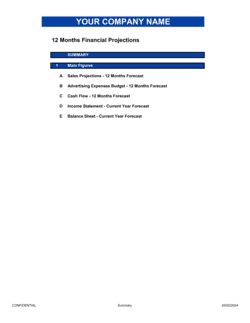
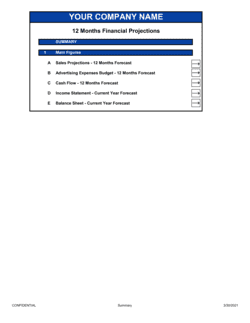
Preparing financial projections for an investor pitchFinancial Projections (12 Months)
Tracking monthly income and expenses against budgetMonthly Financial Report
Setting up an annual operating budget aligned to accounting strategyAnnual Business Budget
Documenting internal financial controls and audit readinessInternal Audit Report
Presenting financial results to a board or investorsFinancial Report

Common mistakes to avoid

❌ Mixing cash-basis and accrual methods within the same period

Why it matters: Inconsistent application produces financial statements that are neither GAAP-compliant nor internally coherent, making them unusable for loan applications, investor diligence, or tax filing.

Fix: Choose one primary method for the entity and apply it uniformly. If a transition is needed, document the change, the effective date, and the cumulative adjustment in the strategy document.

❌ Treating the strategy document as a one-time deliverable

Why it matters: Accounting strategies must be reviewed when the business model changes, when new standards take effect, or when revenue thresholds trigger new reporting requirements β€” an outdated document creates compliance gaps.

Fix: Schedule an annual review of the document tied to fiscal year-end, and assign a named owner responsible for updating it when material changes occur.

❌ Omitting the rationale for rejected alternatives

Why it matters: Without documented reasoning, auditors and future finance team members cannot understand why a particular method was chosen, making it harder to defend policy decisions under scrutiny.

Fix: For each strategy section, add one sentence explaining why the primary alternative was not selected β€” e.g., 'LIFO was rejected because the company reports under IFRS, which prohibits its use.'

❌ Writing controls that do not reflect actual practice

Why it matters: Auditors test operating effectiveness, not just design. A reconciliation control that says it runs weekly but actually runs monthly will generate a finding and cast doubt on the integrity of all reported figures.

Fix: Before finalizing the internal controls section, confirm with the team members who perform each control that the documented frequency and process matches what they actually do.

The 9 key sections, explained

Objectives and Scope

Revenue Recognition Strategies

Inventory Valuation Methods

Depreciation and Amortization Approaches

Expense Classification and Allocation

Tax Accounting Strategy

Financial Reporting Cadence and Format

Internal Controls and Segregation of Duties

Strategy Selection Rationale and Recommendations

How to fill it out

  1. 1

    Define the entity and applicable accounting standard

    Enter your company's legal name, entity type, fiscal year end, and the accounting standard (US GAAP, IFRS, or cash-basis) that governs your financial reporting obligations.

    πŸ’‘ If you are unsure whether GAAP or IFRS applies, check your lender covenants or investor agreements β€” they often specify the required standard explicitly.

  2. 2

    Document your revenue recognition approach

    Identify your primary contract types and map each to either point-in-time or over-time recognition under ASC 606 or IFRS 15. For subscription or multi-deliverable contracts, specify the performance obligations and how standalone selling prices are determined.

    πŸ’‘ If your contracts have variable consideration β€” discounts, refunds, or volume rebates β€” document your estimation method here to avoid restatements later.

  3. 3

    Select and justify your inventory valuation method

    Choose FIFO, weighted average cost, or specific identification based on your inventory type and cost trend. Run a side-by-side COGS comparison under each method using recent inventory data to quantify the financial impact.

    πŸ’‘ LIFO is only available under US GAAP and is prohibited under IFRS β€” confirm your framework before selecting it.

  4. 4

    Set depreciation schedules by asset class

    List each major asset class (equipment, vehicles, leasehold improvements, software), assign a useful life based on actual usage patterns, and select a depreciation method for each class.

    πŸ’‘ Align your book depreciation schedule with IRS asset class guidelines where possible β€” it reduces the number of temporary differences you need to track.

  5. 5

    Define expense classification rules

    Draw a clear line between COGS and operating expenses for your business model, and document the allocation basis for shared overhead costs across departments or product lines.

    πŸ’‘ Write this section as a decision tree β€” 'If the expense is directly tied to producing a unit or delivering a service, classify as COGS; otherwise, classify as operating expense' β€” so any team member can apply it consistently.

  6. 6

    Document tax elections and deferred tax treatment

    List any tax elections you intend to make for the current year (e.g., Section 179, bonus depreciation, QBI deduction) and describe how deferred tax assets and liabilities will be tracked.

    πŸ’‘ Review this section with your CPA before finalizing β€” some elections must be made on the return and cannot be changed retroactively.

  7. 7

    Set the reporting cadence and assign ownership

    Specify the frequency of each financial report, the deadline for completion, the reviewer, and the distribution list. Assign a named individual β€” not just a role title β€” as owner of each reporting deliverable.

    πŸ’‘ Build a simple reporting calendar as an appendix: one row per report type, with columns for frequency, owner, due date, and recipient.

  8. 8

    Review strategy selection against business objectives

    Step back and confirm the combined set of strategies is internally consistent β€” for example, that your depreciation method aligns with your tax election, and your revenue recognition approach matches how you invoice clients.

    πŸ’‘ Have your CPA or auditor review the completed document before it becomes policy β€” catching a methodological conflict at the draft stage is far cheaper than correcting restated financials.

Frequently asked questions

What is a financial accounting strategies document?

A financial accounting strategies document is a written policy reference that outlines the accounting methods a business evaluates or adopts for revenue recognition, inventory valuation, depreciation, expense classification, and financial reporting. It serves as both an internal decision guide and a record of the rationale behind each policy choice, supporting consistency across reporting periods and transparency with auditors, lenders, and investors.

Who should prepare this document?

The CFO, controller, or head of finance typically owns the document, often in collaboration with an external CPA or auditor. For small businesses without a dedicated finance function, the owner or bookkeeper can complete it using a template, then have a CPA validate the strategy choices before they are adopted. The document should be reviewed by anyone responsible for preparing or approving financial statements.

What is the difference between cash-basis and accrual accounting?

Cash-basis accounting records transactions when cash changes hands β€” revenue when received, expenses when paid. Accrual accounting records revenue when earned and expenses when incurred, regardless of cash timing. Most businesses above $27 million in average annual gross receipts are required to use accrual accounting under US tax rules. Accrual provides a more accurate picture of financial performance but requires more sophisticated bookkeeping.

When should a business switch from cash-basis to accrual accounting?

A switch is typically prompted by crossing the IRS gross-receipts threshold, by a lender or investor requiring GAAP-compliant financials, or by the complexity of the business outgrowing simple cash tracking. The transition requires a one-time adjustment to recognize all outstanding receivables, payables, and deferred items as of the conversion date. Document the conversion methodology in your accounting strategies document before filing.

Does this document replace an accounting policy manual?

No β€” this document outlines and evaluates the possible strategies available to your business, while an accounting policy manual is the definitive reference that codifies the chosen methods in operational detail. Think of this document as the decision-making worksheet that precedes and informs the policy manual. Small businesses often use this document alone; larger organizations use it to draft the formal manual.

How does revenue recognition strategy affect financial reporting?

The timing of revenue recognition directly determines which period revenue appears in, affecting gross margin, net income, and key ratios like revenue growth rate and deferred revenue balance. Under ASC 606, companies must identify each performance obligation in a contract and recognize revenue only when that obligation is satisfied. Choosing the wrong recognition pattern overstates or understates income and can trigger audit adjustments or restatements.

Which depreciation method is best for a small business?

Straight-line depreciation is the most straightforward and is appropriate for most small businesses β€” it spreads the cost evenly and is easy to audit. Businesses with significant capital expenditures may prefer accelerated methods (double-declining balance or Section 179 expensing) to reduce taxable income in early years. The best choice depends on your tax position, cash flow needs, and the actual usage pattern of each asset.

How often should accounting strategies be reviewed?

At a minimum, review the document annually at fiscal year-end. Additional reviews are warranted when the business model changes materially, when new accounting standards take effect (such as a new ASC or IFRS standard), when the company crosses a revenue or entity-size threshold, or when preparing for a first audit or capital raise.

Can this document be used to satisfy auditor requests for accounting policies?

Yes, with caveats. Auditors typically request a written summary of significant accounting policies as part of fieldwork. This document provides that foundation, but auditors will also test whether the documented policies match actual practice. Ensure the document is current, complete, and consistent with the books before sharing it with an audit team.

How this compares to alternatives

vs Accounting Policy Manual

An accounting policy manual is the definitive, fully codified reference for all accounting procedures in an organization. A financial accounting strategies document evaluates and selects from available options before those choices are encoded in the manual. Use this document first to make decisions, then formalize them in the policy manual.

vs Financial Report

A financial report presents historical results β€” income, expenses, balance sheet, and cash flow for a completed period. A financial accounting strategies document is forward-looking and prescriptive β€” it defines how those results will be measured and recorded. Both are necessary; they serve fundamentally different purposes.

vs Financial Projections (12 Months)

Financial projections are forward-looking estimates of revenue and expenses based on assumptions. An accounting strategies document defines the measurement rules those projections and actuals will follow. Without a documented accounting strategy, projections and actuals may be calculated on inconsistent bases, making variance analysis meaningless.

vs Internal Audit Report

An internal audit report evaluates whether existing controls and processes are functioning as designed. A financial accounting strategies document defines the policies those controls are meant to uphold. The audit report looks backward at execution; the strategies document looks forward at design.

Industry-specific considerations

SaaS / Technology

Revenue recognition under ASC 606 is particularly complex for SaaS businesses with multi-element arrangements, usage-based pricing, and contract modifications requiring careful allocation of transaction price to each performance obligation.

Manufacturing

Inventory valuation method choice (FIFO vs. weighted average) has a significant impact on COGS and gross margin in manufacturing, especially in periods of volatile raw material costs.

Professional Services

Percentage-of-completion revenue recognition and WIP (work-in-progress) accounting are central strategy decisions for firms billing on long-term project or retainer contracts.

Retail / E-commerce

Returns and refund reserves, loyalty point liability recognition, and gift card breakage income are accounting strategy decisions unique to retail that must be documented and consistently applied.

Template vs pro β€” what fits your needs?

PathBest forCostTime
Use the templateSmall businesses and startups formalizing accounting policies for the first time or preparing for a first auditFree3–6 hours
Template + professional reviewGrowing companies with multi-element contracts, inventory, or significant fixed assets who need CPA validation of strategy choices$300–$800 for a CPA review session1–3 days
Custom draftedMid-market companies preparing for a first GAAP audit, raising institutional capital, or transitioning between accounting standards$1,500–$5,000+ for a full accounting policy engagement2–4 weeks

Glossary

Cash-Basis Accounting
An accounting method that records revenue when cash is received and expenses when cash is paid, regardless of when the transaction was earned or incurred.
Accrual Accounting
An accounting method that records revenue when earned and expenses when incurred, irrespective of when cash changes hands.
Revenue Recognition
The principle governing when and how revenue is recorded in the financial statements β€” in the US, governed by ASC 606.
COGS (Cost of Goods Sold)
The direct costs attributable to producing goods or delivering services sold during a reporting period.
FIFO / LIFO
Inventory valuation methods: First-In First-Out assumes oldest inventory is sold first; Last-In First-Out assumes newest inventory is sold first.
Straight-Line Depreciation
A depreciation method that spreads the cost of a fixed asset evenly over its useful life.
Accelerated Depreciation
A depreciation method that writes off asset value faster in earlier years, reducing taxable income in the short term.
Chart of Accounts
A structured list of all financial accounts used by a business to categorize transactions in the general ledger.
Matching Principle
An accounting rule requiring expenses to be recorded in the same period as the revenue they helped generate.
Working Capital
Current assets minus current liabilities β€” a measure of a business's short-term liquidity and operational efficiency.
Deferred Revenue
Cash received for goods or services not yet delivered, recorded as a liability until the obligation is fulfilled.

Part of your Business Operating System

This document is one of 3,000+ business & legal templates included in Business in a Box.

  • Fill-in-the-blanks β€” ready in minutes
  • 100% customizable Word document
  • Compatible with all office suites
  • Export to PDF and share electronically

Create your document in 3 simple steps.

From template to signed document β€” all inside one Business Operating System.
1
Download or open template

Access over 3,000+ business and legal templates for any business task, project or initiative.

2
Edit and fill in the blanks with AI

Customize your ready-made business document template and save it in the cloud.

3
Save, Share, Send, Sign

Share your files and folders with your team. Create a space of seamless collaboration.

Save time, save money, and create top-quality documents.

β˜…β˜…β˜…β˜…β˜…

"Fantastic value! I'm not sure how I'd do without it. It's worth its weight in gold and paid back for itself many times."

Managing Director Β· Mall Farm
Robert Whalley
Managing Director, Mall Farm Proprietary Limited
β˜…β˜…β˜…β˜…β˜…

"I have been using Business in a Box for years. It has been the most useful source of templates I have encountered. I recommend it to anyone."

Business Owner Β· 4+ years
Dr Michael John Freestone
Business Owner
β˜…β˜…β˜…β˜…β˜…

"It has been a life saver so many times I have lost count. Business in a Box has saved me so much time and as you know, time is money."

Owner Β· Upstate Web
David G. Moore Jr.
Owner, Upstate Web

Run your business with a system β€” not scattered tools

Stop downloading documents. Start operating with clarity. Business in a Box gives you the Business Operating System used by over 250,000 companies worldwide to structure, run, and grow their business.

Free Forever PlanΒ Β·Β No credit card required