Planning An Effective Annual Meeting Template

Free to read β€’ Save or share with one click

FreePlanning An Effective Annual Meeting Template

At a glance

What it is
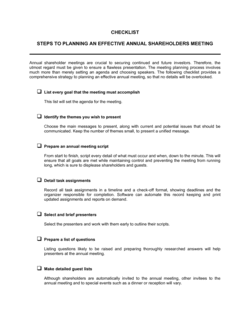
A Planning An Effective Annual Meeting document is a legally structured template that guides corporations, LLCs, and nonprofits through every procedural and compliance requirement of a formal annual meeting β€” from advance notice and quorum rules to resolutions, voting procedures, and recorded minutes. This free Word download gives you a fillable, editable framework you can adapt to your entity type and jurisdiction, then export as PDF for distribution to directors, shareholders, or members.
When you need it
Use it whenever your entity is required by statute, bylaws, or operating agreement to hold an annual general meeting β€” typically once per fiscal year β€” or when a court, regulator, auditor, or lender requests evidence that proper governance procedures were followed. It is also essential when onboarding new directors, approving financial statements, electing officers, or ratifying major decisions made during the year.
What's inside
Meeting notice and delivery requirements, quorum and attendance rules, agenda with standing and special business items, election of directors and officers, financial statement review and approval, shareholder or member resolutions, voting procedures and proxies, and a formal minutes template for recording all decisions taken.

What is a Planning An Effective Annual Meeting Document?

A Planning An Effective Annual Meeting document is a structured governance template that walks corporations, LLCs, and nonprofits through every procedural step required to convene a legally compliant annual meeting β€” from setting the record date and drafting the advance notice to confirming quorum, running the agenda, recording resolutions, and certifying the minutes. Unlike a simple meeting agenda, this template encompasses the full compliance lifecycle: statutory notice requirements, proxy voting procedures, vote recording standards, and the post-meeting documentation that protects directors and satisfies auditors. It is available as a free Word download, editable online and exportable as PDF for distribution to boards, shareholders, and members.

Why You Need This Document

Failing to hold a properly documented annual meeting β€” or holding one without following statutory procedure β€” exposes your entity and its directors to real consequences: resolutions that are challenged and voided, directors who lack legal authority to act because their election was procedurally defective, lenders who put financing on hold pending a clean governance audit, and regulators who treat the absence of meeting records as evidence of broader compliance failures. In due diligence for acquisitions and investment rounds, the minute book is among the first documents reviewed, and gaps in the annual meeting record are among the most common deal-delaying findings. This template eliminates those gaps by giving you a jurisdiction-aware, step-by-step framework that covers every mandatory element β€” so your annual meeting generates a minute book record that stands up to scrutiny long after the meeting adjourns.

Which variant fits your situation?

If your situation is…Use this template
For-profit corporation holding a standard shareholder meetingCorporate Annual Meeting Minutes
LLC holding a required annual member meetingLLC Annual Meeting Minutes
Nonprofit holding its annual membership meetingNonprofit Annual Meeting Minutes
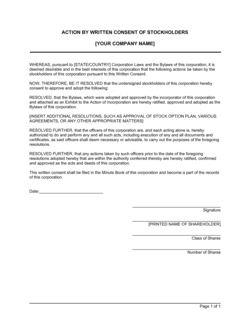
Board needing to take action without a physical meetingWritten Consent in Lieu of Meeting
Organizing a special or emergency meeting outside the annual cycleSpecial Meeting Notice and Agenda
Sending advance meeting notice to shareholders or membersAnnual Meeting Notice Letter
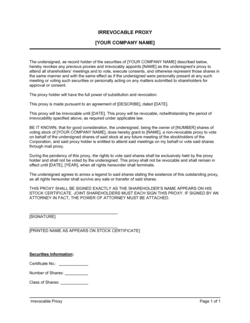
Authorizing a shareholder to vote by proxyProxy Form

Common mistakes to avoid

❌ Defective or late meeting notice

Why it matters: A notice sent outside the required window, missing required information, or delivered by an unauthorized method can render every resolution passed at the meeting void β€” including director elections and financial approvals.

Fix: Map the statutory notice window for your jurisdiction before scheduling the meeting, send notice by all authorized methods, and retain delivery proof in the corporate minute book.

❌ Proceeding without confirmed quorum

Why it matters: Any vote taken without a legally constituted quorum is invalid. Resolutions passed without quorum β€” including director elections β€” have no legal force and may expose directors to personal liability for acting on them.

Fix: Designate a scrutineer to tally in-person attendees and submitted proxies before the chair calls the meeting to order, and formally adjourn if quorum is not met.

❌ Omitting required agenda items

Why it matters: Most corporate statutes require specific items β€” approval of financial statements, election of directors, appointment of auditors β€” at every annual meeting. Skipping them leaves the entity non-compliant even if a meeting was held.

Fix: Build a statutory checklist for your jurisdiction into the agenda template and verify each item is addressed before adjourning.

❌ Recording resolutions without vote counts

Why it matters: Recording only 'resolved unanimously' is insufficient for special resolutions requiring a supermajority threshold β€” and impossible to audit during due diligence, investor review, or litigation.

Fix: Record votes for, against, and abstaining for every resolution, along with the threshold required (majority or supermajority) and the total shares or members represented.

❌ Leaving minutes unsigned or undated

Why it matters: Draft minutes that were never signed carry no legal weight. Courts, auditors, and lenders treat unsigned minutes as no minutes at all β€” exposing directors to claims that governance obligations were never met.

Fix: Establish a firm 30-day deadline from the meeting date for the chair and secretary to review, finalize, and sign the minutes, and file them in the corporate minute book immediately.

❌ Using a generic template that does not match the entity type or jurisdiction

Why it matters: Notice periods, quorum thresholds, voting majorities, and mandatory agenda items differ materially between states, provinces, countries, and entity types. A template drafted for a Delaware corporation will have procedural gaps when used for an Ontario nonprofit.

Fix: Confirm the governing statute and bylaws before completing the template, and customize every procedural field β€” notice period, quorum, voting threshold β€” to match your specific entity and location.

The 10 key clauses, explained

Meeting notice and delivery

In plain language: States how far in advance written notice must be sent, who is entitled to receive it, what the notice must contain, and which delivery methods are legally sufficient.

Sample language
Notice of the Annual Meeting of [SHAREHOLDERS / MEMBERS] of [ENTITY NAME] shall be provided not less than [10 / 21 / OTHER] days and not more than [60] days before the meeting date, delivered by [mail / email / hand delivery] to each [shareholder / member] of record as of the Record Date of [DATE].

Common mistake: Using a notice period shorter than the statutory minimum for the governing jurisdiction. In many states and provinces, a notice defect can invalidate all resolutions passed at the meeting.

Record date

In plain language: Identifies the specific date used to determine which shareholders or members are entitled to notice and voting rights, preventing post-notice transfers from diluting the result.

Sample language
The Board of Directors has fixed [DATE] as the Record Date for determining [shareholders / members] entitled to receive notice of and to vote at the Annual Meeting. Only holders of record as of the close of business on the Record Date shall be entitled to vote.

Common mistake: Setting the record date too close to the meeting date, leaving insufficient time for notice delivery to all entitled parties, which can trigger procedural challenges.

Quorum requirement

In plain language: Specifies the minimum attendance threshold β€” by share count or head count β€” required before the meeting can legally transact business.

Sample language
A quorum shall consist of [holders of at least a majority of the issued and outstanding shares / at least [X] members] entitled to vote, present in person or represented by proxy. If a quorum is not present, the meeting shall be adjourned to [DATE / TIME / PLACE].

Common mistake: Failing to adjourn formally when quorum is not met and proceeding to take votes anyway β€” resolutions passed without quorum are generally void.

Agenda and order of business

In plain language: Lists the formal items of business to be considered, in the order they will be addressed, including both standing items required by statute and any special business.

Sample language
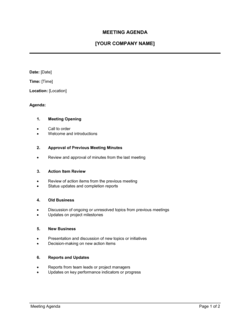
The order of business shall be: (1) Call to order; (2) Proof of notice; (3) Confirmation of quorum; (4) Approval of prior meeting minutes; (5) Presentation of financial statements for the year ended [DATE]; (6) Election of directors; (7) Appointment of auditors; (8) Special business β€” [DESCRIBE]; (9) Adjournment.

Common mistake: Omitting required statutory agenda items β€” such as auditor appointment or financial statement approval β€” leaving the entity non-compliant even though a meeting was held.

Election of directors and officers

In plain language: Sets out the procedure for nominating, voting on, and confirming the election of directors to the board and officers to executive roles for the upcoming term.

Sample language
The following individuals are nominated for election as directors of [ENTITY NAME] to serve until the next Annual Meeting: [NAME], [NAME], [NAME]. A vote of [majority / plurality] of shares present and entitled to vote shall elect each nominee. Elected directors are: [LIST]. The Board shall thereafter appoint officers.

Common mistake: Not recording the vote count β€” or noting only 'unanimously elected' without documenting the method of voting and whether any shares were withheld. Lenders and acquirers routinely request this detail during due diligence.

Financial statements and auditor approval

In plain language: Documents the formal presentation of the entity's annual financial statements and the shareholder or member vote to approve them and ratify or appoint the auditor.

Sample language
The audited financial statements of [ENTITY NAME] for the fiscal year ended [DATE], including the balance sheet, income statement, and cash flow statement, were presented by [NAME / AUDITOR FIRM]. Resolved, that the financial statements are approved as presented and that [AUDITOR FIRM] is appointed as auditor for the fiscal year ending [DATE].

Common mistake: Approving financial statements at the meeting without confirming that copies were distributed to all entitled shareholders in advance β€” in most jurisdictions, this is a statutory requirement.

Shareholder and member resolutions

In plain language: Records each formal resolution proposed at the meeting, the mover and seconder, the vote outcome, and whether it passed as an ordinary or special resolution.

Sample language
Resolved, as an [ordinary / special] resolution, that [TEXT OF RESOLUTION]. Moved by: [NAME]. Seconded by: [NAME]. Votes in favour: [X] ([X]%). Votes against: [X] ([X]%). Abstentions: [X]. Resolution [PASSED / DEFEATED].

Common mistake: Recording resolutions as passed without noting the vote threshold required or the actual vote count β€” making it impossible to verify afterward whether a special resolution threshold was actually met.

Proxy voting procedure

In plain language: Describes how shareholders or members who cannot attend in person may authorize a proxy to vote on their behalf, including the form required and the deadline for submission.

Sample language
Any [shareholder / member] entitled to vote may appoint a proxy by completing the enclosed Proxy Form and delivering it to [ENTITY NAME] at [ADDRESS / EMAIL] no later than [48 hours] before the commencement of the meeting. A proxy need not be a [shareholder / member] of [ENTITY NAME].

Common mistake: Setting a proxy submission deadline so late that the entity cannot tabulate proxies before the meeting opens, creating last-minute disputes about vote counts.

Meeting minutes and certification

In plain language: Establishes the obligation to prepare accurate minutes of the meeting, who is responsible for drafting and signing them, and where they must be kept.

Sample language
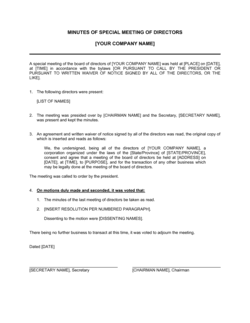
The Secretary shall prepare minutes of the Annual Meeting recording all business conducted, resolutions passed, and votes cast. The minutes shall be certified by the [Chair / Secretary], filed in the corporate minute book within [30] days of the meeting, and available for inspection by any [shareholder / member] on request.

Common mistake: Treating minutes as optional or leaving them unsigned for months. Unsigned draft minutes have no legal force, and gaps in the minute book expose directors to personal liability claims.

Adjournment

In plain language: Documents the formal close of the meeting, the time it was adjourned, and who moved and seconded the adjournment β€” completing the procedural record.

Sample language
There being no further business, a motion to adjourn was moved by [NAME] and seconded by [NAME]. The meeting was adjourned at [TIME] on [DATE]. Certified as a true and accurate record: [CHAIR SIGNATURE] / [SECRETARY SIGNATURE].

Common mistake: Failing to formally adjourn and sign off the minutes β€” leaving the meeting legally open, which can complicate subsequent decisions made between annual cycles.

How to fill it out

  1. 1

    Confirm statutory and bylaw requirements for your jurisdiction

    Before completing any field, identify the governing statute for your entity type and location β€” state corporation act, provincial business corporations act, or nonprofit statute β€” and confirm the required notice period, quorum threshold, and mandatory agenda items.

    πŸ’‘ Check your bylaws or operating agreement first; they may impose stricter requirements than the applicable statute, and the stricter rule controls.

  2. 2

    Set the record date and generate the shareholder or member list

    Fix the record date at least 10–40 days before the meeting (the window varies by jurisdiction), then pull the official list of shareholders or members of record as of that date. This list determines who receives notice and who may vote.

    πŸ’‘ For corporations with multiple share classes, note which classes carry voting rights β€” not all shares vote on all matters.

  3. 3

    Draft and deliver the meeting notice

    Complete the notice section with the meeting date, time, format (in-person, virtual, or hybrid), and location or video-conference link. Attach a draft agenda and proxy form where required by statute or bylaws. Send by the required delivery method within the statutory window.

    πŸ’‘ Keep proof of delivery β€” email read receipts, courier tracking, or a certificate of mailing β€” in the corporate records in case notice is later challenged.

  4. 4

    Prepare the agenda with all required items

    List every standing business item required by statute (financial statement approval, director election, auditor appointment) before any special business. Reserve special resolutions for items you know will require a supermajority vote and flag them in the notice.

    πŸ’‘ Items not listed in the notice generally cannot be voted on at the meeting β€” add anything you anticipate needing approval for, even if only 'any other business' is a placeholder.

  5. 5

    Confirm quorum at call to order

    When opening the meeting, tally shares or members represented in person and by proxy. Record the total against the quorum threshold before any business is conducted. If quorum is not met, formally adjourn to a specified date and do not proceed.

    πŸ’‘ Designate a scrutineer or vote counter before the meeting opens so quorum and vote tabulations are handled by someone other than the chair.

  6. 6

    Record each resolution with vote counts

    For every motion, record the text of the resolution, who moved and seconded it, the votes for, against, and abstaining, and whether it passed as an ordinary or special resolution. Do not summarize or paraphrase β€” use the exact resolution text.

    πŸ’‘ Pre-draft resolution text before the meeting rather than composing it at the table β€” errors in live resolution language create amendment complications later.

  7. 7

    Sign and certify the minutes

    Have the chair and secretary sign the final minutes within 30 days of the meeting. File the signed original in the corporate minute book and distribute copies to directors.

    πŸ’‘ If a director or member requests to review the minutes before signing, set a specific deadline for comments β€” unclosed review loops are the most common reason minutes sit unsigned for years.

  8. 8

    File any required post-meeting corporate documents

    Depending on jurisdiction and entity type, certain post-meeting filings may be required β€” updated director registers, annual returns, or notice of change filings. Complete these within the statutory deadline.

    πŸ’‘ Calendar the filing deadline the day you adjourn the meeting β€” late filings attract penalties and can affect the entity's good standing with lenders and regulators.

Frequently asked questions

What is an annual meeting in a business context?

An annual meeting is a formally convened gathering β€” required by statute, bylaws, or operating agreement β€” at which a corporation's shareholders, an LLC's members, or a nonprofit's membership reviews the prior year's operations and finances, elects directors or officers, and passes resolutions authorizing ongoing and upcoming business. It creates the documented governance record that regulators, lenders, and investors rely on to verify that the entity is properly managed.

Is an annual meeting legally required?

In most jurisdictions, yes β€” for corporations. Most US state corporation statutes, Canadian provincial business corporations acts, and the UK Companies Act require an annual general meeting unless the entity has made a valid election to dispense with meetings (available in some jurisdictions for private companies). LLCs and nonprofits are subject to their operating agreements or governing statutes, which frequently impose the same requirement. Failing to hold a required annual meeting can result in regulatory penalties, loss of good standing, and director liability.

What must be on the annual meeting agenda?

Statutory minimums typically include approval of prior year financial statements, election of directors or confirmation of the board, and appointment or ratification of the auditor. Bylaws may require additional standing items. Special business β€” amendments to articles, major transactions, or any matter requiring a special resolution β€” must be identified in the advance meeting notice or it generally cannot be voted on at the meeting.

What is a quorum and what happens if it is not met?

A quorum is the minimum number of votes β€” by share count or head count β€” that must be represented at a meeting for it to conduct valid business. If quorum is not present when the meeting is called to order, the only valid action is to formally adjourn the meeting to a later date. Any resolution purportedly passed without quorum is void. Most statutes allow an adjourned meeting to proceed with a reduced quorum if notice of the adjournment is properly given.

Can annual meeting resolutions be passed without a physical meeting?

In most US states, Canadian provinces, and the UK, shareholders or members may pass resolutions by written consent in lieu of a meeting β€” but only if the consent is unanimous (all entitled voters must sign in most jurisdictions). For entities with more than a handful of shareholders or members, obtaining unanimous written consent is often impractical, making a properly convened meeting the more reliable route.

Who is required to sign the annual meeting minutes?

Typically the chair of the meeting and the corporate secretary must sign the minutes to certify them as a true and accurate record of the business conducted. Some bylaws require approval by the full board or a resolution at the subsequent meeting. Until signed, minutes are treated as drafts with no evidentiary force in any governance, regulatory, or legal proceeding.

What is the difference between an ordinary resolution and a special resolution?

An ordinary resolution passes by a simple majority β€” more than 50% of votes cast. A special resolution requires a higher threshold, typically 66β…”% or 75% depending on jurisdiction and bylaws, and is used for significant corporate changes such as amending articles of incorporation, approving a merger, or winding up the company. The notice convening the meeting must specifically identify any item that requires a special resolution, so shareholders know the higher threshold applies.

How far in advance must notice of an annual meeting be sent?

Notice periods vary by jurisdiction and entity type. In the US, most state statutes require between 10 and 60 days' advance notice. In Canada, provincial acts typically require 21 days for public companies and 10 days for private corporations. In the UK, 14 clear days' notice is required for private companies and 21 days for public companies. Bylaws may impose longer minimums β€” always apply whichever is stricter.

Do I need a lawyer to plan and run an annual meeting?

For straightforward private corporations and LLCs with a small number of shareholders and no contentious business on the agenda, a well-prepared template is typically sufficient. Engage a lawyer when the meeting involves a contested director election, a special resolution amending foundational documents, a major transaction requiring shareholder approval, or when any shareholder has indicated they may challenge meeting procedures.

How this compares to alternatives

vs Written Consent in Lieu of Meeting

A written consent allows shareholders or directors to pass resolutions by signature without convening a formal meeting β€” but requires unanimous agreement in most jurisdictions. An annual meeting planning template is appropriate when there are multiple shareholders, a contentious agenda item, or a statutory obligation to actually convene. Written consent works best for simple housekeeping decisions with a small, fully aligned ownership group.

vs Corporate Minutes of Annual Meeting

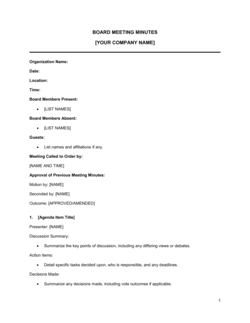
Annual meeting minutes are the official record of what happened at a meeting that has already been held. The planning template is the governance framework used before and during the meeting to ensure compliance β€” covering notice, agenda, quorum, and voting procedure. Both documents are needed: the plan governs the process; the minutes document the outcome.

vs Special Meeting Notice and Agenda

A special meeting is convened outside the annual cycle to address urgent or specific business β€” an emergency financing, a director removal, or an unexpected material transaction. The annual meeting covers the full range of recurring statutory obligations. Use a special meeting when time-sensitive business cannot wait for the next annual cycle.

vs Proxy Form

A proxy form is a discrete instrument by which one shareholder or member authorizes another person to vote on their behalf at a specific meeting. The annual meeting planning template governs the entire meeting process, of which proxy voting is one component. Both documents are typically distributed together with the advance meeting notice.

Industry-specific considerations

Technology / SaaS

Annual meetings triggered by investor rights agreements requiring board elections, stock option plan approvals, and audited financial statement review by venture-backed shareholders.

Professional Services

Partnership or shareholder annual meetings to approve profit distributions, admit new equity partners, and ratify client engagement policies for the coming year.

Retail / E-commerce

Annual shareholder approval of capital expenditure budgets, store expansion plans, and auditor appointments for multi-location retail entities.

Nonprofit / Association

Annual membership meetings to elect board members, approve program budgets, and pass policy resolutions β€” all of which must be recorded to maintain charitable registration and donor confidence.

Jurisdictional notes

United States

Annual meeting requirements are governed by individual state corporation statutes β€” Delaware, California, and New York each have distinct rules on notice periods (typically 10–60 days), quorum (default majority of shares outstanding), and permitted virtual meetings. Many states allow private corporations to dispense with annual meetings entirely by unanimous written consent. The Model Business Corporation Act adopted by most states provides useful defaults, but always check the state of incorporation.

Canada

Federal corporations under the Canada Business Corporations Act and provincial corporations under equivalent acts (e.g., Ontario's OBCA, British Columbia's BCA) must hold an AGM within 15 months of the previous one and no later than 6 months after fiscal year-end. Notice requirements are typically 21 days for distributing corporations. Quebec corporations must comply with the Business Corporations Act (Quebec) and may have French-language documentation obligations. Private corporations can pass resolutions by unanimous written consent in lieu of a meeting.

United Kingdom

Under the Companies Act 2006, private companies are no longer required to hold an AGM unless their articles of association specifically require it. Public companies must hold an AGM within 6 months of their financial year-end. Private companies that choose to hold an AGM must give at least 14 clear days' notice; public companies require 21 days. Members holding 5% or more of voting rights can requisition a general meeting at any time.

European Union

EU member states implement annual general meeting requirements through national company law β€” the EU Shareholder Rights Directive (2007/36/EC, amended 2017) sets minimum standards for listed companies, including a 21-day minimum notice period, the right to add agenda items, and mandatory disclosure of voting results. Requirements for private companies vary significantly by member state. France, Germany, and the Netherlands each impose distinct quorum and voting thresholds. GDPR requirements apply to the collection and processing of shareholder contact and voting data.

Template vs lawyer β€” what fits your deal?

PathBest forCostTime
Use the templatePrivate corporations and LLCs with a small shareholder or member group and no contentious agenda itemsFree2–4 hours to prepare; 1–3 hours to run the meeting
Template + legal reviewEntities with multiple share classes, investor rights agreements, or first-time annual meetings under new bylaws$300–$800 for a lawyer or corporate secretary to review and advise3–5 days
Custom draftedPublic companies, heavily regulated entities, or meetings involving contested elections, special resolutions, or material transactions$1,500–$5,000+ depending on complexity1–3 weeks

Glossary

Annual General Meeting (AGM)
A mandatory yearly gathering of a corporation's or organization's shareholders, members, or directors to review operations, approve financials, and elect leadership.
Quorum
The minimum number or percentage of voting members or shareholders who must be present β€” in person or by proxy β€” for a meeting to conduct valid business.
Proxy
A written authorization allowing one person to vote on behalf of another who cannot attend the meeting in person.
Resolution
A formal decision passed by a vote of shareholders, directors, or members at a meeting, documented in the minutes as a binding corporate act.
Notice Period
The minimum number of days in advance that meeting participants must receive written notification of the date, time, location, and agenda.
Record Date
The cutoff date used to determine which shareholders or members are entitled to receive notice of and vote at the meeting.
Ordinary Resolution
A resolution passed by a simple majority β€” more than 50% β€” of votes cast at a properly constituted meeting.
Special Resolution
A resolution requiring a higher threshold β€” typically 66β…”% or 75% β€” used for significant decisions such as amending articles of incorporation or dissolving the entity.
Minutes
The official written record of the business conducted at a meeting, including attendance, motions proposed, votes taken, and resolutions passed.
Written Consent in Lieu of Meeting
A procedure allowing directors or shareholders to pass resolutions without a physical meeting by signing a written consent document, subject to unanimous agreement in most jurisdictions.
Chair of the Meeting
The individual β€” typically the board chair or president β€” responsible for opening the meeting, managing procedure, recognizing speakers, and calling votes.

Part of your Business Operating System

This document is one of 3,000+ business & legal templates included in Business in a Box.

  • Fill-in-the-blanks β€” ready in minutes
  • Compatible with all office suites
  • Export to PDF and share electronically

Create your document in 3 simple steps.

From template to signed document β€” all inside one Business Operating System.
1
Download or open template

Access over 3,000+ business and legal templates for any business task, project or initiative.

2
Edit and fill in the blanks with AI

Customize your ready-made business document template and save it in the cloud.

3
Save, Share, Send, Sign

Share your files and folders with your team. Create a space of seamless collaboration.

Save time, save money, and create top-quality documents.

β˜…β˜…β˜…β˜…β˜…

"Fantastic value! I'm not sure how I'd do without it. It's worth its weight in gold and paid back for itself many times."

Managing Director Β· Mall Farm
Robert Whalley
Managing Director, Mall Farm Proprietary Limited
β˜…β˜…β˜…β˜…β˜…

"I have been using Business in a Box for years. It has been the most useful source of templates I have encountered. I recommend it to anyone."

Business Owner Β· 4+ years
Dr Michael John Freestone
Business Owner
β˜…β˜…β˜…β˜…β˜…

"It has been a life saver so many times I have lost count. Business in a Box has saved me so much time and as you know, time is money."

Owner Β· Upstate Web
David G. Moore Jr.
Owner, Upstate Web

Run your business with a system β€” not scattered tools

Stop downloading documents. Start operating with clarity. Business in a Box gives you the Business Operating System used by over 250,000 companies worldwide to structure, run, and grow their business.

Start freeΒ Β·Β No credit card required