Action by Written Consent of Shareholders Template

Free Word download β€’ Edit online β€’ Save & share with Drive β€’ Export to PDF

1 pageβ€’20–30 min to fillβ€’Difficulty: Standardβ€’Signature requiredβ€’Legal review recommended
Learn more ↓
FreeAction by Written Consent of Shareholders Template

At a glance

What it is
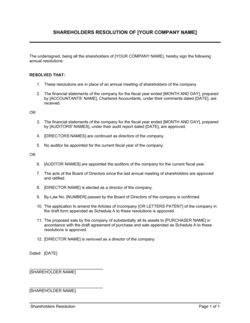
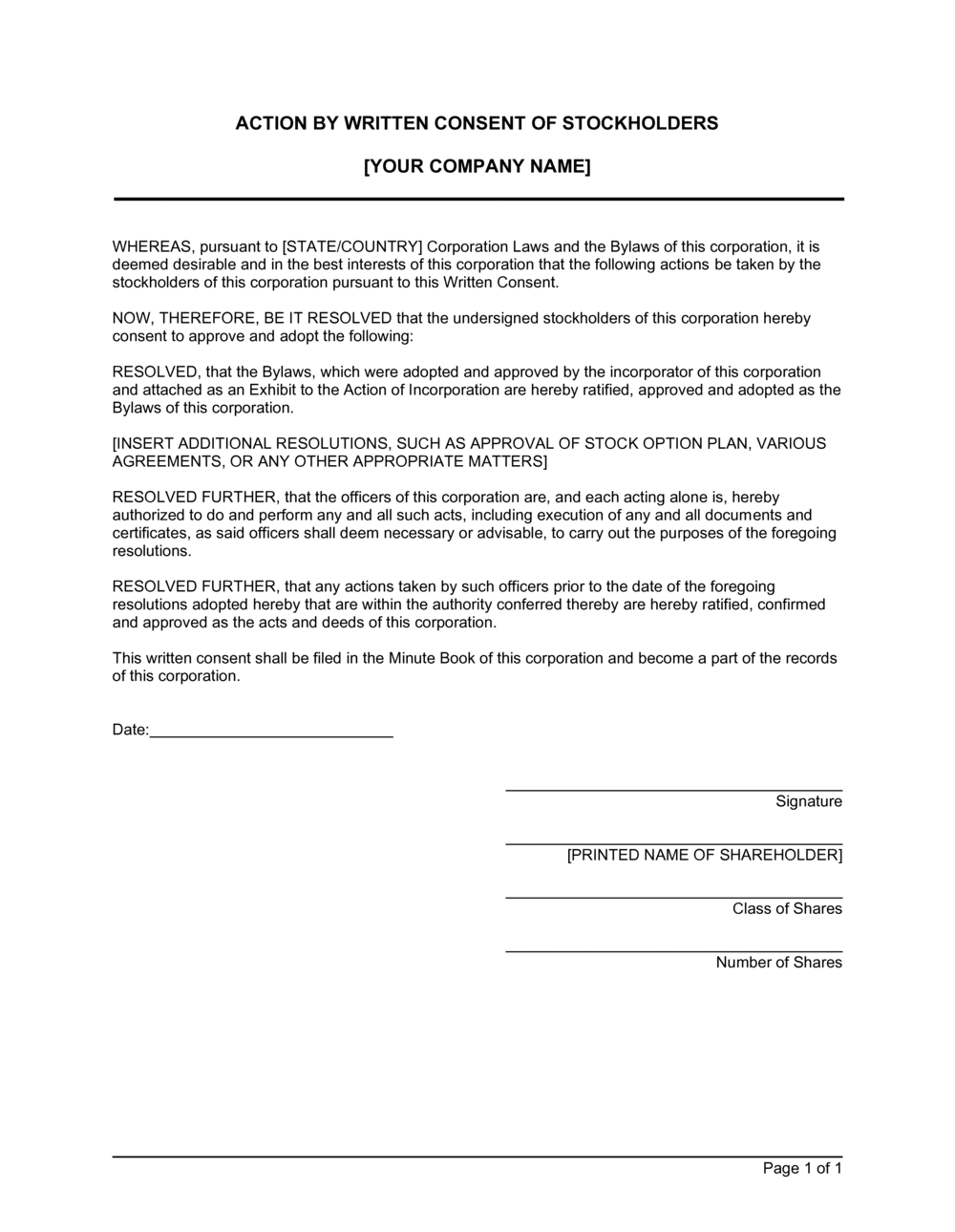
An Action by Written Consent of Shareholders is a legally binding corporate document that allows shareholders to approve resolutions without holding a formal meeting. This free Word download gives you a structured, ready-to-sign template covering the recitals, resolution language, and signature blocks required for the consent to be effective under most state and provincial corporation statutes.
When you need it
Use it whenever shareholders need to approve a corporate action β€” such as electing directors, authorizing a financing round, approving a merger, or ratifying prior board actions β€” and scheduling a formal meeting is impractical or unnecessary. It is especially common in closely held corporations and startups where all shareholders can sign quickly.
What's inside
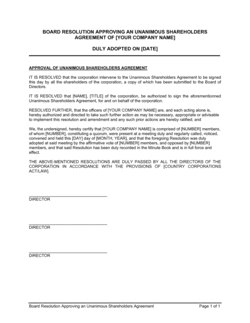
Corporate recitals identifying the company and action being approved, numbered resolution clauses stating exactly what is authorized, a statement of the percentage of shares voting in favor, an effective date, and signature blocks with share-count certifications for each signing shareholder.

What is an Action by Written Consent of Shareholders?

An Action by Written Consent of Shareholders is a binding corporate governance document that allows a corporation's shareholders to approve resolutions β€” electing directors, authorizing equity issuances, approving mergers, or ratifying prior actions β€” without convening a formal meeting. Instead of issuing notice, establishing a quorum, and conducting a vote in person or by proxy, the corporation circulates a written resolution, collects signatures from the required percentage of shareholders, and the action becomes legally effective once the consent threshold is met. In most US states and many other jurisdictions, a properly executed written consent carries the same legal weight as a resolution passed at a duly noticed shareholder meeting.

Why You Need This Document

Without an executed written consent on file, any corporate action that legally requires shareholder approval β€” a new financing round, a charter amendment, a merger, or the election of a new director β€” is technically unauthorized, regardless of how well understood the decision was among the founders or major investors. Investors and acquirers conducting due diligence scrutinize the corporate minute book for precisely this documentation; a missing or defective shareholder consent is one of the most common issues that delays or reprices a transaction. Beyond deal risk, an undocumented shareholder action can expose directors and officers to personal liability for acting without proper authority. This template provides the structure β€” recitals, resolution clauses, consent-threshold statement, and signature blocks with share-count certification β€” needed to create a clean, enforceable record that holds up in diligence, audit, and, if it comes to it, litigation.

Which variant fits your situation?

If your situation is…Use this template
All shareholders are signing and you need unanimous consentUnanimous Written Consent of Shareholders
Board of directors needs to approve actions without a meetingAction by Written Consent of Directors
Approving a specific amendment to the corporate charter or articlesCertificate of Amendment
Electing or removing directors by shareholder vote at a scheduled meetingAnnual Shareholders Meeting Minutes
A special meeting is required for a major transaction and written consent is not permittedSpecial Shareholders Meeting Minutes
LLC members need to approve actions in writing instead of at a meetingAction by Written Consent of LLC Members
Single-member corporation needs to document sole shareholder approvalSole Shareholder Written Consent

Common mistakes to avoid

❌ Using the wrong consent threshold for the action type

Why it matters: Some corporate actions β€” mergers, charter amendments, dissolution β€” require a supermajority (typically two-thirds or two-thirds of each class) rather than a simple majority. Using a simple majority threshold for a supermajority action renders the consent void.

Fix: Check both the applicable corporation statute and your bylaws for the specific action being authorized before stating the required threshold. When in doubt, require unanimity to eliminate any procedural challenge.

❌ Backdating the effective date

Why it matters: Setting an effective date before the last signature is obtained means the consent was technically invalid on the stated date, exposing the corporation and its officers to claims of unauthorized action or, in extreme cases, fraud.

Fix: Use 'the date of the last signature below' as the effective date, or circulate the document with a realistic closing date that allows time for all signatures to be collected.

❌ Failing to provide post-consent notice to non-signing shareholders

Why it matters: In Delaware, California, and most other US states, a majority β€” but not unanimous β€” written consent requires prompt notice to non-consenting shareholders. Skipping this step is a procedural defect that can be raised to invalidate the action.

Fix: Include an explicit notice obligation clause in the template and calendar a reminder to send notice within the statutory deadline β€” typically 10 days after the effective date.

❌ Omitting class-based voting analysis when preferred stock is outstanding

Why it matters: Investors holding preferred stock often have separate class-voting rights that require their affirmative consent for specific actions, regardless of overall majority approval. Ignoring this can result in a consent that appears valid but is legally defective.

Fix: Review the certificate of incorporation and any investor rights agreements before drafting to identify all class-voting triggers, and obtain a separate consent from each required class.

❌ Combining unrelated resolutions into a single RESOLVED clause

Why it matters: If one element of an omnibus resolution is challenged or invalid, courts in many jurisdictions will void the entire clause rather than sever the defective portion β€” undoing all the actions bundled together.

Fix: Draft one RESOLVED clause per discrete action, numbered sequentially. Each clause should stand alone so that a challenge to one does not affect the others.

❌ Not retaining executed originals in the minute book

Why it matters: During due diligence for a financing round, acquisition, or audit, a missing or unsigned written consent creates a gap in the corporate record that can delay or kill a transaction.

Fix: Establish a filing protocol requiring the corporate secretary to confirm all signatures are collected and file the fully executed consent in the minute book within 48 hours of the effective date.

The 9 key clauses, explained

Caption and corporate identification

In plain language: States the full legal name of the corporation, its state or province of incorporation, and the title of the document β€” establishing the legal context for everything that follows.

Sample language
ACTION BY WRITTEN CONSENT OF THE SHAREHOLDERS OF [CORPORATION LEGAL NAME], a [STATE] corporation, in lieu of a special meeting of the shareholders.

Common mistake: Using a trade name or DBA instead of the registered legal entity name. If the entity name doesn't match the certificate of incorporation, the consent can be challenged as identifying the wrong legal person.

Recitals and authority

In plain language: Identifies the statutory or bylaw authority permitting written consent in lieu of a meeting, and sets out the background facts explaining why the action is needed.

Sample language
WHEREAS, pursuant to Section [X] of the [STATE] General Corporation Law and the Corporation's Bylaws, shareholders may take action without a meeting by written consent; and WHEREAS, the Board of Directors has recommended the following action to the shareholders.

Common mistake: Omitting the specific statutory citation. Without it, a court or auditor cannot verify that the written-consent procedure was legally authorized, which can cloud the validity of the action.

Statement of shares entitled to vote

In plain language: Identifies the record date, the total number of outstanding shares entitled to vote, and the breakdown by class β€” confirming the consent threshold calculation is correct.

Sample language
As of [RECORD DATE], the total number of shares of [CORPORATION NAME] outstanding and entitled to vote on the matters set forth herein is [X] shares of Common Stock and [Y] shares of Series [A] Preferred Stock.

Common mistake: Failing to identify each class of voting shares separately. If preferred shareholders have separate class-voting rights on the resolution, omitting the class breakdown can void the consent even if the overall majority threshold is met.

Resolution clauses

In plain language: The operative heart of the document β€” one numbered RESOLVED clause for each specific action approved, drafted in precise, self-contained language.

Sample language
RESOLVED, that the shareholders of the Corporation hereby approve and authorize [SPECIFIC ACTION], in substantially the form attached hereto as Exhibit [A], and authorize any officer of the Corporation to execute and deliver all documents necessary to consummate such action.

Common mistake: Combining multiple unrelated actions into a single RESOLVED clause. If any part of an omnibus resolution is challenged, the entire clause may be voided rather than just the contested portion.

Ratification of prior actions

In plain language: A catch-all resolution that retroactively confirms and approves any related actions already taken by officers or directors before the consent was executed.

Sample language
RESOLVED FURTHER, that all actions taken by the officers and directors of the Corporation in connection with the matters set forth above prior to the date of this Written Consent are hereby ratified, confirmed, and approved in all respects.

Common mistake: Using blanket ratification language without identifying the specific prior actions being ratified. Overly broad ratification clauses can inadvertently shield unauthorized acts from scrutiny.

Consent threshold and effectiveness statement

In plain language: States the number and percentage of shares represented by the signing shareholders, confirms the required threshold is met, and declares the consent effective as of a specific date.

Sample language
The undersigned shareholders, holding [X] shares representing [Y]% of the total outstanding voting shares of the Corporation, which is [sufficient / more than the required majority / unanimous], hereby consent to the foregoing resolutions. This Written Consent shall be effective as of [EFFECTIVE DATE].

Common mistake: Setting the effective date before the last signature date. If any shareholder signs after the stated effective date, the consent may be legally ineffective for the period between the stated date and the final signature.

Filing and notice obligation

In plain language: Addresses the corporation's obligation to notify non-consenting shareholders of the action taken, as required by many corporation statutes after a majority β€” but not unanimous β€” written consent.

Sample language
Prompt notice of the action taken by this Written Consent shall be given to shareholders who did not execute this Consent, in accordance with Section [X] of the [STATE] General Corporation Law, within [10] days after the Effective Date.

Common mistake: Skipping the notice obligation when consent is less than unanimous. Delaware, California, and most other states require post-action notice to non-consenting shareholders β€” failure to provide it can expose the corporation to claims that the action was procedurally defective.

Integration and counterparts clause

In plain language: Confirms that the consent may be signed in counterparts (including electronic signatures) and that all signed copies together constitute one binding document.

Sample language
This Written Consent may be executed in one or more counterparts, each of which shall be deemed an original, and all of which together shall constitute one and the same instrument. Electronic signatures shall be deemed valid.

Common mistake: Omitting electronic signature authorization in the counterparts clause. Without it, some jurisdictions may require wet-ink originals, creating logistical delays when shareholders are geographically dispersed.

Signature blocks with share certification

In plain language: Individual signature blocks for each consenting shareholder that include their name, the number of shares they hold, the class of shares, and the date of signature.

Sample language
Signature: _______________________ | Printed Name: [SHAREHOLDER NAME] | Number of Shares: [X] shares of [Common / Series A Preferred] Stock | Date: [DATE]

Common mistake: Using a single signature page without capturing each shareholder's share count and class. Without this information, it is impossible to verify after the fact that the required consent threshold was actually met.

How to fill it out

  1. 1

    Confirm the statutory authority and bylaw permission

    Check your state or province's corporation statute and your corporate bylaws to verify that written consent in lieu of a meeting is permitted for the specific action you are approving. Some actions β€” particularly charter amendments in certain states β€” require a formal meeting.

    πŸ’‘ Delaware GCL Β§228 permits majority written consent by default; California Corporations Code Β§603 requires unanimous consent unless the articles expressly permit less. Know which rule applies before you draft.

  2. 2

    Set the record date and pull the shareholder register

    Select a record date and obtain the current shareholder register as of that date, including each shareholder's name, address, share count, and class. This list determines who must sign and what consent threshold must be met.

    πŸ’‘ Use the same record date on the consent document and in any notice sent to non-consenting shareholders. Mismatched dates create audit inconsistencies.

  3. 3

    Enter the corporation's legal name and jurisdiction

    Fill in the full registered legal name of the corporation exactly as it appears in the certificate or articles of incorporation, and confirm the state or province of incorporation for the statutory citation.

    πŸ’‘ Cross-check the name against your most recent state filing β€” the corporation's registered name may differ from the operating trade name or website.

  4. 4

    Draft a separate RESOLVED clause for each action

    Write one numbered RESOLVED clause per distinct corporate action being approved. Each clause should be self-contained, identify the specific action with precision, and cross-reference any attached exhibits.

    πŸ’‘ Avoid using defined terms in the resolution that are defined only in an attached agreement β€” the resolution should be readable as a standalone document.

  5. 5

    Calculate and state the consent threshold

    Add up the shares held by all shareholders who will sign and divide by total outstanding shares to confirm the percentage. State this calculation explicitly in the effectiveness clause. Verify separately for each class if class-based voting applies.

    πŸ’‘ Build a simple table listing each shareholder's name, share count, and running cumulative percentage. Attach it as an exhibit if more than five shareholders are signing.

  6. 6

    Set the effective date carefully

    Set the effective date to the date the last required signature is expected or obtained β€” not an earlier aspirational date. For actions that must be effective immediately, use 'the date of the last signature below.'

    πŸ’‘ For financing transactions, confirm with counsel whether the effective date of the written consent must precede the closing date of the transaction. Backdating is legally risky and potentially fraudulent.

  7. 7

    Circulate for signatures and collect with share counts

    Send the signature pages to each shareholder who must sign, either electronically or in hard copy, and confirm each signatory returns the page with their share count filled in. Collect all counterparts before treating the action as authorized.

    πŸ’‘ Use a countersignature checklist tracking who has signed, the date of their signature, and the share count confirmed β€” especially important for rounds with more than three shareholders.

  8. 8

    File the executed consent in the corporate minute book and send notice

    Once all required signatures are collected, date-stamp the final document, add it to the corporate minute book, and β€” if consent was less than unanimous β€” send prompt notice to any non-consenting shareholders within the timeframe required by statute.

    πŸ’‘ Store the executed consent alongside any related board resolutions or transaction agreements so the full authorization chain is traceable in one location.

Frequently asked questions

Do non-consenting shareholders need to be notified?

In most US states, yes. Delaware GCL Β§228(e) requires prompt notice β€” within 10 days of the effective date β€” to any shareholders who did not sign a majority written consent. Notice must describe the action taken. Failure to provide timely notice is a procedural defect that can be raised by non-consenting shareholders in litigation. If the consent is unanimous, no notice obligation arises because there are no non-consenting shareholders.

How this compares to alternatives

vs Action by Written Consent of Directors

A directors' written consent authorizes actions at the board level β€” approving contracts, hiring officers, or authorizing financings β€” while a shareholders' written consent authorizes actions that legally require shareholder approval, such as mergers, charter amendments, or major equity issuances. Many transactions require both documents in sequence: board consent first, then shareholder consent.

vs Annual Shareholders Meeting Minutes

Annual meeting minutes document decisions made at a formally noticed, in-person or virtual meeting with a quorum present. A written consent bypasses the meeting entirely. Meeting minutes are appropriate when an annual meeting is required by statute or bylaws; written consent is faster for interim or out-of-cycle actions when shareholders can be reached quickly.

vs Special Shareholders Meeting Minutes

A special shareholders meeting requires advance notice β€” typically 10 to 60 days β€” and a quorum before any vote. A written consent can be effective within days of circulation once the required signatures are collected. Use special meeting minutes when the action requires a formal meeting by statute, when shareholders are contested, or when proxy solicitation is involved.

vs Shareholders Agreement

A shareholders agreement is a long-form contract that defines ongoing rights and obligations among shareholders β€” transfer restrictions, drag-along, tag-along, voting agreements, and pre-emptive rights. A written consent is a one-time authorization document used to approve a specific action. The two documents interact: the shareholders agreement may specify which actions require written consent and at what threshold.

Industry-specific considerations

Technology / SaaS

Frequently used to authorize new equity rounds, option pool increases, and SAFE note issuances on tight financing timelines without convening a formal shareholder meeting.

Financial Services

Required for regulatory filings, change-of-control approvals, and material amendments to governance documents where regulator deadlines make meeting scheduling impractical.

Real Estate

Used in corporate holding structures to authorize property acquisitions, mortgage refinancings, and entity restructurings that require shareholder-level sign-off.

Professional Services

Closely held professional corporations β€” law firms, accounting firms, medical practices β€” rely on written consents to approve partner buyouts, equity transfers, and shareholder-agreement amendments without disrupting client-service schedules.

Jurisdictional notes

United States

Delaware GCL Β§228 permits majority written consent unless the certificate of incorporation prohibits it β€” making Delaware the most permissive US jurisdiction for shareholder written consents. California Corporations Code Β§603 requires unanimous written consent by default unless the articles expressly authorize less. Most other states follow a majority-consent model similar to Delaware. Federal securities law imposes additional disclosure requirements for written consents by public company shareholders.

Canada

The Canada Business Corporations Act (CBCA) Β§142 permits written resolutions signed by all shareholders entitled to vote, in lieu of a meeting. Most provincial acts β€” including Ontario's OBCA Β§104 β€” follow the same unanimous-consent model. Unlike Delaware, Canada does not generally permit majority written consent; unanimity is the standard, which means all shareholders of record must sign. Quebec corporations governed by the Quebec Business Corporations Act follow the same rule.

United Kingdom

The UK Companies Act 2006 Β§288–296 permits private companies to pass written resolutions signed by the required majority of eligible members β€” an ordinary resolution requires a simple majority; a special resolution requires 75%. Public companies (PLCs) cannot use written resolutions and must hold formal general meetings. The company must circulate the proposed written resolution to all eligible members simultaneously, and members have 28 days to respond before the resolution lapses.

European Union

EU member states vary significantly in their approach to shareholder written consents. Germany and France generally require formal general meetings for shareholder resolutions, though GmbH structures in Germany permit written circular resolutions with unanimous consent. The Netherlands and Luxembourg are more permissive, allowing written resolutions by required majority in private companies. GDPR considerations apply when collecting and storing shareholder signature data electronically across EU jurisdictions.

Template vs lawyer β€” what fits your deal?

PathBest forCostTime
Use the templateClosely held corporations with two to five shareholders approving routine actions like director elections, officer appointments, or minor equity issuancesFree15–30 minutes
Template + legal reviewCorporations with multiple share classes, investor protective provisions, or actions tied to a financing closing or acquisition$300–$7001–2 days
Custom draftedPublic or pre-IPO companies, cross-border transactions, contested shareholder situations, or actions requiring regulatory filings$1,000–$5,000+3–10 business days

Glossary

Written Consent
A signed document through which shareholders approve a corporate resolution without attending a formal meeting, as permitted by most corporation statutes.
Unanimous Written Consent
A written consent signed by every shareholder of record, typically required in jurisdictions or bylaws that do not permit consent by less than all shareholders.
Quorum
The minimum percentage of voting shares that must be present or represented at a meeting for business to be transacted β€” replaced by the required consent threshold in written-consent procedures.
Record Date
The date used to determine which shareholders are entitled to vote or sign a consent, based on who holds shares on that specific calendar date.
Majority Consent Threshold
The percentage of outstanding shares β€” typically a simple majority or supermajority β€” required to make a written consent effective without a meeting.
Recitals
Introductory clauses in a corporate document that identify the company, set out the background facts, and explain why the action is being taken.
Resolution
A formally worded clause within a consent or minutes document that states exactly what action is approved, authorized, or ratified.
Ratification
A resolution that retroactively approves an action already taken, making it as valid as if it had been authorized in advance.
Share Capital
The total number and classes of shares a corporation is authorized to issue, as set out in its articles or certificate of incorporation.
Protective Provisions
Rights held by a class of preferred shareholders β€” typically investors β€” that require their separate consent before the company can take specified major actions.
Minute Book
The official corporate record file containing articles of incorporation, bylaws, share register, board and shareholder resolutions, and related governance documents.

Part of your Business Operating System

This document is one of 3,000+ business & legal templates included in Business in a Box.

  • Fill-in-the-blanks β€” ready in minutes
  • 100% customizable Word document
  • Compatible with all office suites
  • Export to PDF and share electronically

Create your document in 3 simple steps.

From template to signed document β€” all inside one Business Operating System.
1
Download or open template

Access over 3,000+ business and legal templates for any business task, project or initiative.

2
Edit and fill in the blanks with AI

Customize your ready-made business document template and save it in the cloud.

3
Save, Share, Send, Sign

Share your files and folders with your team. Create a space of seamless collaboration.

Save time, save money, and create top-quality documents.

β˜…β˜…β˜…β˜…β˜…

"Fantastic value! I'm not sure how I'd do without it. It's worth its weight in gold and paid back for itself many times."

Managing Director Β· Mall Farm
Robert Whalley
Managing Director, Mall Farm Proprietary Limited
β˜…β˜…β˜…β˜…β˜…

"I have been using Business in a Box for years. It has been the most useful source of templates I have encountered. I recommend it to anyone."

Business Owner Β· 4+ years
Dr Michael John Freestone
Business Owner
β˜…β˜…β˜…β˜…β˜…

"It has been a life saver so many times I have lost count. Business in a Box has saved me so much time and as you know, time is money."

Owner Β· Upstate Web
David G. Moore Jr.
Owner, Upstate Web

Run your business with a system β€” not scattered tools

Stop downloading documents. Start operating with clarity. Business in a Box gives you the Business Operating System used by over 250,000 companies worldwide to structure, run, and grow their business.

Start freeΒ Β·Β No credit card required