Minutes of Meeting Master Template

Free Word download β€’ Edit online β€’ Save & share with Drive β€’ Export to PDF

3 pagesβ€’25–30 min to fillβ€’Difficulty: Standard
Learn more ↓
FreeMinutes of Meeting Master Template

At a glance

What it is
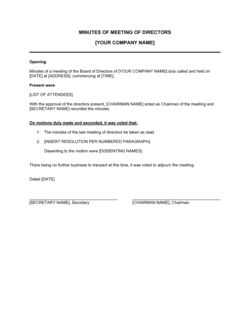
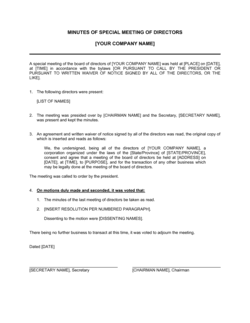
Minutes of Meeting is a structured form used to record what happened during a formal or informal business meeting β€” who attended, what was discussed, what decisions were made, and what actions were assigned. This free Word download gives you a ready-to-use template you can edit online and export as PDF to distribute to participants immediately after the meeting.
When you need it
Use it for any meeting where accountability matters β€” board meetings, committee sessions, project kick-offs, client reviews, or recurring team standups where decisions and action items need a written record.
What's inside
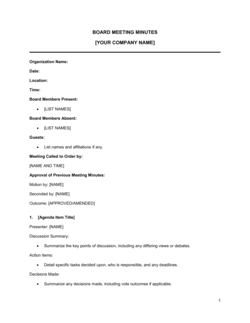
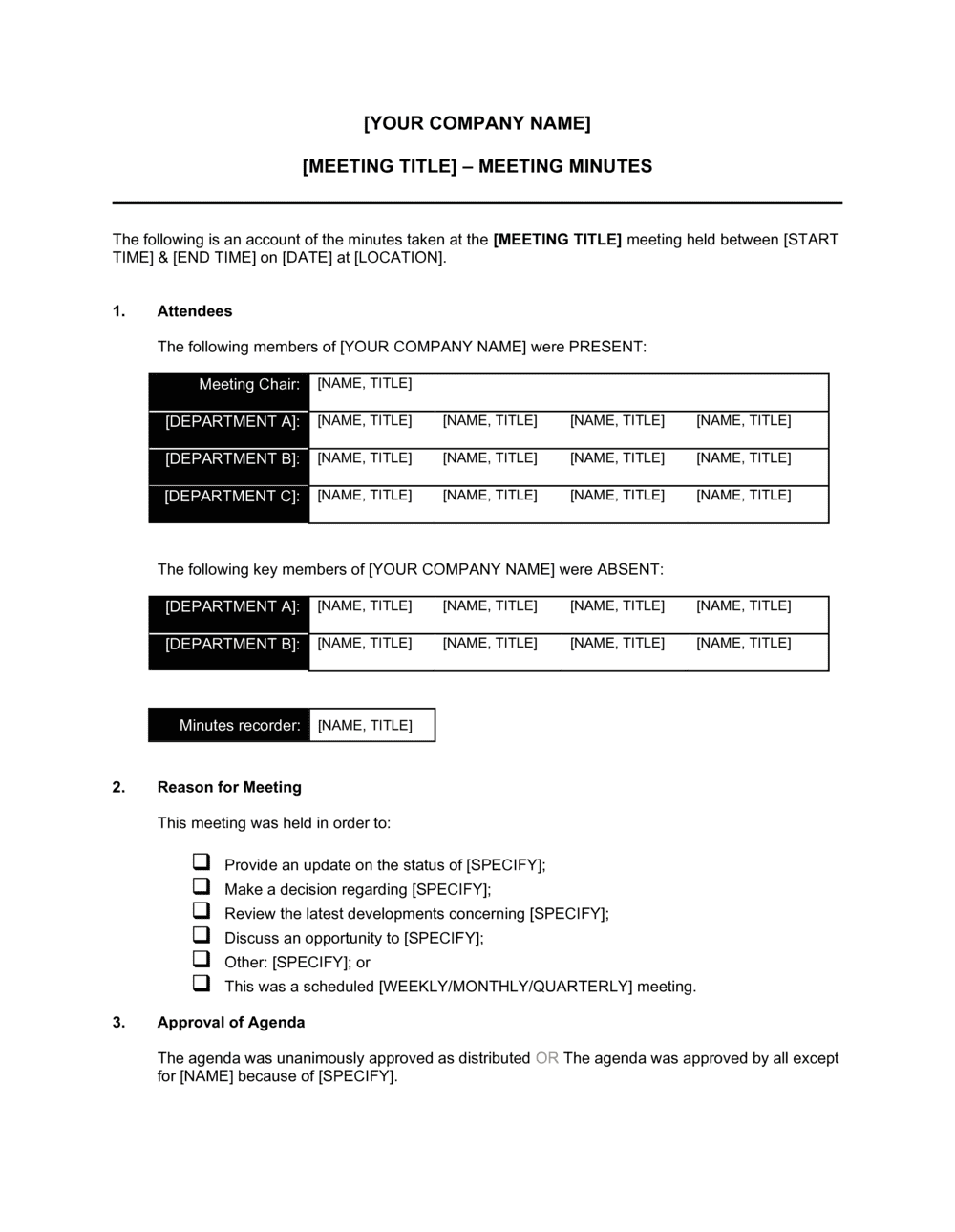
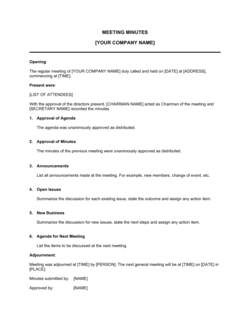
Meeting header details, attendee log, agenda items with discussion summaries, decisions recorded, action items with owners and deadlines, and a next-meeting field to close the record cleanly.

What is a Minutes of Meeting Template?

A Minutes of Meeting form is the official written record of a business meeting β€” capturing who attended, what was discussed under each agenda item, what decisions were made, what votes were recorded, and what tasks were assigned to named individuals with deadlines. It transforms a conversation into an accountable, retrievable document that all participants can reference to confirm what was agreed. From informal project check-ins to formal board sessions, structured minutes replace memory and verbal agreements with a clear, dated record that can withstand scrutiny months or years later.

Why You Need This Document

Without written minutes, decisions made in meetings exist only in the memory of the people who were there β€” and memories diverge quickly. Action items go untracked, scope changes go undocumented, and formal resolutions lack the evidence trail required by corporate statutes, auditors, and funders. For boards and registered entities, failing to maintain minutes is a compliance gap that can invalidate decisions, expose directors to personal liability, and trigger problems during due diligence or regulatory review. Even for operational teams, the absence of a written record means disputes over what was decided must be resolved by credibility rather than documentation. This template gives you a ready-to-use structure that takes under 30 minutes per meeting to complete and creates a defensible record from the moment it is distributed and approved.

Which variant fits your situation?

If your situation is…Use this template
Recording formal resolutions at a board of directors meetingBoard Meeting Minutes
Documenting an annual general meeting for shareholdersAnnual General Meeting Minutes
Logging decisions from a recurring project team standupProject Meeting Minutes
Capturing discussion and votes at a committee sessionCommittee Meeting Minutes
Recording a client kick-off or review meetingClient Meeting Notes
Keeping a quick written record of an informal team check-inInformal Meeting Notes
Documenting a safety or compliance review meetingSafety Meeting Minutes

Common mistakes to avoid

❌ Recording verbatim dialogue

Why it matters: Transcripts are difficult to approve, expose the organization to liability by preserving preliminary opinions as official positions, and obscure the actual decisions made.

Fix: Summarize the outcome and the key reasoning in 2–4 sentences per agenda item. The test is whether a reader who wasn't there can understand what was decided and why.
❌ Assigning actions to a team rather than a named individual

Why it matters: When a task belongs to 'the marketing team' or 'management,' accountability diffuses and the action routinely falls through the cracks by the next meeting.

Fix: Name one person as owner for every action item, even if the underlying work involves multiple people. That person is responsible for coordinating and reporting back.

❌ Distributing approved and draft minutes without distinguishing them

Why it matters: Recipients may rely on a draft as the official record, then find it was amended at the next meeting β€” creating confusion in any later dispute or audit.

Fix: Mark every distributed draft 'DRAFT β€” PENDING APPROVAL' in the header until formally approved. Replace the file with the approved version immediately after the confirming meeting.

❌ Omitting vote counts and abstentions on resolutions

Why it matters: Recording only 'motion carried' without the vote breakdown is insufficient for board governance and makes it impossible to verify whether a required majority was achieved.

Fix: Always record the number of votes for, against, and abstaining. For unanimous decisions, state 'Carried unanimously' rather than leaving the count blank.

The 9 key fields, explained

Meeting header

Attendees and apologies

Chairperson and recorder

Approval of previous minutes

Agenda items and discussion summaries

Decisions and resolutions

Action items

Next meeting details

Signature or confirmation block

How to fill it out

  1. 1

    Complete the meeting header before the meeting starts

    Enter the meeting name, scheduled date, time, and location in advance. Confirm the chair and minute-taker so both know their roles before attendees arrive.

    πŸ’‘ Pre-filling the header and agenda items from the distributed agenda saves 5–10 minutes during the meeting and keeps the recorder focused on discussion rather than formatting.

  2. 2

    Record attendance as people arrive

    Note each attendee's full name and title as they join. Record any proxies and mark apologies from those who notified in advance.

    πŸ’‘ For formal governance meetings, confirm quorum at this step and note it explicitly β€” for example, 'Quorum confirmed: 5 of 7 members present.'

  3. 3

    Log the approval of previous minutes

    Note whether the prior minutes were accepted as written or corrected, and record the names of the mover and seconder.

    πŸ’‘ Keep a copy of the prior approved minutes on hand during the meeting so any disputed wording can be resolved on the spot.

  4. 4

    Summarize each agenda item's discussion

    For each item, write a 2–4 sentence summary of the key points raised, not a transcript. Focus on the reasoning behind decisions, not who said what.

    πŸ’‘ Use shorthand or bullet notes during the meeting, then convert to full sentences within 24 hours while the context is fresh.

  5. 5

    Record every resolution with mover, seconder, and vote

    State the resolution in plain language, name who moved and seconded it, and record the vote count. Mark the outcome clearly as carried or defeated.

    πŸ’‘ Write resolutions in the present tense: 'The board approves...' rather than 'It was agreed that...' β€” the active form is clearer and easier to reference later.

  6. 6

    Capture action items with a named owner and deadline

    For every task that arises, record the exact action, the single person responsible, and a specific due date. Use the action items table so nothing is buried in narrative text.

    πŸ’‘ Read the action items table aloud before closing the meeting to confirm every owner agrees to their task and deadline.

  7. 7

    Distribute the draft and obtain approval

    Send the draft minutes to all attendees within 48 hours, marked clearly as 'DRAFT.' At the next meeting, formally approve or correct them and record the approval date.

    πŸ’‘ Storing approved minutes in a shared folder with a consistent naming convention β€” YYYY-MM-DD_[Meeting Name]_Minutes_Approved β€” makes retrieval straightforward during audits.

Frequently asked questions

What are minutes of a meeting?

Minutes of a meeting are the official written record of what occurred during a formal or informal business meeting. They document who attended, what topics were discussed, what decisions were made, what votes were recorded, and what tasks were assigned. Approved minutes become the authoritative account of the meeting and are retained for governance, legal, and operational reference.

Are meeting minutes legally required?

For corporations, minutes of board meetings and shareholder meetings are typically required by corporate law in the United States, Canada, the UK, and most other jurisdictions. Nonprofits and registered charities face similar requirements for board and committee sessions. For informal team or project meetings, minutes are not legally required but are widely recommended as an operational best practice to track decisions and accountability.

Who is responsible for taking meeting minutes?

In formal governance settings, the corporate secretary or an assigned recorder is responsible. In project or team meetings, the role typically rotates or is assigned to an operations or administrative team member. The chair of the meeting should not take the minutes β€” managing the discussion and capturing it simultaneously produces incomplete records.

What is the difference between meeting minutes and meeting notes?

Meeting minutes are a formal, structured record intended to be reviewed, approved, and retained as the official account of a meeting. Meeting notes are informal summaries β€” often bullet-pointed β€” used for personal reference or quick team communication. Minutes follow a defined format, include formal motions and votes, and require approval at the next meeting. Notes do not carry the same governance weight.

How soon after a meeting should minutes be distributed?

Best practice is to distribute a draft within 24–48 hours of the meeting while the discussion is fresh for all participants. For board and committee meetings, many governance guidelines recommend circulation within 5 business days. Late distribution increases errors, makes attendee corrections harder to gather, and delays action-item follow-up.

How detailed should meeting minutes be?

Minutes should capture what was decided and the key reasoning β€” not a word-for-word transcript. A well-written set of minutes for a one-hour meeting typically runs 1–3 pages. Each agenda item gets a 2–4 sentence summary, every resolution is stated in full, and every action item is recorded with an owner and deadline. More detail is appropriate for contentious decisions where reasoning may need to be defended later.

Do meeting minutes need to be signed?

For formal board and committee meetings, the chair or corporate secretary typically signs the approved minutes as confirmation they are a true record. Many organizations date the approval and add the chair's signature at the meeting where approval is confirmed. Team and project meeting minutes do not typically require signatures, though a named preparer and an approval date should still be recorded.

How long should meeting minutes be kept?

Board and shareholder meeting minutes are permanent corporate records in most jurisdictions and should be retained indefinitely. Committee and governance minutes are typically kept for a minimum of 7 years. Operational team meeting minutes have no universal legal retention requirement, but retaining them for 3–5 years is common practice for audit and dispute resolution purposes.

What should be excluded from meeting minutes?

Exclude verbatim dialogue, personal opinions attributed to named individuals, privileged legal advice discussed in the meeting, and preliminary or exploratory ideas that did not lead to a decision. In camera sessions β€” portions of a meeting held privately β€” are either omitted from general distribution or recorded in a separate restricted document, depending on the organization's governance policy.

How this compares to alternatives

vs Meeting Agenda

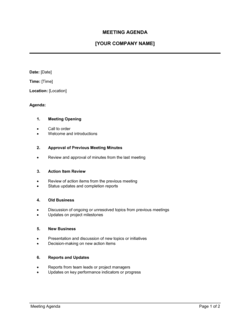
A meeting agenda is a planning document circulated before the meeting that lists topics to be covered in order. Minutes are the record of what actually happened. The agenda structures the meeting; the minutes confirm outcomes. Both should be retained together β€” the agenda as context, the minutes as the authoritative record.

vs Action Item Tracker

An action item tracker is a standalone log maintained between meetings to monitor the status of outstanding tasks. Minutes capture actions at the moment they are assigned. The two documents complement each other: minutes create the action items, and the tracker manages them to completion across multiple meeting cycles.

vs Board Resolution

A board resolution is a standalone formal document recording a single decision made by a board β€” often signed by all directors and filed with the corporate record. Minutes record all business transacted in a meeting, including resolutions. A resolution extracted from minutes and executed as a separate document carries additional formality, which some banks and registries require.

vs Project Status Report

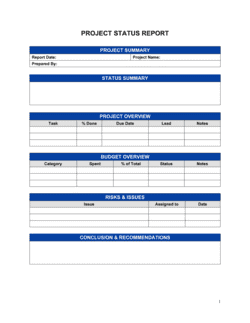
A project status report is a periodic summary of progress, risks, and forecasts prepared for stakeholders who may not attend meetings. Minutes document what was discussed and decided in a specific meeting. Status reports communicate upward; minutes serve as the internal governance record. Both are needed on projects with active steering committees.

Industry-specific considerations

Corporate governance

Board and shareholder meetings require minutes that satisfy corporate statute requirements, record formal resolutions with vote counts, and are retained as permanent corporate records.

Nonprofit and associations

Funders, auditors, and regulators often request board minutes as evidence of governance compliance; minutes must show quorum, conflict-of-interest disclosures, and resolution language.

Professional services

Client steering committees and project governance boards use minutes to track decisions, document scope changes, and create a defensible record if engagement disputes arise.

Construction and real estate

Site progress meetings, owner-architect-contractor (OAC) sessions, and subcontractor coordination calls use structured minutes to log RFI decisions, schedule changes, and safety actions.

Template vs pro β€” what fits your needs?

PathBest forCostTime
Use the templateAny business running team, project, or standard committee meetingsFree15–30 minutes per meeting
Template + professional reviewOrganizations setting up a formal minute-taking process or governance framework for the first time$100–$300 for a governance advisor or corporate secretary reviewHalf a day to establish standards
Custom draftedLarge corporations, regulated entities, or organizations where minutes are regularly subject to legal scrutiny or regulatory filing$500–$2,000+ for a corporate secretary or governance consultant to set up a tailored system1–2 weeks

Glossary

Quorum
The minimum number of members who must be present for a meeting to be valid and for decisions made in it to be binding.
Action Item
A specific task assigned to a named individual during the meeting, with a defined deadline for completion.
Resolution
A formal decision made by a group and recorded in the minutes, often requiring a vote and a record of the outcome.
Agenda
The list of topics to be discussed during the meeting, circulated in advance and used to structure the minutes.
Abstention
A formal declaration by a member that they are neither voting for nor against a resolution, recorded separately from yes and no votes.
Matters Arising
Agenda item reviewing outstanding action items or unresolved issues from the previous meeting's minutes.
Recorder / Minute-Taker
The person responsible for capturing and later distributing the official record of the meeting.
Approved Minutes
Minutes that have been reviewed, corrected if necessary, and formally accepted as accurate by attendees β€” typically at the following meeting.
In Camera
A portion of a meeting held privately, excluding some attendees, whose discussion is recorded separately or omitted from general distribution.
Proxy
An authorized representative who attends and votes on behalf of an absent member, whose presence may count toward quorum depending on governing rules.

Part of your Business Operating System

This document is one of 3,000+ business & legal templates included in Business in a Box.

  • Fill-in-the-blanks β€” ready in minutes
  • 100% customizable Word document
  • Compatible with all office suites
  • Export to PDF and share electronically

Create your document in 3 simple steps.

From template to signed document β€” all inside one Business Operating System.
1
Download or open template

Access over 3,000+ business and legal templates for any business task, project or initiative.

2
Edit and fill in the blanks with AI

Customize your ready-made business document template and save it in the cloud.

3
Save, Share, Send, Sign

Share your files and folders with your team. Create a space of seamless collaboration.

Save time, save money, and create top-quality documents.

β˜…β˜…β˜…β˜…β˜…

"Fantastic value! I'm not sure how I'd do without it. It's worth its weight in gold and paid back for itself many times."

Managing Director Β· Mall Farm
Robert Whalley
Managing Director, Mall Farm Proprietary Limited
β˜…β˜…β˜…β˜…β˜…

"I have been using Business in a Box for years. It has been the most useful source of templates I have encountered. I recommend it to anyone."

Business Owner Β· 4+ years
Dr Michael John Freestone
Business Owner
β˜…β˜…β˜…β˜…β˜…

"It has been a life saver so many times I have lost count. Business in a Box has saved me so much time and as you know, time is money."

Owner Β· Upstate Web
David G. Moore Jr.
Owner, Upstate Web

Run your business with a system β€” not scattered tools

Stop downloading documents. Start operating with clarity. Business in a Box gives you the Business Operating System used by over 250,000 companies worldwide to structure, run, and grow their business.

Start freeΒ Β·Β No credit card required