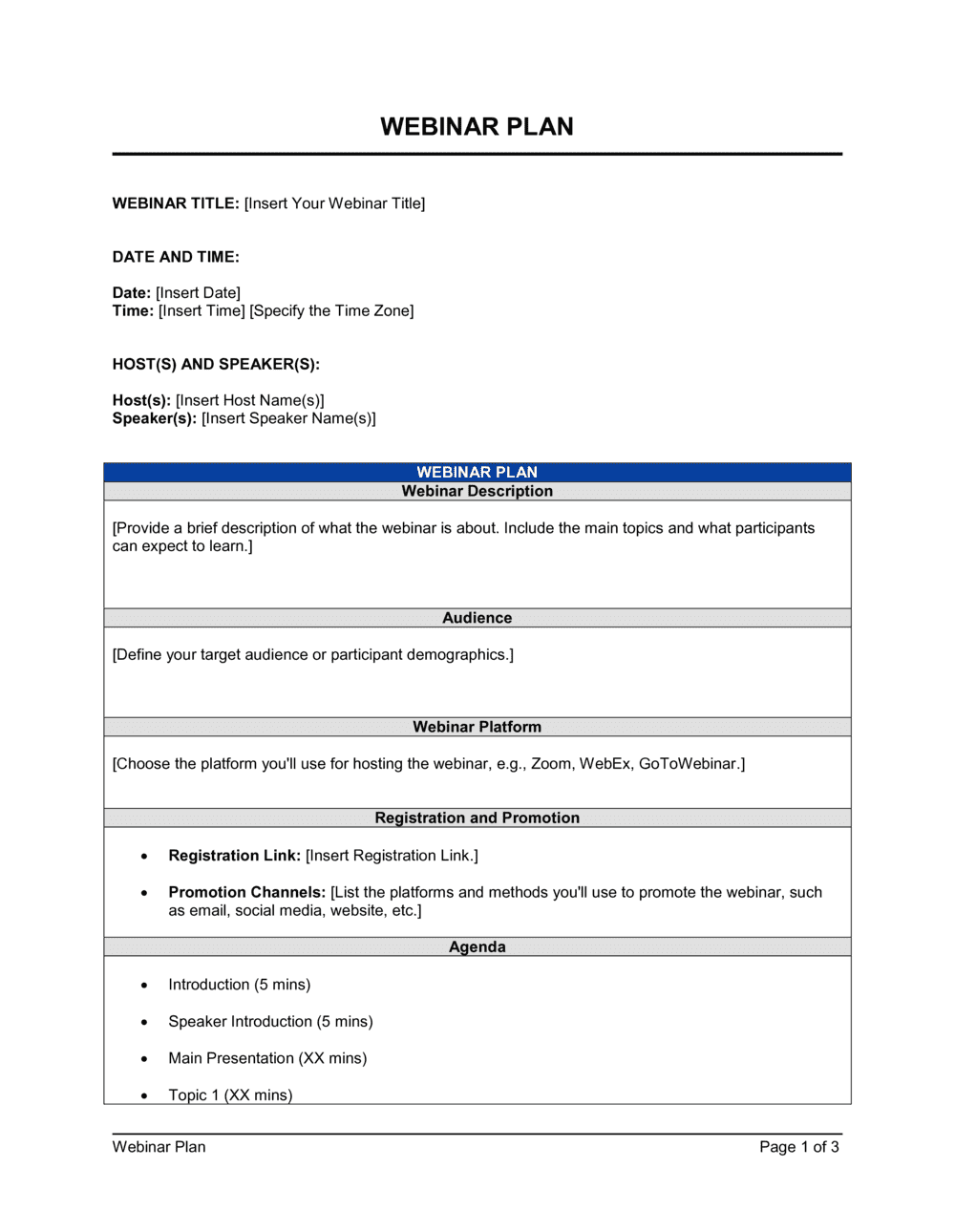
Webinar Planning Template

Free Word download β€’ Edit online β€’ Save & share with Drive β€’ Export to PDF

3 pagesβ€’25–30 min to fillβ€’Difficulty: Standardβ€’Signature requiredβ€’Legal review recommended
Learn more ↓
FreeWebinar Planning Template

At a glance

What it is
A Webinar Planning agreement is a legally binding document that defines the rights, responsibilities, and deliverables for everyone involved in producing and hosting an online event β€” organizers, presenters, sponsors, and platform vendors. This free Word download gives you a structured, editable starting point you can customize and export as PDF before your next webinar, virtual summit, or online training session.
When you need it
Use it any time you engage an external presenter, accept sponsorship funds, collect attendee data, or host a webinar under a third-party platform agreement where IP ownership and liability need to be clearly allocated among the parties involved.
What's inside
Event scope and schedule, presenter duties and compensation, intellectual property assignment, recording and distribution rights, sponsor obligations, attendee data handling and privacy compliance, technical platform responsibilities, cancellation and rescheduling terms, liability limitations, and governing law.

What is a Webinar Planning Agreement?

A Webinar Planning Agreement is a legally binding contract between an event organizer and the presenters, sponsors, and vendors involved in producing and hosting an online event. It defines what each party will deliver, who owns the content and recordings created during the event, how attendee data is collected and shared, what happens if the event is cancelled or a platform fails, and how disputes are resolved. Unlike a casual confirmation email, a signed webinar planning agreement creates enforceable obligations on all sides and provides a clear reference point if any element of the production goes wrong before, during, or after the live session.

Why You Need This Document

Without a written webinar planning agreement, four serious problems tend to surface at the worst possible moment. First, if there is no recording rights clause, a presenter can legally prevent you from distributing, repurposing, or monetizing the recorded session β€” even one you paid to produce. Second, sharing attendee registration data with sponsors without a documented legal basis exposes your organization to GDPR, CCPA, and CASL enforcement, where fines are measured in percentages of annual revenue, not flat fees. Third, a last-minute presenter cancellation with no kill fee clause can leave you absorbing promotional and attendee refund costs with no contractual remedy. Fourth, vague sponsor deliverables described as "brand exposure" generate disputes the moment the event ends. This template closes all four gaps in a single document you can execute in under 30 minutes β€” protecting your content, your attendee data, your revenue, and your relationships with the presenters who make your events worth attending.

Which variant fits your situation?

If your situation is…Use this template
Engaging a paid external speaker for a single webinarWebinar Presenter Agreement
Accepting cash or in-kind sponsorship for a webinar or virtual eventEvent Sponsorship Agreement
Selling access to a recorded webinar as an on-demand courseOnline Course License Agreement
Hiring an AV or platform vendor to provide virtual event technologyEvent Services Agreement
Co-hosting a webinar with a partner organizationCo-Marketing Agreement
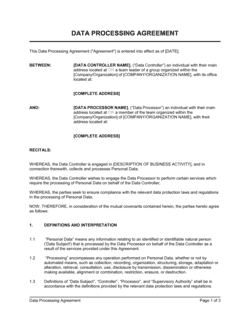
Collecting attendee registration data subject to GDPR or CASLData Processing Agreement
Running a full multi-day virtual conference with multiple speakers and exhibitorsVirtual Conference Planning Agreement

Common mistakes to avoid

❌ No recording rights clause

Why it matters: Without an explicit recording license, the presenter retains full copyright over their portion of the webinar. Distributing, editing, or monetizing the recording without permission exposes the organizer to copyright infringement claims.

Fix: Include a recording and distribution clause that specifies permitted channels, duration, and whether the recording may be sold or gated β€” and have the presenter sign it before the event.

❌ Sharing attendee data with sponsors without a documented legal basis

Why it matters: Under GDPR, CASL, and CCPA, transferring attendee personal data to a third-party sponsor without explicit, informed consent or another valid lawful basis can result in regulatory fines and reputational damage.

Fix: Either obtain explicit attendee opt-in to sponsor data sharing at registration, or restrict your sponsor deliverables to aggregate, anonymized audience metrics only.

❌ Omitting a kill fee for late organizer cancellations

Why it matters: Presenters invest hours preparing materials and rehearsing. A cancellation without financial consequence gives the organizer no incentive to give adequate notice, leaving the presenter uncompensated for preparation time.

Fix: Include a tiered kill fee β€” for example, 25% for cancellations more than 30 days out, 50% within 14 days, and 100% within 7 days β€” with a corresponding notice obligation.

❌ Vague sponsor deliverables with no measurable specifics

Why it matters: Describing a sponsor benefit as 'brand visibility' or 'exposure to attendees' creates immediate dispute risk when the sponsor believes they received less than promised.

Fix: Enumerate every deliverable with measurable specifics: logo tier (gold/silver/bronze), number of pre-event email mentions, speaking segment duration in minutes, and exact placement on the registration page.

❌ Treating all technical failures as force majeure

Why it matters: A presenter joining on an unstable home network or failing to update their platform software is a preventable failure, not an act of God. Overbroad force majeure clauses let parties escape liability for their own negligence.

Fix: Limit force majeure to genuinely unforeseeable, external events beyond the party's control, and include a presenter technical-readiness obligation β€” such as a required rehearsal β€” as a separate contractual duty.

❌ Executing the agreement after preparation work begins

Why it matters: In common-law jurisdictions, obligations and IP assignments signed after the work has already started may lack fresh consideration, potentially making restrictive provisions unenforceable.

Fix: Circulate and execute the agreement before the presenter begins creating materials, before sponsors transfer any funds, and before the registration page goes live.

The 10 key clauses, explained

Parties, event description, and date

In plain language: Identifies the organizer, all presenters, and any sponsors as named legal parties, and defines the webinar title, platform, scheduled date, and expected duration.

Sample language
This Webinar Planning Agreement is entered into on [DATE] between [ORGANIZER LEGAL NAME] ('Organizer') and [PRESENTER FULL NAME / ENTITY] ('Presenter'). The Webinar, titled '[WEBINAR TITLE],' will be hosted on [PLATFORM] on [DATE] from [START TIME] to [END TIME] [TIMEZONE].

Common mistake: Listing a presenter's personal name when they are operating through a business entity. If the wrong party is named, IP assignment and payment obligations may attach to the individual rather than the correct entity.

Presenter duties and deliverables

In plain language: Specifies exactly what the presenter must deliver β€” slide deck, demo, Q&A participation β€” along with submission deadlines and technical requirements like slide format and audio setup.

Sample language
Presenter shall deliver a slide deck in [FORMAT] no later than [X] business days before the event date, participate in a [X]-minute technical rehearsal on [DATE], present for approximately [X] minutes, and respond to audience Q&A for [X] minutes.

Common mistake: Omitting submission deadlines for materials. Without a hard deadline, slides routinely arrive the night before, leaving no time for technical checks or brand alignment.

Compensation and payment terms

In plain language: States the presenter's fee, the payment schedule, the currency, acceptable payment methods, and any expense reimbursement for equipment or connectivity.

Sample language
Organizer shall pay Presenter a speaking fee of $[AMOUNT] [CURRENCY], payable within [X] business days of the event date by [PAYMENT METHOD]. Organizer will reimburse pre-approved travel or equipment expenses up to $[AMOUNT] within [X] days of receipt of invoices.

Common mistake: Agreeing to pay 'after the event' with no specific number of days. Without a defined payment window, presenters have no contractual basis to chase late payment and collection becomes difficult.

Intellectual property ownership and license

In plain language: Defines who owns the webinar content β€” slides, scripts, frameworks β€” and what license the organizer receives to use it after the event, covering recordings, promotional clips, and written summaries.

Sample language
Presenter retains all intellectual property rights in the Presentation Materials. Presenter grants Organizer a non-exclusive, royalty-free license to record, archive, and distribute the Webinar recording in [CHANNELS] for [DURATION / in perpetuity]. Organizer shall not edit the Presentation Materials without Presenter's prior written consent.

Common mistake: Assuming the organizer automatically owns all content because they are paying the speaker fee. Without an explicit license or assignment, the presenter retains full IP rights and can restrict distribution of the recording.

Recording, distribution, and repurposing rights

In plain language: Specifies whether the session will be recorded, who controls the recording file, which channels it may be distributed on, whether it may be sold or gated, and for how long.

Sample language
Organizer shall record the Webinar and may distribute the recording via [CHANNELS β€” e.g., on-demand library, email, YouTube] for [TIME PERIOD]. Organizer [shall / shall not] be permitted to sell access to the recording. Organizer shall credit Presenter in all distributed versions.

Common mistake: Not addressing repurposing at all. Organizers frequently clip recordings for social media or embed them in paid courses β€” without this clause, each use requires a separate negotiation or risks a copyright dispute.

Sponsor obligations and deliverables

In plain language: If sponsors are involved, this clause lists each sponsor's contribution, the specific promotional benefits they receive, the deadlines for asset submission, and the consequences if either party fails to perform.

Sample language
In consideration of a sponsorship contribution of $[AMOUNT], [SPONSOR NAME] shall receive: logo placement on the event registration page, a [X]-minute speaking segment, and mention in [X] pre-event email sends. Sponsor shall submit all brand assets by [DATE].

Common mistake: Describing sponsor benefits vaguely as 'brand exposure.' Each deliverable must be enumerated and measurable β€” number of email mentions, logo size class, and placement location β€” so disputes about what was promised are avoidable.

Attendee data collection and privacy compliance

In plain language: Governs how attendee registration data is collected, stored, and shared β€” specifying which party controls the data, whether it is shared with sponsors, and which privacy laws apply.

Sample language
Organizer is the data controller for all attendee personal data collected via the registration form. Organizer shall process attendee data in compliance with [APPLICABLE LAW β€” e.g., GDPR / CCPA / PIPEDA]. Attendee data shall [not / only with explicit opt-in] be shared with Sponsor.

Common mistake: Sharing the attendee list with sponsors without a documented legal basis. Under GDPR and CASL, transferring personal data to a third-party sponsor without explicit attendee consent exposes the organizer to significant regulatory fines.

Cancellation, rescheduling, and kill fee

In plain language: Sets out the process and financial consequences if the organizer or presenter needs to cancel or postpone the event β€” including notice periods, refund obligations to attendees, and kill fees owed to presenters.

Sample language
If Organizer cancels the Webinar fewer than [X] days before the scheduled date, Organizer shall pay Presenter a kill fee of [X]% of the agreed speaking fee. If Presenter cancels with fewer than [X] days' notice, Organizer's sole remedy shall be a full refund of any fees already paid.

Common mistake: No cancellation clause at all. When a platform fails or a presenter withdraws days before the event, the absence of agreed financial consequences results in protracted disputes over who owes what.

Platform failure and force majeure

In plain language: Allocates risk for events outside the parties' control β€” internet outages, platform downtime, or other technical failures β€” and sets out each party's obligations to reschedule or provide alternatives.

Sample language
Neither party shall be in breach of this Agreement for failures caused by events beyond their reasonable control, including platform outages, internet failures, or acts of God. The affected party shall notify the other within [X] hours and the parties shall use commercially reasonable efforts to reschedule within [X] days.

Common mistake: Treating all technical failures as force majeure. A presenter's failure to test their own equipment or join on a stable connection is a preventable failure, not a force majeure event β€” the clause should be limited to genuinely unforeseeable, external circumstances.

Governing law and dispute resolution

In plain language: Specifies which jurisdiction's law governs the agreement and how disputes are resolved β€” litigation, mediation, or binding arbitration.

Sample language
This Agreement shall be governed by and construed in accordance with the laws of [STATE / PROVINCE / COUNTRY], without regard to its conflict-of-law provisions. Any dispute shall be resolved by [binding arbitration / mediation, followed by litigation] in [CITY].

Common mistake: Defaulting to the organizer's home jurisdiction without considering where the presenter or sponsor operates. A governing-law clause in a state with unfavorable IP or non-disclosure defaults can undermine other provisions in the contract.

How to fill it out

  1. 1

    Identify all parties and their legal entity names

    Enter the full registered legal name of the organizer and each presenter, sponsor, or vendor. For individuals, include their legal name and principal business address.

    πŸ’‘ If a presenter operates through an LLC or corporation, name the entity β€” not the individual β€” to ensure IP assignment and payment obligations bind the correct legal party.

  2. 2

    Define the event scope, platform, and schedule

    Enter the webinar title, hosting platform, scheduled date and time including time zone, expected duration, and the intended audience size or registration cap if applicable.

    πŸ’‘ Include the platform's terms of service version or subscription tier if it affects recording storage limits β€” this prevents disputes over who is responsible for lost recordings.

  3. 3

    Specify presenter deliverables and deadlines

    List every deliverable the presenter must submit β€” slide deck, pre-recorded video, bio, headshot, and social promotion copy β€” with a firm deadline in business days before the event date.

    πŸ’‘ Set slide submission deadlines at least five business days before the event so you have time for a rehearsal and technical check without rushing.

  4. 4

    Complete the compensation and payment block

    Enter the speaker fee or honorarium, the exact payment window in business days post-event, accepted payment methods, and any expense reimbursement cap with a receipts-submission deadline.

    πŸ’‘ State the currency explicitly when the organizer and presenter are in different countries β€” USD and CAD are frequently confused, and the difference compounds on larger fees.

  5. 5

    Negotiate and record IP ownership and recording rights

    Decide whether the organizer receives a license or full assignment of presentation materials, specify which distribution channels are permitted, and state whether the recording may be sold or only offered for free.

    πŸ’‘ If the webinar will be repurposed as a paid on-demand course, get explicit written permission in this clause before the event β€” retroactive negotiations with presenters after a recording is already live are difficult.

  6. 6

    Address attendee data and privacy compliance

    Identify the data controller, list which fields are collected at registration, state the lawful basis for processing under applicable privacy law, and specify whether and how data is shared with sponsors.

    πŸ’‘ If any attendee is located in the EU or UK, GDPR applies to their data regardless of where your organization is based β€” include a GDPR-compliant processing basis and data retention period.

  7. 7

    Set cancellation, rescheduling, and kill fee terms

    Enter the notice thresholds that trigger the kill fee, the kill fee percentage, refund obligations to registered attendees, and the process for rescheduling if either party requests a date change.

    πŸ’‘ A kill fee of 50% of the speaker fee for cancellations within 14 days is a widely accepted industry standard β€” deviating significantly below this may deter experienced presenters.

  8. 8

    Execute before any preparation work begins

    Obtain signatures from all named parties before the presenter begins creating slides, the sponsor transfers funds, or any attendee data is collected via a registration page.

    πŸ’‘ Use a digital signature tool that timestamps execution and stores the fully-signed copy automatically β€” this eliminates disputes about which version of the agreement was accepted.

Frequently asked questions

What is a webinar planning agreement?

A webinar planning agreement is a legally binding document between an event organizer and one or more presenters, sponsors, or platform vendors that defines the scope of the webinar, each party's obligations, IP ownership, recording rights, attendee data handling, and financial terms. It functions as the governing contract for the entire production of an online event and protects all parties if something goes wrong before or during the session.

Do I need a formal agreement for a free webinar?

Yes β€” even for a free webinar, a written agreement protects you on IP ownership, recording distribution, and data privacy. If an external presenter delivers content and you intend to record and repurpose it, you need their written consent to distribute the recording. If you collect attendee registration data, privacy laws apply regardless of whether the event is paid or free. A brief agreement covering these points takes minutes to complete and prevents disputes that can take months to resolve.

Who should sign a webinar planning agreement?

At minimum, the organizer and each paid or external presenter should sign. If sponsors are contributing funds or receiving attendee data, they should sign a sponsor-specific exhibit or addendum. Platform vendors are typically covered by their own terms of service rather than this agreement, but any custom service-level commitments should be documented in a separate vendor agreement.

What happens if a presenter cancels at the last minute?

The agreement's cancellation clause governs this scenario. A well-drafted clause typically requires the presenter to provide a minimum number of days' notice and limits the organizer's remedy to a full refund of any fees already paid rather than consequential damages. Without this clause, the organizer may have a claim for all losses flowing from the cancellation β€” including attendee refunds and promotional costs β€” which can far exceed the speaker fee.

Can I sell access to a recorded webinar after the event?

Only if the presenter's agreement includes explicit permission to do so. Many webinar agreements grant the organizer a license to distribute the recording for free or for archival purposes, but stop short of authorizing commercial resale. If monetizing recordings is part of your business model, include a specific clause granting a license to sell or gate access to the recording β€” and consider offering the presenter a revenue share to secure that right.

How does GDPR affect webinar attendee data?

If any attendee is based in the EU or UK, GDPR applies to how you collect, store, and use their personal data β€” including name, email address, and job title β€” regardless of where your organization is located. You must have a lawful basis for processing (typically legitimate interest or consent), inform attendees of how their data will be used in a privacy notice at registration, and not share their data with sponsors without a separate opt-in. Including a GDPR-compliant data processing clause in your webinar agreement formalizes these obligations.

What is the difference between a webinar planning agreement and a speaker contract?

A speaker contract typically covers a single presenter's deliverables, compensation, and IP terms in isolation. A webinar planning agreement is broader β€” it encompasses the entire event production, including platform responsibilities, sponsor terms, attendee data handling, cancellation policy, and force majeure provisions. For webinars with a single presenter and no sponsors, a speaker contract may be sufficient. For multi-speaker or sponsored events, a full webinar planning agreement is more appropriate.

What is a kill fee and when does it apply?

A kill fee is a partial payment made to a presenter or vendor when the organizer cancels the event after a defined threshold, compensating them for preparation work already completed. Kill fees are typically expressed as a percentage of the agreed fee and scale with proximity to the event date β€” for example, 25% for cancellations more than 30 days out and 100% for cancellations within 7 days. Without a kill fee clause, a last-minute cancellation may entitle the presenter to their full fee as damages under general contract law.

Do I need a lawyer to draft a webinar planning agreement?

For a standard single-presenter webinar with no sponsorship or data sharing, a well-structured template is typically sufficient. Engage a lawyer when the event involves significant sponsor revenue, when attendee data will be shared with third parties, when the presenter is contributing original IP that will be repurposed commercially, or when parties are in multiple jurisdictions with conflicting privacy or IP laws. A one-hour template review typically costs $200–$400 and is worthwhile for any event with material financial or data obligations.

How this compares to alternatives

vs Event Sponsorship Agreement

An event sponsorship agreement focuses exclusively on the relationship between an event organizer and a financial sponsor β€” defining contribution amounts, deliverables, and brand rights. A webinar planning agreement is broader, governing the entire event including presenter duties, IP, attendee data, and platform terms. For sponsored webinars, both documents are often used together, with the sponsorship agreement as an exhibit.

vs Speaker Agreement

A speaker agreement covers a single presenter's obligations, compensation, and IP terms. A webinar planning agreement encompasses the full event production β€” platform coordination, sponsor terms, data privacy, and cancellation policy. For multi-speaker or commercially sponsored webinars, a speaker agreement alone leaves significant gaps in event governance.

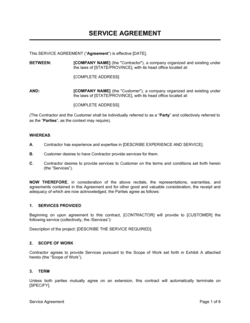
vs Service Agreement

A service agreement governs the delivery of professional services broadly β€” consulting, design, or technology work β€” between a client and a provider. A webinar planning agreement is tailored specifically to live online events, adding clauses for recording rights, attendee data, force majeure for platform failures, and real-time performance obligations that a generic service agreement does not address.

vs Data Processing Agreement

A data processing agreement (DPA) is a standalone document specifically governing how a processor handles personal data on behalf of a controller, required under GDPR when third-party vendors process attendee data. A webinar planning agreement may include basic data handling obligations, but organizations subject to GDPR should execute a full DPA alongside it when the platform vendor or a sponsor has access to attendee personal data.

Industry-specific considerations

Technology / SaaS

Product demo and customer education webinars requiring recording rights to populate on-demand libraries, plus guest expert IP clauses for co-branded thought-leadership sessions.

Professional Services

CLE- or CPD-accredited webinars where presenter credentials must be documented, attendance records retained for compliance, and recordings restricted to licensed viewers only.

Healthcare / MedTech

HIPAA-compliant handling of attendee data, restrictions on recording clinical content without IRB or regulatory clearance, and speaker disclosure requirements for pharmaceutical sponsorships.

Financial Services

FINRA and SEC disclosure requirements for financial content, marketing compliance review obligations before distribution of recordings, and enhanced data retention clauses for regulatory audit trails.

Education and E-learning

Reuse rights for converting live webinars into on-demand courses, LMS integration terms, and FERPA or COPPA considerations when attendees include students under 18.

Nonprofit and Associations

Sponsor acknowledgment obligations tied to grant compliance, member data handling under association bylaws, and volunteer presenter agreements substituting honoraria for monetary compensation.

Jurisdictional notes

United States

IP ownership defaults differ by state β€” California's work-for-hire doctrine is narrower than federal Copyright Act provisions, and independent contractor status affects whether a presenter's work qualifies as work for hire at all. CCPA requires attendee privacy notices for California residents. Non-compete clauses tied to presenter exclusivity are unenforceable in California and several other states, so avoid broad exclusivity language if your presenter base is US-wide.

Canada

CASL (Canada's Anti-Spam Legislation) imposes strict consent requirements before sending follow-up marketing to webinar registrants β€” implied consent has a limited shelf life and must be documented. PIPEDA and provincial privacy acts (particularly Quebec's Law 25) require a privacy notice at registration and restrict sharing attendee data with sponsors without explicit consent. Quebec contracts with Quebec-based presenters or attendees should be available in French.

United Kingdom

UK GDPR applies to attendee data for any webinar accessible to UK residents, requiring a lawful basis for processing and a compliant privacy notice at registration. Presenter agreements should address whether their work constitutes 'work made for hire' under the Copyright, Designs and Patents Act 1988 β€” moral rights (including the right of integrity) cannot be fully waived by individuals in the UK, meaning editing recordings without consent carries copyright risk. IR35 rules may apply if a presenter operates through a personal service company.

European Union

GDPR applies to all personal data collected from EU attendees regardless of the organizer's location, requiring a documented lawful basis, a compliant privacy notice, and a Data Processing Agreement with any platform vendor that processes attendee data. Sharing the attendee list with sponsors requires explicit opt-in consent at registration. Several EU member states β€” including Germany and France β€” require presenter agreements to be in the local language to be enforceable in domestic courts.

Template vs lawyer β€” what fits your deal?

PathBest forCostTime
Use the templateSingle-presenter webinars with straightforward compensation, no third-party data sharing, and no sponsorship revenueFree20–30 minutes
Template + legal reviewSponsored webinars, events where recordings will be sold or licensed, or multi-jurisdiction attendee data collection subject to GDPR or CCPA$200–$5001–3 days
Custom draftedHigh-value virtual summits, recurring webinar series with complex IP licensing, heavily regulated industries such as financial services or healthcare$800–$3,000+1–2 weeks

Glossary

Presenter Agreement
The section or standalone document governing what a speaker will deliver, when they will deliver it, and how they will be compensated.
Recording Rights
A clause specifying who owns the recorded version of the webinar and who may distribute, sell, or repurpose it after the live event.
Intellectual Property Assignment
A provision transferring ownership of slides, scripts, or other content created for the webinar from the presenter to the organizing party β€” or confirming the presenter retains ownership with a limited license.
Force Majeure
A clause excusing a party from performance when an event beyond their control β€” such as a platform outage, natural disaster, or internet failure β€” prevents them from fulfilling their obligations.
Cancellation and Rescheduling Policy
Terms setting out the notice period required to cancel or postpone the event and the financial consequences β€” refunds, kill fees, or rebooking fees β€” for each party.
Data Processing Agreement (DPA)
A contract or clause governing how attendee personal data collected during registration and the event is stored, used, and protected, in compliance with applicable privacy laws.
Kill Fee
A partial payment made to a presenter or vendor when the organizer cancels the event after a defined threshold, compensating for preparation time already spent.
Sponsor Deliverables
The specific promotional or branding benefits β€” logo placement, speaking slots, attendee list access, or verbal mentions β€” that a sponsor receives in exchange for their contribution.
Platform Vendor
The third-party technology provider (such as Zoom, GoToWebinar, or Hopin) whose platform hosts the live stream, manages registrations, and delivers the attendee experience.
Indemnification
A contractual obligation by one party to cover the other's legal costs and damages if a claim arises from the first party's actions β€” for example, a presenter's content infringing a third party's copyright.
Governing Law
The jurisdiction whose laws will be used to interpret the agreement and resolve any dispute between the parties.

Part of your Business Operating System

This document is one of 3,000+ business & legal templates included in Business in a Box.

  • Fill-in-the-blanks β€” ready in minutes
  • 100% customizable Word document
  • Compatible with all office suites
  • Export to PDF and share electronically

Create your document in 3 simple steps.

From template to signed document β€” all inside one Business Operating System.
1
Download or open template

Access over 3,000+ business and legal templates for any business task, project or initiative.

2
Edit and fill in the blanks with AI

Customize your ready-made business document template and save it in the cloud.

3
Save, Share, Send, Sign

Share your files and folders with your team. Create a space of seamless collaboration.

Save time, save money, and create top-quality documents.

β˜…β˜…β˜…β˜…β˜…

"Fantastic value! I'm not sure how I'd do without it. It's worth its weight in gold and paid back for itself many times."

Managing Director Β· Mall Farm
Robert Whalley
Managing Director, Mall Farm Proprietary Limited
β˜…β˜…β˜…β˜…β˜…

"I have been using Business in a Box for years. It has been the most useful source of templates I have encountered. I recommend it to anyone."

Business Owner Β· 4+ years
Dr Michael John Freestone
Business Owner
β˜…β˜…β˜…β˜…β˜…

"It has been a life saver so many times I have lost count. Business in a Box has saved me so much time and as you know, time is money."

Owner Β· Upstate Web
David G. Moore Jr.
Owner, Upstate Web

Run your business with a system β€” not scattered tools

Stop downloading documents. Start operating with clarity. Business in a Box gives you the Business Operating System used by over 250,000 companies worldwide to structure, run, and grow their business.

Start freeΒ Β·Β No credit card required