Minutes of Meeting of Incorporators Template

Free Word download β€’ Edit online β€’ Save & share with Drive β€’ Export to PDF

3 pagesβ€’20–25 min to fillβ€’Difficulty: Standard
Learn more ↓
FreeMinutes of Meeting of Incorporators Template

At a glance

What it is
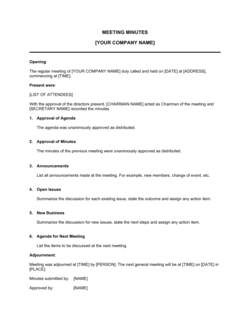
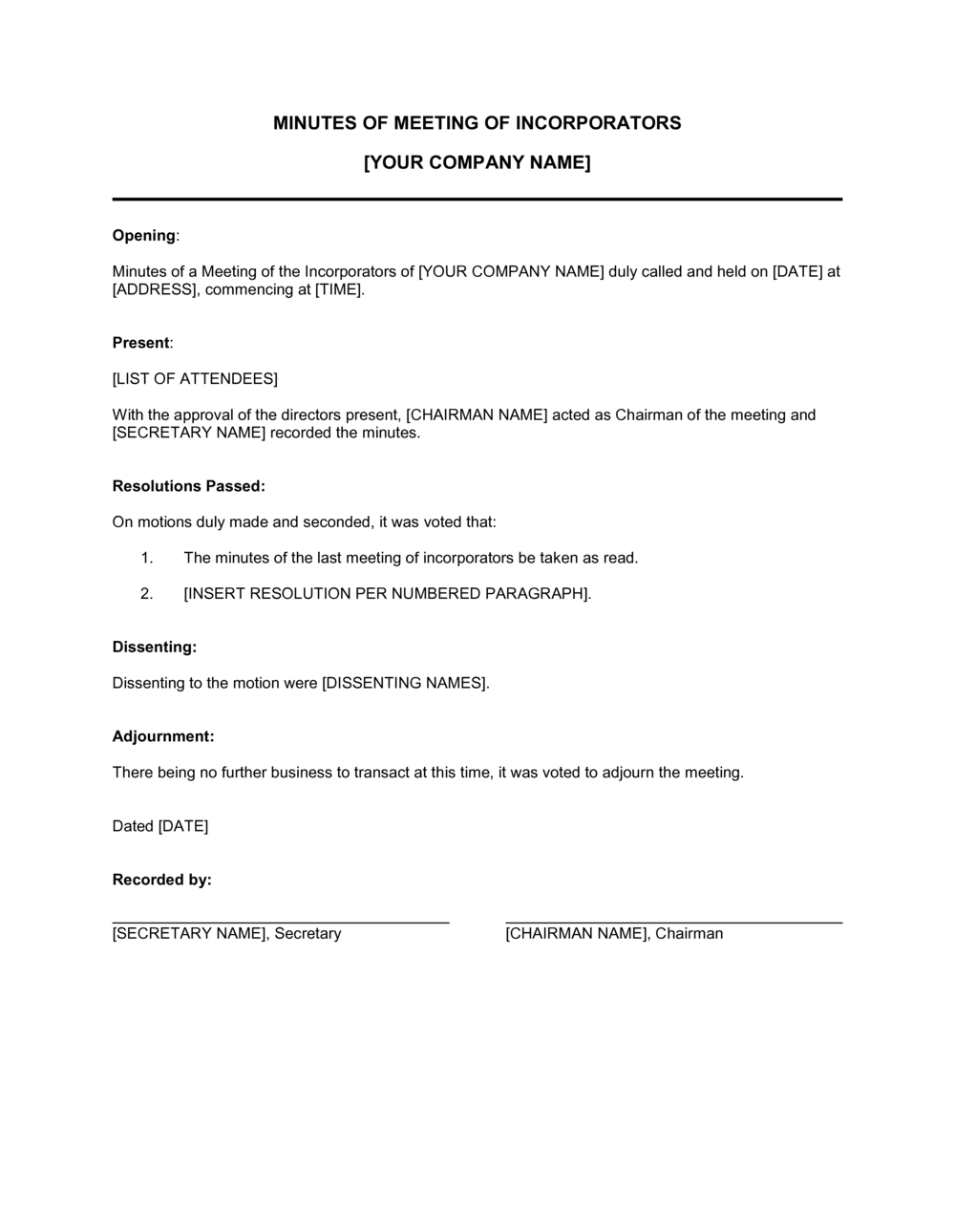
Minutes of Meeting of Incorporators is a formal record of the first meeting held by the incorporators of a newly formed corporation. This free Word download captures each action taken at that meeting β€” adopting bylaws, electing initial directors, and passing foundational resolutions β€” in a structured, legally recognized format you can edit and export as PDF in minutes.
When you need it
Use it immediately after filing articles of incorporation and before the corporation conducts any business. Most states and provinces require a documented organizational meeting to complete the corporate formation process.
What's inside
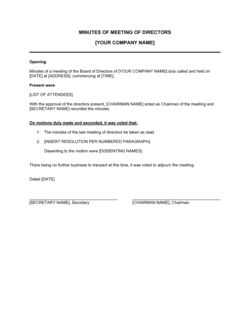
Meeting details including date, time, and location; a list of incorporators present; acknowledgment of the articles of incorporation; adoption of corporate bylaws; election of initial directors; and any other foundational resolutions passed at the meeting.

What is a Minutes of Meeting of Incorporators?

Minutes of Meeting of Incorporators is the official written record of the first formal meeting held by the incorporators of a newly formed corporation. It documents every action taken at that organizational meeting β€” most commonly the adoption of corporate bylaws and the election of the initial board of directors β€” creating an authenticated entry in the corporation's permanent minute book. Unlike ongoing board or shareholder meeting minutes, this document is created exactly once, immediately after the articles of incorporation are filed, to complete the legal formation of the entity.

Why You Need This Document

Without a completed incorporators' meeting record, your corporation's organizational paperwork is legally incomplete. Banks require this document β€” along with the articles of incorporation and bylaws β€” before opening a corporate checking account. Investors and acquirers will flag its absence during due diligence, raising questions about whether foundational resolutions like bylaw adoption and director elections were ever properly made. Missing or undated minutes can also jeopardize time-sensitive tax elections, such as the S-corporation election, which must be filed within 75 days of incorporation. This template gives you a properly structured, ready-to-sign record in under 30 minutes, so your corporate minute book is complete from day one.

Which variant fits your situation?

If your situation is…Use this template
Recording the first meeting of the board of directors after formationMinutes of First Board of Directors Meeting
Documenting ongoing board decisions throughout the yearBoard of Directors Meeting Minutes
Recording decisions made by shareholders at an annual meetingAnnual Shareholders Meeting Minutes
Passing resolutions without holding a formal meetingWritten Consent in Lieu of Meeting
Documenting a special meeting called for a specific purposeSpecial Meeting Minutes
Recording incorporator actions for a nonprofit corporationNonprofit Organizational Meeting Minutes
Capturing LLC member decisions at an organizational meetingLLC Organizational Meeting Minutes

Common mistakes to avoid

❌ Backdating the minutes

Why it matters: Minutes dated before the articles of incorporation were filed suggest actions were taken before the corporation legally existed, which can invalidate early resolutions and raise fraud concerns.

Fix: Always verify the state's official filing date stamp on the articles of incorporation and use a meeting date that falls on or after that date.

❌ Omitting the waiver of notice

Why it matters: Without documented notice or a signed waiver, any resolutions passed at the meeting can be challenged as procedurally defective, potentially requiring ratification at a later meeting.

Fix: Include a waiver-of-notice clause in the minutes and attach individually signed waiver forms from each incorporator.

❌ Failing to attach the adopted bylaws

Why it matters: Adopting bylaws by reference without attaching them means no one can verify what was actually adopted, creating disputes if the bylaws are later amended or lost.

Fix: Attach a complete, signed copy of the bylaws as Exhibit A to the minutes at the time of adoption and keep both documents together in the minute book.

❌ Recording incorporator decisions that belong to the board

Why it matters: Incorporators have a narrow authority limited to organizational actions β€” electing directors and adopting bylaws. Recording operational business decisions in incorporators' minutes blurs authority lines and can expose those decisions to legal challenge.

Fix: Once directors are elected in the incorporators' meeting, convene a separate first board meeting to handle all operational and financial resolutions.

The 9 key fields, explained

Corporation name and jurisdiction

Meeting date, time, and location

List of incorporators present

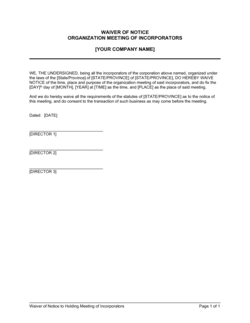
Waiver of notice

Acknowledgment of articles of incorporation

Adoption of bylaws

Election of initial directors

Additional resolutions (optional)

Adjournment and secretary's certification

How to fill it out

  1. 1

    Confirm the corporation's legal name and filing date

    Look up the stamped articles of incorporation from the secretary of state's office and copy the exact legal name and filing date into the template.

    πŸ’‘ Save a PDF of the filed articles alongside the completed minutes in your minute book β€” auditors and banks frequently request both together.

  2. 2

    Enter the meeting date, time, and location

    Record the specific date and time the meeting was held, and the address or platform if held virtually. The date must fall after the articles were filed.

    πŸ’‘ If the meeting was conducted by written consent rather than in person, use a Written Consent in Lieu of Meeting form instead of this template.

  3. 3

    List all incorporators present and confirm quorum

    Name every incorporator who attended and verify that the number present satisfies the quorum requirement in the bylaws or applicable state law.

    πŸ’‘ For a single-incorporator corporation, simply note that the sole incorporator was present and quorum was met.

  4. 4

    Document the waiver of notice

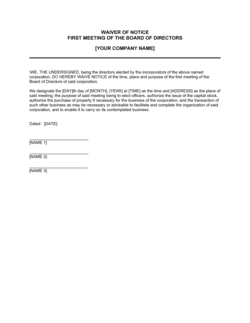
    Confirm that all incorporators received written notice of the meeting at least as far in advance as required by state law, or that each waived notice in writing.

    πŸ’‘ Attach signed waiver-of-notice forms to the back of the minutes in the minute book to eliminate any future challenge to the meeting's validity.

  5. 5

    Record the adoption of bylaws

    Insert the formal resolution adopting the bylaws and note the vote count. Attach the full adopted bylaws as an exhibit to the minutes.

    πŸ’‘ Cross-check that the bylaws you are adopting are consistent with the articles of incorporation before the vote β€” conflicts between the two documents cause governance headaches later.

  6. 6

    Record the election of initial directors

    List each elected director by full legal name. Confirm the number of directors meets the statutory minimum and matches any requirement stated in the articles.

    πŸ’‘ Note whether each director accepted the appointment β€” a director who has not consented to serve is not validly elected.

  7. 7

    Add any additional foundational resolutions

    Include resolutions for fiscal year adoption, bank account authorization, S-election authorization, or any other actions the incorporators are authorized to take.

    πŸ’‘ Keep operational resolutions β€” hiring, contracts, vendor agreements β€” out of the incorporators' minutes. Those belong in the first board meeting minutes.

  8. 8

    Sign and file in the minute book

    Have the meeting secretary (or the sole incorporator) sign the certification at the end of the minutes. Place the signed original in the corporate minute book immediately.

    πŸ’‘ Never store corporate minutes only as an email attachment β€” keep a signed physical or PDF original in a dedicated minute book that travels with the corporate records.

Frequently asked questions

What is the meeting of incorporators?

The meeting of incorporators is the first formal meeting of the person or persons who filed the articles of incorporation for a new corporation. Its primary purpose is to adopt the corporate bylaws and elect the initial board of directors. Once these actions are complete, the incorporators typically have no further role in corporate governance β€” the board and officers take over from that point.

Is a meeting of incorporators required by law?

Most US states and Canadian provinces require or strongly contemplate an organizational meeting as part of the corporate formation process, though the specific form varies. Some jurisdictions permit incorporators to act by written consent instead of holding a formal meeting. Failing to hold the meeting and document it leaves the corporation with an incomplete organizational record, which can create problems when opening bank accounts or seeking financing.

Who are the incorporators of a corporation?

Incorporators are the individuals or entities who sign and file the articles of incorporation. They may be the founders, attorneys, or formation service providers. In many cases, the incorporator and the initial director or shareholder are the same person β€” but not always. Once directors are elected, the incorporators' organizational role ends.

What is the difference between incorporators' minutes and directors' minutes?

Incorporators' minutes record the actions taken at the organizational meeting to complete the legal formation of the corporation β€” adopting bylaws and electing the first directors. Directors' minutes record the ongoing decisions of the board of directors after formation β€” approving contracts, authorizing officers, opening accounts, and managing the business. Both sets of minutes are kept in the corporate minute book.

Do the incorporators' minutes need to be signed?

Yes. The minutes should be signed by the secretary of the meeting β€” typically one of the incorporators acting in that capacity β€” as a certification that the record is accurate. An unsigned set of minutes is not considered an authenticated corporate record and may be rejected by banks, lenders, or government agencies that request corporate documentation.

What happens if we skip the incorporators' meeting?

Skipping or not documenting the meeting leaves the corporation with an incomplete minute book. Banks typically require organizational minutes before opening a corporate account. Investors and acquirers will flag the gap during due diligence. In some jurisdictions, it can also affect the validity of early corporate actions like S-corporation elections that must be filed within a specific window of incorporation.

Can a single incorporator hold the meeting alone?

Yes. A sole incorporator can conduct the meeting without other participants. The minutes should note that the sole incorporator was present, that quorum was met, and that all required actions were taken. The sole incorporator signs both as the meeting participant and as the certifying secretary.

Should bylaws be attached to the incorporators' minutes?

Yes. Best practice is to attach the full adopted bylaws as Exhibit A to the minutes at the time of signing. This creates an unambiguous record of exactly which version of the bylaws was adopted and prevents disputes if the bylaws are later revised. The minute book should contain both documents together.

How this compares to alternatives

vs Minutes of First Board of Directors Meeting

Incorporators' minutes record the organizational actions needed to complete formation β€” adopting bylaws and electing the initial board. The first board meeting minutes record the directors' initial actions after formation β€” electing officers, authorizing a bank account, and issuing shares. Both documents are required; the incorporators' meeting happens first, then immediately followed by the first board meeting.

vs Annual Shareholders Meeting Minutes

Annual shareholders' meeting minutes document recurring governance actions by shareholders β€” electing directors, approving auditors, and voting on major resolutions β€” held each year after formation. Incorporators' minutes are a one-time document created only at the founding of the corporation. Annual meeting minutes replace incorporators' meeting minutes in ongoing corporate recordkeeping.

vs Written Consent in Lieu of Meeting

A written consent in lieu of meeting allows incorporators or directors to approve resolutions by signing a document without convening a formal meeting. It achieves the same legal effect as meeting minutes but does not require scheduling, quorum, or a recorded proceeding. Most jurisdictions permit this alternative for organizational actions when all parties agree.

vs Board of Directors Meeting Minutes

Board of directors meeting minutes record ongoing board decisions throughout the life of the corporation β€” contracts, officer appointments, financings, and major transactions. Incorporators' minutes are used only once at the moment of formation. After directors are elected in the incorporators' meeting, all subsequent formal corporate decisions are captured in board minutes.

Industry-specific considerations

Technology / SaaS

Early-stage tech companies use incorporators' minutes to establish the initial board before issuing founder shares and filing an S-election or 83(b) election within the required time windows.

Professional Services

Law firms, accounting firms, and consulting practices incorporate and use these minutes to satisfy state bar or licensing board requirements for evidence of corporate formation.

Healthcare

Medical and dental practices incorporating as professional corporations must document organizational minutes to satisfy state licensing authority requirements for entity registration.

Retail / E-commerce

Retail businesses use incorporators' minutes to complete the minute book required by banks before opening a business checking account and applying for a merchant account.

Template vs pro β€” what fits your needs?

PathBest forCostTime
Use the templateFounders and small business owners completing standard corporate formation with a single or small group of incorporatorsFree15–30 minutes
Template + professional reviewMulti-founder corporations, professional corporations subject to licensing requirements, or entities planning an immediate funding round$150–$400 for a one-hour attorney review1–2 business days
Custom draftedComplex multi-party incorporations, regulated industries, or corporations with unusual governance structures requiring bespoke organizational documents$500–$1,500+3–7 business days

Glossary

Incorporator
The person or persons who sign and file the articles of incorporation to form a corporation, often before the board of directors is appointed.
Articles of Incorporation
The founding document filed with a state or provincial authority that legally creates a corporation and establishes its basic structure.
Bylaws
The internal rules governing how a corporation is managed, including meeting procedures, officer roles, voting rights, and quorum requirements.
Organizational Meeting
The first formal meeting of incorporators or directors held after incorporation to adopt bylaws, elect officers, and complete the corporate structure.
Quorum
The minimum number of incorporators or directors who must be present at a meeting for business to be validly conducted and resolutions to be binding.
Resolution
A formal decision voted on and approved at a corporate meeting, recorded in the minutes as an official action of the corporation.
Minute Book
A physical or digital binder maintained by a corporation containing all meeting minutes, resolutions, share records, and foundational corporate documents.
Initial Director
A director named in the articles of incorporation or elected at the incorporators' meeting to serve until the first shareholder election.
Waiver of Notice
A signed document by which meeting participants confirm they received adequate notice of the meeting or voluntarily waive the notice requirement.
Corporate Seal
An embossed or inked stamp bearing the corporation's name and jurisdiction of incorporation, sometimes affixed to formal corporate documents.

Part of your Business Operating System

This document is one of 3,000+ business & legal templates included in Business in a Box.

  • Fill-in-the-blanks β€” ready in minutes
  • 100% customizable Word document
  • Compatible with all office suites
  • Export to PDF and share electronically

Create your document in 3 simple steps.

From template to signed document β€” all inside one Business Operating System.
1
Download or open template

Access over 3,000+ business and legal templates for any business task, project or initiative.

2
Edit and fill in the blanks with AI

Customize your ready-made business document template and save it in the cloud.

3
Save, Share, Send, Sign

Share your files and folders with your team. Create a space of seamless collaboration.

Save time, save money, and create top-quality documents.

β˜…β˜…β˜…β˜…β˜…

"Fantastic value! I'm not sure how I'd do without it. It's worth its weight in gold and paid back for itself many times."

Managing Director Β· Mall Farm
Robert Whalley
Managing Director, Mall Farm Proprietary Limited
β˜…β˜…β˜…β˜…β˜…

"I have been using Business in a Box for years. It has been the most useful source of templates I have encountered. I recommend it to anyone."

Business Owner Β· 4+ years
Dr Michael John Freestone
Business Owner
β˜…β˜…β˜…β˜…β˜…

"It has been a life saver so many times I have lost count. Business in a Box has saved me so much time and as you know, time is money."

Owner Β· Upstate Web
David G. Moore Jr.
Owner, Upstate Web

Run your business with a system β€” not scattered tools

Stop downloading documents. Start operating with clarity. Business in a Box gives you the Business Operating System used by over 250,000 companies worldwide to structure, run, and grow their business.

Start freeΒ Β·Β No credit card required