1
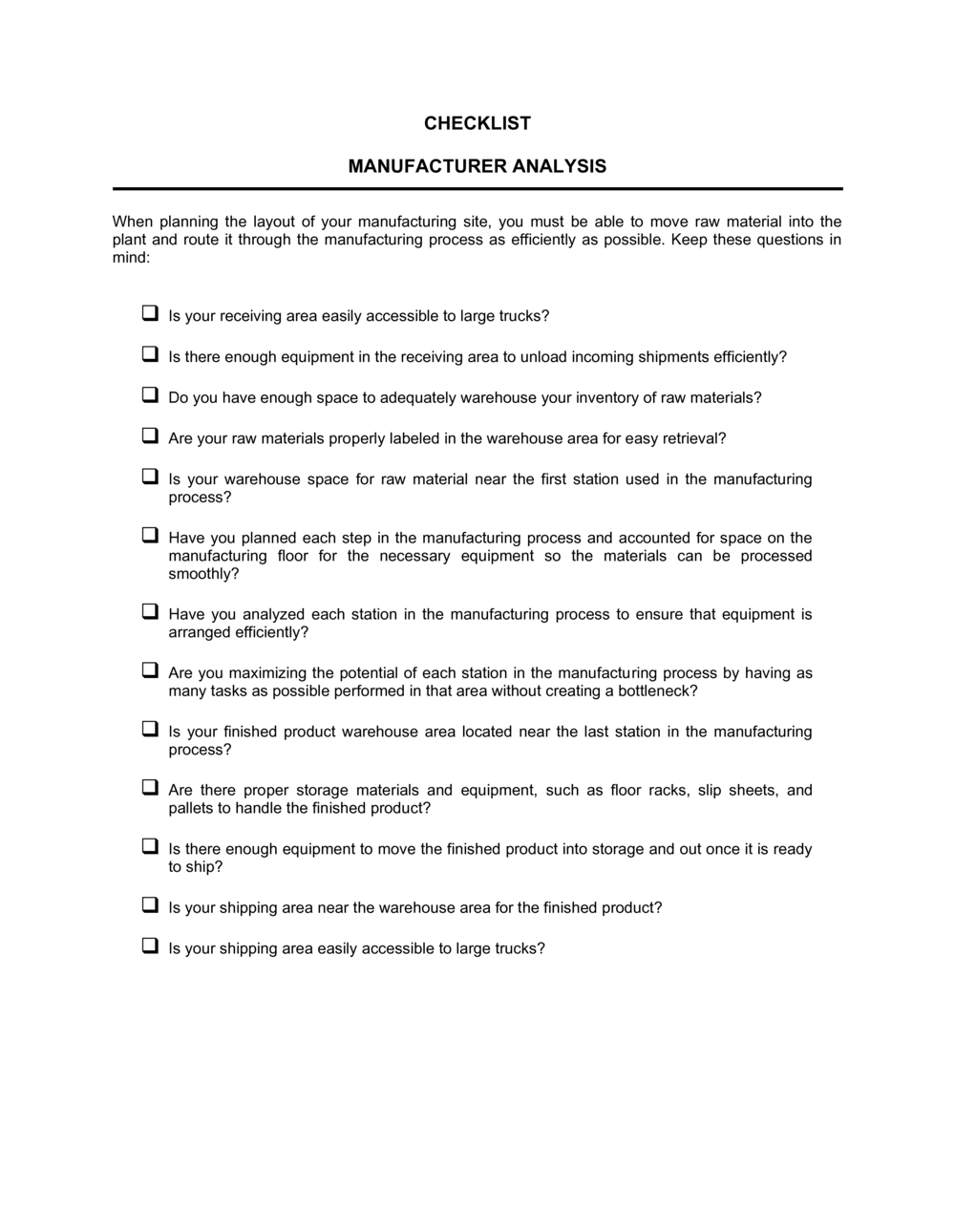
Identify the manufacturers to be evaluated
List all candidate manufacturers with their legal entity names, locations, and primary contact information. Confirm you are evaluating the entity that will actually hold the contract, not a trading intermediary.
💡 Use the manufacturer's registered name from their business license or export documentation — intermediary names and factory names are often different.
2
Gather company profile and ownership information
Request the manufacturer's company registration documents, ownership structure, plant addresses, and a current list of product categories. Cross-reference with trade databases such as Dun & Bradstreet or ImportGenius.
💡 A manufacturing site visit — even virtual — within the past 12 months is worth more than any document the supplier provides about themselves.
3
Complete the capacity and capability section
Record stated annual capacity, current utilization rate, shift structure, and the specific processes they support. Ask for a current production schedule snapshot to validate the utilization figure.
💡 Request evidence of a comparable order — same material, similar volume — they have delivered in the past 18 months.
4
Verify quality certifications directly
Do not rely on certificate copies provided by the supplier. Verify ISO, RoHS, CE, and other certifications through the issuing body's public registry and record the certificate number and expiry date.
💡 Request the last two internal audit reports in addition to the certificate — a recent finding with an open corrective action is more informative than the certificate itself.
5
Request 12 months of OTD and defect rate data
Ask for on-time delivery rate, defect rate in PPM, and the number of corrective action requests issued in the past year. For new suppliers, ask for references from two customers with similar order profiles.
💡 A supplier who cannot or will not produce OTD and PPM data is telling you something important about their measurement culture.
6
Review financial indicators and payment terms
Collect three years of revenue data or audited financials where available. Check trade credit references and confirm payment terms, tooling ownership, and the material escalation policy.
💡 For offshore suppliers, confirm which currency unit pricing is denominated in and whether a forward contract or price lock is available for 12-month agreements.
7
Assess workforce practices and subcontracting
Record total headcount, turnover rate, and whether the manufacturer uses approved subcontractors. Request their most recent labor compliance audit (SEDEX, SMETA, or equivalent) if your market requires ethical sourcing documentation.
💡 Ask specifically which production steps are performed in-house versus subcontracted — vague answers warrant a follow-up factory visit.
8
Score, weight, and record the recommendation
Apply your weighting to each section score, calculate the total, and document the formal recommendation — approved, conditional, or rejected. Record the evaluator names, titles, and sign-off date in the summary section.
💡 Store the completed checklist in your supplier master file alongside the contract. If a dispute or quality failure arises later, the evaluation record establishes what was represented at qualification.