Worksheet_Competitor Analysis

Free download β€’ Use as a template β€’ Print or share

1 pageβ€’20–25 min to useβ€’Difficulty: Standard
Learn more ↓
FreeWorksheet_Competitor Analysis Template

At a glance

What it is
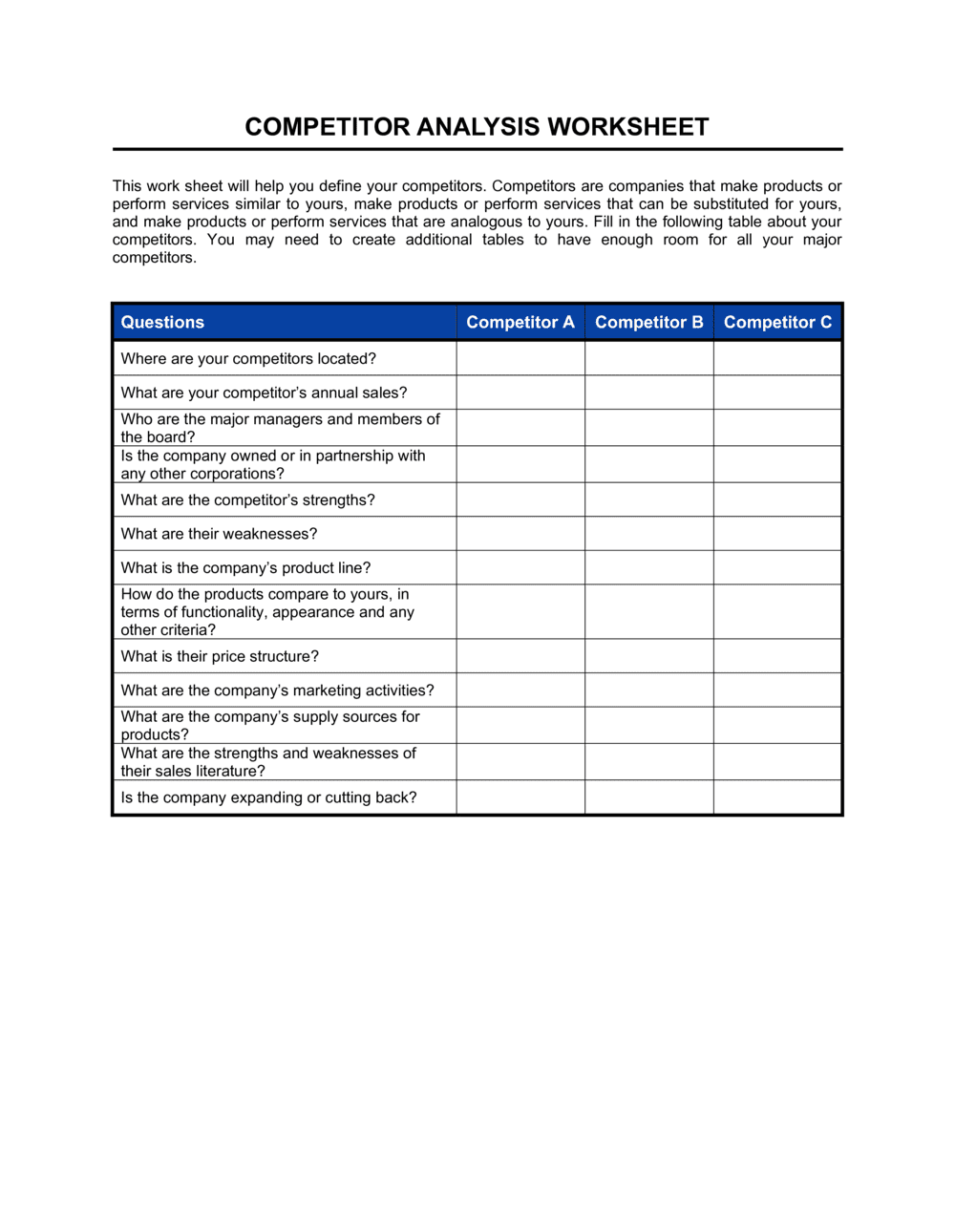
A Competitor Analysis Worksheet is a structured operational document that captures, organizes, and compares intelligence on rival businesses across dimensions such as pricing, product features, positioning, distribution channels, and target customers. This free Word download gives you a ready-to-fill framework you can edit online and export as PDF to share with your strategy, marketing, or leadership team.
When you need it
Use it when launching a new product, entering a new market, preparing a marketing or business plan, or conducting an annual strategic review where understanding the competitive landscape is essential to sound decision-making.
What's inside
Competitor identification, product and pricing comparison, strengths and weaknesses assessment, market positioning map, customer targeting analysis, and a strategic gap summary with recommended actions.

What is a Competitor Analysis Worksheet?

A Competitor Analysis Worksheet is a structured operational document that organizes competitive intelligence on rival businesses into a single, comparable reference. It captures each competitor's product offering, pricing model, target customer segment, marketing channels, and key strengths and weaknesses β€” then synthesizes those findings into a positioning map and a concrete set of strategic recommendations. Unlike a one-off research note, the worksheet applies a consistent framework across all analyzed rivals so decision-makers can draw direct comparisons and identify gaps the market has not yet filled.

Why You Need This Document

Without a structured competitor analysis, strategic decisions rest on impressions rather than evidence β€” and impressions favor whichever competitor your team heard about most recently. Pricing decisions made without benchmarking frequently leave money on the table or price you out of a segment a rival already owns. Product roadmaps built without feature benchmarking invest in capabilities customers already get elsewhere, while genuine differentiation opportunities go unnoticed. A completed competitor analysis worksheet forces the research to happen before a product launch, a pricing change, or a capital raise β€” not after a deal is lost. This template gives you a repeatable framework to run the analysis consistently, share findings across teams, and convert competitive intelligence into assigned actions with owners and deadlines.

Which variant fits your situation?

If your situation is…Use this template
High-level snapshot of four to six direct competitors for an executive audienceCompetitive Analysis Matrix
Visual side-by-side feature comparison for a product or SaaS contextProduct Comparison Chart
Broader internal and external environment review including macro factorsSWOT Analysis
Competitive section within a full investor or lender business planBusiness Plan
Positioning and channel analysis as part of a full marketing strategyMarketing Plan
Tracking competitor changes on a recurring monthly or quarterly basisCompetitive Intelligence Report
Analyzing a single competitor in depth for a new market entry decisionMarket Entry Analysis

Common mistakes to avoid

❌ Analyzing only the most obvious direct competitors

Why it matters: Indirect competitors and the status quo (spreadsheets, manual processes, doing nothing) capture a significant share of deals. Ignoring them leaves the analysis incomplete and the strategy vulnerable.

Fix: Include at least two indirect competitors and explicitly address why a prospect might choose the status quo over any solution in the market.

❌ Using competitor self-reported marketing copy as fact

Why it matters: Marketing copy describes the ideal customer experience, not the average one. Building strategy on a rival's own messaging leads to overestimating their strengths and missing their real weaknesses.

Fix: Cross-reference all competitor claims with independent sources β€” customer reviews, analyst reports, support forum complaints, and your own sales team's win/loss notes.

❌ Completing the analysis once and never updating it

Why it matters: A competitor analysis that is twelve months old is a historical document, not a strategy tool. Competitor pricing, positioning, and product sets shift continuously.

Fix: Set a recurring calendar reminder β€” quarterly for fast-moving markets, semi-annually for stable ones β€” to refresh key data points and review the strategic recommendations.

❌ Skipping the strategic recommendations section

Why it matters: A worksheet that ends at 'here is what competitors do' produces insight without action. Teams that read the analysis but have no assigned next steps default to doing nothing.

Fix: Every completed worksheet must close with at least three specific recommendations, each with a named owner and a target date, before it is shared with stakeholders.

❌ Choosing positioning-map axes based on where your product scores best

Why it matters: A map built on favorable dimensions makes the analysis feel validating but misleads decision-making. If customers don't use those axes to choose, the map is fiction.

Fix: Select axes based on stated customer purchase criteria from win/loss interviews or customer surveys β€” not on internal product strengths.

❌ Treating market share estimates as precise figures

Why it matters: Market share data for private companies is almost never reliable at the level of a single percentage point. Presenting rough estimates as authoritative numbers erodes the worksheet's credibility.

Fix: Label any market share or revenue estimate as approximate and cite the source and date. Use ranges (e.g., '$10M–$30M ARR') rather than single-point estimates when precision is not available.

The 9 key sections, explained

Competitor Identification

Product and Service Overview

Pricing and Packaging

Target Customer and Market Segment

Marketing and Sales Channels

Strengths and Weaknesses

Positioning Map

Competitive Gap and Opportunity Summary

Strategic Recommendations

How to fill it out

  1. 1

    Define the scope and select competitors to analyze

    Decide how many competitors to include β€” typically four to eight β€” and whether the analysis covers direct competitors only or also indirect alternatives. Document your selection criteria so the scope is reproducible.

    πŸ’‘ Start with the competitors you lose deals to most often. Win/loss data from your CRM is more reliable than guesswork about who your real rivals are.

  2. 2

    Gather primary and secondary research for each competitor

    Pull data from competitor websites, pricing pages, job postings, customer reviews on G2 or Capterra, LinkedIn company pages, and public financial filings if available. Note the source and date for each data point.

    πŸ’‘ Job postings reveal competitor priorities faster than any press release β€” if a rival is hiring aggressively for enterprise sales, they are moving upmarket.

  3. 3

    Complete the product and pricing sections

    Fill in each competitor's core offering, key features, pricing model, and published price points. Flag any gaps where pricing is not publicly available and note the research method you used to estimate it.

    πŸ’‘ Sign up for free trials where available. First-hand product experience consistently reveals weaknesses that review sites and marketing copy conceal.

  4. 4

    Assess target customers and market segments

    Identify who each competitor primarily serves β€” company size, industry, buyer role β€” using case studies, customer testimonials, and the language on their homepage.

    πŸ’‘ The customer logos a competitor displays publicly are a direct signal of their target segment and the deals they are most proud to win.

  5. 5

    Map marketing channels and key messages

    Use tools like SimilarWeb or SEMrush to identify traffic sources, and review competitor ad libraries and content archives to extract their leading value proposition.

    πŸ’‘ The headline on a competitor's homepage is their single most tested message β€” treat it as primary evidence of their positioning, not marketing fluff.

  6. 6

    Build the strengths and weaknesses assessment

    Rate each competitor's strengths and weaknesses using evidence β€” customer review scores, response time benchmarks, analyst rankings β€” rather than internal opinion.

    πŸ’‘ Negative reviews on G2, Trustpilot, or Capterra are one of the highest-signal inputs in the entire worksheet. Sort by lowest rating and look for recurring themes.

  7. 7

    Plot the positioning map and identify gaps

    Choose two axes that reflect how your target customers actually choose between options. Plot all competitors and your own company, then identify any unoccupied quadrant or underserved cluster.

    πŸ’‘ If your own company and two competitors cluster in the same quadrant, that is a signal to reposition β€” not confirmation that you are in the right place.

  8. 8

    Write strategic recommendations with owners and dates

    Convert each gap or threat into a specific action: a product change, pricing adjustment, messaging test, or channel investment. Assign an owner and a target completion date before the worksheet leaves your desk.

    πŸ’‘ Limit recommendations to five or fewer. A list of ten actions with no priority signal will produce the same outcome as no recommendations at all.

Frequently asked questions

What is a competitor analysis worksheet?

A competitor analysis worksheet is a structured document that captures and compares intelligence on rival businesses across defined dimensions β€” pricing, product features, target customers, marketing channels, and positioning. It turns fragmented competitive research into a single organized reference that informs product, marketing, and sales strategy.

How many competitors should I include in the analysis?

Four to eight competitors is the practical range for most analyses. Fewer than four risks missing meaningful alternatives; more than eight produces a document too broad to act on. Prioritize the competitors you lose deals to most often, then add one or two indirect alternatives to cover the full range of customer choices.

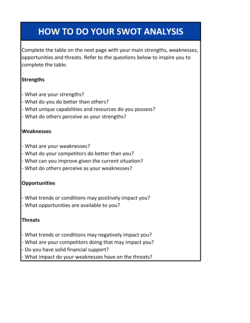
What is the difference between a competitor analysis worksheet and a SWOT analysis?

A competitor analysis worksheet focuses outward β€” it maps specific rivals, their offerings, pricing, and positioning in detail. A SWOT analysis is broader, assessing your own organization's internal strengths and weaknesses alongside external opportunities and threats (which may include competitive factors). Use the competitor worksheet first, then feed its findings into the threats and opportunities sections of a SWOT.

Where can I find reliable data on competitors?

Competitor websites and pricing pages, customer review platforms (G2, Capterra, Trustpilot), LinkedIn company pages, job postings, public financial filings, industry analyst reports, and traffic estimation tools like SimilarWeb or SEMrush are all useful sources. Your own sales team's win/loss notes are often the highest-signal input because they reflect actual purchase decisions, not marketing claims.

How often should a competitor analysis be updated?

Quarterly updates are appropriate for fast-moving markets such as SaaS, consumer tech, or retail. Semi-annual reviews suit more stable industries like professional services or manufacturing. At minimum, refresh the analysis before any major strategic decision β€” a product launch, a pricing change, a new market entry, or a capital raise.

Should I include indirect competitors in the worksheet?

Yes. Indirect competitors β€” businesses solving the same customer problem with a different approach β€” and the status quo (doing nothing, using a spreadsheet) regularly win deals that you thought were yours. Excluding them produces a narrower competitive picture than the one your potential customers actually see when making purchase decisions.

Can a competitor analysis worksheet be used in a business plan or investor deck?

Yes, and it is commonly expected in both contexts. Investors and lenders want evidence that you understand who you are competing against and why customers would choose you. The competitive analysis section of a business plan or pitch deck should be derived directly from the worksheet, condensed into a positioning map and a short differentiation narrative.

How is a competitor analysis different from market research?

Market research studies customer needs, market size, and industry trends β€” the demand side of the market. A competitor analysis studies the supply side β€” who else is trying to meet that demand, how they are doing it, and at what price. Both are needed for a complete strategic picture, and the findings should cross-reference each other.

How this compares to alternatives

vs SWOT Analysis

A SWOT analysis evaluates your own organization across four internal and external dimensions. A competitor analysis worksheet focuses entirely on external rivals β€” their products, pricing, and positioning. The SWOT is broader in scope; the competitor worksheet is deeper on competitive intelligence. Use the competitor worksheet first and feed its findings into the threats and opportunities quadrants of a SWOT.

vs Marketing Plan

A marketing plan defines your own acquisition channels, messaging, budget, and campaign calendar. A competitor analysis worksheet informs that plan by identifying which channels rivals dominate, what messages they use, and which segments are underserved. The worksheet is an input to the plan, not a substitute for it.

vs Business Plan

A business plan is a comprehensive external-facing document covering market analysis, financials, operations, and team. A competitor analysis worksheet is a single focused section of that plan β€” expanded into a standalone working document for deeper competitive research. Complete the worksheet first, then compress its findings into the competitive analysis section of the business plan.

vs Market Research Report

A market research report analyzes customer needs, market size, and industry trends β€” the demand side of the market. A competitor analysis worksheet studies the supply side β€” who is competing for that demand and how. Both are needed for a complete strategic picture, but they answer different questions and should be maintained as separate documents.

Industry-specific considerations

SaaS / Technology

Feature-by-feature comparison tables, pricing tier benchmarking, G2 review score tracking, and positioning against both established platforms and emerging point solutions.

Retail / E-commerce

Price-matching analysis, promotional cadence benchmarking, assortment gap identification, and channel presence comparison across Amazon, direct-to-consumer, and brick-and-mortar.

Professional Services

Service scope and specialization comparison, hourly or project rate benchmarking, client portfolio analysis, and differentiation on credentials or turnaround time.

Food & Beverage

Menu and product range comparison, price-per-unit benchmarking, distribution channel analysis, and brand positioning relative to health, convenience, or premium attributes.

Template vs pro β€” what fits your needs?

PathBest forCostTime
Use the templateFounders, marketers, and product managers conducting competitive research for internal planning or a business planFree4–8 hours of research plus 1 hour to complete the worksheet
Template + professional reviewTeams preparing competitive intelligence for a board presentation, investor raise, or major product launch$500–$2,000 for a market research analyst or strategy advisor review1–2 weeks including primary research
Custom draftedEnterprises entering a new market, companies preparing for an M&A transaction, or organizations requiring primary customer interview research$5,000–$25,000+ for a strategy consulting engagement4–8 weeks

Glossary

Direct Competitor
A business offering the same or nearly identical product or service to the same target customer segment.
Indirect Competitor
A business solving the same customer problem with a different type of product or approach β€” competing for the same budget or attention.
Competitive Positioning
How a company differentiates itself in the minds of target customers relative to alternatives β€” typically expressed as a unique value proposition.
Value Proposition
The specific combination of benefits a product or service delivers to customers that rivals do not, or do not deliver as well.
Market Share
The percentage of total industry revenue or unit sales captured by a single competitor within a defined period.
Pricing Strategy
The deliberate method a company uses to set prices β€” cost-plus, value-based, penetration, premium, or competitive parity.
Differentiation
A distinctive product feature, service quality, brand attribute, or operational capability that makes one offering preferable to another for a target customer.
Win/Loss Analysis
A structured review of deals won and lost, identifying which competitors you beat and which beat you, and why.
Positioning Map
A two-axis visual diagram that plots competitors according to two key attributes β€” such as price versus quality β€” to reveal gaps and clustering in the market.
Competitive Moat
A durable structural advantage β€” such as network effects, switching costs, proprietary data, or patents β€” that makes a company's position difficult for rivals to replicate.

Part of your Business Operating System

This document is one of 3,000+ business & legal templates included in Business in a Box.

  • Fill-in-the-blanks β€” ready in minutes
  • 100% customizable Word document
  • Compatible with all office suites
  • Export to PDF and share electronically

Create your document in 3 simple steps.

From template to signed document β€” all inside one Business Operating System.
1
Download or open template

Access over 3,000+ business and legal templates for any business task, project or initiative.

2
Edit and fill in the blanks with AI

Customize your ready-made business document template and save it in the cloud.

3
Save, Share, Send, Sign

Share your files and folders with your team. Create a space of seamless collaboration.

Save time, save money, and create top-quality documents.

β˜…β˜…β˜…β˜…β˜…

"Fantastic value! I'm not sure how I'd do without it. It's worth its weight in gold and paid back for itself many times."

Managing Director Β· Mall Farm
Robert Whalley
Managing Director, Mall Farm Proprietary Limited
β˜…β˜…β˜…β˜…β˜…

"I have been using Business in a Box for years. It has been the most useful source of templates I have encountered. I recommend it to anyone."

Business Owner Β· 4+ years
Dr Michael John Freestone
Business Owner
β˜…β˜…β˜…β˜…β˜…

"It has been a life saver so many times I have lost count. Business in a Box has saved me so much time and as you know, time is money."

Owner Β· Upstate Web
David G. Moore Jr.
Owner, Upstate Web

Run your business with a system β€” not scattered tools

Stop downloading documents. Start operating with clarity. Business in a Box gives you the Business Operating System used by over 250,000 companies worldwide to structure, run, and grow their business.

Free Forever PlanΒ Β·Β No credit card required