1
Identify the role and gather background materials
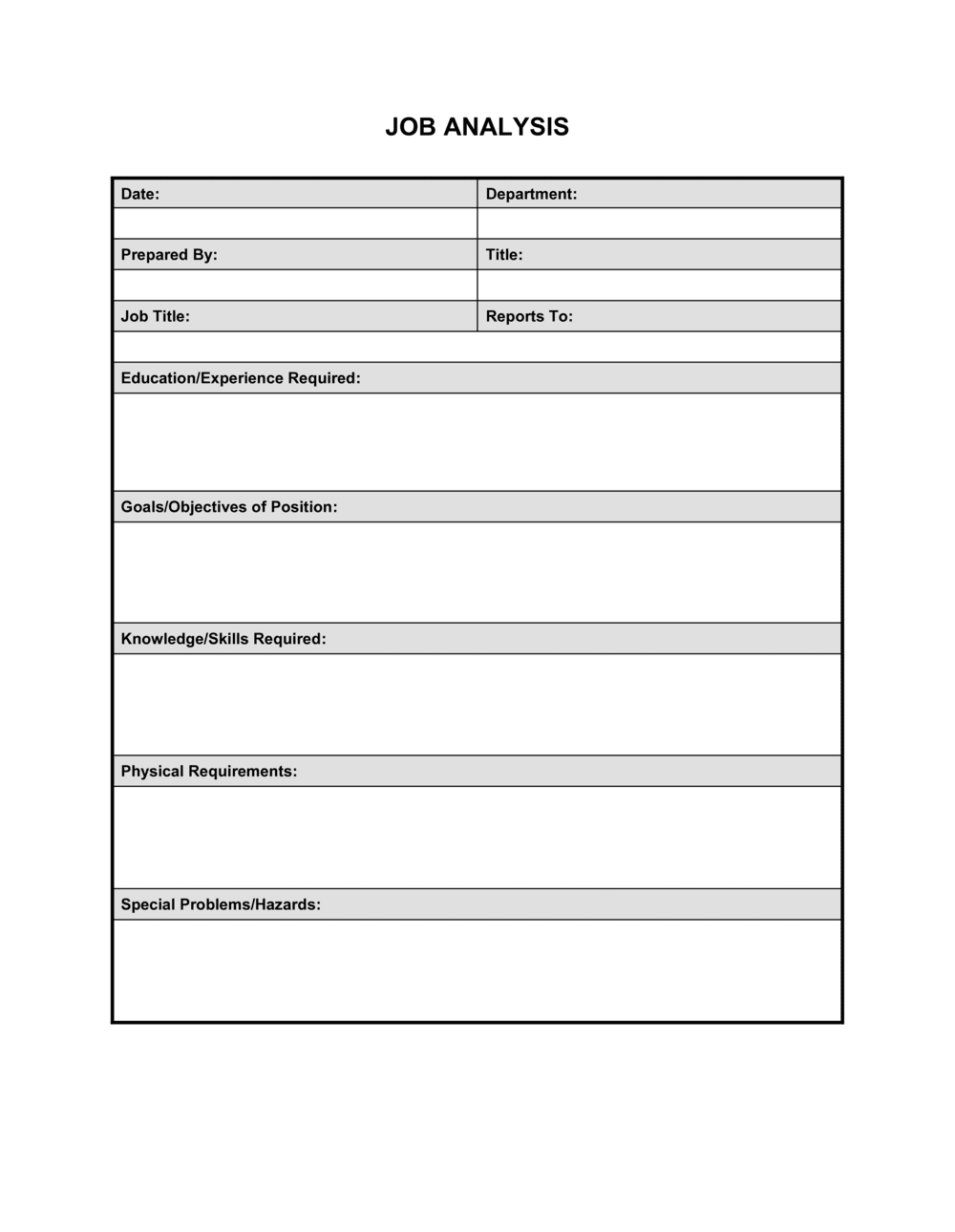
Start with the job title, department, and any existing job description, org chart, or previous analysis. Collect the last performance review cycle's goal list if the role is already filled.
💡 If no prior documentation exists, a 30-minute conversation with the hiring manager before you open the template will cut completion time in half.
2
Select and brief your subject matter experts
Choose two to three current incumbents or recently promoted employees to interview or survey. Brief them on the purpose — improving job clarity and fairness, not evaluating their performance.
💡 Pair SME interviews with at least one direct observation session for roles with significant physical or process components — what people say they do and what they actually do often differ.
3
Build the task inventory from observed duties
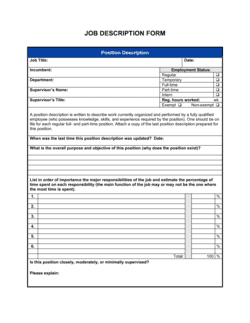
List every discrete task performed in the role, then annotate each with an estimated time percentage and an essential or marginal designation. Group related tasks if the list exceeds 20 items.
💡 Ask SMEs to describe a typical Monday morning in detail — this prompts specific tasks that a high-level question about 'responsibilities' misses.
4
Document KSAs tied to each essential task
For every essential task, ask: what does someone need to know, be able to do, and be capable of to perform this task at a fully-meets-expectations level? Record only what is genuinely required.
💡 Separate 'required on day one' from 'can be learned in the first 90 days' — this distinction directly shapes how you write selection criteria and onboarding plans.
5
Set minimum qualifications based on KSAs, not the incumbent
Translate KSAs into the minimum education, experience, and credentials that would allow someone to perform all essential tasks. Challenge any credential requirement that cannot be linked back to a specific KSA.
💡 A degree requirement that cannot be tied to a specific skill or knowledge area will fail scrutiny in a disparate-impact audit and narrows your talent pool without adding value.
6
Define measurable performance standards for critical tasks
For the five to seven most critical tasks, write a specific, measurable standard for 'fully meets expectations.' Tie each standard to an output, quality threshold, or timeframe.
💡 If you cannot write a measurable standard for a task, it may not be specific enough — return to the task inventory and break it down further.
7
Complete working conditions and physical demands
Record the physical environment, schedule, travel, hazard exposures, and any physical or cognitive demands. Be precise about lifting limits, screen time, and on-call frequency.
💡 For hybrid or remote roles, document the specific on-site requirement — days per week, minimum hours — to avoid ambiguity in offer letters and accommodation requests.
8
Validate with the hiring manager and an HR reviewer
Share the completed analysis with the direct hiring manager and at least one HR reviewer. Confirm that every essential function is accurately documented and that qualifications are defensible.
💡 Record the names and dates of all reviewers in the data-sources section — this creates an audit trail that protects the company in a discrimination or accommodation dispute.