1
State the purpose and scope of the analysis
In the business overview section, record the specific reason for the analysis — strategic planning, loan application, acquisition review, or performance diagnosis. Define the time period the analysis covers.
💡 A clearly stated purpose keeps every section focused. Without it, contributors add tangential information that dilutes the findings.
2
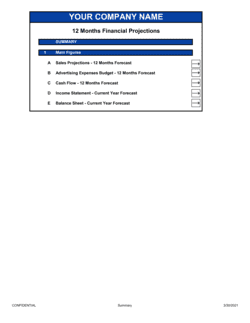
Pull financial data from your accounting system
Enter revenue, gross margin, operating margin, net profit, and cash position for the current and prior comparable period. Source numbers directly from your accounting software or audited statements — do not estimate.
💡 Use the same time period consistently across all financial entries. Mixing monthly, quarterly, and annual figures in the same section creates misleading comparisons.
3
Research and map your competitive landscape
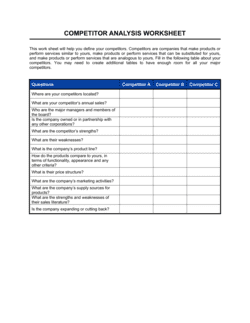
Identify three to five direct competitors. For each, record their primary customer segment, pricing model, key differentiators, and known weaknesses. Use publicly available sources — websites, review platforms, and industry reports.
💡 Customer reviews on G2, Capterra, or Google are often the most honest source of a competitor's real weaknesses.
4
Assess operational capabilities with specific metrics
For each key process — fulfillment, sales, customer support, production — record the current performance metric and the industry benchmark or internal target. Flag any gap greater than 20% as a weakness.
💡 Interview the person who runs each process before filling in this section. Frontline staff routinely identify bottlenecks that management dashboards miss.
5
Segment and analyze your customer revenue
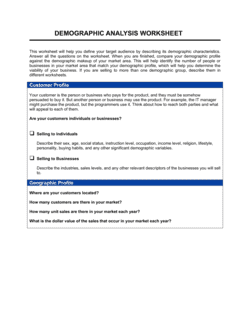
Break total revenue by customer size, segment, product line, and geography. Calculate the share of revenue from your top three customers and your repeat purchase rate.
💡 If your top three customers represent more than 40% of revenue, flag it as a concentration risk — it should appear in both the customer analysis and risk sections.
6
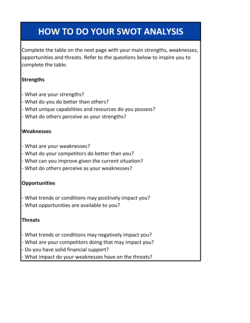
Complete the SWOT summary from your earlier findings
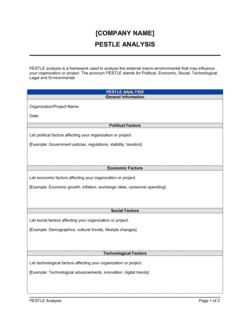
Populate the SWOT only with items that are supported by evidence in the financial, operational, or market sections. Each quadrant should have two to four specific, evidence-backed entries.
💡 Write each SWOT entry as a complete sentence with a number attached. 'Gross margin of 62%, 8 points above industry average' is useful; 'good margins' is not.
7
Identify and quantify strategic gaps
For each gap between current and target state, estimate the revenue impact or cost of not closing it. Prioritize gaps by impact size, not ease of resolution.
💡 Limit yourself to the top three to five gaps. A worksheet with 15 gaps signals an unfocused analysis and makes prioritization impossible.
8
Assign owners and deadlines to every action
Convert the top-priority findings into specific actions with a named owner, a completion date, and a measurable success metric. Review the action list with the relevant stakeholders before finalizing.
💡 Schedule a follow-up review date at the time of completing the worksheet — analysis without a follow-up meeting almost never drives change.