Payment Collections Policy Template

Free Word download β€’ Edit online β€’ Save & share with Drive β€’ Export to PDF

3 pagesβ€’20–30 min to fillβ€’Difficulty: Standard
Learn more ↓
FreePayment Collections Policy Template

At a glance

What it is
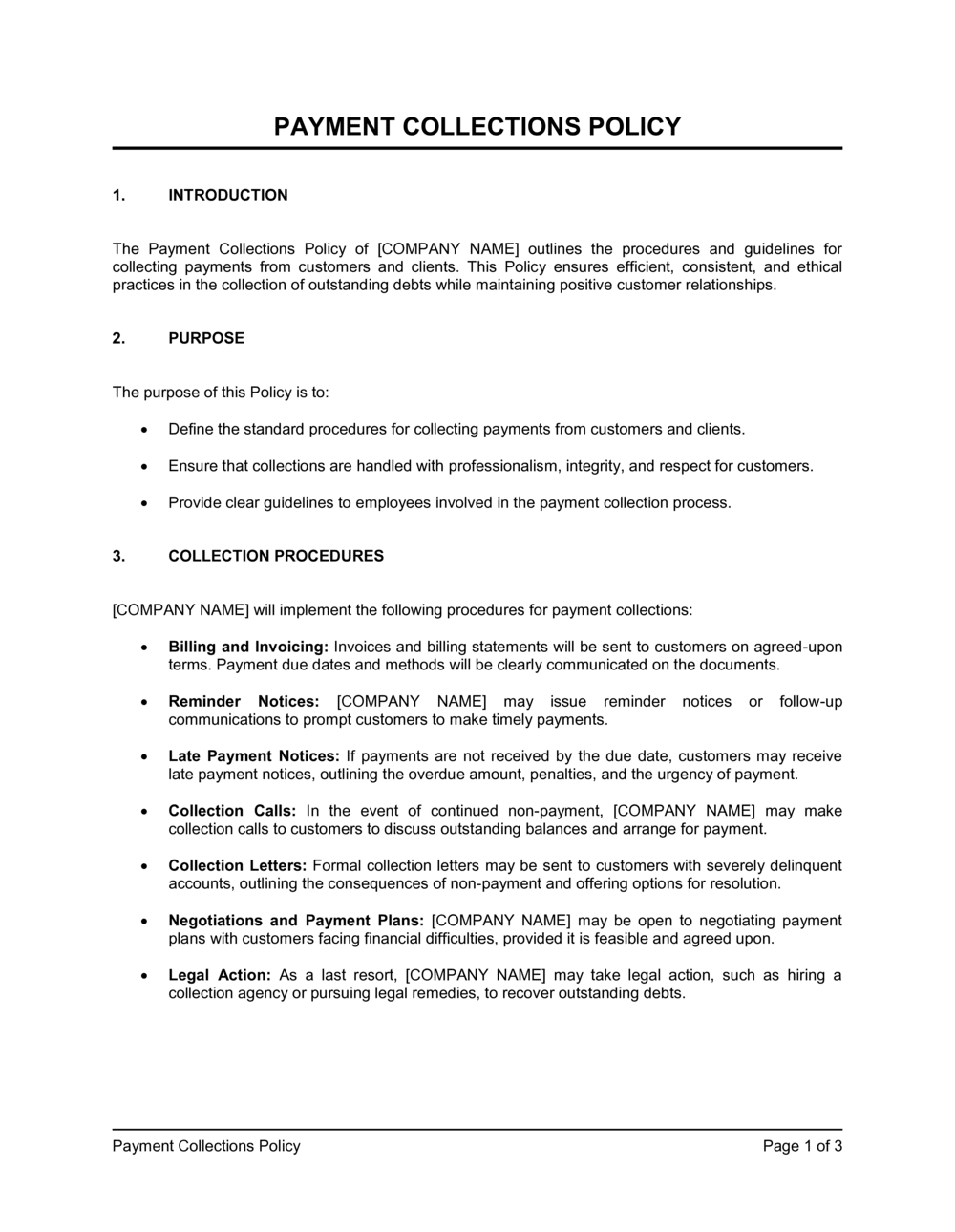
A Payment Collections Policy is an internal operational document that defines how your business extends credit, issues invoices, follows up on overdue balances, escalates delinquent accounts, and ultimately writes off uncollectable debt. This free Word download gives you a ready-to-edit framework you can adapt to your payment terms and AR workflow, then export as PDF for staff training and process documentation.
When you need it
Use it when your accounts receivable balance is growing, payment timelines are inconsistent, or staff are handling overdue accounts differently with no shared standard. It is also essential when onboarding AR staff, responding to an audit, or establishing formal credit controls for the first time.
What's inside
Credit approval criteria, invoice issuance procedures, payment terms, overdue escalation schedule with specific follow-up intervals, dispute resolution steps, late fee and interest rules, write-off authorization thresholds, and third-party collections or legal referral triggers.

What is a Payment Collections Policy?

A Payment Collections Policy is an internal operational document that defines how a business manages the full lifecycle of overdue customer accounts β€” from the first missed payment reminder through credit hold, formal demand, and, where necessary, write-off or third-party referral. It specifies the escalation schedule, late fee structure, dispute resolution process, payment plan authorization rules, and the approval thresholds required before any account is handed to a collections agency or written off as bad debt. Rather than leaving each AR staff member to improvise, the policy gives every person who touches receivables a single, consistent procedure to follow.

Why You Need This Document

Every day an invoice goes unpaid without a structured follow-up, the probability of collecting it drops. Businesses without a documented collections process typically see two compounding problems: days sales outstanding climbs unchecked as balances age in 60- and 90-day buckets, and individual staff members apply wildly inconsistent pressure β€” some waiving late fees routinely, others escalating immediately. The result is a cash flow gap that grows faster than the top line, alongside customer relationships damaged by unpredictable treatment. A written collections policy closes both problems by setting clear triggers, responsibilities, and escalation steps that every customer experiences consistently. It also creates the documented audit trail that supports write-off authorization, legal referral, and any future dispute β€” protecting the business whether the outcome is resolution, recovery, or a clean accounting entry.

Which variant fits your situation?

If your situation is…Use this template
Defining payment terms for new B2B credit accountsCredit Application Form
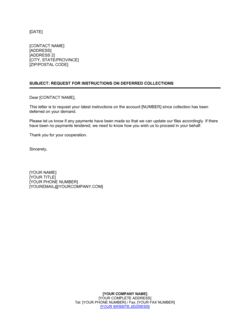
Sending a formal overdue payment notice to a customerPast Due Invoice Letter
Escalating a delinquent account to a formal demand for paymentDemand Letter for Payment
Referring an account to a third-party collections agencyDebt Collection Authorization Letter
Tracking outstanding invoices and aging bucketsAccounts Receivable Aging Report
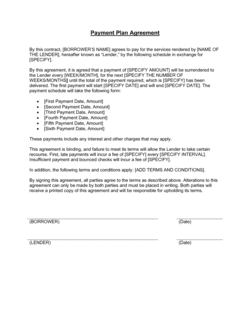
Documenting a negotiated payment arrangement with a delinquent customerPayment Plan Agreement
Setting out the full scope of credit and AR governance for board reportingCredit Policy

Common mistakes to avoid

❌ No named owner for each escalation step

Why it matters: Without a responsible person assigned to each trigger point, reminders go unsent, accounts age unnoticed, and DSO climbs quarter over quarter.

Fix: Assign a specific job title β€” not a team or department β€” to every action in the escalation schedule, and track completion in the AR aging report.

❌ Continuing collections on a disputed invoice

Why it matters: Pursuing payment on an amount the customer formally disputes exposes the business to complaints, regulatory risk, and reputational damage while rarely accelerating resolution.

Fix: Build a formal dispute-pause mechanism into the policy: collections activity stops on the disputed amount the moment a written dispute is received and logged.

❌ Verbal payment plan agreements with no written documentation

Why it matters: If a customer defaults on an informal installment arrangement, the business has no signed evidence of the agreed terms to support escalation or legal action.

Fix: Require a signed Payment Plan Agreement for every installment arrangement, regardless of balance size or customer relationship length.

❌ Applying late fees inconsistently without a documented waiver process

Why it matters: Ad hoc fee waivers undermine the policy's deterrent effect, create customer-fairness disputes, and make AR forecasting unreliable.

Fix: Include a formal waiver process in the policy β€” e.g., Finance Manager approval required, one waiver permitted per customer per 12-month period β€” and log every exception.

❌ Writing off accounts without a complete collections activity log

Why it matters: Undocumented write-offs trigger audit findings and may permanently forfeit legal recovery options if the customer later has assets available.

Fix: Require a complete chronological log of all collection attempts β€” dates, contact names, responses β€” as a mandatory attachment to every write-off authorization request.

❌ Referring accounts to collections without a prior formal demand letter

Why it matters: Collections agencies and courts expect documented pre-referral notice to the debtor; skipping this step weakens the agency's leverage and can reduce recovery rates.

Fix: Make a formal demand letter the mandatory final step before any third-party referral, and require a copy of the sent letter in the referral package.

The 10 key sections, explained

Purpose and scope

Credit approval and customer onboarding

Invoice issuance and payment terms

Overdue escalation schedule

Late fees and interest charges

Dispute resolution process

Payment plan authorization

Credit hold procedures

Write-off and bad debt authorization

Third-party collections and legal referral

How to fill it out

  1. 1

    Define the policy's scope and responsible roles

    Identify which departments, customer categories, and transaction types the policy covers. Assign a named owner for each escalation step β€” AR specialist, Finance Manager, CFO.

    πŸ’‘ List job titles rather than individual names so the policy stays current when staff change.

  2. 2

    Set your credit approval criteria

    Decide the minimum requirements for extending trade credit β€” credit score threshold, trade reference count, credit limit tiers β€” and who has authority to approve exceptions.

    πŸ’‘ Start with a conservative default credit limit (e.g., $2,000) for new accounts and require six months of on-time payment history before increasing it.

  3. 3

    State your standard payment terms and invoice procedures

    Enter your standard terms (Net 30, Net 60), the window for issuing invoices after delivery, and the payment methods you accept. Confirm that remittance instructions appear on every invoice.

    πŸ’‘ If you use multiple terms for different customer tiers, create a simple reference table in this section rather than separate policy documents.

  4. 4

    Build the overdue escalation schedule

    Map out the exact sequence of actions β€” automated reminder, phone call, written notice, credit hold, demand letter β€” and assign a specific day-past-due trigger and responsible role to each step.

    πŸ’‘ Keep the first reminder friendly and automated; escalate tone only after 15+ days. Customers who miss a due date by a few days are usually administrative issues, not credit risks.

  5. 5

    Enter your late fee and interest rate

    Specify the monthly interest rate or fixed late fee and the day it begins accruing. Confirm these rates comply with usury limits in your primary operating jurisdiction.

    πŸ’‘ 1.5% per month (18% per annum) is a common and generally accepted commercial rate in North America; verify local limits before using a higher rate.

  6. 6

    Document the dispute and payment plan procedures

    Set a written dispute submission window (e.g., within 30 days of invoice date), response and resolution timelines, and the conditions under which a payment plan can be offered.

    πŸ’‘ Link the payment plan section to your Payment Plan Agreement template so staff always use the same standardized form.

  7. 7

    Set write-off thresholds and approval authorities

    Enter the dollar thresholds for each approval level and the minimum documentation required before a write-off is submitted.

    πŸ’‘ A two-tier approval structure (Finance Manager for small balances, CFO for large ones) prevents unnecessary executive involvement while maintaining control over material amounts.

  8. 8

    Distribute and train staff before activating the policy

    Share the finalized policy with all affected teams β€” Finance, Sales, Customer Service β€” and conduct a 30-minute walkthrough to confirm everyone understands the escalation triggers and their responsibilities.

    πŸ’‘ Run a quarterly audit of open AR buckets against the escalation schedule to verify the policy is being followed in practice, not just on paper.

Frequently asked questions

What is a payment collections policy?

A payment collections policy is an internal document that defines how a business manages overdue customer accounts from the first missed payment through to write-off or legal referral. It sets the escalation schedule, late fee rules, dispute resolution process, and authorization thresholds for credit holds, payment plans, and bad debt write-offs. It gives every person who touches accounts receivable a consistent process to follow.

Why does a small business need a collections policy?

Without a documented process, AR staff handle overdue accounts inconsistently β€” some follow up aggressively, others let balances age for months. This drives up days sales outstanding, creates cash flow gaps, and exposes the business to bad debt losses that a structured escalation process would have prevented. A collections policy also protects the business in disputes by creating a documented record of every action taken.

What is a typical overdue escalation schedule?

A standard B2B escalation schedule runs: automated email reminder at day 1–7 past due; phone call from an AR specialist at day 8–15; written overdue notice with late fee assessment at day 16–30; credit hold and Finance Manager escalation at day 31–60; formal demand letter at day 61–90; and third-party collections or legal referral after day 90. The exact intervals should be calibrated to your industry's payment norms and your customer mix.

Can I charge late fees on overdue invoices?

Yes, provided the right to charge late fees is stated in your invoices or the underlying contract, and the rate does not exceed the usury limits in your jurisdiction. A rate of 1.5% per month (18% per annum) is widely accepted for commercial transactions in North America. Always confirm applicable limits in your operating region before setting a rate higher than this.

What is the difference between a collections policy and a credit policy?

A credit policy governs the front end of the AR cycle β€” how credit is approved, credit limits, and payment terms extended to customers. A collections policy governs what happens after an invoice is issued and becomes overdue. Many businesses combine both into a single AR policy document; others maintain them separately to allow different ownership and review cycles. This template focuses on the collections side.

When should an overdue account be referred to a collections agency?

Most businesses refer accounts after 90–120 days past due, once all internal escalation steps β€” reminders, phone calls, credit hold, and a formal demand letter β€” have been completed without result. The referral threshold is typically tied to balance size: small balances may be written off directly, while balances above a defined threshold (e.g., $500 or $1,000) are referred. Document your threshold and the required pre-referral steps in the policy.

How do I handle a customer who disputes an invoice while it is overdue?

Pause collections activity on the disputed amount immediately and log the dispute date and details. Assign a resolution owner β€” typically someone in finance or customer service who was not involved in the original sale β€” and set a response deadline of 3–5 business days. Resolve the dispute before resuming collections. Continuing to pursue payment on a formally disputed amount creates legal exposure and rarely accelerates resolution.

How often should a payment collections policy be reviewed?

Review the policy at least once a year, and whenever DSO increases materially, write-off rates rise, or the business enters a new customer segment with different payment norms. A quarterly audit comparing the AR aging report against the escalation schedule will highlight whether the policy is being followed in practice and where process gaps exist.

Does this template work for both product-based and service-based businesses?

Yes. The template covers both delivery models. Product businesses typically invoice on shipment and use shorter payment terms (Net 30), while service businesses often invoice on completion or milestone and may use Net 45 or Net 60. The escalation schedule, late fee structure, and write-off procedures are applicable to both β€” you adjust the payment terms and invoice issuance triggers to match your delivery model.

How this compares to alternatives

vs Credit Policy

A credit policy governs the front end of accounts receivable β€” who qualifies for trade credit, at what limit, and on what terms. A collections policy picks up where the credit policy ends, defining what happens once an invoice goes overdue. Both are needed for a complete AR governance framework, but they can be maintained and reviewed separately.

vs Accounts Receivable Policy

An accounts receivable policy is a broader governance document covering the full AR lifecycle β€” invoicing standards, credit approval, cash application, reconciliation, and collections. A payment collections policy is a focused operational document covering only the collections and escalation portion. Use the collections policy as a standalone or embed it as a module within a broader AR policy.

vs Payment Plan Agreement

A payment collections policy is an internal procedure document staff follow when managing overdue accounts. A payment plan agreement is an external contract signed by the customer and the business to document an approved installment arrangement. The policy should reference the agreement as the required form whenever a payment plan is authorized.

vs Demand Letter for Payment

A demand letter is a formal external communication sent to a specific customer at a defined point in the escalation schedule β€” typically after 60–90 days past due. The collections policy is the internal procedure that defines when and by whom that letter must be sent. The policy drives the process; the demand letter is one output of it.

Industry-specific considerations

Wholesale and distribution

High invoice volumes and net-60 trade credit accounts make a tiered escalation schedule and automated aging reports essential to maintaining cash flow.

Professional services

Project-based billing with milestone invoices requires clear dispute resolution procedures and payment plan options for clients experiencing project delays.

Healthcare and medical practices

Patient and insurer billing involves complex dispute triggers and regulatory constraints on collections practices β€” the policy must distinguish between patient and payer escalation tracks.

SaaS and technology

Subscription billing with automatic renewals requires a collections policy that addresses failed payment retries, account suspension triggers, and reactivation conditions alongside overdue invoice follow-up.

Template vs pro β€” what fits your needs?

PathBest forCostTime
Use the templateSmall and mid-size businesses establishing a first formal collections process or updating an outdated oneFree2–4 hours to customize and finalize
Template + professional reviewBusinesses with complex customer tiers, international receivables, or regulated industries such as healthcare$200–$500 for an accountant or AR consultant review1–3 days
Custom draftedEnterprise finance teams with multi-entity structures, ERP integration requirements, or compliance obligations$1,000–$3,000 for a finance consultant or CFO advisory engagement1–3 weeks

Glossary

Accounts Receivable (AR)
Money owed to a business by customers for goods or services already delivered but not yet paid for.
Aging Report
A report that groups outstanding invoices by how long they have been unpaid, typically in buckets of 0–30, 31–60, 61–90, and 90+ days.
Days Sales Outstanding (DSO)
The average number of days it takes to collect payment after a sale is made β€” a key measure of AR efficiency.
Credit Limit
The maximum outstanding balance a customer is permitted to carry before further orders or services are put on hold.
Net 30 / Net 60
Payment terms requiring the full invoice amount to be paid within 30 or 60 days of the invoice date.
Late Fee
A fixed charge or percentage-based penalty applied to balances that remain unpaid beyond the agreed due date.
Write-Off
An accounting entry that removes an uncollectable receivable from the books as a bad debt expense after exhausting collection efforts.
Dunning
The systematic process of sending escalating payment reminders and notices to customers with overdue balances.
Third-Party Collections
The referral of a delinquent account to an external collections agency, which pursues payment in exchange for a percentage of the recovered amount.
Payment Plan
A documented arrangement allowing a customer to settle an overdue balance in structured installments rather than a single lump sum.
Dispute Resolution
The internal process for investigating and resolving a customer's challenge to the validity or amount of an invoice before escalating collections.

Part of your Business Operating System

This document is one of 3,000+ business & legal templates included in Business in a Box.

  • Fill-in-the-blanks β€” ready in minutes
  • 100% customizable Word document
  • Compatible with all office suites
  • Export to PDF and share electronically

Create your document in 3 simple steps.

From template to signed document β€” all inside one Business Operating System.
1
Download or open template

Access over 3,000+ business and legal templates for any business task, project or initiative.

2
Edit and fill in the blanks with AI

Customize your ready-made business document template and save it in the cloud.

3
Save, Share, Send, Sign

Share your files and folders with your team. Create a space of seamless collaboration.

Save time, save money, and create top-quality documents.

β˜…β˜…β˜…β˜…β˜…

"Fantastic value! I'm not sure how I'd do without it. It's worth its weight in gold and paid back for itself many times."

Managing Director Β· Mall Farm
Robert Whalley
Managing Director, Mall Farm Proprietary Limited
β˜…β˜…β˜…β˜…β˜…

"I have been using Business in a Box for years. It has been the most useful source of templates I have encountered. I recommend it to anyone."

Business Owner Β· 4+ years
Dr Michael John Freestone
Business Owner
β˜…β˜…β˜…β˜…β˜…

"It has been a life saver so many times I have lost count. Business in a Box has saved me so much time and as you know, time is money."

Owner Β· Upstate Web
David G. Moore Jr.
Owner, Upstate Web

Run your business with a system β€” not scattered tools

Stop downloading documents. Start operating with clarity. Business in a Box gives you the Business Operating System used by over 250,000 companies worldwide to structure, run, and grow their business.

Free Forever PlanΒ Β·Β No credit card required