1
Define scope and employment types
Insert your company name, operating location, and tick off which employment categories the policy covers. Include full-time, part-time, and fixed-term employees unless you have a documented reason to exclude any group.
💡 Check whether agency or casual workers are engaged regularly — if so, note their entitlement (or lack thereof) explicitly to prevent ambiguity.
2
Set the qualifying period and eligibility rules
Enter the minimum service period before enhanced sick pay kicks in. Confirm this period does not fall below the statutory minimum in your jurisdiction, as statute overrides any shorter contractual provision.
💡 State probationary-period entitlement separately — employees in probation are often surprised to find enhanced pay does not apply, and a clear policy prevents disputes.
3
Decide on accrual method and annual entitlement
Choose between accrual (e.g., 1 day per month), front-loading (full entitlement on the first day of the leave year), or a fixed grant. Enter the total annual entitlement in days and specify how it is calculated for part-time employees.
💡 Front-loading simplifies administration but means employees who leave mid-year may have used more leave than they accrued — include a clawback clause if you use this method.
4
Write the notification procedure with specific timings
Enter the required notification method (phone call, direct manager contact), the deadline (e.g., 30 minutes before shift start), and what happens if the employee fails to notify without good reason.
💡 Name the fallback contact — the manager's manager or HR — in case the direct manager is unreachable. A missed notification should never be attributable to an unavailable contact.
5
Define documentation thresholds
Enter the number of consecutive absence days after which a fit note is required. Add the self-certification form reference for shorter absences and confirm where completed forms should be submitted.
💡 Align your threshold with local statutory requirements — in the UK, for example, self-certification covers the first 7 calendar days; requiring a note sooner does not override this.
6
Set pay rates and calculate the payment schedule
Enter the percentage of base pay for each tier (e.g., 100% for days 1–5, 50% for days 6–10) and confirm how statutory sick pay applies beyond the enhanced period. State the currency and whether pay is gross or net.
💡 Check that your payroll system can apply tiered sick pay rates automatically — a gap between the written policy and payroll configuration is a common source of payslip errors.
7
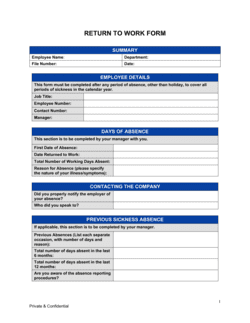
Add the return-to-work interview requirement
Confirm that a return-to-work interview is mandatory after every absence, or set a threshold (e.g., all absences of 3 or more days). Attach or reference the standard interview form so managers use a consistent structure.
💡 Return-to-work interviews are the single most effective lever for reducing absence rates — managers who conduct them consistently see fewer repeat short-term absences within 90 days.
8
Set the review date and assign ownership
Enter the name or role of the person responsible for the annual review, the scheduled review date, and the employee notification lead time for any changes.
💡 Calendar the review date in your HR task management system on the day you publish the policy — policies without a scheduled review are rarely updated until a compliance issue forces it.