Notice to Bank to Stop Payment on Check Template

Free Word download β€’ Edit online β€’ Save & share with Drive β€’ Export to PDF

1 pageβ€’15–25 min to fillβ€’Difficulty: Standard
Learn more ↓
FreeNotice to Bank to Stop Payment on Check Template

At a glance

What it is
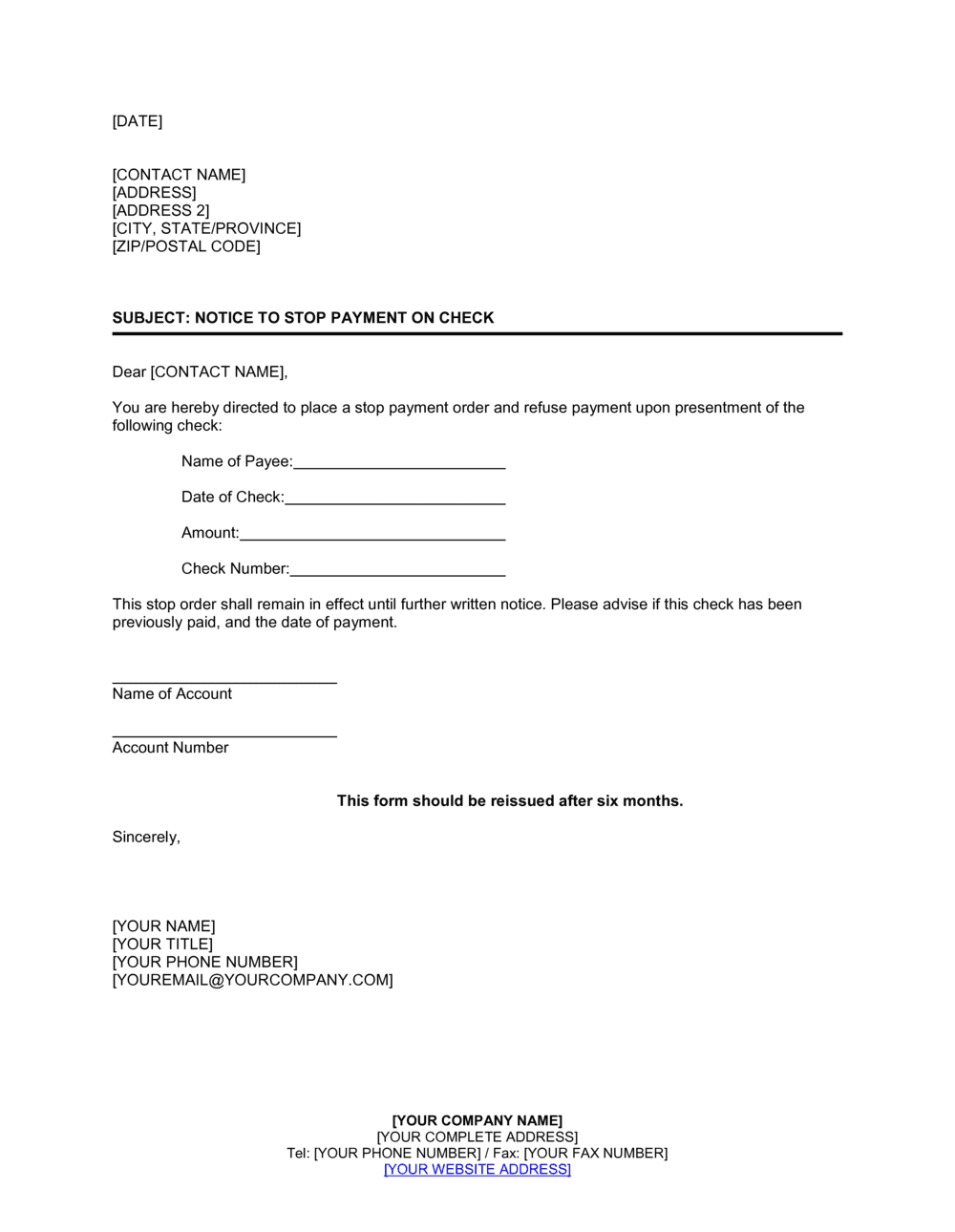
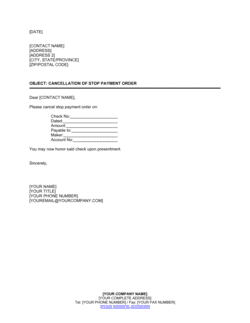
A Notice to Bank to Stop Payment on Check is a formal written instruction from an account holder directing their bank to refuse payment on a specific check before it clears. This free Word download gives you a ready-to-edit letter you can complete in minutes and submit to your bank by mail, fax, or in person to initiate the stop-payment process.
When you need it
Use it when a check has been lost, stolen, sent to the wrong payee, issued for an incorrect amount, or when a dispute with the payee makes payment inappropriate before the matter is resolved.
What's inside
Account holder and bank identification, check details (number, date, amount, and payee), the reason for the stop-payment request, a confirmation of the account holder's authority, and a request for written bank acknowledgment.

What is a Notice to Bank to Stop Payment on Check?

A Notice to Bank to Stop Payment on Check is a formal written instruction an account holder submits to their bank directing it to refuse payment on a specific check before the item clears. It identifies the account, the check number, the exact dollar amount, the payee, and the reason for the cancellation β€” creating a dated, documented record that the account holder acted promptly to halt an erroneous or problematic payment. Banks act on the instruction by flagging the check in their processing system so that if the item is presented, it is returned unpaid to the depositing institution.

Why You Need This Document

Placing a stop-payment order by phone is fast, but without a written record you have no proof the instruction was received if the check clears anyway. A properly completed notice letter gives you a dated paper trail that establishes when you acted, what you authorized, and that you were an authorized signatory on the account β€” the three elements you need if you must dispute an unauthorized charge with the bank or escalate to a regulator. For businesses, the stakes are higher: a lost or stolen check for a vendor payment, a payroll check, or a disputed invoice can represent thousands of dollars. Submitting this letter the same day you place the verbal request costs five minutes and protects you completely against the bank's most common defense β€” that no written instruction was on file.

Which variant fits your situation?

If your situation is…Use this template
Check was lost in the mail before reaching the payeeNotice to Bank to Stop Payment on Check
Check was stolen and fraudulent cashing is suspectedNotice to Bank to Stop Payment on Check
Disputing a vendor invoice and withholding payment pending resolutionLetter Disputing an Invoice
Formally notifying a payee that payment has been stoppedNotice of Stopped Payment to Payee
Requesting a replacement check after the original was canceledCheck Reissuance Request Letter
Disputing an unauthorized bank transaction rather than a checkBank Transaction Dispute Letter

Common mistakes to avoid

❌ Acting after the check has already cleared

Why it matters: A stop-payment order cannot reverse a completed transaction. Once funds have transferred, the bank has no authority to recall them and you must pursue the payee directly.

Fix: Check your account balance and transaction history immediately and submit the stop-payment request the same day you identify a problem.
❌ Providing an incorrect or approximate check amount

Why it matters: Banks match stop-payment orders against the exact dollar-and-cent amount on the check. An approximation β€” even off by one cent β€” may cause the order to fail and the check to clear.

Fix: Pull the exact amount from your check register or a check image in your online banking portal before completing the letter.

❌ Submitting the letter without a follow-up phone call

Why it matters: Mail and fax can be delayed or misdirected, giving the check time to clear before the order is on file.

Fix: Call the bank immediately to place a verbal stop-payment request, then submit this written letter as the formal confirmation and paper trail.

❌ Forgetting to renew the order after 6 months

Why it matters: Most stop-payment orders expire automatically after 6 months. If the underlying issue is unresolved, the check can be presented and honored after the order lapses.

Fix: Set a calendar reminder for 5 months and 3 weeks after the order date to renew it if the check has not yet been returned or destroyed.

The 9 key clauses, explained

Date and bank address block

In plain language: States the date the letter is sent and identifies the bank branch or department receiving the request.

Sample language
[DATE] [BANK NAME] [BRANCH ADDRESS] [CITY, STATE, ZIP] Attn: Account Services Department

Common mistake: Sending the letter to the general bank mailing address rather than the specific branch or department that handles stop-payment orders β€” this delays processing and the check may clear in the meantime.

Account holder identification

In plain language: Identifies the account holder by name, account number, and contact information so the bank can locate the correct account without ambiguity.

Sample language
Re: Stop Payment Request Account Holder: [FULL LEGAL NAME] Account Number: [ACCOUNT NUMBER] Contact: [PHONE / EMAIL]

Common mistake: Providing only a partial account number for privacy reasons. Banks need the full account number to act on the request; redacted numbers cause delays.

Opening instruction paragraph

In plain language: Clearly states the account holder's intent β€” directing the bank in plain language to stop payment on a specific check immediately.

Sample language
I am writing to formally request that you immediately stop payment on the following check drawn on the above-referenced account.

Common mistake: Using vague language like 'please look into this check' rather than an explicit stop-payment directive, which can cause bank staff to treat the letter as an inquiry rather than an actionable instruction.

Check identification details

In plain language: Lists every identifying detail of the check β€” number, issue date, exact dollar amount, and payee name β€” so the bank can match it precisely.

Sample language
Check Number: [CHECK NUMBER] | Issue Date: [DATE] | Amount: $[EXACT AMOUNT] | Payee: [PAYEE NAME]

Common mistake: Providing an approximate or rounded amount instead of the exact dollar-and-cent figure. Banks match on the exact amount; an approximation may cause the order to miss the target check.

Reason for stop-payment request

In plain language: Briefly explains why payment is being stopped β€” lost, stolen, dispute, incorrect amount, or wrong payee β€” giving the bank context and creating a paper trail.

Sample language
The reason for this stop-payment request is: [REASON β€” e.g., the check was lost in transit / the check was issued in error / a dispute exists with the payee regarding the underlying transaction].

Common mistake: Omitting the reason entirely. While not legally required in all cases, banks often ask for it, and having it documented helps if a dispute arises later about why payment was stopped.

Authorization statement

In plain language: Confirms that the person signing the letter is an authorized signatory on the account, establishing their right to issue the stop-payment instruction.

Sample language
I am an authorized signatory on the above-referenced account and have the authority to request this stop-payment order on behalf of [ACCOUNT HOLDER / COMPANY NAME].

Common mistake: Having a non-signatory (e.g., an assistant or junior employee) sign and submit the letter. Banks will reject instructions from unauthorized parties, losing critical processing time.

Fee acknowledgment

In plain language: Acknowledges that the account holder understands a stop-payment fee will be charged, reducing the chance the bank delays action pending fee confirmation.

Sample language
I understand that a stop-payment fee may be applied to my account in accordance with your current fee schedule and I authorize the deduction of that fee.

Common mistake: Disputing or questioning the fee in the letter itself. Banks treat fee disputes as a separate matter, and raising them here can slow processing of the actual stop-payment request.

Acknowledgment request

In plain language: Asks the bank to confirm in writing that the stop-payment order has been placed, establishing a record that the instruction was received and acted upon.

Sample language
Please provide written confirmation that this stop-payment order has been placed on the above check. You may reach me at [PHONE] or [EMAIL].

Common mistake: Not requesting written confirmation. Without it, you have no evidence the order was received, which matters if the check later clears and the bank claims no instruction was on file.

Closing and signature block

In plain language: Closes the letter professionally, includes the account holder's printed name, title (if applicable), and signature.

Sample language
Thank you for your prompt attention to this matter. Sincerely, [SIGNATURE] [PRINTED NAME] [TITLE, IF APPLICABLE] [DATE]

Common mistake: Sending the letter unsigned or with only a typed name. An unsigned stop-payment letter may not be treated as a formal instruction by some bank branches.

How to fill it out

  1. 1

    Confirm the check has not yet cleared

    Log into your online banking or call your bank to verify the check has not already been processed. A stop-payment order cannot reverse a payment that has already cleared.

    πŸ’‘ Act on the same business day you identify the problem β€” most checks clear within 1–3 business days of being deposited.

  2. 2

    Gather the exact check details from your check register

    Locate the check number, issue date, exact dollar-and-cent amount, and the payee's full name exactly as written on the check.

    πŸ’‘ If you do not have a check register, pull a copy of the check image from your online banking portal before it clears.

  3. 3

    Enter your account holder and bank information

    Fill in your full legal name, complete account number, the bank's branch name and address, and your contact details in the header of the letter.

    πŸ’‘ Address the letter to the bank's account services or operations department, not just the branch manager by name.

  4. 4

    State the reason for the stop-payment request

    Choose the most accurate reason β€” lost, stolen, issued in error, wrong payee, or payee dispute β€” and enter it in the reason clause.

    πŸ’‘ Keep the reason factual and brief. One sentence is sufficient; do not include a narrative of the full dispute in this letter.

  5. 5

    Sign the letter as an authorized account signatory

    Sign the letter with the same signature on file with the bank. If the account requires dual signatures, have both signatories sign before submission.

    πŸ’‘ If you manage multiple business accounts at the same bank, specify the exact account number in bold to avoid the order being applied to the wrong account.

  6. 6

    Submit by the fastest available method and follow up by phone

    Deliver the letter in person at the branch, by fax, or via the bank's secure message portal. Immediately follow up with a phone call to confirm receipt and placement of the order.

    πŸ’‘ Most banks also accept a verbal stop-payment request by phone β€” place that call first for speed, then submit this written notice to create a durable paper trail.

  7. 7

    File the bank's written confirmation

    Once the bank provides written or electronic confirmation of the stop-payment order, save it with your financial records alongside a copy of the letter.

    πŸ’‘ Set a calendar reminder for 6 months from the order date to renew it if the underlying issue is still unresolved β€” most stop-payment orders expire after 6 months.

Frequently asked questions

What is a notice to bank to stop payment on a check?

It is a formal written instruction from an account holder directing their bank to refuse to honor a specific check before it clears. The letter identifies the account, provides the check's number, date, exact amount, and payee, states the reason for the request, and asks the bank to confirm the order in writing. It creates a paper trail that supports the account holder if the check is later presented and cleared in error.

Can I stop payment on a check after it has already been deposited?

Not if it has already cleared. A stop-payment order only works while the check is still in transit through the banking system β€” typically within 1–3 business days of being deposited. Once funds have transferred from your account to the payee's account, the transaction is final and the bank cannot reverse it. Act on the same day you identify the problem.

Does stopping payment on a check cost money?

Yes. Most banks charge a stop-payment fee ranging from $15 to $35 per check, which is debited directly from your account. Some banks waive the fee for premium checking accounts or business accounts with higher balance tiers. Check your bank's current fee schedule before submitting the request and include an explicit fee authorization in your letter to avoid processing delays.

How long does a stop-payment order last?

In the United States, stop-payment orders typically expire after 6 months. In Canada, the period varies by bank but is commonly 6 months as well. After expiry, the check can be presented and honored unless you renew the order. If the underlying issue is unresolved at the 6-month mark, contact your bank to renew the order before it lapses.

Does a written letter carry more weight than a verbal stop-payment request?

Both are effective, and banks typically act on verbal requests immediately by phone. The written letter matters because it creates a dated, documented paper trail. If the check later clears and you need to dispute the charge, the letter proves when and how you instructed the bank. Best practice is to place the verbal request by phone for speed and then submit the written notice the same day.

What information do I need to complete a stop-payment notice?

You need your full legal name, your complete bank account number, the check number, the exact issue date, the exact dollar-and-cent amount, and the payee's name exactly as written on the check. You also need the bank's correct mailing or fax address for account services. Missing or approximate details are the most common reason stop-payment orders fail to match the target check.

What happens if the bank honors the check after I submitted a stop-payment order?

If you submitted a valid, timely stop-payment order and the bank processed the check anyway, the bank is generally liable for the loss under the Uniform Commercial Code in the US. You should file a formal written complaint with the bank, reference your stop-payment confirmation, and request a credit for the amount. If the bank refuses, escalate to your state banking regulator or the Consumer Financial Protection Bureau.

Can a payee sue me for stopping payment on a check?

Stopping payment is generally lawful when there is a legitimate reason β€” lost check, billing dispute, or issuing error. However, if the underlying debt is valid and you stop payment without justification, the payee can pursue collection through civil court. In some US states, issuing a check with intent to stop payment fraudulently can carry criminal liability. Always stop payment for a legitimate reason and address the underlying obligation separately.

How this compares to alternatives

vs ACH Stop Payment Request

An ACH stop payment request halts an electronic funds transfer rather than a paper check. The process, form, and bank deadlines differ β€” ACH stops must often be placed before 3:00 PM on the business day prior to the scheduled transfer. A check stop-payment notice does not cover ACH transactions; use the correct instrument for the payment type.

vs Letter Disputing an Invoice

A letter disputing an invoice is sent to the payee or vendor to contest the charges and request a correction. A stop-payment notice is sent to the bank to block the check while the dispute is resolved. Both are often used together β€” dispute the invoice with the vendor and stop the check with the bank simultaneously.

vs Notice of Stopped Payment to Payee

A notice of stopped payment to the payee informs the recipient that the check has been canceled and explains why. The bank notice authorizes the bank to act; the payee notice manages the business relationship and prevents the payee from re-presenting the check or escalating unnecessarily. Both letters are typically sent at the same time.

vs Check Reissuance Request Letter

A check reissuance request asks the bank or payee to issue a replacement check after the original has been stopped. The stop-payment notice cancels the original; the reissuance request initiates the replacement. For lost or misdirected checks, you will typically need both documents in sequence.

Industry-specific considerations

Construction and Contracting

Stopping payment on progress checks when a contractor fails to meet milestones or when lien waivers have not been received before payment was issued.

Retail and E-commerce

Canceling checks issued to suppliers for orders that were never delivered, shipped incorrectly, or returned before the check cleared.

Professional Services

Stopping payment on retainer or fee checks when a services engagement is terminated before work begins or when scope disputes arise post-issuance.

Healthcare and Medical Practices

Halting vendor or supplier checks when billing errors are identified and the practice needs time to reconcile invoices before releasing payment.

Template vs pro β€” what fits your needs?

PathBest forCostTime
Use the templateAny account holder stopping payment on a lost, stolen, or erroneously issued checkFree5–10 minutes
Template + professional reviewBusinesses stopping payment as part of a formal vendor dispute or potential fraud investigation$0–$100 (brief review by an accountant or office counsel)30–60 minutes
Custom draftedHigh-value checks involved in litigation, fraud, or where the bank has already honored the check in error$200–$600 (attorney-drafted demand letter)1–3 days

Glossary

Stop Payment Order
A bank instruction from an account holder directing the bank to refuse to honor a specific check that has not yet been processed.
Check Number
The unique sequential number printed on a check, used by the bank to identify the specific item subject to the stop-payment request.
Payee
The individual or company named on the check as the intended recipient of the funds.
Drawer
The account holder who wrote and signed the check, also referred to as the maker.
Clearing
The process by which a check moves through the banking system and funds are transferred from the drawer's account to the payee's account.
Stop Payment Fee
A service charge banks levy to process a stop-payment order, typically ranging from $15 to $35 per check depending on the institution.
Stop Payment Expiry
The period after which a stop-payment order automatically lapses β€” typically 6 months in the US, after which it must be renewed if still needed.
ACH Stop Payment
A separate bank instruction used to halt an electronic funds transfer rather than a paper check β€” not covered by a standard check stop-payment notice.
Check Register
An account holder's log of all checks issued, including number, date, payee, and amount β€” the primary source for confirming check details in a stop-payment request.

Part of your Business Operating System

This document is one of 3,000+ business & legal templates included in Business in a Box.

  • Fill-in-the-blanks β€” ready in minutes
  • 100% customizable Word document
  • Compatible with all office suites
  • Export to PDF and share electronically

Create your document in 3 simple steps.

From template to signed document β€” all inside one Business Operating System.
1
Download or open template

Access over 3,000+ business and legal templates for any business task, project or initiative.

2
Edit and fill in the blanks with AI

Customize your ready-made business document template and save it in the cloud.

3
Save, Share, Send, Sign

Share your files and folders with your team. Create a space of seamless collaboration.

Save time, save money, and create top-quality documents.

β˜…β˜…β˜…β˜…β˜…

"Fantastic value! I'm not sure how I'd do without it. It's worth its weight in gold and paid back for itself many times."

Managing Director Β· Mall Farm
Robert Whalley
Managing Director, Mall Farm Proprietary Limited
β˜…β˜…β˜…β˜…β˜…

"I have been using Business in a Box for years. It has been the most useful source of templates I have encountered. I recommend it to anyone."

Business Owner Β· 4+ years
Dr Michael John Freestone
Business Owner
β˜…β˜…β˜…β˜…β˜…

"It has been a life saver so many times I have lost count. Business in a Box has saved me so much time and as you know, time is money."

Owner Β· Upstate Web
David G. Moore Jr.
Owner, Upstate Web

Run your business with a system β€” not scattered tools

Stop downloading documents. Start operating with clarity. Business in a Box gives you the Business Operating System used by over 250,000 companies worldwide to structure, run, and grow their business.

Start freeΒ Β·Β No credit card required