Online Retailer Business Plan Template

Free Word download β€’ Edit online β€’ Save & share with Drive β€’ Export to PDF

28 pagesβ€’2h 25m – 3h 15m to fillβ€’Difficulty: Expert
Learn more ↓
FreeOnline Retailer Business Plan Template

At a glance

What it is
An Online Retailer Business Plan is a structured document that maps your e-commerce venture's product strategy, target market, competitive positioning, fulfillment model, marketing channels, and 3–5 year financial projections into a single investor- and lender-ready reference. This free Word download gives you a complete, editable starting point you can customize and export as PDF to share with banks, investors, or your own leadership team.
When you need it
Use it when launching a new online store, applying for a business loan or e-commerce-focused financing, raising startup capital, or formalizing a growth strategy for an existing shop that has outgrown its informal origins.
What's inside
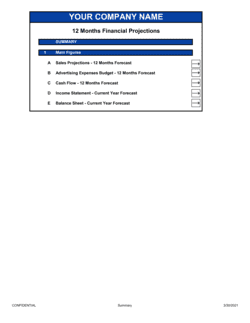
Executive summary, company overview, market and competitive analysis, product catalog and sourcing strategy, marketing and customer acquisition plan, technology and platform infrastructure, fulfillment and logistics operations, management team, and financial projections including P&L, cash flow, and inventory cost model.

What is an Online Retailer Business Plan?

An Online Retailer Business Plan is a structured document that defines an e-commerce business's product strategy, target market, competitive positioning, fulfillment model, marketing and customer acquisition approach, technology infrastructure, and 3–5 year financial projections β€” including a P&L, cash flow statement, and inventory working capital model. Unlike a general business plan, it addresses the operational and financial realities specific to product-based online selling: SKU-level unit economics, supplier lead times, platform scalability, channel-level CAC, and the cash tied up in inventory ahead of sales. Founders use it to raise equity or debt financing; operators use it to align teams around measurable growth milestones and hold the business accountable to a concrete plan.

Why You Need This Document

Without a written plan, e-commerce businesses consistently hit the same wall: they run out of cash while growing because nobody modeled the inventory cash requirement alongside the revenue forecast. Lenders and investors who fund online retail businesses look specifically for a fulfillment model, a channel-level customer acquisition strategy, and a working capital schedule β€” and decline applications that omit them. A structured plan also forces decisions before they become expensive: which two or three acquisition channels to fund first, which SKUs have margins too thin to survive at scale, and at what order volume the current fulfillment setup breaks. Completing this template before you spend significantly on inventory or advertising turns those potential surprises into planned line items β€” and gives you a document credible enough to take to a bank or investor meeting.

Which variant fits your situation?

If your situation is…Use this template
Launching a general direct-to-consumer product brandOnline Retailer Business Plan
Opening a restaurant or food-service businessRestaurant Business Plan
Starting a nonprofit e-commerce or social enterpriseNonprofit Business Plan
Quick internal planning or early-stage product ideationOne-Page Business Plan
Planning a new product launch within an existing online storeNew Product Launch Plan
Pitching an investor with a visual slide formatPitch Deck
Aligning a growing e-commerce team around a 3-year roadmapStrategic Plan

Common mistakes to avoid

❌ Projecting revenue without a matching inventory model

Why it matters: E-commerce businesses routinely run out of cash while growing because inventory must be purchased weeks before revenue is collected β€” a gap that compounds with every growth spike.

Fix: Build a month-by-month inventory cash requirement model alongside the P&L, showing opening stock, purchases, COGS, and closing stock for each period.

❌ Using top-down market sizing with no bottom-up check

Why it matters: Citing '$6 trillion in global e-commerce' with a claimed 0.01% share sounds reasonable but is meaningless without a customer count and order volume model to support it.

Fix: Build a bottom-up estimate: reachable customer count Γ— estimated purchase frequency Γ— AOV = realistic revenue ceiling for Year 3.

❌ Listing every marketing channel without channel-level budgets

Why it matters: A plan that says 'we will use paid social, SEO, influencers, email, and Google Shopping' without spend allocation or CAC estimates signals no real acquisition strategy.

Fix: Prioritize two to three channels, assign a monthly budget to each, and show the expected orders and CAC generated per channel in the financial model.

❌ Ignoring return rates in the financial projections

Why it matters: E-commerce return rates average 20–30% in categories like apparel and footwear β€” omitting them overstates net revenue by a material amount and misleads on true gross margin.

Fix: Apply a category-appropriate return rate assumption to gross order volume to arrive at net revenue, and include return processing costs in the fulfillment cost line.

❌ Skipping the technology and platform section

Why it matters: Platform transaction limits, API constraints, and checkout customization ceilings become operational blockers at scale β€” and upgrading mid-growth is expensive and disruptive.

Fix: Document your current platform, its capacity limits, and the revenue threshold at which you will need to upgrade, with an estimated migration cost.

❌ Writing the executive summary first

Why it matters: An executive summary written before the rest of the plan is done will contain figures and claims that contradict the detailed sections, making the document look uncoordinated.

Fix: Write every other section first, then distill the executive summary from the finished plan using actual numbers from the financial model.

The 10 key sections, explained

Executive Summary

Company Overview

Market Analysis

Competitive Analysis

Products and Sourcing Strategy

Marketing and Customer Acquisition

Technology and Platform Infrastructure

Fulfillment and Logistics

Management Team

Financial Projections

How to fill it out

  1. 1

    Complete the company overview and define your offer

    Enter your legal entity name, store URL, platform, and a one-sentence mission. Define your product category, number of SKUs at launch, and average selling price.

    πŸ’‘ Lock the product scope before writing any other section β€” scope creep mid-document creates inconsistencies between the product, financial, and marketing sections.

  2. 2

    Build the market analysis with category-specific data

    Research your specific product category using sources like Statista, IBISWorld, or trade association reports. Size TAM at the category level, SAM by reachable geography and customer segment, and SOM by realistic Year 3 order volume.

    πŸ’‘ Cross-check top-down category sizing against a bottom-up estimate: target customer count Γ— purchase frequency Γ— AOV. The two numbers should be within 30% of each other.

  3. 3

    Map competitors and define your differentiation

    Identify at least four competitors including Amazon and big-box alternatives. For each, note price point, fulfillment speed, product breadth, and brand positioning. Write one specific paragraph on why your store wins against each.

    πŸ’‘ Run a live test purchase from your top two competitors before writing this section β€” delivery experience, packaging, and post-purchase email reveal differentiation opportunities not visible from their websites.

  4. 4

    Document your sourcing model and unit economics

    Enter supplier name, country, minimum order quantity, lead time, and landed cost per unit for each major SKU group. Calculate gross margin per SKU and flag any product with a margin below 40%.

    πŸ’‘ Build a separate supplier risk table noting backup suppliers for your top three revenue-generating SKUs β€” lenders ask about single-supplier dependency.

  5. 5

    Define acquisition channels with CAC estimates

    Select two to three primary acquisition channels. For each, estimate monthly spend, expected CAC, and conversion rate. Tie these inputs directly to your Year 1 revenue model.

    πŸ’‘ If you have no historical CAC data, use industry benchmarks by category (e.g., fashion DTC paid social CAC averages $25–$60) and note the source β€” estimated benchmarks are more credible than blank fields.

  6. 6

    Describe your fulfillment model and capacity

    State whether you self-fulfill, use a 3PL, dropship, or use a hybrid. Enter average shipping cost per order, return rate assumption, and maximum daily order capacity under the current model.

    πŸ’‘ Include the 3PL contract threshold β€” the order volume at which you must upgrade the fulfillment agreement β€” so investors can see you have modeled the scaling constraint.

  7. 7

    Build the financial model from unit economics up

    Model monthly P&L for Year 1 starting from order volume Γ— AOV, subtract COGS and returns to get net revenue, then layer in marketing, platform, fulfillment, and G&A costs. Extend annually for Years 2–5.

    πŸ’‘ Add a separate tab showing inventory cash requirements month by month β€” this is the single most common cash flow surprise in e-commerce and will be the first thing a lender checks.

  8. 8

    Write the executive summary last

    Pull the single strongest data point from each section and compress into 1–2 pages. Include your funding ask, the specific milestone it funds, and your projected payback timeline.

    πŸ’‘ If your executive summary exceeds two pages, cut the weakest paragraph. Investors read the summary and the financial model first; everything else is diligence material.

Frequently asked questions

What is an online retailer business plan?

An online retailer business plan is a structured document that maps an e-commerce business's product strategy, target market, competitive positioning, fulfillment model, marketing channels, and financial projections into a single reference. It is used to raise capital, secure business loans, and align a founding team around a concrete growth strategy before significant money is spent on inventory or advertising.

What sections should an online retailer business plan include?

A complete plan covers ten sections: executive summary, company overview, market analysis, competitive analysis, products and sourcing strategy, marketing and customer acquisition, technology and platform infrastructure, fulfillment and logistics, management team, and financial projections. The financial section should include a P&L, cash flow statement, and an inventory working capital model β€” the last item is specific to product-based e-commerce and is frequently omitted from generic templates.

Do I need a business plan to start an online store?

You do not legally need one to register a store, but you need one the moment you seek external capital, apply for a business loan, or spend more than a few thousand dollars on inventory. The planning process itself is valuable β€” building the financial model forces you to confront CAC, gross margin, and inventory cash requirements before they become live problems.

How is an online retailer business plan different from a general business plan?

The core structure is similar, but an online retailer plan requires sections that a general plan omits: a technology and platform infrastructure section, a fulfillment and logistics model, channel-level CAC estimates, return rate assumptions in the financial model, and an inventory working capital schedule. Lenders and investors familiar with e-commerce will look for all of these specifically.

What financial projections should I include?

Include a monthly P&L for Year 1 (with revenue broken down by channel), annual projections for Years 2–5, a cash flow statement, and a month-by-month inventory cash requirement schedule. Key metrics to model explicitly include AOV, conversion rate, CAC by channel, gross margin, return rate, and repeat purchase rate. These are the inputs investors will stress-test first.

How long should an online retailer business plan be?

For a bank loan or investor audience, 20–30 pages plus a financial model appendix is the accepted range. Internal operating plans can be shorter. A one-page canvas works for early ideation but is not sufficient for any capital raise. The financial model is typically attached as a separate Excel or Google Sheets file and does not count toward the page target.

Can I use this template for a dropshipping business?

Yes β€” the template covers dropshipping as a sourcing and fulfillment model variant. In the products and sourcing section, document your supplier relationships, margin per SKU after supplier cost, and the average fulfillment time from order placement to customer delivery. Note that dropshipping margins are typically lower (15–30%) than branded inventory models, so the financial projections must reflect the higher volume needed to reach profitability targets.

How often should an online retailer business plan be updated?

Update it before any new capital raise, loan renewal, or significant strategic pivot. For an actively growing store, a full annual review aligned to the fiscal year is standard, with a mid-year checkpoint to reconcile the financial model against actual orders, CAC, and inventory levels. A plan more than 12 months old is a historical document, not a live strategy tool.

What do investors look for in an e-commerce business plan?

The four things investors examine first: unit economics (CAC, LTV, and gross margin), the inventory and working capital model, the customer acquisition strategy with realistic CAC estimates by channel, and evidence that the founding team has operated an e-commerce business before. Hockey-stick revenue projections with no supporting order volume model, and a competitive analysis that ignores Amazon, are the two fastest ways to lose credibility.

How this compares to alternatives

vs General Business Plan

A general business plan covers any business type with a standard structure. An online retailer plan adds e-commerce-specific sections β€” platform infrastructure, fulfillment model, channel-level CAC, return rate assumptions, and an inventory working capital schedule β€” that general templates omit. Use the general plan for service or SaaS businesses; use this one for any product-based online store.

vs One-Page Business Plan

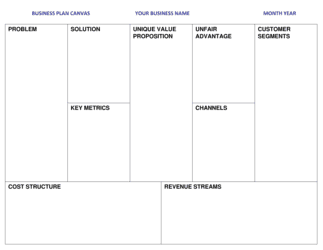
A one-page canvas is a rapid-alignment tool for early ideation or internal team alignment. It lacks the financial depth, market evidence, and operational detail that lenders and investors require. Use it to test the concept quickly, then build the full online retailer plan before approaching any capital source.

vs Marketing Plan

A marketing plan focuses exclusively on customer acquisition, channel strategy, and campaign execution. An online retailer business plan includes the marketing strategy as one of ten sections, paired with financial projections, sourcing, fulfillment, and team details. Investors and lenders need the full picture; a standalone marketing plan is insufficient for capital-raise purposes.

vs Product Launch Plan

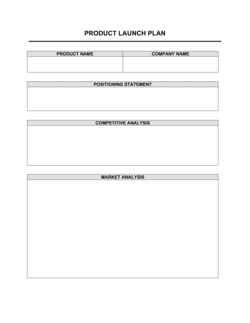
A product launch plan covers the go-to-market execution for a single product or collection β€” launch timeline, channel tactics, and success metrics. An online retailer business plan covers the entire business, including multi-year financials and operational infrastructure. Use the launch plan for individual product releases; use this template when presenting the business as a whole.

Industry-specific considerations

Apparel and Fashion

Return rates of 20–35% must be modeled into net revenue; size and fit descriptions reduce returns and are a direct margin lever.

Health, Beauty, and Wellness

Subscription and auto-replenishment models dramatically improve LTV and reduce CAC payback periods; FDA labeling requirements affect product launch timelines.

Consumer Electronics and Accessories

High AOV enables larger paid acquisition budgets per order, but longer purchase cycles require a multi-touch attribution model in the marketing section.

Food, Beverage, and Specialty Grocery

Cold chain logistics, shelf life, and USDA/FDA compliance add material fulfillment and regulatory costs that must be reflected in the operations and financial sections.

Home Goods and Furniture

Oversized item shipping costs and damage-in-transit return rates are disproportionately high; white-glove delivery services affect margin but reduce return rates significantly.

Sports, Outdoors, and Hobby

Strong seasonal demand patterns require an inventory purchasing calendar tied to the cash flow model to avoid both stockouts during peak periods and overstock in off-season.

Template vs pro β€” what fits your needs?

PathBest forCostTime
Use the templateEarly-stage founders, SBA loans under $350K, and internal team alignmentFree2–4 weeks (30–60 hours)
Template + professional reviewSeed raises up to $500K, first bank loan, or plans requiring a validated financial model$500–$2,000 for a financial model review or e-commerce advisor session3–5 weeks
Custom draftedSeries A raises, institutional lenders, or complex multi-channel operations with significant inventory financing$3,000–$8,000 for a professional business plan writer with e-commerce experience4–8 weeks

Glossary

Average Order Value (AOV)
Total revenue divided by the number of orders in a given period β€” a key lever for e-commerce profitability alongside conversion rate and traffic.
Customer Acquisition Cost (CAC)
Total sales and marketing spend divided by the number of new customers acquired in the same period.
Customer Lifetime Value (LTV)
The total gross profit expected from a single customer over the entire relationship, used to determine how much you can profitably spend to acquire them.
Conversion Rate
The percentage of website visitors who complete a purchase β€” industry average for e-commerce is 1–4% depending on category and traffic source.
Dropshipping
A fulfillment model where the retailer never holds inventory β€” orders are forwarded directly to a third-party supplier who ships to the customer.
SKU (Stock Keeping Unit)
A unique identifier assigned to each distinct product variant (size, color, style) for tracking inventory and sales.
Cost of Goods Sold (COGS)
The direct cost of products sold in a period, including purchase price, inbound freight, and duties β€” used to calculate gross margin.
Return Rate
The percentage of orders returned by customers, which directly reduces net revenue and increases fulfillment costs.
Gross Margin
Revenue minus COGS, expressed as a percentage of revenue β€” healthy e-commerce margins typically run 40–65% for branded products.
3PL (Third-Party Logistics)
An outsourced fulfillment provider that warehouses inventory, picks and packs orders, and manages shipping on the retailer's behalf.
ROAS (Return on Ad Spend)
Revenue generated per dollar spent on paid advertising β€” a ROAS of 3Γ— means $3 in revenue for every $1 spent on ads.

Part of your Business Operating System

This document is one of 3,000+ business & legal templates included in Business in a Box.

  • Fill-in-the-blanks β€” ready in minutes
  • 100% customizable Word document
  • Compatible with all office suites
  • Export to PDF and share electronically

Create your document in 3 simple steps.

From template to signed document β€” all inside one Business Operating System.
1
Download or open template

Access over 3,000+ business and legal templates for any business task, project or initiative.

2
Edit and fill in the blanks with AI

Customize your ready-made business document template and save it in the cloud.

3
Save, Share, Send, Sign

Share your files and folders with your team. Create a space of seamless collaboration.

Save time, save money, and create top-quality documents.

β˜…β˜…β˜…β˜…β˜…

"Fantastic value! I'm not sure how I'd do without it. It's worth its weight in gold and paid back for itself many times."

Managing Director Β· Mall Farm
Robert Whalley
Managing Director, Mall Farm Proprietary Limited
β˜…β˜…β˜…β˜…β˜…

"I have been using Business in a Box for years. It has been the most useful source of templates I have encountered. I recommend it to anyone."

Business Owner Β· 4+ years
Dr Michael John Freestone
Business Owner
β˜…β˜…β˜…β˜…β˜…

"It has been a life saver so many times I have lost count. Business in a Box has saved me so much time and as you know, time is money."

Owner Β· Upstate Web
David G. Moore Jr.
Owner, Upstate Web

Run your business with a system β€” not scattered tools

Stop downloading documents. Start operating with clarity. Business in a Box gives you the Business Operating System used by over 250,000 companies worldwide to structure, run, and grow their business.

Free Forever PlanΒ Β·Β No credit card required