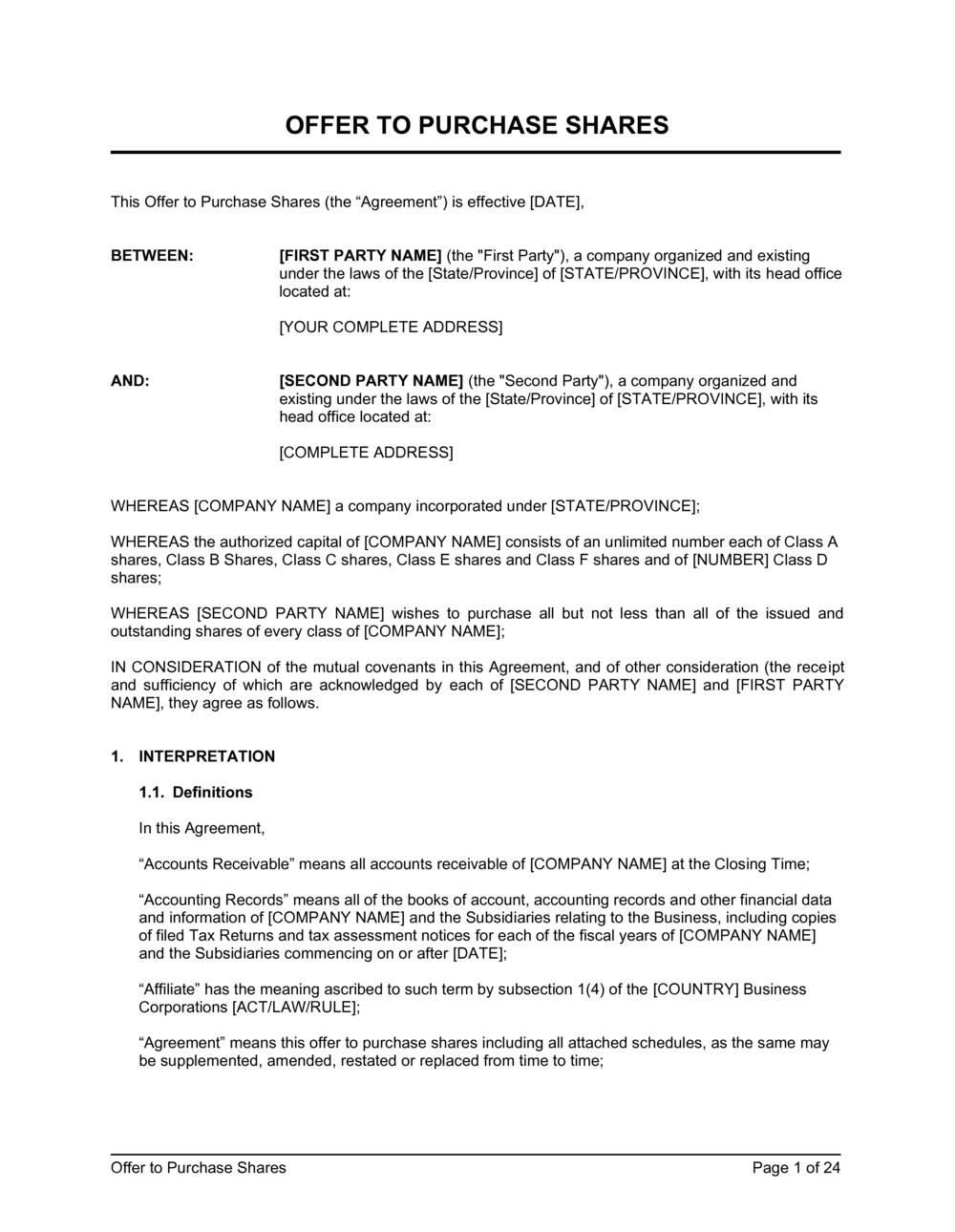
Offer to Purchase Shares Agreement Venture Capital Template

Free Word download β€’ Edit online β€’ Save & share with Drive β€’ Export to PDF

24 pagesβ€’35–45 min to fillβ€’Difficulty: Complex
Learn more ↓
FreeOffer to Purchase Shares Agreement Venture Capital Template

At a glance

What it is
An Offer to Purchase Shares Agreement (Venture Capital) is a formal written notice from a venture capital investor to a startup or private company, setting out the specific terms under which the investor proposes to acquire a defined number of shares. This free Word download gives you a structured, ready-to-send letter you can edit online and export as PDF in minutes.
When you need it
Use it when a VC firm or individual investor is ready to formally propose an equity investment in a private company β€” after due diligence but before a binding share purchase agreement is executed. It establishes the key commercial terms in writing and signals serious intent to close.
What's inside
Identification of the offeror and target company, the number and class of shares being purchased, the proposed price per share, total consideration, conditions precedent, a proposed closing date, and an acceptance mechanism for the receiving party to confirm agreement in principle.

What is an Offer to Purchase Shares Agreement (Venture Capital)?

An Offer to Purchase Shares Agreement (Venture Capital) is a formal written notice issued by a venture capital investor or fund to a private company, proposing to acquire a specific number and class of shares at an agreed price per share. It records the core commercial terms of the proposed investment β€” pre-money valuation, total consideration, conditions that must be met before closing, and the proposed closing date β€” in a structured letter format before a binding share purchase agreement is negotiated and executed. Unlike a full term sheet, it focuses narrowly on the acquisition mechanics rather than governance and investor rights, making it the practical first document in a seed or early-stage equity transaction.

Why You Need This Document

Proceeding with a venture capital share purchase based on verbal agreement or informal email exchanges exposes both the investor and the company to serious risk. Without a written offer letter, there is no agreed reference point for price, share class, or conditions β€” leaving either party free to reinterpret the deal terms as negotiations progress. For the investor, an undocumented offer provides no exclusivity protection, meaning the company can simultaneously negotiate with competing investors using the investor's own valuation as a floor. For the company, accepting an undocumented offer creates uncertainty about what conditions the investor can invoke to delay or walk away from the deal. This template puts the key terms in writing quickly, triggers a defined acceptance and exclusivity period, and creates the documented foundation from which lawyers can draft the definitive share purchase agreement β€” reducing the risk of a deal falling apart over a misremembered detail.

Which variant fits your situation?

If your situation is…Use this template
Acquiring 100% of a company's shares from existing shareholdersShare Purchase Agreement
Investor making a convertible loan that may convert to equity laterConvertible Note Agreement
Formalizing investment terms before drafting full deal documentsTerm Sheet (Venture Capital)
Purchasing newly issued shares directly from the company treasurySubscription Agreement
Acquiring shares from an existing shareholder rather than the companyShare Transfer Agreement
Issuing a right of first refusal on shares before a third-party saleRight of First Refusal Agreement
Documenting a co-investor's proportional share of the offerCo-Investment Side Letter

Common mistakes to avoid

❌ No expiry date on the offer

Why it matters: An offer with no expiry remains technically open indefinitely, and a late acceptance at an inconvenient moment can create an unintended binding obligation.

Fix: Always include a specific expiry date and time. Five to ten business days from issuance is the market norm for VC share purchase offers.
❌ Omitting the share class

Why it matters: Common and preferred shares carry materially different economic and governance rights. An offer that omits the class is ambiguous and will require renegotiation before any binding document can be drafted.

Fix: State the exact share class as it appears in the company's articles of incorporation or the most recent funding round documentation.

❌ Vague conditions precedent with no ownership or deadline

Why it matters: A condition that says 'satisfactory due diligence' with no deadline can be used indefinitely to delay or reopen price negotiations after the offer is accepted.

Fix: Assign each condition to a responsible party and attach a specific completion deadline.

❌ Skipping the confidentiality clause

Why it matters: Unintended disclosure of offer terms to other investors or the press can reset valuation expectations and give competing bidders an advantage.

Fix: Include a mutual confidentiality obligation covering both the existence and the terms of the offer, with carve-outs only for professional advisors.

The 9 key clauses, explained

Parties and introduction

In plain language: Identifies the offeror and the target company by full legal name and registered address, and states the date of the letter.

Sample language
This offer is made on [DATE] by [INVESTOR LEGAL NAME], of [ADDRESS] ('Offeror'), to [COMPANY LEGAL NAME], incorporated in [JURISDICTION] ('Company').

Common mistake: Using a trade name instead of the registered legal entity name. Mismatched names between this letter and subsequent binding documents create execution delays.

Offer to purchase and share details

In plain language: States the number of shares, the share class, and the specific price per share the offeror is willing to pay.

Sample language
The Offeror hereby offers to purchase [NUMBER] [CLASS] shares of the Company at a price of $[AMOUNT] per share, representing a pre-money valuation of $[VALUATION].

Common mistake: Omitting the share class. Common and preferred shares carry different rights β€” failing to specify the class creates ambiguity that can delay or derail closing.

Total consideration

In plain language: Sets out the aggregate purchase price and how and when it will be paid β€” lump sum at closing, staged tranches, or subject to milestones.

Sample language
The aggregate consideration payable by the Offeror shall be $[TOTAL AMOUNT], payable in full on the Closing Date by wire transfer to the Company's designated account.

Common mistake: Describing staged payments without tying each tranche to a specific milestone or date. Vague staging language is the single most common cause of post-offer payment disputes.

Pre-money valuation and ownership

In plain language: States the implied pre-money and post-money valuation and the resulting ownership percentage the investor will hold after the transaction closes.

Sample language
This offer reflects a pre-money valuation of $[AMOUNT] and a post-money valuation of $[AMOUNT], resulting in the Offeror holding approximately [X]% of the Company's fully diluted share capital upon closing.

Common mistake: Omitting the 'fully diluted' qualifier. Ownership stated on an issued-shares basis can look materially different once options and warrants are counted in.

Conditions precedent

In plain language: Lists the specific conditions that must be satisfied before the Offeror is obligated to complete the purchase β€” such as board approval, due diligence sign-off, or regulatory consent.

Sample language
This offer is conditional upon: (a) satisfactory completion of the Offeror's due diligence; (b) approval by the Company's board of directors; and (c) execution of a definitive Share Purchase Agreement in a form acceptable to both parties.

Common mistake: Listing conditions without specifying who is responsible for satisfying each one and by what date. Open-ended conditions can be used to indefinitely delay or renegotiate terms.

Proposed closing date

In plain language: Sets the target date on which the transaction is expected to complete, with funds transferred and shares registered in the investor's name.

Sample language
Subject to satisfaction of the conditions above, the Offeror proposes a Closing Date of [DATE], or such other date as the parties may agree in writing.

Common mistake: Setting an unrealistically short closing timeline before legal documentation is drafted. Rushed closings that miss the stated date can create uncertainty about whether the offer remains open.

Exclusivity period

In plain language: Requests that the company refrain from soliciting or accepting competing offers for a defined period while the parties work toward closing.

Sample language
In consideration of the Offeror's due diligence investment, the Company agrees not to solicit, negotiate, or accept any competing offers for the purchase of its shares for a period of [X] days from the date of acceptance of this offer.

Common mistake: Making the exclusivity period too long without a corresponding obligation to progress deal documentation. Founders accept 60-day exclusivity and then face a slow-moving investor with no recourse.

Confidentiality

In plain language: Requires both parties to keep the existence and terms of the offer confidential until a binding agreement is executed or a public announcement is authorized.

Sample language
Both parties agree to keep the terms of this offer strictly confidential and not to disclose them to any third party without the prior written consent of the other party, except to professional advisors under an equivalent duty of confidence.

Common mistake: Omitting confidentiality entirely from a share purchase offer letter. Disclosure of offer terms to other investors or competitors can affect valuation negotiations or trigger unwanted third-party interest.

Acceptance mechanism and expiry

In plain language: States how the receiving party should formally accept the offer β€” typically countersignature β€” and the deadline by which acceptance must be received.

Sample language
This offer will remain open for acceptance until [DATE / TIME] ('Expiry'). To accept, please sign and return the enclosed copy of this letter. This offer lapses automatically if not accepted by the Expiry.

Common mistake: No expiry date. An open-ended offer can be 'accepted' weeks later at a time no longer convenient for the offeror, creating an unintended contractual obligation.

How to fill it out

  1. 1

    Enter both parties' legal names and addresses

    Replace the placeholders with the investor's and target company's full registered legal names and addresses. Confirm the company's jurisdiction of incorporation.

    πŸ’‘ Pull the exact legal name from the company's most recent corporate registry filing β€” even small discrepancies cause problems when executing the final share purchase agreement.

  2. 2

    Specify the share class, number, and price per share

    Enter the exact share class (e.g., Series A preferred), the number of shares being purchased, and the agreed price per share. Cross-check the class with the company's current capitalization table.

    πŸ’‘ Confirm with the company whether the shares are newly issued or being transferred from an existing shareholder β€” the mechanics and tax treatment differ significantly.

  3. 3

    Calculate and state the total consideration

    Multiply the number of shares by the price per share and enter the total. State the payment method (wire transfer) and whether payment will be made in a single tranche or staged.

    πŸ’‘ For staged payments, attach a separate schedule naming each milestone and its corresponding dollar amount rather than embedding milestones in the letter body.

  4. 4

    State the pre-money valuation and resulting ownership

    Enter the agreed pre-money valuation, calculate the post-money valuation, and state the Offeror's resulting ownership percentage on a fully diluted basis.

    πŸ’‘ Request an up-to-date cap table from the company before completing this section β€” undisclosed options or warrants can shift the fully diluted percentage by several points.

  5. 5

    List and assign the conditions precedent

    Enumerate each condition that must be met before closing, and note who is responsible for satisfying it. Include a deadline for each condition where possible.

    πŸ’‘ Limit conditions to items that are genuinely deal-critical. Every additional condition gives the other party a potential exit point.

  6. 6

    Set the closing date and exclusivity period

    Enter a realistic closing date β€” typically 30–60 days from acceptance β€” and an exclusivity period of the same or shorter duration.

    πŸ’‘ Align the exclusivity period with the time you realistically need to draft and negotiate the definitive share purchase agreement.

  7. 7

    Set the acceptance deadline and send

    Enter a clear expiry date and time for the offer. Export the completed letter as PDF, sign it, and deliver it to the company's authorized representative.

    πŸ’‘ Send via email with read receipt and keep a timestamped copy. In any future dispute, proof of delivery and the exact offer terms will be the first thing either party's lawyer requests.

Frequently asked questions

What is an offer to purchase shares in a venture capital context?

An offer to purchase shares (venture capital) is a formal written notice from an investor to a private company, proposing to acquire a specific number and class of shares at a defined price. It sets out the key commercial terms β€” valuation, consideration, conditions, and closing timeline β€” before a binding share purchase agreement is drafted. It signals serious intent and establishes a framework for final documentation.

Is this offer letter legally binding?

In most jurisdictions, an offer letter of this type is not a binding share purchase agreement β€” it is a statement of intent subject to conditions precedent and the execution of definitive documents. However, specific clauses such as confidentiality and exclusivity are typically binding on acceptance. Consider consulting a lawyer if you need certainty about which provisions create enforceable obligations in your jurisdiction.

What is the difference between this offer letter and a term sheet?

A term sheet is a broader pre-deal document covering governance, investor rights, anti-dilution, and liquidation preferences across several pages. An offer to purchase shares is narrower β€” it focuses specifically on the share acquisition mechanics: price, quantity, conditions, and closing date. For simple seed or early-stage rounds, the offer letter may substitute for a full term sheet; for Series A and beyond, both are typically used.

What happens after this letter is accepted?

Acceptance triggers the exclusivity period and starts the clock on conditions precedent such as due diligence completion and board approval. The parties then negotiate and execute a definitive Share Purchase Agreement incorporating the terms agreed in this letter, along with any shareholder agreement or investor rights agreement required for the new share class.

Does this letter need to be signed to be valid?

The offer itself is issued by the investor and does not require their countersignature β€” it is a unilateral proposal. To create a record of acceptance, the template includes an acceptance mechanism where the company's authorized representative countersigns and returns the letter. This countersigned copy becomes the reference document until definitive agreements are executed.

How is the price per share determined in a VC offer?

Price per share is derived from the agreed pre-money valuation divided by the company's fully diluted share count. For example, a $5M pre-money valuation with 5,000,000 shares outstanding on a fully diluted basis yields a price of $1.00 per share. Investors and founders typically negotiate the pre-money valuation first, then calculate the implied price per share from the cap table.

What conditions precedent are typically included?

The most common conditions are: satisfactory completion of investor due diligence, board of directors approval of the transaction, execution of a definitive share purchase agreement, and any required regulatory or third-party consents. For larger rounds, shareholder approval or a right-of-first-refusal waiver from existing investors may also be required.

Can multiple investors co-sign a single offer letter?

Yes β€” for syndicated rounds where two or more investors are co-investing, all offerors can be named in a single letter with their respective share allocations and consideration amounts listed separately. Alternatively, each investor can issue a separate offer letter for their portion of the round, which simplifies individual negotiation but increases administrative overhead for the company.

How this compares to alternatives

vs Share Purchase Agreement

A Share Purchase Agreement is the definitive, binding contract that transfers share ownership and governs all warranties, representations, and indemnities. This offer letter precedes it β€” establishing commercial intent and key terms before the full legal documentation is drafted. You need both: the offer letter to agree terms quickly, the SPA to make them binding.

vs Term Sheet (Venture Capital)

A VC term sheet is a broader pre-deal document covering governance rights, board composition, anti-dilution provisions, and liquidation preferences across multiple pages. This offer letter is narrower, focusing solely on the share acquisition: price, quantity, conditions, and closing. For simple early-stage rounds, the offer letter may be sufficient; complex rounds typically require both.

vs Letter of Intent

A Letter of Intent (LOI) is used across a range of business transactions β€” M&A, real estate, partnerships β€” to express intent before binding documents are drafted. This offer letter is purpose-built for equity investment in a private company, with share-class, valuation, and conditions language specific to venture capital practice. Use the LOI for general transactions; use this template for VC share purchases.

vs Subscription Agreement

A Subscription Agreement is the binding document by which an investor subscribes for newly issued shares directly from the company. This offer letter precedes it β€” it records the investor's proposal and the agreed terms, while the subscription agreement is the instrument that actually creates the shares and transfers consideration. The offer letter starts the deal; the subscription agreement closes it.

Industry-specific considerations

Technology / SaaS

Offer letters in SaaS rounds frequently reference MRR multiples as the valuation anchor and include milestone-based tranche conditions tied to ARR targets.

Biotech / Life Sciences

Conditions precedent typically include clinical trial milestone completion and regulatory filing status, making the conditions section the most heavily negotiated part of the letter.

Fintech

Regulatory approval conditions are standard β€” licensing requirements in banking, payments, or lending mean conditions precedent can extend closing timelines significantly.

Consumer and E-commerce

Valuation anchors often reference trailing twelve-month revenue multiples or GMV, and offer letters may include a revenue run-rate representation as a condition to closing.

Template vs pro β€” what fits your needs?

PathBest forCostTime
Use the templateAngel investors and early-stage VC funds issuing standard seed or pre-seed offers to domestic companiesFree15–30 minutes
Template + professional reviewSeries A offers, cross-border investments, or rounds involving complex preferred share terms$300–$800 (lawyer or M&A advisor review)1–2 days
Custom draftedInstitutional VC rounds above $5M, deals with regulatory conditions, or multi-jurisdiction share structures$1,500–$5,000+1–2 weeks

Glossary

Offeror
The investor or entity making the formal proposal to purchase shares.
Target Company
The private company whose shares are being offered to be purchased.
Share Class
The category of shares being purchased β€” e.g., common, Series A preferred, or Series B preferred β€” each carrying different rights.
Price Per Share
The per-unit consideration the offeror proposes to pay for each share, used to calculate total purchase consideration.
Total Consideration
The aggregate amount payable for all shares being acquired, calculated as price per share multiplied by number of shares.
Conditions Precedent
Specific events or approvals that must occur before the share purchase can legally close, such as board approval or regulatory clearance.
Pre-Money Valuation
The agreed value of the company immediately before the investment is made, used to determine the investor's ownership percentage post-closing.
Post-Money Valuation
The company's implied value immediately after the new investment is added β€” pre-money valuation plus the investment amount.
Closing Date
The specific date on which funds are transferred and share ownership is formally transferred to the investor.
Acceptance Period
The deadline by which the receiving party must respond to the offer, after which the offer lapses if not accepted.

Part of your Business Operating System

This document is one of 3,000+ business & legal templates included in Business in a Box.

  • Fill-in-the-blanks β€” ready in minutes
  • 100% customizable Word document
  • Compatible with all office suites
  • Export to PDF and share electronically

Create your document in 3 simple steps.

From template to signed document β€” all inside one Business Operating System.
1
Download or open template

Access over 3,000+ business and legal templates for any business task, project or initiative.

2
Edit and fill in the blanks with AI

Customize your ready-made business document template and save it in the cloud.

3
Save, Share, Send, Sign

Share your files and folders with your team. Create a space of seamless collaboration.

Save time, save money, and create top-quality documents.

β˜…β˜…β˜…β˜…β˜…

"Fantastic value! I'm not sure how I'd do without it. It's worth its weight in gold and paid back for itself many times."

Managing Director Β· Mall Farm
Robert Whalley
Managing Director, Mall Farm Proprietary Limited
β˜…β˜…β˜…β˜…β˜…

"I have been using Business in a Box for years. It has been the most useful source of templates I have encountered. I recommend it to anyone."

Business Owner Β· 4+ years
Dr Michael John Freestone
Business Owner
β˜…β˜…β˜…β˜…β˜…

"It has been a life saver so many times I have lost count. Business in a Box has saved me so much time and as you know, time is money."

Owner Β· Upstate Web
David G. Moore Jr.
Owner, Upstate Web

Run your business with a system β€” not scattered tools

Stop downloading documents. Start operating with clarity. Business in a Box gives you the Business Operating System used by over 250,000 companies worldwide to structure, run, and grow their business.

Start freeΒ Β·Β No credit card required