Offer to Purchase Shares Agreement Template

Free Word download β€’ Edit online β€’ Save & share with Drive β€’ Export to PDF

14 pagesβ€’30–40 min to fillβ€’Difficulty: Complex
Learn more ↓
FreeOffer to Purchase Shares Agreement Template

At a glance

What it is
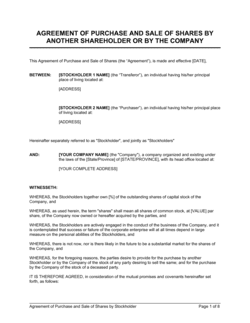
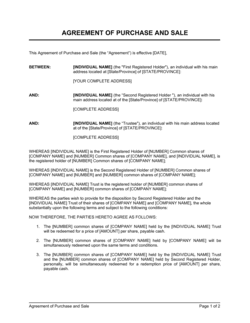
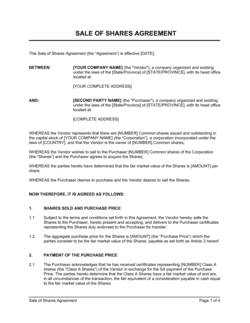
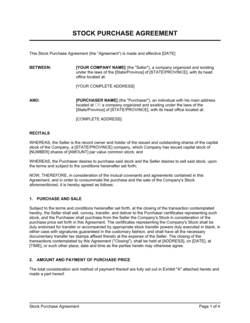
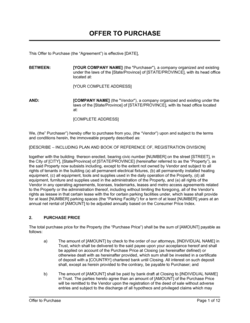
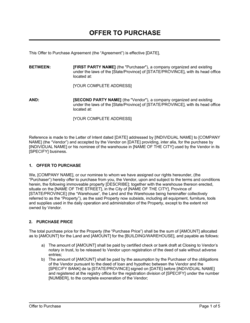
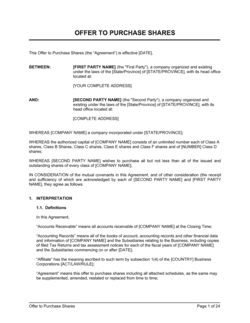
An Offer To Purchase Shares Agreement is a formal written notice from a prospective buyer to a shareholder stating the buyer's intent to acquire a specified number of shares at a defined price and on stated terms. This free Word download gives you a ready-to-edit letter you can tailor to any private share transaction and export as PDF in minutes.
When you need it
Use it when approaching an existing shareholder to buy their stake, making an offer as part of a buyout or succession plan, or responding to a right-of- first-refusal notice from a departing owner. It formally initiates the share transfer process and creates a documented record of agreed terms.
What's inside
Party identification, share class and quantity, offered price per share and total consideration, payment method and timeline, conditions precedent, offer expiry date, and a clear call to action requesting written acceptance.

What is an Offer To Purchase Shares Agreement?

An Offer To Purchase Shares Agreement is a formal written letter from a prospective buyer to an existing shareholder formally proposing the acquisition of a specified number of shares at a defined price, on stated payment terms, and subject to any applicable conditions. It serves as the documented starting point of a private share transaction β€” establishing the offered consideration, describing the exact shares in question, and inviting binding written acceptance by a firm deadline. Once accepted, the letter typically creates an enforceable obligation to complete the transfer on the stated terms.

Why You Need This Document

Negotiating a share purchase verbally or through informal email threads creates serious risk: without a written offer on fixed terms, either party can walk away claiming the price or conditions were never finalized. A formal offer letter eliminates that ambiguity by committing the buyer's price to paper, setting a clear acceptance deadline, and documenting any conditions β€” such as board approval or due diligence sign-off β€” that must be satisfied before closing. It also satisfies the procedural requirements many shareholder agreements impose on any share transfer, protecting both buyer and seller from a transfer being challenged as invalid. For business owners managing a buyout, succession, or investor exit, this template gives you a professional, ready-to-use starting point that keeps the transaction on a clear and documented track.

Which variant fits your situation?

If your situation is…Use this template
Acquiring 100% of a company's shares from all shareholdersShare Purchase Agreement
Buying out a business partner's full ownership interestBusiness Partner Buyout Agreement
Exercising a right of first refusal on departing shareholder's sharesRight of First Refusal Notice
Offering to purchase shares with structured installment paymentsInstallment Share Purchase Agreement
Documenting a completed share transfer after the offer is acceptedStock Transfer Agreement
Offering equity to an employee as compensationStock Option Agreement

Common mistakes to avoid

❌ Omitting the share class and certificate numbers

Why it matters: Without specifying the exact shares, it is unclear which block is being offered upon β€” especially where a shareholder holds multiple classes or tranches.

Fix: Pull the details directly from the company's share register and include class, certificate numbers, and the percentage of total issued shares represented.
❌ Leaving payment terms vague

Why it matters: An offer that states 'payment to be agreed at closing' creates a second negotiation after acceptance and can cause the deal to stall or fall through.

Fix: Specify the payment instrument, the bank account or escrow details, and the exact number of business days post-acceptance by which funds must be received.

❌ Skipping conditions precedent when board approval is required

Why it matters: Many shareholder agreements prohibit transfers without board or majority shareholder consent. Closing without that approval can make the transfer legally void.

Fix: Review the company's articles and shareholder agreement before sending the offer and include all required approvals as explicit conditions precedent.

❌ Setting no expiry date on the offer

Why it matters: An open-ended offer leaves the offeror exposed to price risk β€” the offeree could accept months later at a price that no longer reflects the company's value.

Fix: Always include a firm expiry date, typically 14–21 days from the date of the offer, and state clearly that the offer lapses automatically if not accepted by then.

The 9 key clauses, explained

Parties and date

In plain language: Identifies the offeror (buyer) and offeree (current shareholder) by full legal name and address, and states the date the offer is made.

Sample language
This Offer to Purchase Shares is made on [DATE] by [OFFEROR FULL NAME], of [ADDRESS] ('Offeror'), to [OFFEREE FULL NAME], of [ADDRESS] ('Offeree').

Common mistake: Using a trade name or abbreviation instead of the registered legal entity name β€” this can create ambiguity about who is bound by the offer.

Description of shares

In plain language: Specifies the company whose shares are being purchased, the share class, certificate numbers if applicable, and the exact number of shares.

Sample language
The Offeror hereby offers to purchase [NUMBER] [CLASS] shares of [COMPANY FULL NAME] (the 'Company'), currently registered in the name of the Offeree, representing approximately [X]% of the Company's issued and outstanding shares.

Common mistake: Omitting the share class or certificate numbers β€” without these details, the offer cannot be matched to a specific block of shares in the company's register.

Offered price and total consideration

In plain language: States the price per share and the aggregate total amount the offeror agrees to pay if the offer is accepted.

Sample language
The Offeror offers to purchase the Shares at a price of $[AMOUNT] per share, for a total consideration of $[TOTAL AMOUNT] (the 'Purchase Price').

Common mistake: Stating only the total price without the per-share price β€” this makes it harder to verify the arithmetic and gives the offeree less transparency on valuation.

Payment method and timeline

In plain language: Describes how and when the purchase price will be paid β€” lump sum, wire transfer, installments, or escrow β€” and the expected payment date.

Sample language
The Purchase Price shall be paid in full by wire transfer to the Offeree's designated bank account within [X] business days of the Offeree's written acceptance of this Offer.

Common mistake: Leaving payment method undefined β€” an offer without clear payment mechanics is difficult to enforce and creates disputes at closing.

Conditions precedent

In plain language: Lists any conditions that must be met before the purchase becomes binding β€” such as shareholder or board approval, due diligence sign-off, or regulatory clearance.

Sample language
This Offer is conditional upon: (a) approval of the Company's board of directors; (b) satisfactory completion of the Offeror's due diligence review; and (c) no material adverse change in the Company's financial condition prior to closing.

Common mistake: Omitting conditions entirely when board or shareholder approval is required by the company's articles β€” closing without approval can make the transfer void.

Representations by the offeree

In plain language: Asks the offeree to confirm that they own the shares free and clear of any liens, encumbrances, or competing claims, and that they have the authority to sell.

Sample language
By accepting this Offer, the Offeree represents that the Shares are owned beneficially and legally by the Offeree, free of all liens, charges, and encumbrances, and that the Offeree has full authority to sell and transfer the Shares.

Common mistake: Skipping this clause because the parties know each other β€” undisclosed pledges or spousal co-ownership claims can surface at closing and halt the transfer.

Offer expiry

In plain language: Sets a firm deadline by which the offeree must respond in writing, after which the offer lapses automatically with no further obligation on either party.

Sample language
This Offer shall remain open for acceptance until [TIME] on [DATE] ('Expiry Date'). If not accepted in writing by the Expiry Date, this Offer shall be deemed withdrawn and of no further force or effect.

Common mistake: Setting an expiry date that is too far in the future β€” leaving an offer open for more than 30 days exposes the offeror to price risk if company value changes.

Governing law

In plain language: Specifies which jurisdiction's laws govern the interpretation and enforcement of the offer letter.

Sample language
This Offer shall be governed by and construed in accordance with the laws of [STATE / PROVINCE / COUNTRY], without regard to its conflict-of-law rules.

Common mistake: Omitting governing law entirely β€” when parties are in different jurisdictions, a dispute over which law applies can delay resolution significantly.

Acceptance mechanism

In plain language: Explains how the offeree formally accepts β€” typically by signing and returning a copy β€” and confirms that acceptance creates a binding obligation to complete the sale.

Sample language
To accept this Offer, the Offeree shall sign and return a copy of this letter to the Offeror at [EMAIL / ADDRESS] by the Expiry Date. Upon delivery of the signed acceptance, this Offer shall become a binding agreement between the parties.

Common mistake: Accepting verbally or via informal email without following the written acceptance mechanism β€” oral acceptances are difficult to prove and may not satisfy shareholder agreement requirements.

How to fill it out

  1. 1

    Enter the parties' full legal names and addresses

    Fill in the offeror's and offeree's full legal names exactly as they appear on official company records or government ID. Include complete mailing addresses for both parties.

    πŸ’‘ Cross-check the offeree's name against the company's share register before sending β€” a mismatch can invalidate the transfer.

  2. 2

    Describe the shares precisely

    State the company name, share class (e.g., Class A Common), certificate numbers if available, and the exact number of shares being offered upon.

    πŸ’‘ Request a copy of the share certificate or shareholder register extract before drafting so every detail is accurate.

  3. 3

    Set the price per share and total consideration

    Enter the agreed or proposed price per share and calculate the total. If the valuation was based on a specific method β€” book value, earnings multiple, or independent appraisal β€” reference it briefly.

    πŸ’‘ Noting the valuation basis strengthens the offer's credibility and reduces the chance of a counter-argument on pricing.

  4. 4

    Define payment method and timeline

    Specify how payment will be made (wire transfer, certified cheque, escrow) and the number of business days after acceptance by which payment will be sent.

    πŸ’‘ Wire transfer with a 3–5 business day window is the most common and easiest to verify β€” avoid 'upon closing' without a fixed closing date.

  5. 5

    List any conditions precedent

    Add any approvals, clearances, or diligence requirements that must be satisfied before the sale can close. If there are none, state explicitly that the offer is unconditional.

    πŸ’‘ Review the company's shareholder agreement before drafting β€” many agreements require board or majority shareholder consent for any share transfer.

  6. 6

    Set a realistic offer expiry date

    Choose an expiry date that gives the offeree enough time to seek advice β€” typically 14 to 21 days β€” without leaving the offer open so long that market conditions shift materially.

    πŸ’‘ If the offeree needs more time, it is better to issue a formal extension in writing than to leave the original deadline unenforced.

  7. 7

    Send via traceable delivery and request written acceptance

    Deliver the offer by email with read receipt or by courier so you have a record of receipt. Ask the offeree to sign and return a copy by the expiry date as the acceptance mechanism.

    πŸ’‘ Keep a timestamped copy of both the sent offer and the returned acceptance β€” this is your evidence of a binding agreement if any dispute arises later.

Frequently asked questions

What is an offer to purchase shares agreement?

An offer to purchase shares agreement is a formal written letter from a prospective buyer to an existing shareholder stating the buyer's intent to acquire a specified number of shares at a defined price and on stated terms. It formally initiates the share purchase process, documents the proposed economics, and sets an acceptance deadline β€” creating a clear record of what was offered and when.

Is an offer to purchase shares legally binding?

The offer letter itself is generally not binding until the offeree accepts it in writing by the stated deadline. Once accepted, it typically becomes a binding agreement to complete the sale on the stated terms, subject to any conditions precedent being satisfied. Because enforceability depends on jurisdiction and the specific language used, consider having the final version reviewed by a lawyer for high-value transactions.

What is the difference between an offer to purchase shares and a share purchase agreement?

An offer to purchase shares is a short letter proposing the transaction and requesting acceptance β€” it initiates the deal. A share purchase agreement is the full binding contract that governs the complete transfer, with representations, warranties, indemnities, and closing mechanics. For simple private transactions, an accepted offer letter may suffice; for larger or more complex deals, the parties typically proceed to a full share purchase agreement after the offer is accepted.

Does an offer to purchase shares need to be signed?

The offer letter is typically signed by the offeror when sent. The offeree signs and returns a copy to signal acceptance. In most jurisdictions, a written offer accepted in writing creates a binding obligation without notarization or witness requirements, though some shareholder agreements impose additional execution formalities. Check the company's shareholder agreement for any specific signing requirements.

What happens if the offer expires without a response?

If the offeree does not accept in writing by the stated expiry date, the offer lapses automatically and neither party is obligated to proceed. The offeror is free to withdraw, renegotiate, or make a new offer on different terms. A clear expiry clause protects the offeror from being held to a price that no longer reflects current conditions.

Can the offeree negotiate the price or terms?

Yes. If the offeree wants different terms, they typically respond with a counter-offer β€” which legally terminates the original offer and substitutes new terms for the offeror to accept or decline. Both parties should document any agreed changes in writing before proceeding to closing.

When should I involve a lawyer in a share purchase offer?

For straightforward transactions between known parties involving a modest number of shares, a well-drafted template is typically sufficient. Engage a lawyer when the transaction involves a controlling interest or full acquisition, when the company has complex cap table structures or outstanding options, when the shareholder agreement has unusual transfer restrictions, or when the purchase price exceeds $100,000.

Does the company's shareholder agreement affect the offer?

Yes, often significantly. Many shareholder agreements include right-of- first-refusal clauses requiring the selling shareholder to offer shares to existing shareholders before any third party. They may also require board or majority shareholder consent for any transfer. Always review the shareholder agreement before sending an offer to ensure the process and terms comply with its requirements.

How this compares to alternatives

vs Share Purchase Agreement

An offer to purchase shares is a short letter that proposes the transaction and requests acceptance. A share purchase agreement is the full binding contract executed after acceptance, covering representations, warranties, indemnities, and all closing mechanics in detail. For simple private deals, an accepted offer letter may be sufficient; complex or high-value acquisitions require a full share purchase agreement.

vs Letter of Intent (LOI)

A letter of intent outlines proposed terms for a transaction but is typically non-binding and used as a starting point for negotiation. An offer to purchase shares is a more definitive document β€” it states firm terms and invites binding acceptance by a specific deadline. Use an LOI when terms are still being negotiated; use an offer letter when both parties are ready to commit.

vs Stock Transfer Agreement

A stock transfer agreement documents the completed transfer of shares after both parties have agreed to proceed. An offer to purchase shares comes earlier in the process β€” it is the formal proposal that, once accepted, leads to the execution of a transfer agreement. The offer initiates the deal; the transfer agreement closes it.

vs Right of First Refusal Notice

A right of first refusal notice is issued by an existing shareholder who has received a third-party offer, notifying other shareholders of their right to match it. An offer to purchase shares is the buyer's side of the same transaction β€” the formal proposal. The two documents often work together when a shareholder agreement includes ROFR provisions.

Industry-specific considerations

Technology / SaaS

Founder buybacks of departing co-founder equity and investor secondary sales are common, often tied to vesting cliff milestones and cap table management.

Professional Services

Partner buyouts in law firms, accounting practices, and consultancies frequently use structured offer letters with installment payment terms tied to client revenue retention.

Retail / Franchising

Franchise group consolidations and multi-location buyouts typically require board approval and franchisor consent as conditions precedent in the offer letter.

Manufacturing

Family business succession transfers and management buyouts of operational companies often involve independent share valuations referenced in the offer price clause.

Template vs pro β€” what fits your needs?

PathBest forCostTime
Use the templatePrivate share purchases between known parties where price and terms are already informally agreedFree15–30 minutes
Template + professional reviewTransactions above $50,000 or where the company has a shareholder agreement with transfer restrictions$200–$500 for a lawyer to review and customize1–2 days
Custom draftedControlling interest acquisitions, complex cap tables, or cross-border share purchases$1,000–$3,000+3–7 days

Glossary

Offeror
The person or entity making the offer to purchase the shares.
Offeree
The current shareholder who holds the shares being offered upon.
Share Class
A category of shares (e.g., common or preferred) with defined rights, voting powers, and dividend entitlements.
Consideration
The total payment offered in exchange for the shares β€” typically expressed as a price per share multiplied by the number of shares.
Conditions Precedent
Specific requirements that must be satisfied before the share purchase can close β€” such as board approval, regulatory clearance, or due diligence completion.
Offer Expiry Date
The deadline by which the offeree must accept or reject the offer, after which it lapses automatically.
Right of First Refusal
A shareholder agreement provision giving existing shareholders the right to match any third-party offer before the shares can be sold externally.
Closing Date
The scheduled date on which the share transfer is completed and consideration is paid.
Shareholder Agreement
A private contract among shareholders that governs share transfers, buyout procedures, and company governance.
Valuation Method
The basis used to arrive at the offered price per share β€” such as book value, earnings multiple, or independent appraisal.

Part of your Business Operating System

This document is one of 3,000+ business & legal templates included in Business in a Box.

  • Fill-in-the-blanks β€” ready in minutes
  • 100% customizable Word document
  • Compatible with all office suites
  • Export to PDF and share electronically

Create your document in 3 simple steps.

From template to signed document β€” all inside one Business Operating System.
1
Download or open template

Access over 3,000+ business and legal templates for any business task, project or initiative.

2
Edit and fill in the blanks with AI

Customize your ready-made business document template and save it in the cloud.

3
Save, Share, Send, Sign

Share your files and folders with your team. Create a space of seamless collaboration.

Save time, save money, and create top-quality documents.

β˜…β˜…β˜…β˜…β˜…

"Fantastic value! I'm not sure how I'd do without it. It's worth its weight in gold and paid back for itself many times."

Managing Director Β· Mall Farm
Robert Whalley
Managing Director, Mall Farm Proprietary Limited
β˜…β˜…β˜…β˜…β˜…

"I have been using Business in a Box for years. It has been the most useful source of templates I have encountered. I recommend it to anyone."

Business Owner Β· 4+ years
Dr Michael John Freestone
Business Owner
β˜…β˜…β˜…β˜…β˜…

"It has been a life saver so many times I have lost count. Business in a Box has saved me so much time and as you know, time is money."

Owner Β· Upstate Web
David G. Moore Jr.
Owner, Upstate Web

Run your business with a system β€” not scattered tools

Stop downloading documents. Start operating with clarity. Business in a Box gives you the Business Operating System used by over 250,000 companies worldwide to structure, run, and grow their business.

Free Forever PlanΒ Β·Β No credit card required