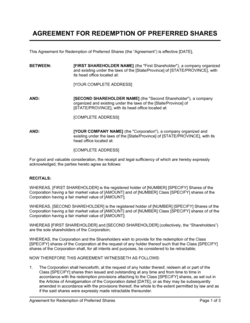
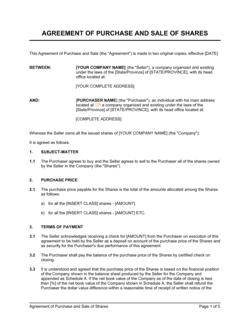
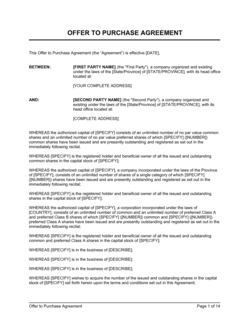
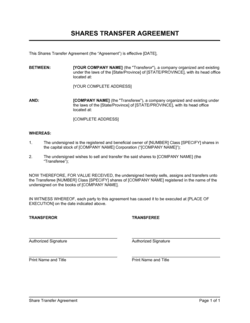
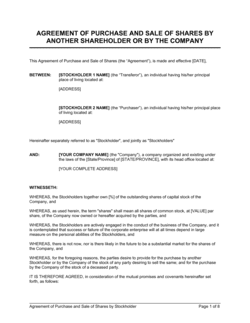
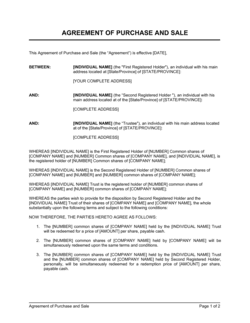
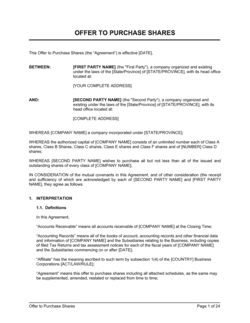
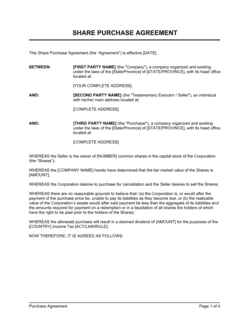
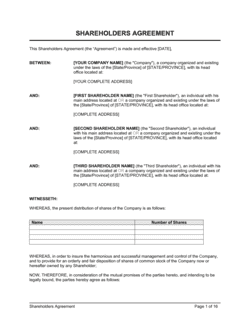
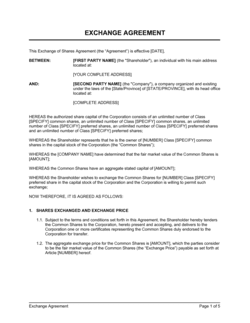
Exchange of Shares Agreement Template

Free Word download • Edit online • Save & share with Drive • Export to PDF

2 pages25–30 min to fillDifficulty: StandardSignature requiredLegal review recommended
Learn more ↓
FreeExchange of Shares Agreement Template

At a glance

What it is
An Exchange of Shares Agreement is a legally binding contract in which two parties agree to transfer ownership of shares in one company in exchange for shares in another company, without any cash changing hands. This free Word download provides a structured, professionally drafted starting point covering share descriptions, exchange ratios, representations and warranties, conditions precedent, and closing mechanics — ready to edit online and export as PDF.
When you need it
Use it when two businesses want to cross-invest in each other through equity, when a merger or acquisition is structured as a share swap rather than a cash deal, or when a parent company restructures ownership among subsidiaries by exchanging share classes rather than paying cash consideration.
What's inside
Party and share identification, exchange ratio and valuation basis, representations and warranties from both sides, conditions precedent to closing, covenants, closing mechanics and delivery obligations, indemnification, governing law, and dispute resolution provisions.

What is an Exchange of Shares Agreement?

An Exchange of Shares Agreement is a legally binding contract in which two parties agree to transfer ownership of shares in their respective companies to each other simultaneously, without any cash changing hands. The transaction is governed by an exchange ratio — a calculated rate that reflects the agreed relative valuations of both businesses — so that each party receives equity proportionate to what it gives up. Unlike a share purchase, there is no buyer and no seller in the conventional sense: both parties are simultaneously transferor and transferee, making the agreement bilateral in structure and mutual in obligation. The document records the exact shares being transferred, the basis for the exchange ratio, each party's representations about title and authority, the conditions that must be satisfied before closing, and the mechanics of simultaneous delivery.

Why You Need This Document

Without a properly executed exchange of shares agreement, a non-cash equity transfer between two companies exists only as an oral understanding or an email chain — neither of which constitutes legal title to shares in most jurisdictions. The consequences of proceeding informally are concrete: share registers that do not reflect reality, capital gains tax exposure that a structured agreement could have deferred, and no enforceable remedy if one party refuses to complete the transfer or breaches its representations. If a company later seeks external investment, is acquired, or undergoes a corporate audit, undocumented share ownership creates a due diligence failure that can delay or kill the transaction. This template provides the structure to document the exchange correctly from the outset — covering valuation basis, conditions precedent, interim covenants, and closing deliverables — so that both parties hold legally recognized, unencumbered equity in each other from the moment the registers are updated.

Which variant fits your situation?

If your situation is…Use this template
Merging two companies entirely through a stock-for-stock dealMerger Agreement
Acquiring a company by issuing shares instead of paying cashShare Purchase Agreement
Exchanging shares as part of a joint venture formationJoint Venture Agreement
Cross-licensing IP rights alongside a share exchangeIP License Agreement
Restructuring share classes within a single companyShareholders Agreement
Swapping convertible notes for equity at a valuation eventConvertible Note Agreement
Issuing new shares to a strategic partner in exchange for their sharesStock Subscription Agreement

Common mistakes to avoid

❌ Describing shares by percentage rather than fixed number

Why it matters: If either company issues new shares between signing and closing, a percentage-based description shifts the number of shares being exchanged without either party formally agreeing to the change.

Fix: Always specify a fixed number of shares in the agreement. If dilution between signing and closing is a concern, add a covenant prohibiting new share issuances without written consent.

❌ No conditions precedent for shareholder or regulatory consent

Why it matters: Proceeding without all required approvals can void the transfer under applicable corporate law, leaving the parties in a disputed ownership position that is expensive to unwind.

Fix: Identify every consent required — board approval, shareholder vote, pre-emptive right waivers, and any regulatory filings — and make them express conditions precedent before closing is triggered.

❌ Omitting interim covenants between signing and closing

Why it matters: Without restrictions on the period between signing and closing, one party can issue new shares, pledge existing shares, or change the company's capital structure, materially altering what the other party receives.

Fix: Include a covenant requiring both parties to carry on business in the ordinary course, with an express prohibition on share issuances, disposals, or encumbrances without written consent.

❌ No indemnification cap or time limit

Why it matters: Open-ended indemnification obligations can expose a party to liability far exceeding the value of the shares exchanged, making the transaction economically irrational in hindsight.

Fix: Set a maximum aggregate indemnification liability — typically 50–100% of the agreed share value — and a claim notice period of 12 to 24 months from closing.

❌ Choosing governing law inconsistent with the companies' incorporation jurisdictions

Why it matters: Mandatory corporate law provisions in a company's jurisdiction of incorporation apply regardless of contractual choice of law, creating conflicts that can override key agreement terms.

Fix: Align the governing law clause with the jurisdiction of the company whose shares are most central to the transaction, or take legal advice on which jurisdiction's mandatory rules could override the contract.

❌ Failing to update share registers on closing day

Why it matters: In many jurisdictions, legal title to shares does not pass until the transferee's name is entered in the company's share register — a delay creates a gap period where ownership is legally ambiguous.

Fix: Make register updates an express closing deliverable. Both companies should update their share registers simultaneously on the closing date and provide copies to both parties as confirmation.

The 10 key clauses, explained

Parties and Recitals

In plain language: Identifies each party by full legal entity name and jurisdiction, and provides the background context explaining why the exchange is taking place.

Sample language
This Exchange of Shares Agreement ('Agreement') is entered into on [DATE] between [PARTY A LEGAL NAME], a [ENTITY TYPE] incorporated under the laws of [JURISDICTION] ('Party A'), and [PARTY B LEGAL NAME], a [ENTITY TYPE] incorporated under the laws of [JURISDICTION] ('Party B').

Common mistake: Using a trade name instead of the registered legal entity name — creating an enforcement problem if the counterparty disputes which legal person is bound.

Description of Shares to Be Exchanged

In plain language: Specifies exactly which shares each party is transferring: share class, number of shares, nominal value, and the company they represent ownership in.

Sample language
Party A shall transfer to Party B [NUMBER] [CLASS] shares in [COMPANY A NAME] (the 'Party A Shares'), free and clear of all liens and encumbrances. Party B shall transfer to Party A [NUMBER] [CLASS] shares in [COMPANY B NAME] (the 'Party B Shares').

Common mistake: Describing shares by percentage of ownership rather than a fixed number — percentages shift if new shares are issued before closing, causing a dispute over what was agreed.

Exchange Ratio and Valuation Basis

In plain language: States how the parties arrived at the number of shares each receives, references the agreed valuations of both companies, and confirms no cash will change hands.

Sample language
The parties agree that the exchange ratio of [X] Party A Shares for every [Y] Party B Shares is based on valuations of $[AMOUNT] for Company A and $[AMOUNT] for Company B as set out in the Valuation Report dated [DATE] attached as Schedule [X]. No cash consideration is payable under this Agreement.

Common mistake: Agreeing an exchange ratio without documenting the valuation methodology — leaving the ratio vulnerable to challenge if one party later argues the figures were based on misrepresentation.

Representations and Warranties

In plain language: Each party states that it owns the shares it is transferring, that those shares are free of third-party claims, that it has authority to enter the agreement, and that no consents are outstanding.

Sample language
Each party represents and warrants to the other that: (a) it is the sole legal and beneficial owner of the shares being transferred; (b) those shares are free and clear of all liens, charges, options, and encumbrances; (c) it has full legal authority to enter into and perform this Agreement; and (d) no shareholder, regulatory, or third-party consent is required other than as listed in Schedule [X].

Common mistake: Giving only the transferring party representations and ignoring the recipient's warranties — failing to confirm the recipient's shares are also unencumbered and properly issued.

Conditions Precedent to Closing

In plain language: Lists the actions or approvals that must be completed before either party is required to exchange shares — such as board resolutions, shareholder approvals, or regulatory filings.

Sample language
The obligation of each party to complete the exchange is conditional upon: (a) the board of each company having passed a resolution approving the transfer; (b) any pre-emptive rights of existing shareholders having been waived in writing; and (c) no material adverse change having occurred in either company between the date of this Agreement and the Closing Date.

Common mistake: Omitting a material adverse change condition — leaving a party obligated to complete the exchange even if one company suffers a significant financial deterioration before closing.

Covenants Between Signing and Closing

In plain language: Obliges each party to conduct its business in the ordinary course between signing and closing, not to issue new shares or incur unusual liabilities without the other's consent.

Sample language
Between the date of this Agreement and the Closing Date, each party covenants that it shall: (a) carry on its business in the ordinary course; (b) not issue, transfer, or grant options over any shares without the prior written consent of the other party; and (c) promptly notify the other party of any event that could constitute a material adverse change.

Common mistake: No interim covenants at all — allowing one party to dilute, encumber, or structurally change the shares being exchanged in the period between signing and closing.

Closing Mechanics and Delivery Obligations

In plain language: Specifies the closing date, location, and what each party must deliver — share transfer forms, updated share registers, board resolutions, and any other documents required to complete legal transfer.

Sample language
Closing shall take place on [DATE] at [LOCATION / via electronic exchange]. At Closing, each party shall deliver: (a) duly executed share transfer form(s); (b) original share certificates (or a lost certificate indemnity); (c) a copy of the board resolution approving the transfer; and (d) an updated shareholders register reflecting the transfer.

Common mistake: Not specifying what happens if one party fails to deliver at closing — leaving the other party without a clear right to rescind or seek specific performance.

Lock-Up and Transfer Restrictions

In plain language: Restricts each party from selling, transferring, or pledging the received shares for a defined period after closing to provide stability and prevent immediate resale.

Sample language
Each party agrees that it shall not, for a period of [X] months following the Closing Date, sell, transfer, assign, pledge, or otherwise dispose of any of the shares received under this Agreement without the prior written consent of the other party.

Common mistake: Omitting a lock-up clause entirely, allowing one party to immediately sell the received shares to a competitor or third party without notice.

Indemnification

In plain language: Requires each party to compensate the other for losses arising from a breach of its representations, warranties, or covenants, subject to agreed caps and time limits.

Sample language
Each party ('Indemnifying Party') shall indemnify and hold harmless the other party ('Indemnified Party') from and against any losses, liabilities, damages, and costs arising from: (a) any breach of the Indemnifying Party's representations or warranties; or (b) any failure to perform its obligations under this Agreement. Indemnification claims must be notified within [X] months of Closing and shall not exceed an aggregate amount of $[CAP].

Common mistake: No cap or time limit on indemnification claims — exposing one party to open-ended liability that may exceed the value of the shares exchanged.

Governing Law and Dispute Resolution

In plain language: Specifies which jurisdiction's law governs the agreement and the mechanism for resolving disputes — arbitration, mediation, or litigation in a named court.

Sample language
This Agreement is governed by and construed in accordance with the laws of [STATE / PROVINCE / COUNTRY]. Any dispute arising out of or in connection with this Agreement shall be submitted to binding arbitration administered by [AAA / JAMS / ICC] in [CITY], except that either party may seek injunctive relief in any court of competent jurisdiction.

Common mistake: Choosing a governing law that differs from the jurisdiction where the companies are incorporated — creating conflicts between the contract's terms and mandatory corporate law rules that cannot be contracted out of.

How to fill it out

  1. 1

    Identify all parties with full legal entity details

    Enter each party's complete registered legal name, entity type, and jurisdiction of incorporation in the opening clause. Confirm these details match the companies' current corporate registry entries.

    💡 Pull the exact legal name from the company's certificate of incorporation — one word difference from the registered name can complicate share register updates and enforcement.

  2. 2

    Specify each block of shares precisely

    List the share class, exact number of shares, nominal value, and the company in which those shares are held for each side of the exchange. Attach a current capitalization table for each company as a schedule.

    💡 Use a fixed share count, not a percentage — percentages are unstable if either company issues new shares between signing and closing.

  3. 3

    Document the exchange ratio and valuation basis

    State the agreed valuation of each company, the resulting exchange ratio, and reference any independent valuation report as a scheduled attachment. Confirm explicitly that no cash consideration is payable.

    💡 If neither party has commissioned a formal valuation, document the agreed methodology (e.g., last-round price, EBITDA multiple, or agreed book value) in writing — this evidence matters if the ratio is later disputed.

  4. 4

    Complete the representations and warranties for both parties

    Work through each representation — title, no encumbrances, authority, no required consents — and confirm it is accurate for both companies. List any exceptions or qualifications in a disclosure schedule.

    💡 A disclosure schedule attached at signing limits warranty breach claims for facts the other party already knew — use it to surface known issues rather than hiding them.

  5. 5

    List all conditions precedent and obtain them before closing

    Identify every approval, consent, or waiver needed — board resolutions, shareholder consent, pre-emptive right waivers, regulatory filings — and set a deadline by which each must be satisfied.

    💡 Send pre-emptive right waiver requests to all existing shareholders immediately after signing to avoid a closing delay at the last minute.

  6. 6

    Set the lock-up period and transfer restriction terms

    Agree on a lock-up duration appropriate to the deal context — typically 6 to 24 months for strategic cross-investments — and specify any carve-outs for transfers to affiliates or estate planning.

    💡 A 12-month lock-up is the most commonly accepted standard in strategic share exchanges; anything shorter invites the other party to negotiate harder on other terms.

  7. 7

    Define indemnification caps and claim notice periods

    Set a maximum aggregate indemnification liability for each party — typically expressed as a percentage of the agreed share value — and a time window for raising warranty claims after closing.

    💡 An indemnification cap of 100% of the agreed value of the shares exchanged is standard; caps below 50% are frequently rejected during negotiation.

  8. 8

    Execute and update share registers at closing

    Both parties sign the agreement and all closing deliverables simultaneously. Update each company's share register on the same day and issue new share certificates if required by the applicable company law.

    💡 Failure to update the share register immediately after closing creates a period of ambiguity about legal ownership — in several jurisdictions, legal title does not pass until the register is updated.

Frequently asked questions

What is an exchange of shares agreement?

An exchange of shares agreement is a legally binding contract in which two parties agree to transfer shares in their respective companies to each other without any cash changing hands. The transaction is structured around an agreed exchange ratio derived from the relative valuations of the two businesses. It is commonly used in mergers, strategic partnerships, and corporate restructurings where both parties want cross-ownership without a cash outlay.

When should I use an exchange of shares agreement instead of a share purchase agreement?

Use an exchange of shares agreement when no cash is changing hands and both parties are simultaneously transferring shares to each other. A share purchase agreement is the appropriate document when one party is acquiring shares from another in exchange for cash consideration. If the deal involves a mix — partial cash and partial share swap — you may need a hybrid agreement or a share purchase agreement with a share consideration clause.

What is an exchange ratio and how is it calculated?

An exchange ratio is the number of shares in Company B that a holder of one share in Company A will receive. It is calculated by dividing the agreed per-share value of Company A's shares by the agreed per-share value of Company B's shares. For example, if Company A shares are valued at $10 each and Company B shares at $5 each, the exchange ratio is 2 — meaning one Company A share is exchanged for two Company B shares. The ratio should be anchored to a documented valuation to protect both parties.

Do I need shareholder approval to execute a share exchange?

In most jurisdictions, transferring a significant block of shares requires a board resolution at minimum, and may require a shareholder vote depending on the size of the transaction relative to the company, the articles of association, and any existing shareholders agreement. Pre-emptive rights held by existing shareholders typically must be waived in writing before the exchange can proceed. Failing to obtain required approvals can render the transfer void. Legal advice specific to each company's jurisdiction is strongly recommended before signing.

What is the difference between an exchange of shares agreement and a share swap?

The two terms describe the same type of transaction — a non-cash bilateral transfer of equity between two parties. "Share exchange agreement" is the more common usage in corporate M&A contexts, particularly in the US and Canada. "Share swap" is often used in financial markets to describe derivative instruments, which are a different product entirely. When drafting a non-cash equity exchange between operating companies, "exchange of shares agreement" is the clearer and more legally precise term.

Are there tax implications to a share exchange?

Yes, and they vary significantly by jurisdiction. In the United States, share exchanges may qualify as tax-free reorganizations under IRC Section 368 if specific structural requirements are met. In Canada, a Section 85 rollover may defer capital gains. In the UK and EU, share-for-share relief may apply under specific conditions. Without proper structuring, both parties may trigger capital gains tax on the exchange as if shares were sold at fair market value. Tax advice from a qualified advisor is essential before executing any share exchange transaction.

What happens if one party breaches the agreement after signing but before closing?

If the conditions precedent are not met or a party fails to deliver closing documents, the non-breaching party typically has the right to rescind the agreement and claim damages. Some agreements include specific performance clauses allowing the non-breaching party to seek a court order compelling the other party to complete the exchange. Whether damages or specific performance is available depends on the agreement's terms and the applicable governing law. Including a clear remedies clause at drafting stage avoids ambiguity if a dispute arises.

Do I need a lawyer to complete an exchange of shares agreement?

For straightforward domestic exchanges between closely held companies, a professionally drafted template provides a strong starting point. Legal review is strongly recommended whenever significant share values are involved, the companies are incorporated in different jurisdictions, tax-free treatment is desired, or complex corporate structures are in play. A solicitor or corporate attorney review typically costs $500–$2,500 depending on complexity and is a worthwhile investment relative to the risk of an improperly documented ownership transfer.

What documents should be delivered at closing?

Standard closing deliverables for a share exchange include: duly executed share transfer forms for each block of shares, original share certificates or a lost certificate indemnity, a certified copy of each company's board resolution approving the transfer, written evidence of any shareholder consents or pre-emptive right waivers, and updated share registers for both companies reflecting the new ownership. Some jurisdictions also require a stamp duty filing or regulatory notification within a specified period after transfer.

How this compares to alternatives

vs Share Purchase Agreement

A share purchase agreement transfers shares from a seller to a buyer in exchange for cash. An exchange of shares agreement is a bilateral non-cash transaction where both parties simultaneously transfer shares to each other. The key practical difference is that a share purchase involves a single direction of consideration — money — while a share exchange involves two simultaneous equity transfers with no cash. Use a share purchase agreement whenever cash is the primary consideration.

vs Shareholders Agreement

A shareholders agreement governs the ongoing relationship between co-owners of a company — voting rights, dividend policy, transfer restrictions, and exit mechanisms. An exchange of shares agreement is a transactional document that effects a one-time transfer of equity between two separate companies. After a share exchange closes, the parties will typically also need a shareholders agreement to govern their new joint ownership relationship in each other's company.

vs Joint Venture Agreement

A joint venture agreement establishes a new or existing shared enterprise, defining governance, profit sharing, and contributions. An exchange of shares agreement is specifically the mechanism by which equity is transferred as part of a transaction — it may form one component of a joint venture but does not on its own govern the ongoing venture. Complex joint venture formations often require both documents.

vs Merger Agreement

A merger agreement combines two companies into one legal entity, with shareholders of the target company typically receiving shares in the surviving entity. An exchange of shares agreement leaves both companies as separate legal entities and simply results in each holding an equity stake in the other. Mergers require significantly more regulatory, tax, and corporate law process; an exchange of shares is a lower-complexity alternative suited to strategic cross-investment rather than full combination.

Industry-specific considerations

Technology / SaaS

Share exchanges commonly structure strategic partnerships between SaaS companies seeking cross-platform integration, with IP assignment and license terms often negotiated alongside the equity exchange.

Financial Services

Regulatory capital requirements and licensing conditions in each company may need to be satisfied as conditions precedent, and exchange ratios are typically anchored to audited net asset values.

Manufacturing

Joint venture formation between manufacturers often involves a share exchange to align incentives across supply chains, with warranty representations extending to physical assets and environmental liabilities.

Professional Services

Mergers between professional services firms — law firms, accountancies, consultancies — use share exchanges to combine equity without triggering cash tax events, with non-compete and client non-solicitation covenants critical to the deal.

Jurisdictional notes

United States

Share exchanges may qualify as tax-free reorganizations under IRC Section 368(a)(1)(B) if the acquiring corporation exchanges solely its own voting stock for at least 80% of the target's shares. State corporate law — particularly Delaware, New York, and California — governs share transfer mechanics, board approval requirements, and shareholder rights. State securities laws (Blue Sky laws) may require filings even for private company transactions. Consult a tax attorney before executing any exchange intended to qualify as a tax-free reorganization.

Canada

Canadian corporations must comply with the Canada Business Corporations Act or applicable provincial corporate statute. A Section 85 election under the Income Tax Act may allow shareholders to defer capital gains on the exchange if specific conditions are met, including a joint election between the transferor and the corporation. Quebec civil law applies distinct rules on share transfers for companies incorporated provincially in Quebec. Pre-emptive rights under shareholders agreements are common and must be formally waived before the exchange proceeds.

United Kingdom

UK share transfers require a Stock Transfer Form (J30) and payment of 0.5% Stamp Duty on transfers valued above £1,000, payable within 30 days of the instrument. Share-for-share exchanges may qualify for Capital Gains Tax rollover relief under TCGA 1992 Section 135 if HMRC clearance is obtained in advance. Companies Act 2006 governs director and shareholder approvals. The company's articles of association and any existing shareholders agreement must be reviewed for pre-emption rights before any transfer.

European Union

EU member states each have distinct corporate law requirements for share transfers — France, Germany, the Netherlands, and Spain impose varying approval, notarization, and registration requirements. The EU Mergers Directive provides tax neutrality for cross-border share exchanges within the EU where the transaction meets the qualifying conditions, but member state implementation varies. GDPR implications may arise where the exchange results in access to personal data held by either company. Legal advice in each relevant member state is essential for any cross-border EU share exchange.

Template vs lawyer — what fits your deal?

PathBest forCostTime
Use the templateDomestic share exchanges between closely held private companies of similar size with straightforward cap tablesFree1–3 hours to complete the template
Template + legal reviewExchanges involving significant share values, multiple share classes, or companies in different provinces or states$500–$2,5003–7 days
Custom draftedCross-border transactions, publicly traded companies, tax-free reorganization treatment, or transactions above $1M in share value$3,000–$15,000+2–6 weeks

Glossary

Exchange Ratio
The number of shares in one company that a party receives in exchange for each share in the other company, calculated based on an agreed valuation of both entities.
Representations and Warranties
Factual statements each party makes about itself — ownership of shares, absence of liens, authority to enter the agreement — that the other party relies on to close the deal.
Conditions Precedent
Specific events or actions that must occur before either party is obligated to complete the share exchange — such as regulatory approval or shareholder consent.
Share Transfer
The legal act of conveying ownership of shares from one party to another, documented by a share transfer form and updated in the company's share register.
Indemnification
A contractual obligation by one party to compensate the other for losses arising from a breach of representations, warranties, or covenants in the agreement.
Closing
The date and event at which both parties simultaneously deliver and receive the exchanged shares, completing the transaction.
Good Title
Confirmation that the transferring party owns the shares free of any liens, charges, or third-party claims and has full authority to transfer them.
Dilution
The reduction in an existing shareholder's percentage ownership that results from the issuance or transfer of additional shares to another party.
Lock-Up Period
A contractually agreed period after closing during which the recipient of exchanged shares cannot sell or transfer those shares.
Pre-Emptive Rights
Existing shareholders' contractual right to purchase new shares before they are offered to outside parties — a right that may need to be waived before an exchange can proceed.
Anti-Dilution Provision
A clause protecting a shareholder from dilution by adjusting the exchange ratio or granting additional shares if new equity is issued below the agreed valuation.

Part of your Business Operating System

This document is one of 3,000+ business & legal templates included in Business in a Box.

  • Fill-in-the-blanks — ready in minutes
  • 100% customizable Word document
  • Compatible with all office suites
  • Export to PDF and share electronically

Create your document in 3 simple steps.

From template to signed document — all inside one Business Operating System.
1
Download or open template

Access over 3,000+ business and legal templates for any business task, project or initiative.

2
Edit and fill in the blanks with AI

Customize your ready-made business document template and save it in the cloud.

3
Save, Share, Send, Sign

Share your files and folders with your team. Create a space of seamless collaboration.

Save time, save money, and create top-quality documents.

★★★★★

"Fantastic value! I'm not sure how I'd do without it. It's worth its weight in gold and paid back for itself many times."

Managing Director · Mall Farm
Robert Whalley
Managing Director, Mall Farm Proprietary Limited
★★★★★

"I have been using Business in a Box for years. It has been the most useful source of templates I have encountered. I recommend it to anyone."

Business Owner · 4+ years
Dr Michael John Freestone
Business Owner
★★★★★

"It has been a life saver so many times I have lost count. Business in a Box has saved me so much time and as you know, time is money."

Owner · Upstate Web
David G. Moore Jr.
Owner, Upstate Web

Run your business with a system — not scattered tools

Stop downloading documents. Start operating with clarity. Business in a Box gives you the Business Operating System used by over 250,000 companies worldwide to structure, run, and grow their business.

Start free · No credit card required