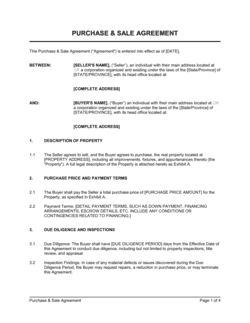
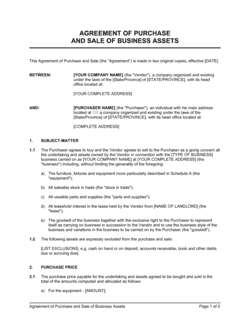
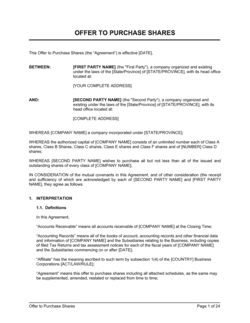
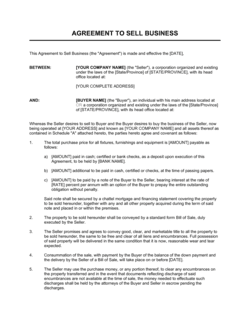
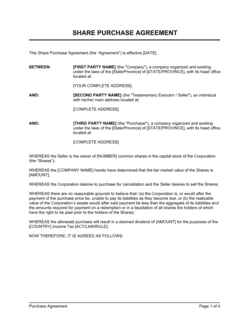
Agreement of Purchase and Sale of Shares Template

Free Word download • Edit online • Save & share with Drive • Export to PDF

5 pages25–35 min to fillDifficulty: ComplexSignature requiredLegal review recommended
Learn more ↓
FreeAgreement of Purchase and Sale of Shares Template

At a glance

What it is
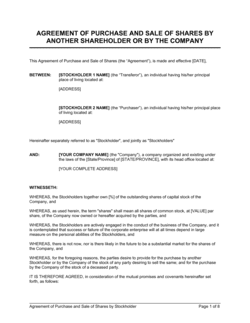
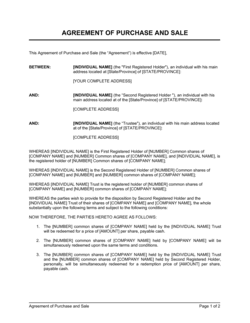
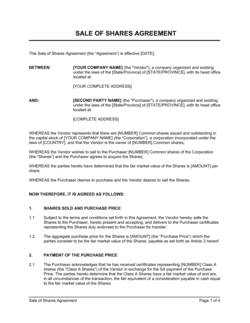
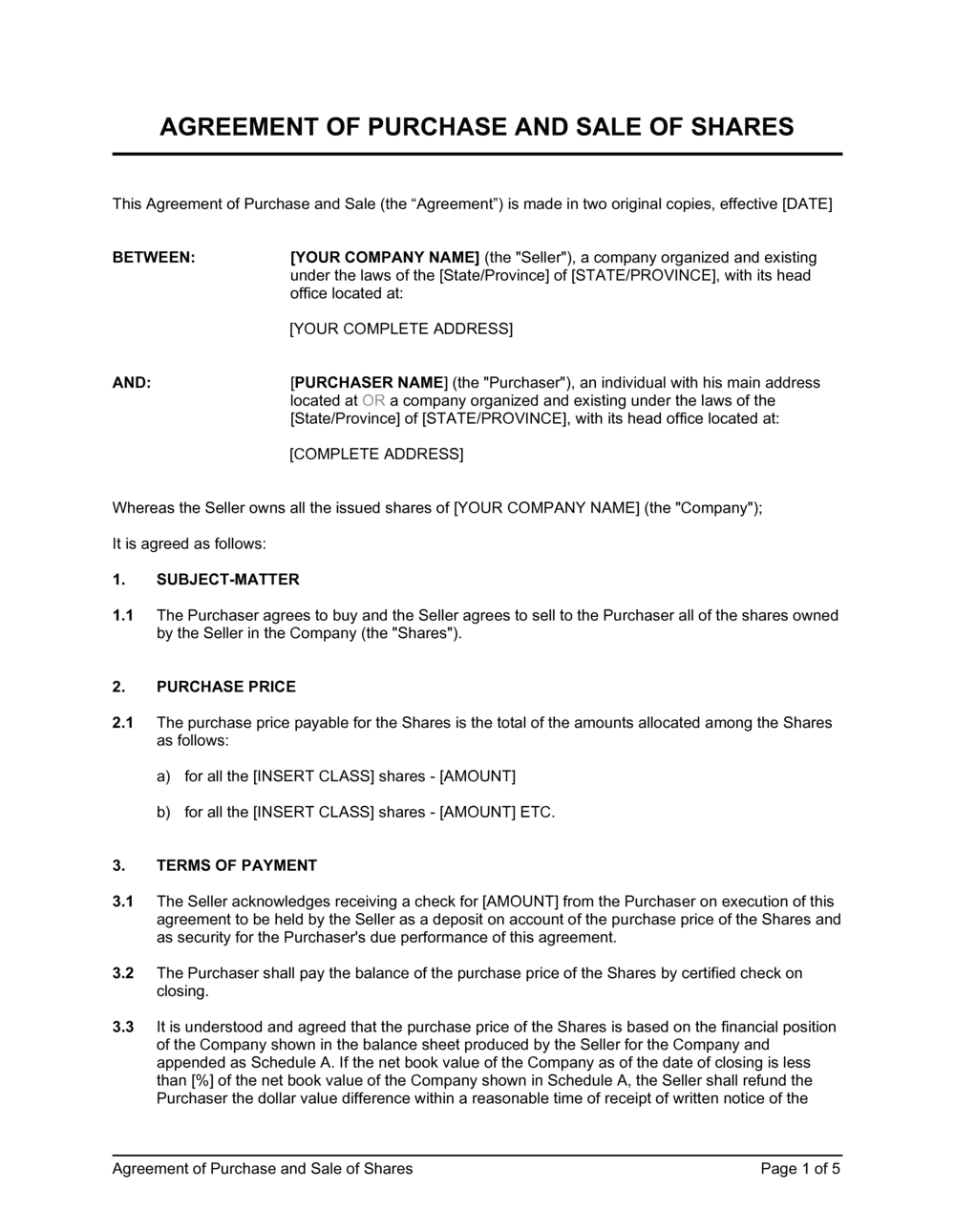
An Agreement of Purchase and Sale of Shares is a legally binding contract between a seller and a buyer governing the transfer of ownership of shares in a private company. This free Word download covers purchase price, representations and warranties, closing conditions, indemnification, and post-closing obligations in a single structured document you can edit online and export as PDF.
When you need it
Use it whenever a private company's shares are being sold — whether in a full acquisition, partial ownership transfer, founder buyout, or investor exit. It is required before the closing date of any share transfer to establish binding obligations on both the seller and the buyer.
What's inside
Parties and share details, purchase price and payment terms, representations and warranties from both seller and buyer, closing conditions, indemnification obligations, non-compete and non-solicitation restrictions, confidentiality, and governing law and dispute resolution.

What is an Agreement of Purchase and Sale of Shares?

An Agreement of Purchase and Sale of Shares is a legally binding contract under which a seller transfers ownership of shares in a private corporation to a buyer in exchange for an agreed purchase price. It governs every material dimension of the transaction: the precise shares being sold, the total consideration and payment structure, the seller's representations about the company's financial and legal condition, the conditions that must be met before closing can occur, indemnification obligations for post-closing claims, and post-closing restrictions on the seller. Unlike a simple share transfer form, a properly drafted share purchase agreement creates enforceable rights and obligations on both sides and eliminates the ambiguity that would otherwise be resolved through expensive litigation.

Why You Need This Document

Without a written agreement of purchase and sale of shares, a share transaction exposes both parties to serious and concrete risk. The buyer has no contractual basis to claim compensation if the seller's representations about the company's finances, tax obligations, or outstanding litigation turn out to be false. The seller has no enforceable mechanism to ensure the buyer completes the purchase or pays any deferred consideration. Without defined closing conditions, either party can delay or abandon the transaction without consequence. Without a non-compete clause, a seller can take the purchase price and immediately open a competing business targeting the same customers. Courts will not fill these gaps favorably — they will apply default statutory rules or leave the injured party without a remedy. This template gives both buyer and seller a structured, professionally drafted starting point that protects their interests at every stage of the transaction, from signing through post-closing.

Which variant fits your situation?

If your situation is…Use this template
Acquiring 100% of a private company's shares from a single sellerAgreement of Purchase and Sale of Shares (Full Acquisition)
Purchasing selected business assets rather than sharesAsset Purchase Agreement
Transferring a minority stake to a new investorShare Subscription Agreement
Selling shares in a publicly traded companyStock Purchase Agreement (Public)
Buying out a business partner's share of a partnershipPartnership Buyout Agreement
Documenting the terms of a shareholder exit under a shareholders agreementShareholders Agreement
Transferring shares as part of a management buyoutManagement Buyout Agreement

Common mistakes to avoid

❌ No working capital adjustment mechanism

Why it matters: Without a post-closing true-up, the seller can reduce cash balances or increase payables between signing and closing, delivering a business worth materially less than the agreed price.

Fix: Define a target working capital amount in the agreement and include a post-closing adjustment mechanism with a defined calculation methodology and dispute resolution process.

❌ Pervasive knowledge qualifiers on seller representations

Why it matters: When every material representation is qualified by 'to Seller's knowledge,' the buyer absorbs risk for unknown liabilities the seller could have discovered through basic review of company records.

Fix: Limit knowledge qualifiers to representations where actual knowledge is genuinely appropriate — such as litigation threat awareness — and require the seller to make reasonable inquiry before invoking a knowledge qualifier.

❌ No indemnification cap or basket

Why it matters: Unlimited seller indemnification liability is a non-starter for most sellers, causing deals to stall. Conversely, a buyer with no floor on claims faces death by a thousand small losses.

Fix: Agree on a basket (typically 0.5–1% of purchase price) below which individual claims are not actionable, and a cap (typically 10–20% of purchase price, 100% for fundamental reps) above which seller liability does not extend.

❌ Omitting a long-stop date for conditions precedent

Why it matters: Without a termination date, either party can delay satisfying conditions indefinitely, leaving the other party in legal limbo with no right to walk away or seek damages.

Fix: Insert a long-stop date — typically 60–120 days after signing — after which either party may terminate the agreement if conditions remain unsatisfied, with liability allocation depending on which party caused the failure.

❌ Using the same non-compete for all seller types

Why it matters: Courts strike down non-competes that are unreasonably broad relative to the seller's actual role. A struck-down clause offers no protection at all, leaving the buyer exposed to direct competition from the very person who sold them the business.

Fix: Calibrate duration (12–36 months), geography, and restricted activity to the seller's specific involvement. A passive shareholder needs a narrower restriction than a hands-on founder with existing customer relationships.

❌ Signing without spousal or domestic partner consent where required

Why it matters: In several jurisdictions, shares held during a marriage may be treated as matrimonial property. A sale completed without the required spousal consent can be voided or challenged post-closing.

Fix: Confirm whether spousal consent is required under the governing jurisdiction's family property laws and obtain it in writing before the closing date.

The 10 key clauses, explained

Parties and Share Description

In plain language: Identifies the seller and buyer as legal entities, specifies the exact number and class of shares being transferred, and confirms the seller holds good and marketable title free of encumbrances.

Sample language
This Agreement is entered into on [DATE] between [SELLER FULL LEGAL NAME] ('Seller') and [BUYER FULL LEGAL NAME] ('Buyer'). Seller agrees to sell, and Buyer agrees to purchase, [NUMBER] [CLASS] shares of [COMPANY LEGAL NAME] (the 'Shares'), representing [X]% of the issued and outstanding share capital.

Common mistake: Describing shares by percentage only, without stating the actual number and class. If new shares are issued between signing and closing, a percentage figure becomes ambiguous and can trigger closing disputes.

Purchase Price and Payment Terms

In plain language: States the total consideration, the payment method (cash, notes, or shares), the schedule for payment, and any post-closing price adjustments such as working capital true-ups or earn-out provisions.

Sample language
The total purchase price for the Shares is $[AMOUNT] (the 'Purchase Price'), payable as follows: (a) $[AMOUNT] in cash at Closing; (b) $[AMOUNT] by way of a vendor take-back promissory note bearing interest at [X]% per annum, due [DATE]; and (c) up to $[AMOUNT] by way of an earn-out as set out in Schedule [X].

Common mistake: Omitting a working capital adjustment mechanism. Without one, the seller can drain cash or run up payables between signing and closing, effectively reducing the value the buyer receives without reducing the stated price.

Seller's Representations and Warranties

In plain language: The seller's binding factual statements about the company's ownership, financial condition, absence of litigation, compliance with laws, material contracts, and tax obligations — relied upon by the buyer to complete the deal.

Sample language
Seller represents and warrants to Buyer, as of the date hereof and as of the Closing Date, that: (a) Seller has full legal capacity and authority to enter into this Agreement; (b) the Shares are owned beneficially and of record by Seller, free and clear of all liens and encumbrances; (c) the Company's financial statements for the fiscal year ended [DATE] fairly present the financial position of the Company in accordance with [GAAP / ASPE / IFRS].

Common mistake: Accepting overly qualified representations with pervasive 'to Seller's knowledge' carve-outs. Knowledge-qualified reps shift risk to the buyer even for matters the seller could have discovered with reasonable inquiry.

Buyer's Representations and Warranties

In plain language: The buyer's statements confirming legal capacity, authority to complete the purchase, source of funds, and absence of any conflict with other agreements — assuring the seller the deal can close.

Sample language
Buyer represents and warrants to Seller that: (a) Buyer has full legal capacity and authority to enter into this Agreement and to perform its obligations hereunder; (b) this Agreement constitutes a valid and binding obligation of Buyer; (c) Buyer has or will have at Closing sufficient funds to pay the Purchase Price.

Common mistake: Omitting buyer representations entirely on the assumption that only the seller needs to warrant. If the buyer cannot fund or close, the seller needs a breach-of-contract claim grounded in written representations.

Conditions Precedent to Closing

In plain language: Lists the specific requirements each party must satisfy before either is obligated to complete the transaction — including regulatory approvals, third-party consents, bring-down of representations, and absence of a material adverse change.

Sample language
The obligation of Buyer to complete the purchase is subject to the satisfaction, at or before Closing, of the following conditions: (a) all representations of Seller shall be true and correct in all material respects as of the Closing Date; (b) Seller shall have obtained the consents set out in Schedule [X]; (c) no Material Adverse Change shall have occurred since the date of this Agreement.

Common mistake: Drafting conditions so broadly that either party can manufacture a failure to close without consequence. Every condition should have a clear objective standard and specify which party bears the obligation to satisfy it.

Closing Mechanics and Deliverables

In plain language: Specifies the closing date, location (or virtual process), and the documents and funds each party must deliver at closing — including share certificates, corporate resolutions, officer resignations, and legal opinions.

Sample language
Closing shall take place on [DATE] at [LOCATION / virtually via electronic exchange]. At Closing, Seller shall deliver: (a) certificates representing the Shares, duly endorsed for transfer; (b) resignations of all directors and officers as requested by Buyer; (c) corporate minute books and records of the Company.

Common mistake: No closing deliverables checklist. Without a defined list, closing becomes a negotiation rather than an execution — delaying completion and creating disagreements about what was promised.

Indemnification

In plain language: Sets out each party's obligation to compensate the other for losses caused by a breach of representations, warranties, or covenants, and establishes caps, floors, and time limits on indemnification claims.

Sample language
Seller shall indemnify and hold harmless Buyer from and against any losses, damages, or expenses arising out of or resulting from any breach of Seller's representations, warranties, or covenants. Seller's aggregate indemnification liability shall not exceed [X]% of the Purchase Price, and no claim shall be made unless individual losses exceed $[BASKET AMOUNT].

Common mistake: No cap or basket on indemnification. Without a cap, the seller's liability is theoretically unlimited — most sellers will not sign such a clause, and the absence of agreed limits is one of the most common deal-closing obstacles.

Non-Compete and Non-Solicitation

In plain language: Prevents the seller from starting or joining a competing business, and from soliciting the company's employees or customers, for a defined period after closing.

Sample language
For a period of [X] years following Closing, Seller shall not, directly or indirectly: (a) carry on or be engaged in any business that competes with the Business within [GEOGRAPHIC AREA]; or (b) solicit or hire any employee, customer, or supplier of the Company.

Common mistake: Using the same non-compete language regardless of the seller's role in the business. A founder-operator requires broader restrictions than a passive minority shareholder — courts will strike down overbroad clauses, voiding protection entirely.

Confidentiality

In plain language: Restricts both parties from disclosing the terms of the transaction or confidential information about the company obtained during due diligence — both before and after closing.

Sample language
Each party agrees to keep confidential all Confidential Information disclosed in connection with this Agreement and the transactions contemplated herein, and shall not disclose such information to any third party without the prior written consent of the other party, except as required by law.

Common mistake: No carve-out for required regulatory or legal disclosures. Without one, a party who must disclose under securities law or a court order is technically in breach of the confidentiality clause.

Governing Law, Dispute Resolution, and Entire Agreement

In plain language: Specifies which jurisdiction's laws govern the contract, how disputes are resolved (arbitration, mediation, or litigation), and confirms this agreement supersedes all prior representations and discussions.

Sample language
This Agreement shall be governed by and construed in accordance with the laws of [JURISDICTION]. Any dispute arising hereunder shall be submitted to binding arbitration in [CITY] under the rules of [AAA / ICDR / ADR Institute of Canada]. This Agreement constitutes the entire agreement between the parties and supersedes all prior negotiations, representations, and understandings.

Common mistake: Choosing a governing jurisdiction with no connection to either party or the target company. Several jurisdictions — including Delaware and Ontario — have well-developed corporate law that produces predictable outcomes; choosing an unfamiliar jurisdiction creates unnecessary legal uncertainty.

How to fill it out

  1. 1

    Identify the parties and describe the shares precisely

    Enter the full legal names of the seller and buyer — not trade names — and specify the exact number, class, and certificate numbers of the shares being transferred. Confirm that no liens, pledges, or encumbrances exist on the shares.

    💡 Pull the share details directly from the company's share register to avoid discrepancies that can delay closing.

  2. 2

    Set the purchase price and payment structure

    State the total consideration and break it into components — cash at closing, vendor take-back notes, and any earn-out. If a working capital adjustment applies, define the target working capital amount and the true-up mechanism.

    💡 Fix the working capital peg to the average of the last three months' balance sheets, not the most recent month alone, to reduce gaming risk.

  3. 3

    Draft and schedule the seller's representations and warranties

    Work through each representation category — title, authority, financials, taxes, material contracts, litigation, and compliance — and note any exceptions in a disclosure schedule attached to the agreement.

    💡 Treat the disclosure schedules as seriously as the representations themselves. An undisclosed liability the seller knew about at signing is grounds for an indemnification claim post-closing.

  4. 4

    Define the conditions precedent to closing

    List every approval, consent, and certification required before closing — regulatory filings, landlord consents, lender waivers, and third-party change-of-control approvals. Assign responsibility for satisfying each condition to the appropriate party.

    💡 Set a long-stop date by which all conditions must be satisfied; if not met, either party may terminate. A transaction without a deadline can drag on indefinitely.

  5. 5

    Negotiate and cap the indemnification provisions

    Agree on a deductible (basket), a cap (as a percentage of purchase price), and a survival period for representations and warranties — typically 12–24 months post-closing, with longer periods for tax and fundamental representations.

    💡 Representations and warranties insurance (RWI) is increasingly used to bridge indemnification gaps in mid-market deals — factor in the premium cost when negotiating the cap.

  6. 6

    Tailor the non-compete restrictions to the seller's role

    Set the geographic scope, duration, and restricted activities proportionate to the seller's involvement in the business. An active founder-operator warrants 2–3 year restrictions; a passive shareholder with no customer relationships may need only 12 months.

    💡 Confirm non-compete enforceability under the governing jurisdiction before finalizing duration and geography — California and several EU member states impose strict limits.

  7. 7

    Prepare the closing deliverables checklist

    List every document, certificate, and action required from each party at closing: share certificates, corporate resolutions, officer resignations, updated minute books, tax clearance certificates, and legal opinions.

    💡 Circulate the closing checklist to both parties' counsel at least two weeks before the closing date to surface missing items early.

  8. 8

    Execute before the stated closing date

    Both parties must sign the agreement and exchange all required deliverables on or before the closing date. Ensure signatures are obtained from all required signatories — including spousal consent if shares are matrimonial property in the applicable jurisdiction.

    💡 Use a virtual data room and e-signature platform to manage execution across multiple signatories and jurisdictions, and to timestamp each signature for the record.

Frequently asked questions

What is an agreement of purchase and sale of shares?

An agreement of purchase and sale of shares is a legally binding contract under which a seller transfers ownership of private company shares to a buyer for an agreed purchase price. It governs every aspect of the transaction — price, payment terms, representations about the company, closing conditions, indemnification, and post-closing restrictions. It is the primary legal document in any private company share acquisition and replaces informal letters of intent once both parties are ready to commit to binding obligations.

What is the difference between a share purchase and an asset purchase?

In a share purchase, the buyer acquires ownership of the company itself — including all its assets, liabilities, contracts, and contingent obligations. In an asset purchase, the buyer cherry-picks specific assets and assumed liabilities, leaving everything else with the seller's corporate entity. Share purchases are simpler to complete — contracts and licenses transfer automatically — but the buyer inherits all historic liabilities. Asset purchases offer cleaner liability protection but require reassigning every material contract, which often triggers third-party consent requirements.

What representations and warranties should a seller give?

Standard seller representations cover: authority and capacity to sell, clear title to the shares free of encumbrances, accuracy of financial statements, completeness of material contracts, absence of undisclosed litigation, compliance with applicable laws, accuracy of tax filings, and no material adverse change in the business since the last financial statements. Each representation that cannot be given cleanly should be qualified in a disclosure schedule attached to the agreement.

Do I need a lawyer to complete a share purchase agreement?

For any transaction involving a privately held company, legal review is strongly recommended. A share purchase agreement creates binding representations, indemnification obligations, and post-closing restrictions that can result in significant financial exposure if drafted incorrectly. A template provides a solid structural foundation, but a commercial lawyer familiar with the applicable jurisdiction should review and adapt it for the specific transaction — particularly the indemnification structure, conditions precedent, and non-compete provisions.

What is an earn-out and when should one be used?

An earn-out is a post-closing payment mechanism under which a portion of the purchase price is contingent on the acquired business achieving defined financial or operational targets — typically over 12–36 months post-closing. Earn-outs bridge valuation gaps when a seller believes the business will outperform current financials and the buyer is not willing to pay a premium upfront. They are commonly used in founder exits where the seller remains involved post-closing. Earn-outs require very precise drafting of the measurement metrics, accounting methodology, and dispute resolution process to avoid post-closing litigation.

How long does closing typically take after signing?

In most private company share transactions, the period between signing and closing runs 30–90 days. The duration depends on the complexity of required regulatory approvals (competition/antitrust filings, industry licences), third-party consent requirements (landlords, key suppliers, lenders), and the extent of outstanding due diligence. Simple transactions with no regulatory requirements can close in as few as 5–10 business days. The long-stop date in the agreement should reflect realistic timelines with some buffer for unexpected delays.

What is a representations and warranties insurance policy?

Representations and warranties insurance (RWI) is a policy that pays out to the buyer if a seller's representation turns out to be inaccurate post-closing, effectively replacing the seller as the source of indemnification. It is increasingly common in mid-market transactions ($10M–$250M) because it allows the seller to receive sale proceeds without retaining escrow, and gives the buyer a well-capitalized insurer to claim against. Premiums typically run 2–4% of the coverage limit.

Are non-compete clauses in a share purchase agreement enforceable?

Non-competes included in a legitimate business sale agreement are generally treated more favorably by courts than employment non-competes, because the seller receives meaningful consideration — the purchase price — in exchange for the restriction. Courts in most jurisdictions enforce them if they are reasonable in duration (typically 2–3 years for a business sale), geographic scope, and breadth of restricted activity. California law is a notable exception — it bans most non-competes even in business sale contexts unless the seller disposes of their entire ownership interest.

What happens if one party fails to close after signing?

If the buyer fails to close without a legitimate termination right, the seller's typical remedies include retaining a deposit, claiming specific performance (a court order compelling the buyer to close), or suing for damages equal to the deal value lost. If the seller fails to close without a legitimate termination right, the buyer may seek specific performance or damages. Specific performance is often the preferred remedy in share transactions because damages are difficult to quantify. The agreement should expressly state that specific performance is an available remedy to avoid arguments that money damages are adequate.

How this compares to alternatives

vs Asset Purchase Agreement

An asset purchase agreement transfers specific assets and assumed liabilities to the buyer, leaving the selling corporate entity intact with its remaining obligations. A share purchase agreement transfers the entire company — all assets and liabilities together. Share purchases are simpler to execute for the buyer but carry greater liability risk; asset purchases offer liability protection but require reassigning every major contract and licence.

vs Shareholders Agreement

A shareholders agreement governs the ongoing relationship between co-owners of a company — voting rights, dividend policy, transfer restrictions, and dispute mechanisms. A share purchase agreement governs a one-time transaction in which ownership changes hands. The two documents interact: a shareholders agreement's right of first refusal or drag-along provisions often must be satisfied before a share purchase agreement can be completed.

vs Letter of Intent

A letter of intent outlines the key proposed terms of a deal in a non-binding or partially binding preliminary document, used to confirm alignment before due diligence and legal drafting begin. A share purchase agreement is the final, fully binding contract executed at or near closing. The letter of intent is the starting point; the share purchase agreement is the legally enforceable endpoint.

vs Business Purchase Agreement

A business purchase agreement is a broader term that may refer to either an asset or share acquisition. An agreement of purchase and sale of shares is a specific form of business purchase agreement that transfers ownership through equity rather than through individual asset transfers. When the target is a corporation and the buyer wants to acquire it as a going concern without triggering contract reassignments, the share purchase structure is preferred.

Industry-specific considerations

Technology / SaaS

IP ownership confirmations, SaaS customer contract assignment consents, and key-person retention provisions are critical closing conditions in technology share acquisitions.

Professional Services

Client non-solicitation provisions and professional licence transfer requirements are central deal terms; earn-outs tied to client retention rates are commonly used to manage goodwill risk.

Manufacturing

Environmental liability representations, equipment ownership confirmations, and regulatory permit transferability require detailed disclosure schedules and tailored indemnification carve-outs.

Retail / E-commerce

Inventory valuation true-ups, lease assignment consents, and supplier contract change-of-control clauses are frequent closing condition items in retail share transactions.

Jurisdictional notes

United States

Share purchase agreements in the US are primarily governed by state corporate law — Delaware law applies to most incorporated entities due to its well-developed case law. Non-compete enforceability varies sharply by state: California generally prohibits them even in business sale contexts unless the seller disposes of their entire interest. Federal antitrust (HSR Act) pre-merger filing requirements apply to transactions above current reporting thresholds (approximately $119M in 2025).

Canada

Canadian share purchase agreements are governed by provincial corporate and contract law — Ontario and British Columbia have mature commercial frameworks. Federal Competition Act merger notification may be required for transactions above the applicable thresholds. Quebec transactions involving Quebec-incorporated entities require French-language versions or bilingual documentation for provincial compliance. Spousal consent requirements under provincial family property legislation should be confirmed before closing.

United Kingdom

UK share purchase agreements are governed by English law (or Scots law for Scottish entities) and typically follow the approach codified in the SPA Negotiation Guide published by the City of London Law Society. The CMA (Competition and Markets Authority) has jurisdiction over mergers where the target's UK turnover exceeds £70M or the combined market share exceeds 25%. TUPE regulations may apply if the transaction effectively amounts to a business transfer.

European Union

EU-level merger control under EC Regulation 139/2004 applies when the combined worldwide turnover exceeds €5B and EU-wide turnover of each of at least two parties exceeds €250M. Below these thresholds, member-state competition authorities have jurisdiction. GDPR requires careful treatment of personal data transferred as part of any due diligence process. Post-employment non-competes ancillary to business sales are generally enforceable across the EU when proportionate to the legitimate interest protected, but duration and financial compensation requirements vary by member state.

Template vs lawyer — what fits your deal?

PathBest forCostTime
Use the templateSimple share transfers between known parties with no earn-out, no regulatory approvals, and a straightforward indemnification structureFree2–4 hours to complete
Template + legal reviewMost private company acquisitions up to $5M where the buyer and seller want a solid document reviewed for jurisdiction-specific compliance$1,500–$5,000 for legal review and negotiation support1–3 weeks
Custom draftedTransactions over $5M, multi-jurisdiction deals, complex earn-out or equity rollover structures, regulated industries, or contested valuations$10,000–$50,000+ depending on deal complexity4–12 weeks

Glossary

Shares
Units of ownership in a corporation that represent a proportionate claim on its assets, earnings, and voting rights.
Purchase Price
The total consideration agreed between the buyer and seller in exchange for the transferred shares, which may be fixed, contingent, or adjusted post-closing.
Representations and Warranties
Statements of fact made by each party about themselves and the company that are relied upon by the other party in agreeing to complete the transaction.
Conditions Precedent
Requirements that must be fulfilled before either party is obligated to complete the closing — such as regulatory approvals, third-party consents, or due diligence sign-off.
Indemnification
A contractual obligation by one party to compensate the other for losses, claims, or damages arising from a breach of a representation, warranty, or covenant.
Closing
The date and event on which all conditions have been met, documents are signed, consideration is exchanged, and legal ownership of the shares transfers to the buyer.
Earn-Out
A post-closing payment mechanism under which part of the purchase price is contingent on the acquired business meeting specified financial or operational targets.
Due Diligence
The buyer's investigation of the target company's legal, financial, and operational standing before committing to complete the purchase.
Material Adverse Change (MAC)
A clause permitting a buyer to withdraw from the transaction if a significant negative event occurs between signing and closing that affects the company's value.
Non-Compete Clause
A post-closing restriction preventing the seller from starting or joining a competing business within a defined geography and time period.
Drag-Along Right
A provision allowing a majority shareholder to compel minority shareholders to join in a sale of shares on the same terms.
Escrow
A portion of the purchase price held by a neutral third party after closing to secure the seller's indemnification obligations for a defined period.

Part of your Business Operating System

This document is one of 3,000+ business & legal templates included in Business in a Box.

  • Fill-in-the-blanks — ready in minutes
  • 100% customizable Word document
  • Compatible with all office suites
  • Export to PDF and share electronically

Create your document in 3 simple steps.

From template to signed document — all inside one Business Operating System.
1
Download or open template

Access over 3,000+ business and legal templates for any business task, project or initiative.

2
Edit and fill in the blanks with AI

Customize your ready-made business document template and save it in the cloud.

3
Save, Share, Send, Sign

Share your files and folders with your team. Create a space of seamless collaboration.

Save time, save money, and create top-quality documents.

★★★★★

"Fantastic value! I'm not sure how I'd do without it. It's worth its weight in gold and paid back for itself many times."

Managing Director · Mall Farm
Robert Whalley
Managing Director, Mall Farm Proprietary Limited
★★★★★

"I have been using Business in a Box for years. It has been the most useful source of templates I have encountered. I recommend it to anyone."

Business Owner · 4+ years
Dr Michael John Freestone
Business Owner
★★★★★

"It has been a life saver so many times I have lost count. Business in a Box has saved me so much time and as you know, time is money."

Owner · Upstate Web
David G. Moore Jr.
Owner, Upstate Web

Run your business with a system — not scattered tools

Stop downloading documents. Start operating with clarity. Business in a Box gives you the Business Operating System used by over 250,000 companies worldwide to structure, run, and grow their business.

Start free · No credit card required