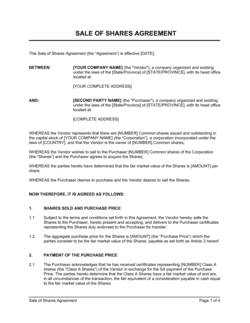
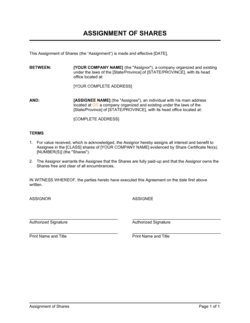
Shares Transfer Agreement Short Template

Free Word download • Edit online • Save & share with Drive • Export to PDF

1 page20–25 min to fillDifficulty: StandardSignature requiredLegal review recommended
Learn more ↓
FreeShares Transfer Agreement Short Template

At a glance

What it is
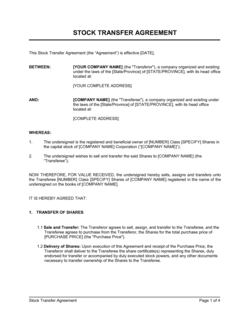
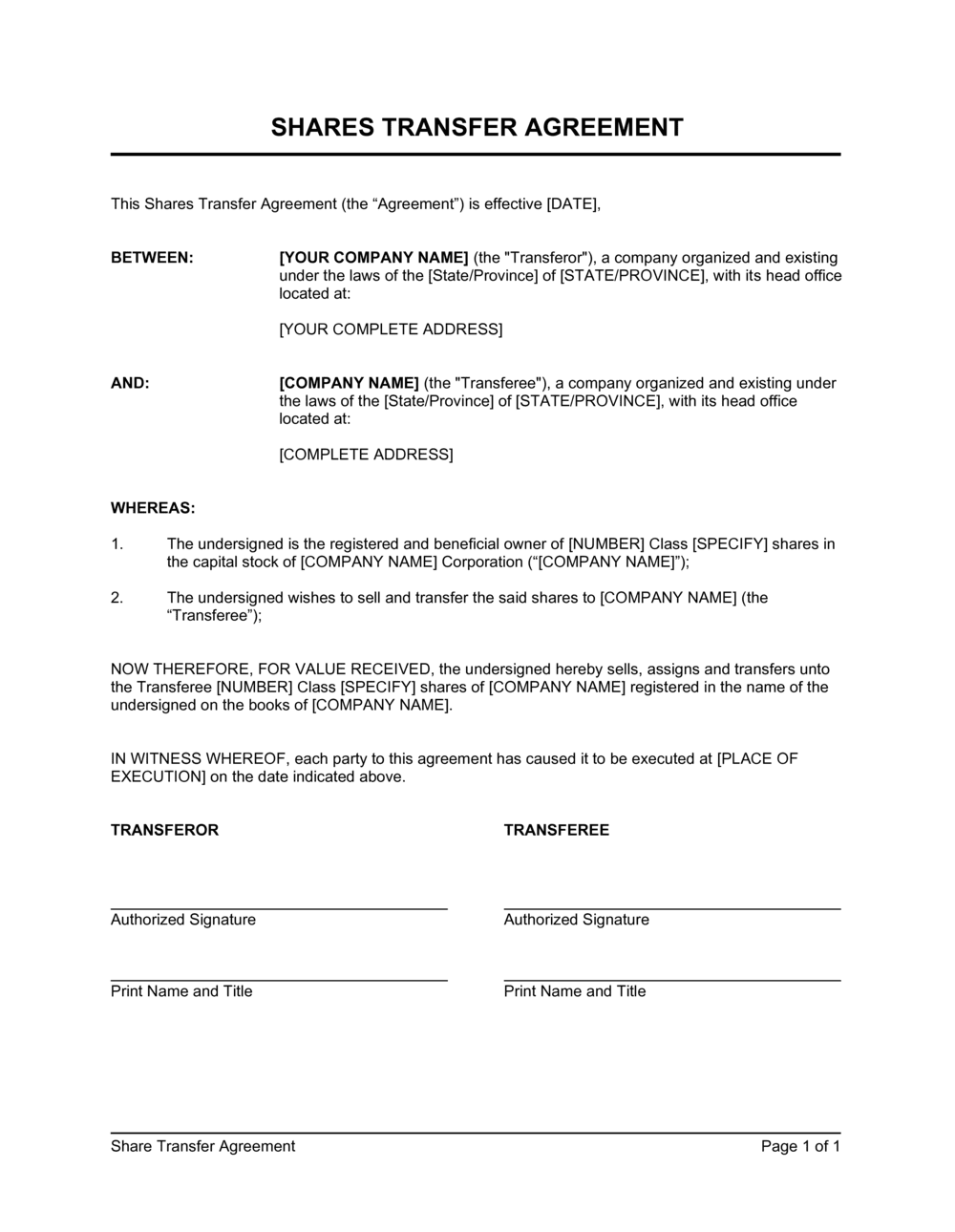
A Shares Transfer Agreement (Short Form) is a concise legal document that records the transfer of a defined number of shares from one party (the Transferor) to another (the Transferee) at an agreed price. This free Word download covers share class, consideration, representations, and the steps required to update the corporate registry — packaged into a single, executable document suitable for simple owner-to-owner or intra-group transfers.
When you need it
Use it when transferring shares between existing shareholders, moving shares between entities in the same corporate group, or selling a minority stake to a known buyer where a full share purchase agreement would be disproportionate to the transaction's complexity.
What's inside
Identification of the parties and the company whose shares are being transferred, share class and exact number, purchase price and payment mechanics, representations and warranties from each party, transfer mechanics and registry update obligations, and governing law.

What is a Shares Transfer Agreement (Short Form)?

A Shares Transfer Agreement (Short Form) is a concise legal document that records the transfer of a defined parcel of shares from one party — the Transferor — to another — the Transferee — at an agreed consideration. It identifies both parties and the company whose shares are moving, specifies the share class and exact number, sets out the purchase price and payment mechanics, records the representations each party makes at signing, and establishes the steps required to update the corporate register and vest legal title in the new holder. The short form is designed for transactions where the parties know each other, the price is agreed, and the full warranty and indemnity structure of a long-form share purchase agreement would be disproportionate to the deal's complexity.

Why You Need This Document

Transferring shares with nothing more than a handshake or a board minute leaves both parties legally exposed in several directions at once. Without a signed agreement, there is no written record of the agreed price, leaving the door open to disputes over consideration years later — particularly relevant in estate or divorce proceedings. The Transferee has no documented basis to enforce the transfer if the Transferor later claims it was conditional or never finalized. Without explicit representations from the Transferor that the shares are free from encumbrances and pre-emption rights have been waived, the Transferee acquires shares without any contractual remedy if a prior charge or a right of first refusal emerges after completion. For the Transferor, the absence of a signed agreement means no clean evidence that title has passed, leaving ongoing liability as the registered holder for dividends, voting obligations, and shareholder litigation. This template closes all four gaps in a single, short document — providing a clear paper trail for the company secretary, the tax authorities, and any future buyer conducting diligence on the cap table.

Which variant fits your situation?

If your situation is…Use this template
Transferring shares with full representations, warranties, and indemnitiesShare Purchase Agreement (Long Form)
Issuing new shares to an investor rather than transferring existing onesStock Subscription Agreement
Selling a majority stake or the entire businessBusiness Sale Agreement
Transferring shares subject to a right of first refusal or drag-alongShareholders Agreement
Transferring LLC membership interest rather than corporate sharesMembership Interest Transfer Agreement
Documenting a gift of shares with no monetary considerationShare Gift Agreement
Recording a share transfer as part of a divorce or separation settlementProperty Settlement Agreement

Common mistakes to avoid

❌ Skipping the pre-emption rights check

Why it matters: Nearly every private company's articles or shareholders agreement grants existing shareholders a right of first refusal. Transferring without complying gives those shareholders grounds to have the transfer set aside and can expose the Transferor to liability for breach of the shareholders agreement.

Fix: Review the company's articles and any shareholders agreement before execution. Obtain written waivers from all eligible shareholders or comply formally with the offer-out procedure before signing the transfer agreement.

❌ Using nominal consideration without documenting intent

Why it matters: A $1 or £1 consideration on a transfer of commercially valuable shares will be re-characterised by tax authorities as a transfer at fair market value, triggering capital gains tax on the Transferor and potentially stamp duty on the actual value for the Transferee.

Fix: Either use the fair market value as consideration, or obtain a professional valuation and document the basis for any below-market price in writing before signing.

❌ Executing the agreement without the stock transfer form

Why it matters: A signed transfer agreement is a contract to transfer shares — it does not by itself vest legal title in the Transferee. Without a completed stock transfer form and register update, the Transferor remains the legal holder and retains all shareholder rights.

Fix: Prepare and execute the stock transfer form simultaneously with the agreement and deliver both to the company secretary on completion day.

❌ Choosing a governing law with no connection to the company or parties

Why it matters: Share transfers in most jurisdictions are governed by the law of the place of incorporation of the company whose shares are being transferred. A governing law clause pointing elsewhere may be ignored by local courts.

Fix: Set the governing law to the jurisdiction in which the company is incorporated unless you have specific legal advice supporting a different choice.

The 9 key clauses, explained

Parties and recitals

In plain language: Identifies the Transferor, Transferee, and the company whose shares are being transferred, and provides brief background on why the transfer is occurring.

Sample language
This Shares Transfer Agreement is entered into on [DATE] between [TRANSFEROR FULL LEGAL NAME] of [ADDRESS] ('Transferor') and [TRANSFEREE FULL LEGAL NAME] of [ADDRESS] ('Transferee') in respect of shares in [COMPANY NAME], a [ENTITY TYPE] incorporated in [JURISDICTION] (registration number [NUMBER]).

Common mistake: Using a trade name instead of the registered legal entity name for any party. If the name doesn't match the share register, the transfer cannot be properly recorded and the company's register update will be delayed or rejected.

Description of shares being transferred

In plain language: States the exact number of shares, their class, and their nominal value — the core subject matter of the agreement.

Sample language
The Transferor agrees to transfer to the Transferee [NUMBER] [CLASS] shares of [COMPANY NAME], each with a nominal value of [$X / £X / €X], representing approximately [X]% of the issued share capital of the Company (the 'Shares').

Common mistake: Stating only the number of shares without specifying class. A company with multiple share classes — ordinary and preference, for example — creates ambiguity that can void the transfer or produce a different transaction than intended.

Purchase price and payment terms

In plain language: Sets out the total consideration payable, the price per share, the payment method, and the timing of payment relative to completion.

Sample language
In consideration for the transfer of the Shares, the Transferee shall pay the Transferor the sum of [$X] (being [$X] per Share) (the 'Purchase Price') by [bank transfer / cheque] on or before the Completion Date.

Common mistake: Setting a nominal consideration of $1 without documenting whether the transaction is intended as a gift or a sale at fair market value. Regulators and tax authorities in most jurisdictions will assess whether the consideration reflects market value and may impose tax on the difference.

Transferor's representations and warranties

In plain language: The Transferor confirms they legally own the shares, have authority to transfer them, and that the shares are free from any encumbrances, charges, or third-party claims.

Sample language
The Transferor represents and warrants that: (a) the Transferor is the sole registered and beneficial owner of the Shares; (b) the Shares are fully paid and free from all encumbrances; (c) the Transferor has full power and authority to enter into and perform this Agreement; and (d) no consent, approval, or notification is required to effect the transfer other than as set out herein.

Common mistake: Omitting a warranty that all pre-emption rights and rights of first refusal have been waived or complied with. If the company's shareholders agreement contains a right of first refusal that was not followed, the transfer can be challenged and potentially unwound.

Transferee's representations and warranties

In plain language: The Transferee confirms they have authority to enter the agreement and, where required, that they are an accredited or eligible investor.

Sample language
The Transferee represents and warrants that: (a) the Transferee has full power and authority to enter into and perform this Agreement; (b) the execution and performance of this Agreement does not violate any applicable law or agreement binding on the Transferee; and (c) the Transferee is acquiring the Shares for its own account and not with a view to distribution.

Common mistake: Skipping the Transferee's representations entirely. If the Transferee later claims they lacked authority or capacity, the Transferor has no contractual basis for a remedy without this clause.

Pre-emption rights and third-party consents

In plain language: Confirms that any right of first refusal, pre-emption right, or board or shareholder approval required by the company's constitution or shareholders agreement has been satisfied.

Sample language
The Transferor confirms that all pre-emption rights and rights of first refusal (if any) applicable to the Shares under the Company's [Articles of Association / Shareholders Agreement dated [DATE]] have been duly waived or complied with, and all required consents have been obtained prior to the date of this Agreement.

Common mistake: Assuming no pre-emption rights exist without checking the articles or any shareholders agreement. Nearly every private company constitution contains a right of first refusal — executing a transfer without complying with it is grounds for the other shareholders to have the transfer set aside.

Transfer mechanics and completion

In plain language: Sets out the steps each party must take to complete the transfer — delivery of the stock transfer form, payment, and any board resolutions required to approve the registration.

Sample language
Completion shall take place on [DATE] ('Completion Date'). At Completion: (a) the Transferor shall deliver to the Transferee a duly executed stock transfer form in respect of the Shares; (b) the Transferee shall pay the Purchase Price in full; and (c) the Company shall update its register of members to reflect the Transferee as the holder of the Shares within [5] business days of receiving the executed transfer form.

Common mistake: Relying on verbal instruction to the company secretary to update the register without requiring a signed stock transfer form. Without the form, the transfer is not formally recorded, the Transferee has no legal title, and the Transferor remains liable as the registered holder.

Stamp duty and taxes

In plain language: Allocates responsibility for any stamp duty, transfer tax, or similar levy arising from the transfer and sets out who bears the cost.

Sample language
The Transferee shall be responsible for the payment of any stamp duty, stamp duty reserve tax, or other transfer taxes arising in connection with this Agreement and shall account for such amounts to the relevant tax authority within the period required by applicable law.

Common mistake: Leaving tax allocation silent. In jurisdictions with stamp duty on share transfers (UK, Ireland, Australia), silence typically means the Transferee pays — but a dispute between the parties over who bears the cost can delay registration.

Governing law and jurisdiction

In plain language: Specifies which jurisdiction's law governs the agreement and which courts have authority to resolve any disputes.

Sample language
This Agreement shall be governed by and construed in accordance with the laws of [GOVERNING JURISDICTION]. Each party submits to the exclusive jurisdiction of the courts of [JURISDICTION] for the resolution of any dispute arising under or in connection with this Agreement.

Common mistake: Choosing a governing law with no connection to where the company is incorporated or where the parties are based. If a dispute arises, local courts may decline jurisdiction or apply their own law regardless of what the contract states.

How to fill it out

  1. 1

    Confirm authority to transfer and check the company constitution

    Before completing the template, review the company's articles of association and any shareholders agreement to identify pre-emption rights, board approval requirements, or transfer restrictions that must be satisfied.

    💡 Request a certified copy of the current articles from the company secretary — not the version filed at incorporation, which may have been amended.

  2. 2

    Enter the legal names and addresses of all parties

    Use the full registered legal name for any corporate party and the full legal name as it appears on government-issued ID for individuals. Include addresses that match registration or residency records.

    💡 For intra-group transfers, confirm each entity's registration number and jurisdiction of incorporation — corporate groups often have similarly named entities that are easy to confuse.

  3. 3

    Identify the shares with precision

    State the exact number of shares, their class (e.g., ordinary, common, Series A preferred), and nominal or par value. Cross-reference the company's current register of members to confirm the Transferor holds exactly the shares described.

    💡 If the shares carry different rights depending on class, attach the relevant section of the articles as a schedule so both parties have the rights on record at signing.

  4. 4

    Set the purchase price and document the basis for valuation

    Enter the total consideration and the per-share price. If the transfer is not at arm's length — for example, intra-group or to a family member — note the basis for the agreed price (e.g., board-approved valuation, accountant's certificate, or nominal consideration with a gift intent).

    💡 In most jurisdictions, transfers at below-market value between related parties trigger a deemed disposition at fair market value for tax purposes — document your valuation basis before signing.

  5. 5

    Complete the representations and warranties for both parties

    Review each representation in Clauses 4 and 5. If any statement is not accurate — for example, if a consent is still outstanding — amend the language or add a condition precedent rather than signing a false warranty.

    💡 A false representation at closing gives the injured party a claim for misrepresentation — potentially unwinding the transfer and triggering damages well beyond the share price.

  6. 6

    Confirm pre-emption compliance and obtain any required consents

    Document the waiver or compliance with any right of first refusal in the pre-emption clause. Attach written waivers from all eligible shareholders or the relevant board resolution authorizing the transfer.

    💡 Keep the waiver letters with the executed agreement — if the transfer is ever challenged, the paper trail demonstrating pre-emption compliance is your primary defence.

  7. 7

    Execute the agreement and the stock transfer form simultaneously

    Both parties sign the agreement, and the Transferor simultaneously executes the prescribed stock transfer form (Form J30 in the UK, or equivalent). Deliver both documents to the company secretary together with the share certificate.

    💡 Never sign the agreement without also completing the stock transfer form on the same day — holding a signed agreement without the form leaves the Transferee without legal title.

  8. 8

    Pay stamp duty and submit for registry update

    If stamp duty applies, stamp or adjudicate the document within the required period (30 days in the UK, for example). Deliver the stamped transfer form to the company secretary and confirm that the register of members has been updated.

    💡 Request written confirmation from the company secretary that the register has been updated and, where share certificates are issued, request a new certificate in the Transferee's name.

Frequently asked questions

What is a shares transfer agreement?

A shares transfer agreement is a legal document that records the sale or transfer of a specified number of shares from one party (the Transferor) to another (the Transferee) at an agreed consideration. It sets out the share class, price, representations each party makes, and the steps required to complete the transfer and update the company's register of members. The short form is designed for straightforward transactions where full warranties and indemnities are not required.

When should I use the short form instead of a full share purchase agreement?

Use the short form for simple transfers between known parties — such as intra-group restructures, transfers to a co-founder or family member, or the sale of a small minority stake at an agreed price. Use a full share purchase agreement when the transaction involves a significant price, complex due diligence, extensive warranties and indemnities, deferred consideration, or an earn-out. The short form is not appropriate for majority or controlling interest acquisitions.

Do I need a lawyer to complete a shares transfer agreement?

For routine intra-group or nominal-value transfers between parties who know each other well, a well-prepared template is typically sufficient. Legal review is recommended when the consideration is material, the company's articles contain complex pre-emption or drag-along provisions, the parties are in different tax jurisdictions, or the transfer is part of a broader restructuring. A short legal review typically costs $300–$800 and is worthwhile when the share value is significant.

What is the difference between a shares transfer agreement and a stock transfer form?

A shares transfer agreement is the contract between the parties recording the agreed terms of the transfer — price, representations, and completion mechanics. A stock transfer form (such as Form J30 in the UK) is a prescribed statutory form that the company uses to formally update its register of members. Both are typically required: the agreement governs the deal; the transfer form implements it on the register. Signing only the agreement without the form leaves the Transferee without legal title.

What happens if the company's articles contain a right of first refusal?

If the articles or a shareholders agreement grants existing shareholders a right of first refusal, the Transferor must first offer the shares to eligible shareholders at the proposed price before transferring to the intended Transferee. Failing to comply makes the transfer voidable — the other shareholders can apply to court to have it set aside. Always check the articles and obtain written waivers or follow the formal offer-out procedure before executing a transfer agreement.

Is stamp duty payable on a share transfer?

Stamp duty applies in several jurisdictions. In the UK, stamp duty of 0.5% of the consideration is payable on transfers of certificated shares above £1,000, and the document must be stamped within 30 days of execution. In Ireland, the rate is 1%. In Australia, stamp duty on share transfers was abolished at the federal level but some states still apply it to unlisted shares. In the US and Canada, there is no federal stamp duty on share transfers, though certain provincial or state-level securities transfer taxes may apply.

Does a share transfer need to be notarized?

Notarization is not required for share transfers in the US, Canada, UK, or most EU member states for private company shares. Some civil-law jurisdictions — including Germany, France, and Spain — require that transfers of shares in certain entity types (GmbH, SAS, SL) be notarized or certified by a notary public. Always confirm local requirements for the jurisdiction in which the company is incorporated.

What tax implications arise from a share transfer?

The Transferor typically triggers a capital gains tax event based on the difference between the consideration received and their acquisition cost. In intra-group transfers, rollover relief or group relief may defer or eliminate the gain, subject to conditions. The Transferee's acquisition cost for future CGT purposes is generally the price paid. Transfers at below fair market value between related parties can result in the Transferor being treated as having received fair market value regardless of the actual price. Tax advice specific to each party's jurisdiction is strongly recommended before completing any non-arm's-length transfer.

How long does a share transfer take to complete?

Executing the agreement and transfer form can be done in a single day once both parties have reviewed and agreed to the terms. The register update by the company secretary typically takes 3–5 business days after receipt of the executed transfer form and any stamped documents. If stamp duty must be paid first (as in the UK), allow an additional 1–2 weeks for HMRC processing. New share certificates, where applicable, are usually issued within 2–4 weeks of registration.

How this compares to alternatives

vs Share Purchase Agreement (Long Form)

A long-form share purchase agreement includes extensive due diligence representations, indemnity schedules, locked-box or completion-accounts price adjustment mechanics, and post-completion covenants. The short form is appropriate for simple transfers between known parties at an agreed price with minimal risk allocation. Use the long form whenever the transaction value is material or the buyer is acquiring a controlling interest.

vs Stock Subscription Agreement

A subscription agreement governs the issuance of new shares by the company to an investor in exchange for fresh capital — the company is a party and the share count increases. A transfer agreement moves existing shares between shareholders with no new capital entering the company. The legal consequences, tax treatment, and corporate approvals required differ significantly between the two.

vs Shareholders Agreement

A shareholders agreement governs the ongoing relationship between all shareholders of a company — voting rights, dividend policy, transfer restrictions, and exit mechanics. A shares transfer agreement is a one-time transaction document recording a specific transfer. The two are complementary: the shareholders agreement often dictates the terms under which a transfer can occur; the transfer agreement records the execution of that transfer.

vs Business Sale Agreement

A business sale agreement may transfer shares as part of a broader acquisition of the entire business, including assets, liabilities, contracts, and employees — with full warranties and indemnities. A shares transfer agreement (short form) is limited to recording the movement of a defined parcel of shares at a fixed price with basic representations. Use a business sale agreement for any transaction where operational continuity, liabilities, and integration are at stake.

Industry-specific considerations

Technology / SaaS

Intra-group IP holding company restructures, founder share rebalancing before a funding round, and employee equity buybacks following departure.

Professional Services

Equity transfers between retiring and incoming partners in accountancy, law, and consulting firms, typically at book or formula value.

Family-owned businesses

Generational succession transfers from founders to children or trusts, often at nominal or below-market consideration with gift tax implications.

Real estate and property holding

Transfers of shares in property-holding SPVs as an alternative to direct asset transfers, often structured to manage stamp duty land tax exposure.

Jurisdictional notes

United States

Share transfers in US corporations are governed primarily by state law — Delaware, for example, requires endorsement on the share certificate or a separate instrument of transfer. Securities law considerations apply even for private transfers; confirm that an exemption from registration (typically Rule 144 or the intrastate exemption) covers the transaction. There is no federal stamp duty on share transfers, though some states impose a securities transfer tax.

Canada

Share transfers in federally incorporated companies are governed by the Canada Business Corporations Act; provincial companies follow their applicable provincial act. A share transfer form endorsed on the certificate or a separate transfer form is required. Capital gains tax applies at the federal level (50% inclusion rate as of 2024 — verify current rate); intra-group transfers may qualify for a rollover under ITA s.85. Quebec transfers involving shares in provincially regulated entities may require French-language documentation.

United Kingdom

UK private company share transfers require a stock transfer form (Form J30) executed by the Transferor. Stamp duty of 0.5% of the consideration applies to transfers above £1,000 and must be paid to HMRC within 30 days of execution; the document must be physically stamped before the company can update its register. Pre-emption rights under the Companies Act 2006 apply unless excluded by the articles. CREST is used for certificated unlisted share transfers through a manual CREST entry.

European Union

Formalities vary significantly by member state and entity type. In Germany, transfers of GmbH shares (Geschäftsanteile) must be notarized by a German notary — a simple written agreement is insufficient. In France, transfers of SAS shares require registration with the tax authority within one month and attract a 0.1% registration duty. In Spain, transfers of SL shares must be recorded in a public deed before a notary. Always verify local notarization, registration, and transfer tax requirements before relying on the short-form template.

Template vs lawyer — what fits your deal?

PathBest forCostTime
Use the templateRoutine intra-group transfers, nominal-value transfers between related parties, or transfers of a small minority stake between known shareholdersFree30–60 minutes
Template + legal reviewTransfers involving material consideration, complex pre-emption provisions, cross-border parties, or non-arm's-length pricing$300–$8002–5 business days
Custom draftedControlling interest transfers, transactions with deferred consideration or earn-outs, heavily regulated industries, or multi-jurisdiction corporate groups$1,500–$5,000+1–3 weeks

Glossary

Transferor
The existing shareholder who is selling or transferring shares to another party.
Transferee
The party receiving the shares and assuming ownership rights upon completion of the transfer.
Share Class
A designated category of shares — such as ordinary, common, or preferred — each carrying specific voting, dividend, and liquidation rights.
Consideration
The price or other value exchanged for the shares — typically a cash amount stated per share or as a lump sum.
Stock Transfer Form
A standard prescribed form used to formally record a share transfer on the company's register of members; required in the UK and many other jurisdictions.
Register of Members
The company's official record of current shareholders, share classes, and the number of shares held by each — updated upon every valid transfer.
Right of First Refusal
A provision in a shareholders agreement giving existing shareholders the right to purchase shares before they may be sold to an outside party.
Stamp Duty
A government tax levied on share transfer documents in certain jurisdictions — in the UK, 0.5% of the consideration; in Ireland, 1% — payable before the transfer is registered.
Representations and Warranties
Factual statements made by each party at the time of signing — such as that the Transferor owns the shares free of encumbrances — that give the other party a remedy if they prove false.
Encumbrance
Any charge, lien, pledge, option, or restriction that limits the owner's ability to freely transfer shares.
Completion
The moment at which ownership formally passes from Transferor to Transferee — typically when consideration is paid and the transfer is delivered.

Part of your Business Operating System

This document is one of 3,000+ business & legal templates included in Business in a Box.

  • Fill-in-the-blanks — ready in minutes
  • 100% customizable Word document
  • Compatible with all office suites
  • Export to PDF and share electronically

Create your document in 3 simple steps.

From template to signed document — all inside one Business Operating System.
1
Download or open template

Access over 3,000+ business and legal templates for any business task, project or initiative.

2
Edit and fill in the blanks with AI

Customize your ready-made business document template and save it in the cloud.

3
Save, Share, Send, Sign

Share your files and folders with your team. Create a space of seamless collaboration.

Save time, save money, and create top-quality documents.

★★★★★

"Fantastic value! I'm not sure how I'd do without it. It's worth its weight in gold and paid back for itself many times."

Managing Director · Mall Farm
Robert Whalley
Managing Director, Mall Farm Proprietary Limited
★★★★★

"I have been using Business in a Box for years. It has been the most useful source of templates I have encountered. I recommend it to anyone."

Business Owner · 4+ years
Dr Michael John Freestone
Business Owner
★★★★★

"It has been a life saver so many times I have lost count. Business in a Box has saved me so much time and as you know, time is money."

Owner · Upstate Web
David G. Moore Jr.
Owner, Upstate Web

Run your business with a system — not scattered tools

Stop downloading documents. Start operating with clarity. Business in a Box gives you the Business Operating System used by over 250,000 companies worldwide to structure, run, and grow their business.

Start free · No credit card required