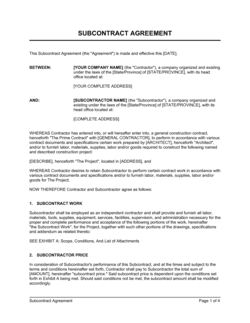
Freelance Contract Template

Free Word download β€’ Edit online β€’ Save & share with Drive β€’ Export to PDF

6 pagesβ€’25–35 min to fillβ€’Difficulty: Complexβ€’Signature requiredβ€’Legal review recommended
Learn more ↓
FreeFreelance Contract Template

At a glance

What it is
A Freelance Contract is a legally binding agreement between a client and a self-employed individual that defines the scope of work, payment terms, IP ownership, confidentiality obligations, and termination conditions for a project-based engagement. This free Word download gives you a structured, professionally drafted starting point you can edit online and export as PDF to sign before work begins.
When you need it
Use it any time you hire a freelancer β€” designer, developer, writer, consultant, or other independent worker β€” or any time you take on a client engagement as a freelancer. Both sides need the protection of a written agreement before a single deliverable changes hands.
What's inside
Parties and engagement details, scope of work and deliverables, payment schedule and late-fee terms, intellectual property assignment, confidentiality, independent contractor status, revision and approval process, termination rights, and governing law.

What is a Freelance Contract?

A Freelance Contract is a legally binding agreement between a client and a self-employed individual β€” designer, developer, writer, consultant, or other independent worker β€” that governs a discrete project engagement from start to finish. It defines the scope of work and deliverables in measurable terms, sets the fee structure and payment schedule, assigns intellectual property ownership to the client upon full payment, and establishes what happens if either party wants to end the engagement early. Unlike a casual email exchange, a properly drafted freelance contract creates enforceable obligations on both sides and eliminates the ambiguity that courts otherwise resolve using jurisdiction-specific defaults β€” which frequently favor whichever party had less bargaining power at the time the dispute arose.

Why You Need This Document

Without a written freelance contract, both sides are exposed in ways that only become visible when something goes wrong. A freelancer who delivers work without a signed agreement retains copyright by default in most jurisdictions β€” meaning the client may not legally own what they paid for. A client who pays a deposit with no written scope has no enforceable basis to demand revision, rejection, or return of funds if the deliverable misses the mark. Payment disputes with no contract are resolved by whoever has the better paper trail of emails and messages; scope disputes are decided by whoever's recollection is more convincing. A signed freelance contract, executed before the first deliverable, closes all of these gaps β€” protecting the freelancer's right to be paid and the client's right to own what they commissioned. This template gives you a professionally structured starting point that covers every clause a real-world engagement requires, in plain language both parties can read and understand before they sign.

Which variant fits your situation?

If your situation is…Use this template
Engaging a freelancer for a single defined project with a fixed feeFreelance Contract (Fixed-Price)
Retaining a freelancer on an ongoing hourly or weekly basisIndependent Contractor Agreement
Hiring a freelancer who will access confidential business informationNon-Disclosure Agreement
Engaging a freelance software developer with source code deliverablesSoftware Development Agreement
Subcontracting work from a prime contractor to a freelancerSubcontractor Agreement
Commissioning a freelance designer to create brand or visual assetsGraphic Design Contract
Engaging a freelance writer for ongoing content productionContent Writing Agreement

Common mistakes to avoid

❌ Starting work before the contract is signed

Why it matters: An unsigned agreement is unenforceable. If a client disputes payment or ownership after work is delivered, you have no written contract to point to β€” only emails and verbal promises.

Fix: Adopt a firm policy: no work begins until the signed contract and deposit are received. Use eSign to remove friction and close the gap between proposal acceptance and execution.

❌ Vague or open-ended scope of work

Why it matters: Undefined deliverables invite scope creep. Clients add requests framed as 'small changes' that collectively double the project size, while the freelancer has no contractual basis to charge for them.

Fix: Describe every deliverable with enough specificity that both parties could independently judge whether it was delivered. Attach a detailed brief as Schedule A and include an explicit exclusions list.

❌ No deposit or front-loaded payment

Why it matters: A freelancer who completes 80% of a project before the first payment lands has effectively extended an interest-free loan to the client β€” and has no leverage if payment is refused on delivery.

Fix: Require a deposit of at least 25–50% of the total fee at contract signing, before any work begins. Tie remaining payments to defined milestones, not to client satisfaction.

❌ Relying on 'work for hire' without an IP assignment clause

Why it matters: In the US, most freelance deliverables do not qualify as work for hire under copyright law. Without an explicit assignment clause, the freelancer may legally retain ownership of the final work even after the client pays in full.

Fix: Include a specific IP assignment clause that transfers all rights to the client upon receipt of full payment. State that this applies worldwide and in perpetuity.

❌ No kill fee for client-initiated cancellation

Why it matters: Clients who cancel mid-project often dispute what is owed, arguing that incomplete work has no value. Without a kill fee clause, recovering compensation for completed work requires litigation.

Fix: Define a kill fee β€” typically 20–30% of the remaining contract value β€” payable if the client cancels after work has commenced. This is a standard industry term that most professional clients accept.

❌ Omitting a deemed-acceptance clause

Why it matters: Without a feedback deadline, a client can withhold approval indefinitely. Final payment milestones tied to acceptance can remain unpaid for months while the deliverable sits in the client's inbox.

Fix: Add a clause stating that if the client does not provide written feedback within a defined window (typically 5–7 business days), the deliverable is deemed accepted and the associated payment becomes due.

The 10 key clauses, explained

Parties and engagement details

In plain language: Identifies the client and freelancer as legal entities or individuals, states the effective date, and describes the nature of the engagement in one or two sentences.

Sample language
This Freelance Contract ('Agreement') is entered into as of [DATE] between [CLIENT LEGAL NAME], a [STATE/COUNTRY] [ENTITY TYPE] ('Client'), and [FREELANCER FULL NAME / BUSINESS NAME] ('Freelancer'). Client engages Freelancer to provide [GENERAL SERVICE DESCRIPTION] as further specified in Schedule A.

Common mistake: Using a personal name for a business that is actually an LLC or corporation. If the contracting entity and the signatory don't match, enforcing payment or IP terms against the right party becomes complicated.

Scope of work and deliverables

In plain language: Specifies exactly what will be produced, in what format, by what date β€” and what is explicitly out of scope to prevent scope creep.

Sample language
Freelancer shall deliver the work product described in Schedule A ('Deliverables') by [DEADLINE DATE]. The following are expressly excluded from scope: [EXCLUSION 1], [EXCLUSION 2]. Any work beyond this scope requires a written change order signed by both parties.

Common mistake: Describing deliverables in vague terms like 'website design' without specifying page count, file formats, or functional requirements. Disputes about what was promised are the leading cause of freelance contract litigation.

Payment, invoicing, and late fees

In plain language: States the total fee or rate, the payment schedule (milestone, deposit, or net terms), and the interest or penalty that applies to overdue invoices.

Sample language
Client shall pay Freelancer a fixed fee of $[AMOUNT] USD, payable as follows: [X]% ($[DEPOSIT]) due upon execution; remaining [X]% ($[BALANCE]) due within [14] days of final delivery. Invoices unpaid after [14] days accrue interest at [1.5]% per month.

Common mistake: No deposit requirement at all. Without an upfront payment, the freelancer bears 100% of the financial risk if the client disappears or cancels mid-project.

Intellectual property assignment

In plain language: Transfers ownership of all work product created under the agreement to the client upon receipt of full payment, including all copyrights, design rights, and related IP.

Sample language
Upon receipt of full payment, Freelancer irrevocably assigns to Client all right, title, and interest in the Deliverables, including all copyrights and IP rights worldwide. Prior to full payment, Freelancer retains all rights and Client receives no license to use the Deliverables.

Common mistake: Assuming a 'work for hire' clause alone is sufficient. In the US, work for hire applies only to employees and nine specific commissioned-work categories. For most freelance output, an explicit IP assignment clause is required to transfer ownership.

Freelancer's retained rights and portfolio license

In plain language: Clarifies what the freelancer may keep β€” pre-existing tools, processes, and generic code β€” and whether they may display the work in their portfolio.

Sample language
Freelancer retains all rights to pre-existing materials, tools, and methodologies incorporated into the Deliverables ('Background IP'). Client grants Freelancer a non-exclusive right to display the Deliverables in Freelancer's portfolio, subject to [any confidentiality restrictions below].

Common mistake: No portfolio clause in either direction. Clients then claim the freelancer cannot show the work; freelancers then display work the client considers confidential. One sentence resolves this at signing.

Confidentiality

In plain language: Prohibits the freelancer from disclosing or using the client's non-public business information β€” strategy, pricing, customer data, and product details β€” during and after the engagement.

Sample language
Freelancer agrees to keep confidential all non-public information disclosed by Client in connection with this Agreement ('Confidential Information') and not to use it for any purpose other than performing the Services. This obligation survives termination for [2] years.

Common mistake: No confidentiality clause at all on the assumption a separate NDA covers it. If no NDA was signed, the freelancer has no written obligation to protect sensitive information shared during the project.

Independent contractor status

In plain language: States that the freelancer is not an employee, that the client does not control how work is performed, and that each party is responsible for their own taxes.

Sample language
Freelancer is an independent contractor and not an employee, agent, or partner of Client. Client shall not withhold income taxes, FICA, or other employment taxes from Freelancer's fees. Freelancer is solely responsible for all taxes on amounts paid under this Agreement.

Common mistake: Adding language that requires the freelancer to work set hours, use client equipment exclusively, or attend daily check-ins. Behavioral control language contradicts independent contractor status and can trigger misclassification liability.

Revisions, approvals, and acceptance

In plain language: Defines how many rounds of revisions are included in the fee, the timeline for client feedback, and when a deliverable is deemed accepted.

Sample language
The fee includes up to [2] rounds of revisions per Deliverable. Additional revisions are billed at $[HOURLY RATE]/hour. Client shall review each Deliverable within [5] business days of delivery. Failure to provide written feedback within this period constitutes acceptance.

Common mistake: No deemed-acceptance clause. Without one, a client can withhold feedback indefinitely, blocking final payment while the freelancer has no recourse.

Termination and kill fee

In plain language: Sets out the conditions under which either party may end the contract early, what work-in-progress payment is owed, and the kill fee if the client cancels without cause.

Sample language
Either party may terminate this Agreement with [14] days written notice. If Client terminates without cause after work has commenced, Client shall pay Freelancer for all work completed to date plus a kill fee of [25]% of the remaining contract value. Freelancer shall deliver all completed work product upon receipt of these payments.

Common mistake: No kill fee provision. Clients who cancel a project mid-stream often dispute what is owed for work in progress. A defined kill fee eliminates the argument and compensates the freelancer for lost opportunity.

Governing law and dispute resolution

In plain language: Specifies which jurisdiction's law governs the agreement and how disputes are resolved β€” arbitration, small claims court, or litigation β€” and in what venue.

Sample language
This Agreement is governed by the laws of [STATE / PROVINCE / COUNTRY], without regard to conflict-of-law principles. Any dispute not resolved by good-faith negotiation within [30] days shall be submitted to binding arbitration under [AAA / JAMS] rules in [CITY], except that either party may seek injunctive relief in any court of competent jurisdiction.

Common mistake: Choosing the client's home jurisdiction without considering where the freelancer is located. In many countries, courts apply local consumer-protection or employment law regardless of the governing-law clause when the freelancer is the weaker party.

How to fill it out

  1. 1

    Enter the parties' legal names and effective date

    Use the client's full registered entity name (not a brand name) and the freelancer's legal name or registered business name. Enter the date both parties will sign β€” not the project start date.

    πŸ’‘ Ask for a copy of the client's business registration if you are a freelancer engaging a new company for the first time. Knowing the exact legal name prevents collection problems if payment is disputed.

  2. 2

    Write the scope of work in Schedule A

    List every deliverable with a specific description, file format, quantity, and due date. Add a line explicitly stating what is out of scope. Attach any creative brief, technical specification, or wireframe as an exhibit.

    πŸ’‘ Write deliverables specific enough that a stranger who wasn't in the kickoff meeting could judge whether they were met. Vagueness costs money when disputes arise.

  3. 3

    Set the fee, deposit, and payment schedule

    Enter the total project fee and break it into at least two payments β€” a deposit of 25–50% due at signing, and the balance tied to a milestone or final delivery. Add your net terms and the late-fee rate.

    πŸ’‘ For projects over $5,000, use three payment milestones: deposit at signing, mid-project on a defined deliverable, and final on acceptance. This limits exposure on both sides.

  4. 4

    Confirm the IP assignment and retained rights

    Verify the IP assignment clause transfers ownership upon full payment β€” not at signing. Add any background IP (tools, libraries, templates) you are retaining. Specify whether you may show the work in your portfolio.

    πŸ’‘ If you are building on open-source libraries or licensed assets, list them explicitly in the Background IP section so the client knows what is and is not assigned.

  5. 5

    Fill in revision limits and the acceptance timeline

    Enter the number of included revision rounds and the per-hour rate for additional revisions. Set a realistic client review window β€” 3 to 7 business days is standard β€” and include the deemed-acceptance clause.

    πŸ’‘ Two rounds of revisions is standard for most creative work. One round is appropriate for short-turnaround or commodity work; three or more is reasonable only for complex multi-phase projects.

  6. 6

    Set the termination notice period and kill fee

    Choose a notice period proportionate to project length β€” 7 days for projects under 4 weeks, 14 days for longer engagements. Calculate the kill fee as a percentage of the remaining contract value, typically 20–30%.

    πŸ’‘ Tie the kill fee percentage to project phase: lower in early discovery, higher once design or development is substantially underway.

  7. 7

    Select the governing law and dispute resolution method

    Choose the jurisdiction where you or your client is located and confirm it is appropriate for both parties. Select arbitration for faster, lower-cost resolution or litigation if you prefer court access.

    πŸ’‘ Freelancers working internationally should specify arbitration β€” it is easier to enforce across borders than a court judgment.

  8. 8

    Sign before any work begins

    Both parties must sign and date the agreement before the first billable hour or deliverable is started. Send the contract via eSign, obtain a countersigned copy, and save it with the project file.

    πŸ’‘ Use Business in a Box eSign to timestamp execution and store the fully-executed copy. An unsigned contract is not enforceable in most jurisdictions.

Frequently asked questions

What is a freelance contract?

A freelance contract is a legally binding agreement between a client and a self-employed individual or business that governs a project-based engagement. It defines the scope of work, payment terms, IP ownership, confidentiality obligations, and what happens if the project is cancelled or a dispute arises. It protects both parties and replaces informal email threads as the authoritative record of agreed terms.

Do I need a freelance contract for every project?

Yes β€” for any project where the fee, IP ownership, or timeline matters. Even small projects benefit from a written agreement because they document what was promised, who owns the output, and when payment is due. The cost of drafting a contract is always lower than the cost of a payment dispute or IP argument with no written record to resolve it.

Who owns the work a freelancer produces?

Without a written agreement, the freelancer typically retains copyright in most countries under default copyright law. The client only receives a license to use the work, not ownership of it. To transfer full ownership, the contract must include an explicit IP assignment clause that transfers all rights to the client upon payment. Relying on the US work-for-hire doctrine alone is insufficient for most freelance deliverables β€” it applies to employees and a narrow list of commissioned work categories, not general freelance output.

What should a freelance contract include?

At minimum: parties and effective date, scope of work with specific deliverables, total fee and payment schedule (including a deposit), IP assignment upon full payment, confidentiality obligations, independent contractor status, revision and acceptance terms, kill fee for client-initiated cancellation, and governing law. Missing any of these creates a gap that courts fill with jurisdiction-specific defaults, which frequently favor whichever party had less bargaining power.

Can a freelance contract be used internationally?

Yes, with appropriate adjustments. Specify the governing law clearly β€” courts in some countries apply local law regardless of what the contract states. For cross-border engagements, choose arbitration over litigation for dispute resolution, as arbitral awards are generally easier to enforce internationally than court judgments. State the payment currency explicitly, and be aware that VAT or GST registration obligations may apply depending on the jurisdictions involved.

What is a kill fee in a freelance contract?

A kill fee is a predetermined payment the client owes if they cancel the project after work has begun. It is typically calculated as a percentage of the remaining contract value β€” commonly 20–30% β€” and compensates the freelancer for time already invested and for the opportunity cost of declining other work to take the project. Kill fees are a standard term in creative, design, and development contracts and are generally accepted by professional clients.

Is a freelancer the same as an independent contractor?

The terms are often used interchangeably in practice. Legally, both refer to a self-employed individual engaged for specific work without the tax withholding, benefits, or behavioral control associated with employment. The distinction matters for tax classification: in the US, a client engaging a freelancer for $600 or more in a calendar year must issue a Form 1099-NEC. Misclassifying a freelancer who functions as an employee exposes the client to back taxes, penalties, and benefit liability.

How many revision rounds should a freelance contract allow?

Two rounds of revisions is the industry standard for most creative and development work. One round is appropriate for short-turnaround or commodity deliverables. Three or more rounds may be reasonable for complex multi-phase projects where early-stage ambiguity is expected. The contract should specify an hourly rate for revisions beyond the included rounds and set a deadline by which revision requests must be submitted β€” typically within 5 to 7 business days of delivery.

Do I need a lawyer to create a freelance contract?

For standard domestic freelance engagements, a well-drafted template is sufficient for most freelancers and small business clients. Consider engaging a lawyer when the project fee exceeds $25,000, when the deliverables involve sensitive IP in a competitive market, when the client is in a heavily regulated industry, or when the engagement crosses multiple international jurisdictions. A 1-hour template review typically costs $150–$400 and is worthwhile for high-value or long-term engagements.

How this compares to alternatives

vs Independent Contractor Agreement

An independent contractor agreement typically governs an ongoing hourly or retainer-based relationship with no defined end date. A freelance contract is project-specific β€” it defines a discrete scope, fixed or milestone-based fee, and a completion date. Use the contractor agreement for recurring engagements; use the freelance contract when the work has a clear beginning and end.

vs Non-Disclosure Agreement

An NDA covers only confidentiality obligations and is often signed before any commercial terms are discussed. A freelance contract includes a confidentiality clause but also governs payment, IP, deliverables, and termination. For most projects, the freelance contract's confidentiality clause is sufficient; a standalone NDA is appropriate when sensitive information must be shared before the project scope is finalized.

vs Service Agreement

A service agreement is broader and typically used by companies engaging other businesses for ongoing or multi-service arrangements. A freelance contract is narrower and written for a single individual providing a defined project deliverable. The service agreement suits B2B vendor relationships; the freelance contract suits individual creative or technical project engagements.

vs Subcontractor Agreement

A subcontractor agreement is used when a prime contractor engages a third party to perform part of the prime's obligations to an end client. It includes flow-down clauses mirroring the prime contract's requirements, indemnification for the prime's liability, and restrictions on client contact. A standard freelance contract lacks these elements and is not appropriate for subcontracting arrangements.

Industry-specific considerations

Technology and software development

Source code ownership, open-source license disclosures, development environment requirements, and bug-fix warranty periods are essential additions to the standard IP assignment clause.

Creative and marketing agencies

Client approval milestones tied to payments, subcontractor flow-down confidentiality obligations, and portfolio display rights require explicit treatment when agencies subcontract creative work.

Professional services and consulting

Non-solicitation of the client's employees and customers, report-ownership transfer, and engagement-specific confidentiality regarding pricing and client financials are critical clauses.

Media and publishing

First-publication rights, licensing versus assignment of copyright, kill fees for commissioned but unused editorial work, and syndication restrictions are industry-standard terms that deviate from a generic freelance template.

Jurisdictional notes

United States

Most freelance deliverables do not qualify as work for hire under 17 U.S.C. Β§101 β€” an explicit IP assignment clause is required to transfer copyright. Clients must issue a Form 1099-NEC for payments of $600 or more per calendar year. Non-compete clauses imposed on freelancers are unenforceable in California and several other states. The FTC's worker classification rules continue to evolve β€” behavioral-control language in the contract should be avoided.

Canada

Copyright in commissioned works vests in the creator by default under the Copyright Act unless assigned in writing. Moral rights β€” the creator's right to attribution and integrity β€” cannot be assigned but can be waived; include a moral rights waiver clause for commercial clients. GST/HST may apply to freelance services depending on the freelancer's annual revenue threshold. Quebec engagements may require French-language contracts for provincially regulated contexts.

United Kingdom

UK copyright law vests ownership in the creator for most freelance work; a written assignment is required to transfer it to the client. IR35 rules apply when a freelancer operates through a personal service company β€” the client may be deemed the employer for tax purposes if the engagement resembles employment. The contract should avoid substitution-restriction and supervision language that could trigger IR35 reclassification. Post-Brexit, VAT rules for cross-border digital services require separate consideration.

European Union

Copyright and moral rights protections are strong across EU member states, with moral rights generally non-waivable in France, Germany, and several other countries β€” unlike in common-law jurisdictions. GDPR applies if the freelancer processes personal data on behalf of the client; a Data Processing Addendum is required in that case. Platform-work directive negotiations may reclassify certain gig-economy freelancers as employees in some member states β€” check current status in the relevant country.

Template vs lawyer β€” what fits your deal?

PathBest forCostTime
Use the templateFreelancers and small business clients engaging on standard domestic projects under $25,000Free15–30 minutes
Template + legal reviewProjects over $25,000, cross-border engagements, or deliverables involving sensitive IP or regulated industries$150–$400 for a 1-hour attorney review1–3 days
Custom draftedHigh-value long-term engagements, enterprise clients requiring custom terms, or complex multi-jurisdiction arrangements$800–$3,000+1–2 weeks

Glossary

Scope of Work
A written description of exactly what the freelancer agrees to deliver β€” specific tasks, formats, quantities, and deadlines β€” forming the performance standard for the contract.
Deliverable
A tangible output the freelancer must produce by a specified date, such as a completed design file, written article, or deployed feature.
Intellectual Property Assignment
A clause that transfers ownership of all work product created under the contract from the freelancer to the client upon full payment.
Work for Hire
A US copyright doctrine under which certain commissioned works are deemed owned by the commissioning party from creation β€” not all freelance work qualifies automatically, making an IP assignment clause essential.
Independent Contractor Status
A classification confirming the freelancer is not an employee, meaning the client does not withhold taxes, provide benefits, or control how the work is performed β€” only the result.
Kill Fee
A predetermined payment the client owes if the project is cancelled after work has begun, compensating the freelancer for time already invested.
Revision
A requested change to a delivered work product; contracts typically specify a maximum number of included revisions before additional fees apply.
Net Payment Terms
The number of days after invoice date within which the client must remit payment β€” commonly Net 14, Net 30, or Net 45 for freelance engagements.
Indemnification
A clause requiring one party to compensate the other for losses, damages, or legal costs arising from a specific type of breach or third-party claim.
Governing Law
The jurisdiction whose laws apply to interpret and enforce the contract β€” typically the state or country where the client or freelancer is located.
Moral Rights
Rights under copyright law β€” particularly in Canada and the EU β€” that allow creators to claim authorship and object to modifications, separate from economic IP ownership.

Part of your Business Operating System

This document is one of 3,000+ business & legal templates included in Business in a Box.

  • Fill-in-the-blanks β€” ready in minutes
  • 100% customizable Word document
  • Compatible with all office suites
  • Export to PDF and share electronically

Create your document in 3 simple steps.

From template to signed document β€” all inside one Business Operating System.
1
Download or open template

Access over 3,000+ business and legal templates for any business task, project or initiative.

2
Edit and fill in the blanks with AI

Customize your ready-made business document template and save it in the cloud.

3
Save, Share, Send, Sign

Share your files and folders with your team. Create a space of seamless collaboration.

Save time, save money, and create top-quality documents.

β˜…β˜…β˜…β˜…β˜…

"Fantastic value! I'm not sure how I'd do without it. It's worth its weight in gold and paid back for itself many times."

Managing Director Β· Mall Farm
Robert Whalley
Managing Director, Mall Farm Proprietary Limited
β˜…β˜…β˜…β˜…β˜…

"I have been using Business in a Box for years. It has been the most useful source of templates I have encountered. I recommend it to anyone."

Business Owner Β· 4+ years
Dr Michael John Freestone
Business Owner
β˜…β˜…β˜…β˜…β˜…

"It has been a life saver so many times I have lost count. Business in a Box has saved me so much time and as you know, time is money."

Owner Β· Upstate Web
David G. Moore Jr.
Owner, Upstate Web

Run your business with a system β€” not scattered tools

Stop downloading documents. Start operating with clarity. Business in a Box gives you the Business Operating System used by over 250,000 companies worldwide to structure, run, and grow their business.

Start freeΒ Β·Β No credit card required