Entertainment Agreement Template

Free Word download β€’ Edit online β€’ Save & share with Drive β€’ Export to PDF

7 pagesβ€’25–35 min to fillβ€’Difficulty: Complexβ€’Signature requiredβ€’Legal review recommended
Learn more ↓
FreeEntertainment Agreement Template

At a glance

What it is
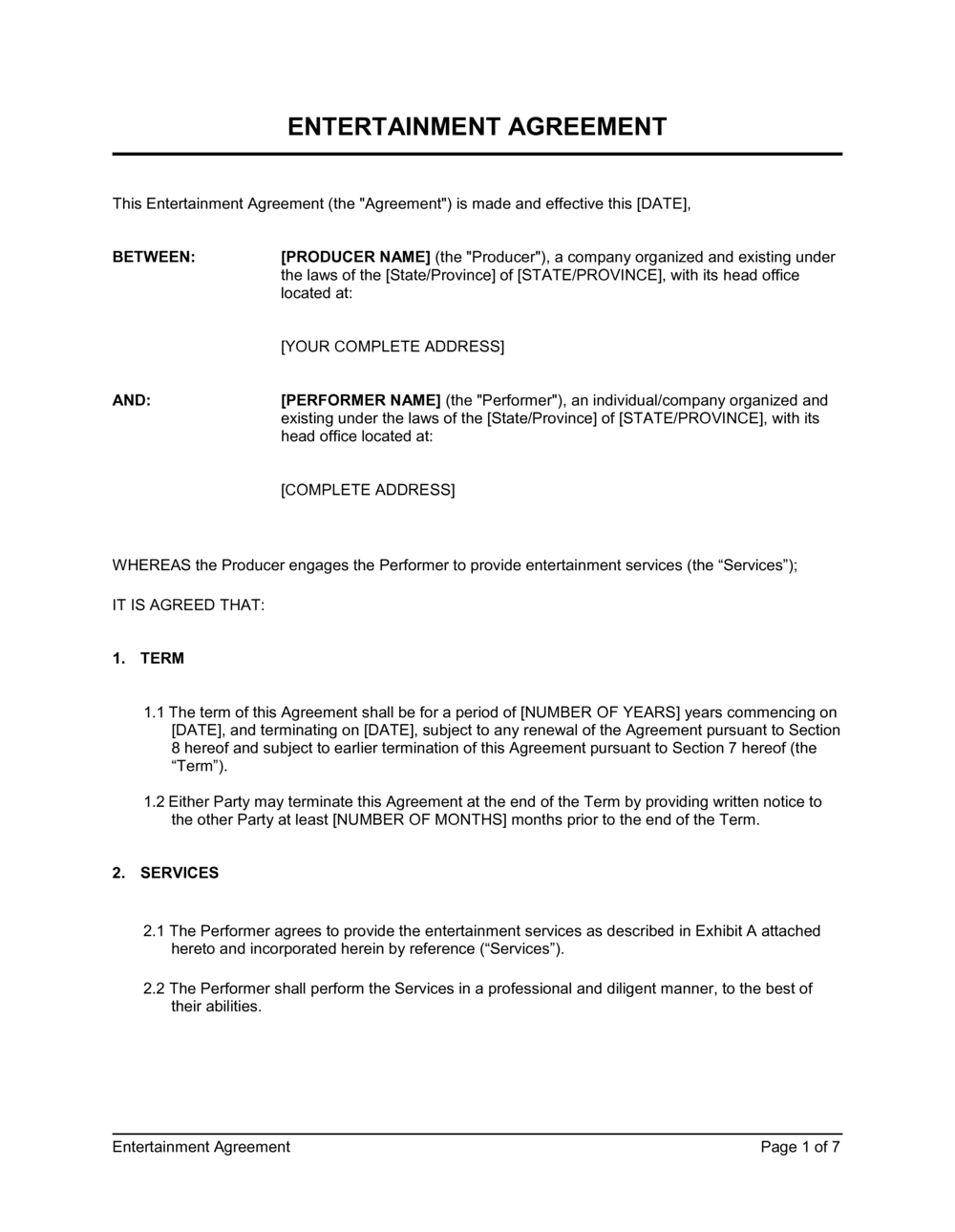
An Entertainment Agreement is a legally binding contract between a hiring party β€” a promoter, producer, venue, or event organizer β€” and a performer or entertainment service provider that defines every material term of the engagement. This free Word download covers performance scope, fees, scheduling, intellectual property, cancellation, and liability in a single document you can edit online and export as PDF.
When you need it
Use it any time you book a performer, band, DJ, comedian, speaker, or entertainment act for a live event, production, or promotional appearance where payment and performance obligations need to be enforceable in writing.
What's inside
Parties and engagement details, performance scope and schedule, compensation and payment terms, IP and recording rights, cancellation and force majeure, rider and technical requirements, indemnification, and governing law.

What is an Entertainment Agreement?

An Entertainment Agreement is a legally binding contract between a hiring party β€” a promoter, venue operator, producer, or event organizer β€” and a performer or entertainment service provider that governs every material term of the engagement. It defines the performance scope, schedule, compensation, deposit and kill-fee structure, intellectual property and recording rights, exclusivity restrictions, rider obligations, cancellation rights, and liability allocation in a single enforceable document. Unlike an informal booking confirmation or email exchange, a properly executed entertainment agreement creates documented obligations on both sides and provides a clear framework for resolving disputes over payment, cancellation, or rights.

Why You Need This Document

Without a written entertainment agreement, both parties are exposed to significant financial and legal risk. A promoter who cancels without a kill-fee clause may face unlimited damages claims based on the performer's lost earnings. A performer who allows broad recording rights without a separate license may find their performance commercially exploited across streaming platforms without compensation. Disputes over unmet rider requirements, disputed deposit refunds, and last-minute cancellations are among the most common β€” and most costly β€” issues in live entertainment, and they are almost always the result of relying on verbal agreements or generic emails. A signed entertainment agreement, executed before any deposit changes hands or public announcement is made, eliminates those ambiguities for the cost of 30 minutes and a legal review where the stakes warrant it.

Which variant fits your situation?

If your situation is…Use this template
Booking a live musical act for a one-night concert or festivalLive Performance Agreement
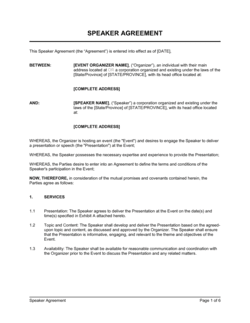
Engaging a speaker for a corporate conference or keynoteSpeaker Agreement
Hiring a DJ for a private event or nightclub residencyDJ Services Agreement
Contracting a comedian or variety act for a recurring venue residencyEntertainment Agreement (Residency)
Engaging on-screen talent for a film, TV, or commercial productionTalent Release Agreement
Booking entertainment for a private event such as a wedding or galaEntertainment Agreement (Private Event)
Commissioning a musical performance for a brand activation or sponsorshipBrand Entertainment Partnership Agreement

Common mistakes to avoid

❌ Using a stage name instead of the legal entity name

Why it matters: A contract signed in a stage name may be unenforceable against the performer's actual legal entity, making it difficult to pursue payment disputes or enforce non-compete and IP terms.

Fix: Require the performer's legal name or registered entity name and confirm it matches the bank account and tax documents before execution.

❌ Omitting a tiered cancellation and kill-fee schedule

Why it matters: A flat 'deposit forfeited on cancellation' clause may be treated as an unenforceable penalty rather than liquidated damages, leaving the promoter with no financial protection for a last-minute cancellation that has already incurred marketing and venue costs.

Fix: Draft at least two cancellation tiers β€” one for cancellations more than 30 days out and one for closer cancellations β€” with percentages calibrated to actual anticipated losses.

❌ Failing to attach a signed rider as a contract schedule

Why it matters: A rider referenced but not attached and executed is merely a list of preferences β€” not a contractual obligation. Unmet technical requirements can then be used as a pretext to cancel without penalty.

Fix: Attach the rider as a signed, initialed Schedule A at the time of contract execution, treating it as an integral part of the agreement.

❌ Granting broad recording rights without a streaming license

Why it matters: Live-streaming or commercially releasing a recorded performance that includes third-party compositions requires synchronization, mechanical, and streaming licenses separate from the performance contract. Missing licenses expose both parties to copyright infringement claims.

Fix: Limit recording rights in the base contract to internal archival use, and require a separate signed licensing addendum before any public broadcast or streaming occurs.

❌ No force majeure clause specific to live events

Why it matters: A generic force majeure clause that omits government-ordered venue closures, pandemic-related restrictions, or public safety emergencies left thousands of entertainment contracts unresolved during COVID-19, resulting in prolonged litigation.

Fix: Include an explicit list of force majeure events relevant to live entertainment β€” government orders, public health emergencies, and venue destruction β€” along with a rescheduling mechanism and deposit-holding provision.

❌ Choosing a governing law with no connection to the performance jurisdiction

Why it matters: Several jurisdictions β€” including California and certain EU member states β€” apply local performer-protection statutes regardless of what the contract's choice-of-law clause says, making a remote governing-law selection practically meaningless and creating confusion about which court has authority.

Fix: Select the jurisdiction where the performance physically occurs, or the jurisdiction most closely connected to both parties, and confirm that choice does not conflict with mandatory local performer protections.

The 10 key clauses, explained

Parties and engagement details

In plain language: Identifies the hiring party and performer by legal name, defines the specific engagement (event name, venue, date, and set duration), and confirms each party's role.

Sample language
This Entertainment Agreement is entered into on [DATE] between [HIRING PARTY LEGAL NAME] ('Promoter') and [PERFORMER / ENTITY LEGAL NAME] ('Performer'). Performer agrees to provide entertainment services at [VENUE NAME], [VENUE ADDRESS], on [DATE(S)], commencing at [START TIME] for a minimum set duration of [X] minutes.

Common mistake: Using a stage name or band name instead of the performer's legal entity. If the performer is incorporated or has a loan-out company, the contract must name that entity β€” otherwise enforcement against the correct party becomes complicated.

Performance scope and technical requirements

In plain language: Describes what the performer will deliver β€” set list flexibility, number of sets, duration, and technical requirements β€” and references the attached rider.

Sample language
Performer shall perform [NUMBER] set(s) of approximately [X] minutes each. Technical requirements, hospitality, and staging specifications are set out in the Rider attached as Schedule A, which Promoter agrees to fulfill at its cost no later than [X] hours before the performance.

Common mistake: Incorporating the rider by reference without attaching it as a signed schedule. A rider that isn't executed as part of the contract can be disputed as non-binding, leaving technical and hospitality obligations unenforceable.

Compensation, payment schedule, and expenses

In plain language: States the total performance fee, the deposit amount and due date, the balance payment date, accepted payment methods, and any reimbursable travel or accommodation expenses.

Sample language
Promoter shall pay Performer a total performance fee of $[AMOUNT] ([CURRENCY]). A non-refundable deposit of $[AMOUNT] is due upon execution of this Agreement. The remaining balance of $[AMOUNT] shall be paid in full no later than [X] days before the performance date. Promoter shall also reimburse pre-approved travel and accommodation expenses up to $[CAP].

Common mistake: Omitting the payment method and timing for the balance. Saying 'balance due at show' creates disputes about whether wire transfer, cash, or check is acceptable and exactly when 'at show' means.

Intellectual property and recording rights

In plain language: Defines who owns recordings, photos, and footage made at the performance, whether the event may be live-streamed or broadcast, and what use the hiring party may make of content featuring the performer.

Sample language
Promoter may photograph and record the performance solely for internal archival purposes. Any broadcast, streaming, commercial exploitation, or public release of recordings or footage featuring Performer requires Performer's prior written consent and a separate license agreement. All underlying rights in the Performer's original material remain with Performer.

Common mistake: Granting blanket recording and broadcast rights without compensation. A promoter who live-streams a concert without a separate streaming license may infringe the performer's performance rights and underlying copyright, exposing both parties to third-party claims from rights holders.

Exclusivity and competing engagements

In plain language: Restricts the performer from performing for direct competitors or at nearby venues within a defined radius and time window around the contracted engagement.

Sample language
Performer agrees not to perform for any event in the [X]-mile radius of [VENUE] within [X] days before or after the performance date, unless otherwise agreed in writing by Promoter.

Common mistake: Setting an exclusivity radius so broad that it is commercially unreasonable. Courts in several jurisdictions will strike down an unenforceable exclusivity clause, potentially voiding related non-compete obligations in the same agreement.

Cancellation, postponement, and kill fee

In plain language: Sets out each party's rights and financial obligations if the event is cancelled or postponed, including the kill fee the promoter pays for a late cancellation and the conditions under which the performer forfeits the deposit.

Sample language
If Promoter cancels the engagement more than [30] days before the performance date, Promoter shall forfeit the deposit. If Promoter cancels within [30] days, Promoter shall pay Performer a kill fee equal to [X]% of the total performance fee. If Performer cancels, Performer shall refund the deposit within [10] business days.

Common mistake: No tiered cancellation structure β€” a flat forfeiture regardless of how far in advance. Courts may find a flat all-or-nothing forfeiture clause to be a penalty rather than liquidated damages, making it unenforceable in common-law jurisdictions.

Force majeure

In plain language: Suspends or terminates obligations without penalty when performance is made impossible by events outside either party's control β€” including natural disasters, government restrictions, or public health emergencies.

Sample language
Neither party shall be in breach of this Agreement if performance is prevented by an event of Force Majeure, including but not limited to acts of God, natural disasters, governmental orders, public health emergencies, or venue destruction. The affected party shall notify the other within [48] hours. If the Force Majeure event persists beyond [30] days, either party may terminate this Agreement without liability, except that any deposit paid shall be held in trust and applied to a rescheduled engagement within [12] months.

Common mistake: Defining force majeure too narrowly β€” listing only natural disasters and omitting government-ordered venue closures or pandemic-related restrictions, the very scenarios most likely to affect live events.

Indemnification and liability

In plain language: Allocates responsibility between the parties for losses arising from their respective acts β€” the promoter bears liability for venue safety and audience management; the performer bears liability for their own conduct and equipment.

Sample language
Each party ('Indemnifying Party') shall indemnify, defend, and hold harmless the other party from any claims, damages, or costs arising from the Indemnifying Party's own negligence, breach, or willful misconduct. Promoter is solely responsible for venue safety, ticketing, and crowd management. Performer is solely responsible for their performance equipment and on-stage conduct.

Common mistake: Mutual indemnification without fault carve-outs, which can inadvertently require the performer to indemnify the promoter for venue failures or crowd incidents entirely outside the performer's control.

Merchandising and ancillary revenue

In plain language: Defines whether the performer may sell merchandise at the venue, what percentage (if any) the venue takes from merchandise sales, and who controls the sale process.

Sample language
Performer retains the right to sell Performer's branded merchandise at the Venue during the event. Venue shall receive [X]% of gross merchandise sales as a venue commission. Promoter shall provide a dedicated merchandise table and access no later than [X] hours before doors open.

Common mistake: Omitting a merchandise clause entirely. Without it, venues often impose a standard 20–30% merchandise commission that the performer discovers only at load-in, with no ability to negotiate.

Governing law and dispute resolution

In plain language: Specifies which jurisdiction's law governs the agreement and how disputes are resolved β€” arbitration, mediation, or litigation β€” and in which forum.

Sample language
This Agreement is governed by the laws of [STATE / PROVINCE / COUNTRY]. Any dispute arising under this Agreement shall first be submitted to non-binding mediation. If unresolved within [30] days, the dispute shall be submitted to binding arbitration administered by [AAA / JAMS / LCIA] in [CITY], except that either party may seek injunctive relief in any court of competent jurisdiction.

Common mistake: Choosing a governing law that has no connection to where the performance occurs. Some jurisdictions apply local entertainment law regardless of a contractual choice-of-law clause, particularly where union agreements or statutory performer protections apply.

How to fill it out

  1. 1

    Enter the legal names of both parties

    Use the full registered legal name for both the hiring party and the performer. If the performer operates through a loan-out company or LLC, use that entity's name, not the artist's personal name.

    πŸ’‘ Ask for the performer's W-9 or equivalent tax form before execution β€” the name on the contract must match the name on the tax document to avoid withholding complications.

  2. 2

    Define the engagement details precisely

    Enter the event name, venue address, performance date, load-in time, set start time, number of sets, and set duration. Avoid ranges β€” '45 to 60 minutes' invites disputes. Pick a number.

    πŸ’‘ If the event involves multiple stages or a headline and support slot, specify which slot the performer is contracted for to prevent ambiguity at the event.

  3. 3

    Set the fee, deposit amount, and payment schedule

    Enter the total fee, the non-refundable deposit (typically 25–50%), the deposit due date, the balance due date, and the accepted payment method. Include a cap on reimbursable travel expenses.

    πŸ’‘ State the currency explicitly β€” especially for international bookings where USD and local currency values diverge.

  4. 4

    Attach and execute the rider as Schedule A

    Include the performer's technical rider β€” sound, lighting, backline, hospitality β€” as a signed schedule. Both parties should initial each page of the rider at execution.

    πŸ’‘ If the rider includes a hospitality clause with specific food and beverage requests, confirm with the venue before signing that these can be met. Unmet rider terms are a common cancellation trigger.

  5. 5

    Specify recording and IP rights

    Decide whether the event will be photographed, recorded, or live-streamed, and state those rights explicitly. If streaming is planned, reference the applicable platform license and any third-party rights clearances required.

    πŸ’‘ Live-streaming a performance that includes cover songs requires separate synchronization and streaming licenses from the underlying rights holders β€” this is the performer's responsibility in most contracts but should be confirmed in writing.

  6. 6

    Set the cancellation and kill-fee tiers

    Define at least two cancellation windows β€” for example, more than 30 days before the event and 30 days or fewer β€” with a specific percentage of the fee owed in each scenario. Include the performer's deposit-refund obligation if they cancel.

    πŸ’‘ Frame kill-fee amounts as genuine estimates of loss, not punitive penalties. Courts are more likely to enforce liquidated damages clauses that approximate actual damage β€” lost ticket revenue, marketing spend, etc.

  7. 7

    Confirm governing law and execute before the engagement

    Select the governing jurisdiction that has the closest connection to the performance location. Both parties must sign before any deposit changes hands or public announcement of the booking is made.

    πŸ’‘ Use Business in a Box eSign to timestamp execution and retain a fully-executed copy in BIB Drive β€” unexecuted draft agreements have been used in court to argue there was no binding contract.

  8. 8

    Verify union and guild obligations before finalizing

    If the performer or venue is subject to union agreements β€” IATSE, AFM, SAG-AFTRA, or Equity β€” confirm that the contract terms are consistent with the applicable collective bargaining agreement before signing.

    πŸ’‘ Union minimum fees, overtime rules, and pension and welfare contributions are non-negotiable. A contract that undercuts them is void to the extent of the conflict, and the hiring party is still liable for the union minimums.

Frequently asked questions

What is an entertainment agreement?

An entertainment agreement is a legally binding contract between a hiring party β€” such as a promoter, venue, or producer β€” and a performer or entertainment service provider. It defines the scope of the performance, compensation, payment schedule, intellectual property rights, cancellation terms, and liability allocation. It replaces informal booking confirmations with enforceable obligations on both sides.

What should an entertainment agreement include?

At minimum: legal names of both parties, engagement details (venue, date, set duration), total fee with payment schedule and deposit terms, rider requirements as a signed schedule, IP and recording rights, exclusivity restrictions, a tiered cancellation and kill-fee schedule, a force majeure clause specific to live events, indemnification, merchandising rights, and governing law with a dispute-resolution mechanism.

Is an entertainment agreement legally binding?

Yes β€” an entertainment agreement is generally enforceable as a binding contract when it includes an offer, acceptance, and consideration (the performance fee), and is signed by both parties before any deposit changes hands. Courts in most jurisdictions treat entertainment contracts the same as any commercial services agreement. Certain terms β€” overly broad exclusivity clauses or disproportionate penalty clauses β€” may be unenforceable, but the remainder of the contract typically survives.

What is a kill fee in an entertainment contract?

A kill fee is a pre-agreed sum the hiring party pays the performer if the engagement is cancelled after a specified cutoff date. It compensates the performer for turning down other bookings and for preparation costs already incurred. Kill fees are typically expressed as a percentage of the total fee β€” for example, 50% if cancelled within 14 days of the event β€” and are enforceable when structured as genuine estimates of loss rather than punitive penalties.

Who owns the recording of a live performance?

Ownership depends on the contract terms. In the absence of an agreement, the performer typically retains rights in their original performance and underlying compositions. The promoter or venue may own the physical recording medium, but has no right to broadcast or commercially exploit the recording without a separate license from the performer and, for musical works, from the underlying rights holders. Always address recording rights explicitly in the agreement to avoid disputes.

Can a performer cancel an entertainment agreement?

Yes, but cancellation by the performer typically triggers financial consequences under the contract β€” most commonly the obligation to return the deposit within a specified period. If the cancellation is without justification and causes the promoter measurable losses (marketing costs, venue fees, ticket refunds), the promoter may have additional claims for damages beyond the deposit. Force majeure events β€” illness, natural disaster, government restriction β€” are the primary exceptions that excuse cancellation without penalty.

Do entertainment agreements need to comply with union rules?

Where the performer is a member of a union or guild β€” such as AFM (American Federation of Musicians), SAG-AFTRA, or Equity β€” or where the venue is a union shop under IATSE, the entertainment agreement must comply with the applicable collective bargaining agreement. Union minimum fees, rest periods, and benefit contributions are mandatory and cannot be contracted away. Consult the relevant union's standard form contracts before drafting or executing an agreement involving union members.

What happens if the venue is cancelled or destroyed before the event?

A properly drafted force majeure clause will excuse both parties from performance obligations if the venue becomes unavailable due to events outside their control β€” fire, flood, or government closure. The contract should specify whether deposits are refunded immediately or held in trust for a rescheduled engagement within a defined window (typically 12 months). Without a force majeure clause, the legal outcome depends on common-law frustration-of-contract doctrine, which varies by jurisdiction.

Do I need a lawyer to draft an entertainment agreement?

For straightforward single-event bookings at standard commercial rates, a well-structured template is typically sufficient. Engage an entertainment lawyer when the engagement involves significant fees (above $10,000), union compliance, live streaming or broadcast rights, complex IP arrangements, international performers, or material exclusivity and non-compete terms. A focused template review by an entertainment attorney typically costs $300–$800 and is worthwhile for high-profile bookings.

How this compares to alternatives

vs Speaker Agreement

A speaker agreement covers a keynote or conference presentation by an individual rather than a live performance by an act or group. Speaker agreements focus on presentation content, usage rights for recorded talks, and confidentiality around proprietary material. Entertainment agreements address performance rights, rider requirements, merchandising, and union compliance β€” elements largely absent from speaker contracts.

vs Independent Contractor Agreement

An independent contractor agreement is a general-purpose services contract for ongoing or project-based freelance work. It lacks the performance-specific provisions an entertainment agreement requires β€” rider schedules, kill fees, exclusivity windows, recording rights, and force majeure tailored to live events. Using a generic contractor agreement for a live booking leaves material entertainment-specific risks unaddressed.

vs Talent Release Form

A talent release form grants the hiring party the right to use a person's image, voice, or likeness in media β€” it is a consent document, not a services contract. An entertainment agreement governs the entire booking relationship, including payment, performance obligations, and cancellation. A release form is typically a one-page exhibit that supplements an entertainment agreement rather than replacing it.

vs Venue Rental Agreement

A venue rental agreement governs the hiring party's right to occupy and use a physical space for an event β€” it says nothing about what performers will do there, who owns the recording, or who bears liability for a cancelled act. An entertainment agreement governs the performer-promoter relationship. Most live events require both documents β€” one with the venue and one with each act.

Industry-specific considerations

Live events and concerts

Multi-act billing, headline versus support slot definitions, festival stage scheduling, and tiered cancellation structures for large-scale ticket events.

Film and television production

SAG-AFTRA compliance, screen credit obligations, residuals, talent loan-out arrangements, and synchronization rights for underlying musical compositions.

Hospitality and venues

Recurring residency bookings, in-house audio-visual equipment obligations, bar minimum guarantees tied to performance fees, and house percentage deals.

Corporate events and brand activations

Exclusivity preventing performers from endorsing competitors, brand approval rights over setlists and attire, and social media posting obligations tied to the engagement.

Jurisdictional notes

United States

Union agreements β€” AFM for musicians, SAG-AFTRA for recorded media talent, IATSE for crew, and Equity for theatrical performers β€” impose mandatory minimums that override contrary contract terms. California's strong public policy against restraint of trade means exclusivity and non-compete clauses must be narrowly tailored. Some states treat entertainment contracts as personal services contracts with limited specific-performance remedies. Federal copyright law governs underlying composition and sound recording rights.

Canada

Provincial employment standards may apply to performers depending on how their engagement is classified β€” employee versus independent contractor. ACTRA governs performers in recorded media. SOCAN, Re:Sound, and other Canadian rights collectives require separate licensing for live performances involving copyrighted music. Quebec engagements may require French-language contract provisions under the Charter of the French Language.

United Kingdom

UK performers' rights under the Copyright, Designs and Patents Act 1988 grant performers independent rights in their live performances, separate from the underlying composition rights. Musicians' Union and Equity standard agreements set minimum fees for many categories of live and recorded engagement. The Equality Act 2010 limits certain exclusivity clauses that could be construed as restraints on trade. IR35 rules require careful contractor classification for performers operating through personal service companies.

European Union

The EU Rental and Lending Rights Directive and the Digital Single Market Directive provide performers with equitable remuneration rights for broadcasts and streaming that cannot be waived by contract in most member states. Post-employment exclusivity restrictions must generally be accompanied by financial compensation to be enforceable. GDPR applies to any personal data collected in connection with ticketing, streaming, or performer data processing. VAT treatment of entertainment services varies significantly across member states.

Template vs lawyer β€” what fits your deal?

PathBest forCostTime
Use the templateSingle-event bookings at standard commercial rates below $5,000 with no union involvement or broadcast rightsFree30–45 minutes
Template + legal reviewBookings above $5,000, cross-border performers, live-streaming or broadcast rights, or any union or guild compliance requirement$300–$8002–5 business days
Custom draftedMajor festival headliners, film or TV talent agreements, touring deals, or complex multi-party entertainment structures$1,500–$8,000+1–4 weeks

Glossary

Engagement
The specific performance or entertainment service the performer agrees to deliver, including date, venue, duration, and format.
Rider
An addendum to the main contract specifying the performer's technical, hospitality, or logistical requirements β€” such as sound equipment, dressing rooms, or catering.
Deposit
A portion of the agreed fee paid upfront to secure the booking, typically 25–50% of the total, and often non-refundable upon cancellation by the performer.
Force Majeure
A clause excusing both parties from performance obligations when an event beyond their control β€” a natural disaster, government order, or pandemic β€” makes performance impossible.
Kill Fee
A contractually agreed sum paid to the performer if the hiring party cancels the engagement after a defined cutoff, compensating for lost opportunity.
Synchronization Rights
The right to combine a musical composition or performance with visual content β€” film, TV, or advertising β€” requiring separate licensing from mechanical and performance rights.
Moral Rights
An artist's right, recognized in many jurisdictions, to object to treatment of their work that harms their reputation β€” distinct from copyright ownership.
Exclusivity
A restriction preventing the performer from accepting competing bookings within a defined territory or time window around the contracted engagement.
Indemnification
A contractual obligation requiring one party to compensate the other for losses, damages, or legal costs arising from specified events or breaches.
Governing Law
The jurisdiction whose laws apply to interpret and enforce the agreement, which determines available remedies and procedural rules in a dispute.
Performance Bond
A financial guarantee β€” typically an insurance product β€” that reimburses the hiring party if the performer fails to appear or fulfill the contract.
Merchandising Rights
The contractual right to sell branded goods β€” T-shirts, recordings, signed memorabilia β€” at or in connection with the performance.

Part of your Business Operating System

This document is one of 3,000+ business & legal templates included in Business in a Box.

  • Fill-in-the-blanks β€” ready in minutes
  • 100% customizable Word document
  • Compatible with all office suites
  • Export to PDF and share electronically

Create your document in 3 simple steps.

From template to signed document β€” all inside one Business Operating System.
1
Download or open template

Access over 3,000+ business and legal templates for any business task, project or initiative.

2
Edit and fill in the blanks with AI

Customize your ready-made business document template and save it in the cloud.

3
Save, Share, Send, Sign

Share your files and folders with your team. Create a space of seamless collaboration.

Save time, save money, and create top-quality documents.

β˜…β˜…β˜…β˜…β˜…

"Fantastic value! I'm not sure how I'd do without it. It's worth its weight in gold and paid back for itself many times."

Managing Director Β· Mall Farm
Robert Whalley
Managing Director, Mall Farm Proprietary Limited
β˜…β˜…β˜…β˜…β˜…

"I have been using Business in a Box for years. It has been the most useful source of templates I have encountered. I recommend it to anyone."

Business Owner Β· 4+ years
Dr Michael John Freestone
Business Owner
β˜…β˜…β˜…β˜…β˜…

"It has been a life saver so many times I have lost count. Business in a Box has saved me so much time and as you know, time is money."

Owner Β· Upstate Web
David G. Moore Jr.
Owner, Upstate Web

Run your business with a system β€” not scattered tools

Stop downloading documents. Start operating with clarity. Business in a Box gives you the Business Operating System used by over 250,000 companies worldwide to structure, run, and grow their business.

Free Forever PlanΒ Β·Β No credit card required