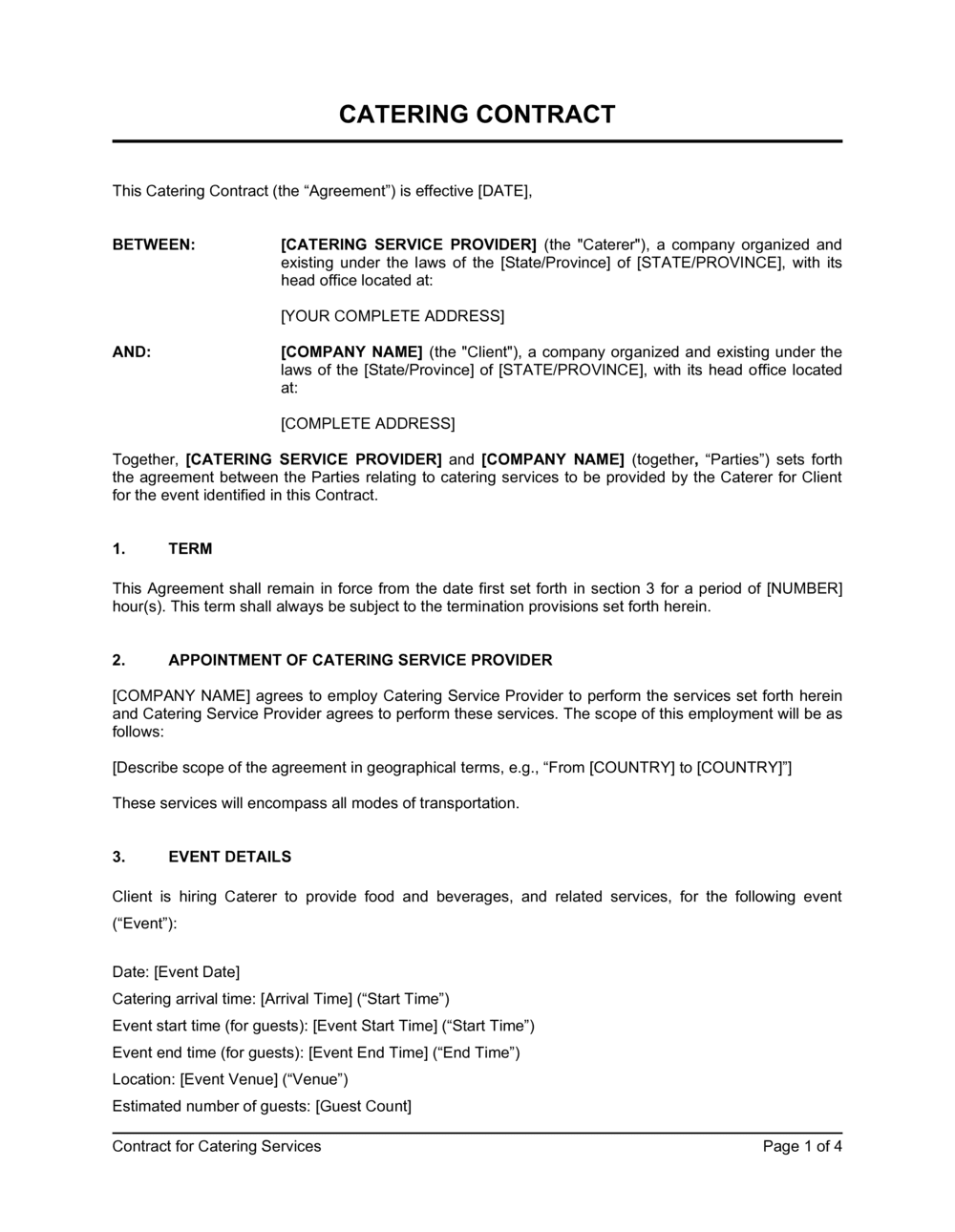
Catering Contract Template

Free Word download β€’ Edit online β€’ Save & share with Drive β€’ Export to PDF

4 pagesβ€’25–35 min to fillβ€’Difficulty: Complexβ€’Signature requiredβ€’Legal review recommended
Learn more ↓
FreeCatering Contract Template

At a glance

What it is
A Catering Contract is a legally binding agreement between a catering company and a client that defines the full terms of food and beverage service for a specific event. This free Word download covers menu selection, guest count, pricing, deposit schedule, cancellation terms, liability, and staffing β€” ready to edit online and export as PDF for both parties to sign before the event date.
When you need it
Use it any time a catering company is engaged to provide food and beverage service for a defined event β€” whether a corporate function, wedding reception, private party, or conference. It protects both the caterer's revenue and the client's expectations before a single dollar changes hands.
What's inside
Event and venue details, confirmed menu with dietary accommodations, guest count and per-head pricing, payment schedule and deposit terms, cancellation and refund policy, force majeure, liability and insurance requirements, staffing obligations, and governing law.

What is a Catering Contract?

A Catering Contract is a legally binding agreement between a catering company or independent caterer and a client that defines the complete terms of food and beverage service for a specific event. It identifies both parties, describes the event date and venue, sets out the agreed menu, establishes the guest count and guaranteed minimum, specifies the total fee with all extras itemized, and governs what happens if the event is cancelled, runs over time, or is disrupted by circumstances outside either party's control. Unlike a verbal booking or an email confirmation, a signed catering contract creates enforceable obligations on both sides and provides a clear resolution framework if the service does not go as planned.

Why You Need This Document

Without a catering contract, a caterer who has purchased $4,000 of perishable food and booked six staff members has no legal basis to recover those costs if the client cancels four days before the event. On the client side, no contract means no enforceable obligation for the caterer to deliver the specific menu, staffing level, or service style that was discussed in initial conversations. Post-event disputes over missing courses, surprise invoices for staffing and equipment, and tip expectations become credibility contests rather than contract interpretation. A signed catering contract eliminates all of these scenarios by locking in the agreed terms before any money or food changes hands. For any catered event above a few hundred dollars in value, it is the single most important document in the booking process β€” and this template gives you a professional, ready-to-sign starting point in minutes.

Which variant fits your situation?

If your situation is…Use this template
Catering a wedding reception with custom menu and bar serviceWedding Catering Contract
Providing food and beverage for a corporate conference or retreatCorporate Catering Agreement
Drop-off catering with no on-site staff or serviceDrop-Off Catering Contract
Recurring catering arrangement for office meals or weekly eventsCatering Service Retainer Agreement
Engaging a third-party caterer as a subcontractor through a venueCatering Subcontractor Agreement
Food truck booking for a private or public eventFood Truck Event Contract
Full-service event including catering, dΓ©cor, and coordinationEvent Planning Contract

Common mistakes to avoid

❌ No guaranteed minimum guest count

Why it matters: Without a minimum, the caterer purchases and prepares food for the estimated count and has no contractual basis to bill for no-shows. A 200-person event that draws 120 guests can wipe out the event's profitability entirely.

Fix: Set a guaranteed minimum at 90–95% of the estimated count and include it explicitly in the payment calculation β€” the client pays the greater of actual attendance or the guaranteed minimum.

❌ Vague scope of services with no schedule

Why it matters: Describing services as 'full catering' without a detailed menu and service-type schedule creates room for the client to claim they expected passed appetizers, a carving station, or a dessert bar that the caterer never planned.

Fix: Attach a signed Schedule A describing every course, service style, and included item, and reference it explicitly in the contract body.

❌ Flat non-refundable deposit with no cancellation scale

Why it matters: A single flat deposit does not reflect escalating costs β€” a cancellation 60 days out when you have committed staff and placed food orders leaves you with losses well above the initial deposit.

Fix: Implement a tiered cancellation schedule with at least three thresholds that mirror your actual cost commitments as the event date approaches.

❌ Guaranteeing an allergen-free environment in writing

Why it matters: Caterers operating in shared kitchens or sourcing from commercial suppliers cannot guarantee the complete absence of allergens. A written guarantee creates strict liability if a guest suffers an allergic reaction.

Fix: Acknowledge specific dietary restrictions you will accommodate and state clearly that cross-contamination cannot be fully eliminated in a shared kitchen environment.

❌ No overtime clause for event extensions

Why it matters: Events routinely run over schedule. Without a contracted overtime rate, the caterer has no legal basis to charge for the additional hours worked by kitchen and service staff.

Fix: Include a clear overtime rate per staff member per 30- or 60-minute increment and require written or verbal authorization from the client's designated representative to activate it.

❌ Force majeure clause that omits government orders and public health events

Why it matters: A clause covering only natural disasters leaves both parties exposed when government-mandated shutdowns, venue closures, or public health restrictions prevent the event from occurring.

Fix: Broaden the force majeure definition to include government orders, public health emergencies, and venue closures outside either party's control, and specify how pre-paid amounts are handled in each scenario.

The 10 key clauses, explained

Event details and scope of services

In plain language: Identifies the event date, start and end times, venue address, and the specific catering services included β€” whether full-service, buffet, cocktail reception, or drop-off only.

Sample language
Caterer agrees to provide catering services for [CLIENT NAME]'s event on [DATE] from [START TIME] to [END TIME] at [VENUE NAME AND ADDRESS]. Services include [BUFFET / PLATED / COCKTAIL RECEPTION] as described in Schedule A.

Common mistake: Describing services in vague terms like 'full catering' without a Schedule A. When the client expects passed appetizers and the caterer planned a buffet, disputes are expensive and damage the relationship.

Menu and dietary accommodations

In plain language: Sets out the agreed menu in writing, including any dietary alternatives for allergies or religious requirements, and establishes the deadline by which menu changes must be submitted.

Sample language
The agreed menu is set out in Schedule B. Menu changes must be submitted in writing no later than [X] days before the event. Caterer will accommodate [DIETARY RESTRICTIONS] as noted in Schedule B but cannot guarantee an allergen-free environment.

Common mistake: Guaranteeing a completely allergen-free environment in writing. Caterers preparing food in shared kitchens cannot make this guarantee β€” and doing so creates strict liability exposure if a guest has a reaction.

Guest count and guaranteed minimum

In plain language: Establishes the estimated guest count, the guaranteed minimum the client will be billed for regardless of attendance, and the deadline to submit a final confirmed count.

Sample language
Client estimates [X] guests. The guaranteed minimum is [X] guests. Final confirmed guest count must be provided no later than [X] business days before the event. Caterer will prepare for up to [X + 10%] guests at no additional charge.

Common mistake: Setting no guaranteed minimum at all. If 40 guests RSVP and only 20 attend, the caterer absorbs food and labor costs for 20 plates β€” a guaranteed minimum eliminates this risk.

Pricing, fees, and payment schedule

In plain language: States the per-head rate or flat fee, any additional charges (bar service, staffing, equipment rental, travel), and the schedule of deposit and final payment due dates.

Sample language
Total estimated fee: $[AMOUNT] based on [X] guests at $[PER HEAD RATE] plus [ITEMIZED EXTRAS]. Deposit of [X]% due upon signing. Balance due no later than [X] days before the event date.

Common mistake: Quoting a per-head rate without itemizing extras. Clients receive a $3,500 invoice expecting $2,400 and discover $1,100 in staffing, linen, and equipment charges they did not anticipate.

Cancellation and refund policy

In plain language: Defines what happens to the deposit and any pre-paid amounts if the client cancels, scaled by the number of days' notice given before the event.

Sample language
Cancellation more than [90] days before the event: deposit forfeited. Cancellation [31–90] days before: [50]% of total contract value due. Cancellation [30] days or fewer before the event: [100]% of total contract value due.

Common mistake: No cancellation scale at all β€” just 'deposit is non-refundable.' A caterer who purchases food and books staff for a 200-person event that cancels 10 days out has losses far exceeding the deposit.

Staffing and conduct

In plain language: Specifies the number of service staff, their roles, uniform requirements, and the caterer's responsibility for staff conduct, background checks, and compliance with venue rules.

Sample language
Caterer shall provide [X] servers, [X] bartenders, and [X] supervisory staff for the event. All staff will wear [UNIFORM DESCRIPTION]. Caterer is solely responsible for staff wages, taxes, and conduct throughout the event.

Common mistake: Omitting who is responsible for staff gratuities. If the contract is silent, disputes arise at the end of the night about whether the client owes an additional 18–20% on top of the service fee.

Overtime and event extension

In plain language: Sets the hourly rate charged for each 30 or 60 minutes the event runs beyond the contracted end time, and requires the client to notify the caterer's supervisor to authorize an extension.

Sample language
If Client requests service beyond [END TIME], Caterer will accommodate subject to staff availability at $[RATE] per [30/60] minutes per staff member, billed in [30/60]-minute increments. Authorization must be given by [CLIENT REP NAME / TITLE].

Common mistake: No overtime clause at all. A wedding that runs two hours long with no overtime provision leaves the caterer absorbing additional labor costs with no legal basis to invoice for them.

Liability, insurance, and indemnification

In plain language: Allocates responsibility for food safety incidents, personal injury, property damage, and third-party claims, and requires each party to carry adequate insurance.

Sample language
Caterer shall maintain general liability insurance of at least $[X]M per occurrence and provide a certificate of insurance upon request. Client shall indemnify Caterer against claims arising from Client's negligence or misuse of the venue. Caterer shall indemnify Client for claims arising from Caterer's food preparation or staff conduct.

Common mistake: No insurance requirement for the client. If a guest damages venue property or injures another guest and the venue holds the event organizer liable, an uninsured client leaves the caterer exposed too.

Force majeure

In plain language: Excuses both parties from performance if the event is made impossible by circumstances outside their control β€” natural disasters, government orders, or venue closure β€” and specifies what happens to payments already made.

Sample language
Neither party shall be liable for failure to perform due to events beyond their reasonable control, including natural disaster, government-mandated shutdown, or venue closure. In such event, Caterer shall refund any amounts paid less documented expenses incurred to date.

Common mistake: Force majeure clauses that cover only natural disasters but not government shutdowns or public health orders β€” a gap that became costly for many caterers during 2020–2021 event cancellations.

Governing law and dispute resolution

In plain language: Specifies which jurisdiction's law governs the contract and how disputes are resolved β€” arbitration, mediation, or litigation β€” and where any proceedings will take place.

Sample language
This Agreement is governed by the laws of [STATE / PROVINCE / COUNTRY]. Any dispute shall first be submitted to mediation in [CITY]. If mediation fails, disputes shall be resolved by binding arbitration administered by [ORGANIZATION] in [CITY].

Common mistake: Choosing a governing jurisdiction with no connection to where the event occurs or either party operates. Some courts will refuse to apply foreign governing law and default to local rules, creating unpredictable outcomes.

How to fill it out

  1. 1

    Enter the parties' full legal names and contact details

    Use the caterer's registered business name β€” not a trade name β€” and the client's full legal name or entity name. Include mailing addresses and primary contact emails for both parties.

    πŸ’‘ If the client is booking on behalf of a corporation, confirm the entity name matches their payment method to avoid invoicing disputes later.

  2. 2

    Complete the event details block

    Enter the event date, start and end times, and the full venue address. Specify the type of service β€” plated dinner, buffet, cocktail reception, or drop-off β€” in the scope-of-services field.

    πŸ’‘ Include the venue contact name and a secondary contact in case of last-minute venue changes on the event day.

  3. 3

    Attach the menu as Schedule A

    List every course, dish, and beverage included in the agreed package. Note any dietary accommodations β€” gluten-free, halal, vegan β€” and attach this as a signed Schedule A rather than embedding it in the contract body.

    πŸ’‘ A separate signed schedule lets you update menu details without re-executing the full contract β€” just amend the schedule.

  4. 4

    Set the guest count, guaranteed minimum, and final count deadline

    Enter the estimated guest count, the guaranteed minimum you will bill regardless of attendance, and the date by which the client must confirm the final count.

    πŸ’‘ Set the guaranteed minimum at 90–95% of the estimated count β€” close enough to protect you, low enough not to alarm the client.

  5. 5

    Fill in pricing, extras, and the payment schedule

    State the per-head rate or flat fee, itemize all additional charges (bar service, staffing, linen rental, travel), and set the deposit amount and due dates for each payment installment.

    πŸ’‘ Require a minimum 25–30% deposit at signing to cover the cost of food purchasing commitments you make in advance.

  6. 6

    Define the cancellation policy with a tiered scale

    Set forfeiture thresholds at three intervals β€” for example, 90+ days, 31–90 days, and 30 days or fewer β€” so the client understands escalating consequences as the event approaches.

    πŸ’‘ Calculate your actual food-purchasing and labor-booking timelines and align your cancellation thresholds to those real cost commitments.

  7. 7

    Complete the liability and insurance section

    Enter the insurance coverage amounts you carry, specify any insurance the client must provide, and confirm that each party's indemnification scope is clearly separated.

    πŸ’‘ Request a certificate of insurance from the venue and review it before the event β€” some venues require caterers to be named as additional insureds.

  8. 8

    Sign before collecting the deposit

    Both parties must sign the contract before the deposit is paid. Do not accept payment based on an email confirmation alone β€” an unsigned contract is difficult to enforce in a dispute.

    πŸ’‘ Use a timestamped e-signature tool so you have a clear record of when each party executed the agreement.

Frequently asked questions

What is a catering contract?

A catering contract is a legally binding agreement between a caterer and a client that sets out the full terms of food and beverage service for a specific event. It covers the menu, guest count, pricing, deposit, payment schedule, cancellation policy, staffing, liability, and governing law. A signed contract protects the caterer's revenue and protects the client's expectations before any money changes hands.

What should a catering contract include?

At minimum, a catering contract should include: event date, time, and venue; a detailed menu attached as a schedule; confirmed guest count and guaranteed minimum; per-head rate or flat fee with all extras itemized; deposit amount and payment due dates; a tiered cancellation policy; staffing obligations; overtime rates; liability and insurance requirements; force majeure language; and governing law. Missing any of these is a common source of post-event disputes.

Is a catering contract legally required?

No law mandates a catering contract, but without one, either party has only verbal assurances and email threads to rely on in a dispute. Courts in most jurisdictions will enforce a written catering contract that includes the key terms, signatures, and consideration. For any event above $1,000 in value, a signed contract is considered standard practice in the industry.

How much deposit should a catering contract require?

Most catering contracts require a deposit of 25–50% of the total estimated fee, paid at signing to secure the date. The deposit covers the caterer's early costs β€” menu planning, initial food purchasing commitments, and booking staff. The balance is typically due 7–14 days before the event. For large events over $10,000, a three-installment structure (deposit, mid-point, and final payment) is common.

What happens if a client cancels a catering contract?

The cancellation policy in the contract governs what the client owes. A well-drafted tiered policy scales forfeiture based on how close to the event date the cancellation occurs β€” for example, deposit forfeiture only for cancellations 90+ days out, 50% of the total contract for 30–90 days, and 100% within 30 days. Without a written policy, the caterer must prove actual damages in court to recover costs beyond the deposit.

Can a catering contract be cancelled due to force majeure?

Yes, if the contract contains a force majeure clause that covers the specific triggering event β€” natural disaster, government shutdown, or venue closure. When force majeure applies, neither party is typically liable for non-performance. The contract should specify what happens to amounts already paid, whether the event can be rescheduled, and how documented pre-event expenses are handled before any refund is issued.

Who is liable if a guest gets sick from food served at a catered event?

Liability depends on the contract's indemnification clause and applicable food safety regulations in the jurisdiction. Typically, the caterer bears responsibility for food safety in preparation, storage, and service. A catering contract should require the caterer to carry general liability and food contamination insurance and include an indemnification clause allocating responsibility between the parties. Consider consulting a lawyer when drafting liability language for high-attendance events.

Does a catering contract need to be signed by both parties?

Yes. A catering contract is only enforceable against a party who has agreed to its terms, and a signature β€” whether ink or electronic β€” is the standard evidence of agreement. In practice, caterers who collect a deposit without a signed contract often find that unsigned terms are treated as unenforceable in a payment dispute. Always execute the contract before accepting any payment.

What is the difference between a catering contract and a catering proposal?

A catering proposal is a non-binding document β€” typically a quote or service outline β€” that the caterer sends to a prospective client before terms are agreed. It may include a sample menu, pricing estimates, and a description of services. A catering contract is the binding agreement signed by both parties after they have agreed on the specific terms. The proposal leads to the contract; only the contract is legally enforceable.

How this compares to alternatives

vs Event Planning Agreement

An event planning agreement covers the full scope of event coordination β€” venue sourcing, vendor management, logistics, and timeline β€” not just food and beverage. A catering contract is narrower, binding only the food and beverage service terms. Use an event planning agreement when a coordinator is managing multiple vendors; use a catering contract to bind the caterer specifically.

vs Venue Rental Agreement

A venue rental agreement governs use of a physical space β€” access hours, capacity, noise restrictions, and damage deposits. A catering contract governs the food and beverage service occurring within that space. Events typically require both documents, executed with separate counterparties, and the catering contract should reference the venue's rules and insurance requirements.

vs Service Agreement

A general service agreement covers the delivery of professional services without the food-industry-specific provisions a catering context requires β€” guaranteed minimums, menu schedules, dietary accommodation clauses, food safety liability, and liquor liability. A catering contract is a specialized service agreement tailored to the unique risks of food and beverage events.

vs Independent Contractor Agreement

An independent contractor agreement defines the relationship between a hiring party and a self-employed individual performing ongoing work. A catering contract is event-specific, binding a catering business to perform defined services on a particular date. Use a contractor agreement for an ongoing engagement with a private chef; use a catering contract for a discrete booked event.

Industry-specific considerations

Hospitality and events

High-volume booking environments where standard contracts with tiered cancellation scales and guaranteed minimums protect revenue across dozens of simultaneous event commitments.

Corporate and professional services

Recurring office catering, conference food service, and executive dining require contracts that address repeating service schedules, purchase order references, and net-30 invoicing terms.

Food and beverage

Independent caterers and restaurant-based catering divisions use the contract to document food safety obligations, staffing ratios, and equipment ownership to manage liability exposure.

Retail and consumer

Private clients booking weddings, milestone celebrations, and social events need clear menu schedules, dietary accommodation acknowledgments, and cancellation terms that reflect personal financial risk.

Jurisdictional notes

United States

Catering contracts are governed by state contract law, which varies significantly. Liquor liability exposure is particularly state-specific β€” dram shop laws in states like Texas, Illinois, and Pennsylvania impose liability on servers who provide alcohol to visibly intoxicated guests. Food safety obligations are governed by the FDA Food Safety Modernization Act at the federal level and state health codes at the local level. Contracts should specify the governing state and, where alcohol is served, reference compliance with the applicable state liquor authority.

Canada

Catering contracts in Canada are governed by provincial contract law. Liquor service is regulated by provincial authorities β€” the AGCO in Ontario, the BCLDB in British Columbia β€” and caterers must hold the appropriate catering or special occasion permit. Contracts in Quebec must be available in French for provincially regulated parties. Consumer protection legislation in several provinces may limit the enforceability of certain cancellation fee clauses against individual (non-business) clients.

United Kingdom

Catering contracts in the UK are subject to the Consumer Rights Act 2015 when the client is a consumer, which requires terms to be fair and transparent β€” aggressive cancellation penalties may be challenged as unfair contract terms. Food safety obligations are governed by the Food Safety Act 1990 and associated hygiene regulations. Caterers serving alcohol must hold a premises or personal licence under the Licensing Act 2003, and the contract should confirm licence compliance.

European Union

EU member states apply the Unfair Contract Terms Directive (93/13/EEC) to consumer catering contracts, potentially invalidating disproportionate cancellation clauses. Food safety is governed by EU Regulation 852/2004 on food hygiene, and allergen disclosure obligations are mandatory under EU Regulation 1169/2011 β€” caterers must provide written allergen information for all dishes. GDPR applies to any personal data collected from clients or guests during the booking and event process.

Template vs lawyer β€” what fits your deal?

PathBest forCostTime
Use the templateIndependent caterers and small catering businesses handling standard events under $10,000Free20–30 minutes
Template + legal reviewEvents over $10,000, alcohol service, or venues with specific insurance and indemnification requirements$200–$500 for a 1-hour lawyer review2–5 days
Custom draftedLarge-scale catering operations, multi-day events, corporate accounts with bespoke terms, or regulated liquor service environments$800–$2,500+1–2 weeks

Glossary

Per-Head Rate
The price charged per guest, multiplied by the confirmed guest count to produce the total food and beverage fee.
Guaranteed Minimum
The minimum number of guests the client commits to paying for regardless of actual attendance β€” protects the caterer's revenue floor.
Deposit
A non-refundable or partially refundable upfront payment made by the client to secure the caterer's date and begin event preparation.
Force Majeure
A clause excusing both parties from performance obligations when an event is prevented by circumstances outside their reasonable control, such as natural disasters or government-mandated shutdowns.
Cancellation Policy
The schedule of fees or deposit forfeiture that applies when a client cancels, scaled by how far in advance the cancellation occurs.
Dietary Accommodation
Adjustments to the menu to address guests' allergies, religious dietary restrictions, or personal food preferences β€” typically confirmed in writing before the event.
Run-of-Show
A detailed timed schedule of the event β€” ceremony, cocktail hour, dinner service, speeches β€” used by the caterer to plan service timing and staffing.
Overtime Clause
A provision specifying the hourly rate charged if an event runs beyond the contracted service window, typically billed in 30- or 60-minute increments.
Indemnification
A contractual obligation by one party to compensate the other for losses, claims, or damages arising from specified events β€” commonly used to shift liability for food safety incidents.
Liquor Liability
Insurance or contractual coverage addressing claims arising from alcohol served at an event, including third-party injury or property damage.
Attrition
The difference between the contracted guest count and the actual count at the event β€” contracts commonly permit attrition of 5–10% without a price adjustment.

Part of your Business Operating System

This document is one of 3,000+ business & legal templates included in Business in a Box.

  • Fill-in-the-blanks β€” ready in minutes
  • 100% customizable Word document
  • Compatible with all office suites
  • Export to PDF and share electronically

Create your document in 3 simple steps.

From template to signed document β€” all inside one Business Operating System.
1
Download or open template

Access over 3,000+ business and legal templates for any business task, project or initiative.

2
Edit and fill in the blanks with AI

Customize your ready-made business document template and save it in the cloud.

3
Save, Share, Send, Sign

Share your files and folders with your team. Create a space of seamless collaboration.

Save time, save money, and create top-quality documents.

β˜…β˜…β˜…β˜…β˜…

"Fantastic value! I'm not sure how I'd do without it. It's worth its weight in gold and paid back for itself many times."

Managing Director Β· Mall Farm
Robert Whalley
Managing Director, Mall Farm Proprietary Limited
β˜…β˜…β˜…β˜…β˜…

"I have been using Business in a Box for years. It has been the most useful source of templates I have encountered. I recommend it to anyone."

Business Owner Β· 4+ years
Dr Michael John Freestone
Business Owner
β˜…β˜…β˜…β˜…β˜…

"It has been a life saver so many times I have lost count. Business in a Box has saved me so much time and as you know, time is money."

Owner Β· Upstate Web
David G. Moore Jr.
Owner, Upstate Web

Run your business with a system β€” not scattered tools

Stop downloading documents. Start operating with clarity. Business in a Box gives you the Business Operating System used by over 250,000 companies worldwide to structure, run, and grow their business.

Start freeΒ Β·Β No credit card required