Record Label Agreement Template

Free Word download • Edit online • Save & share with Drive • Export to PDF

6 pages25–35 min to fillDifficulty: ComplexSignature requiredLegal review recommended
Learn more ↓
FreeRecord Label Agreement Template

At a glance

What it is
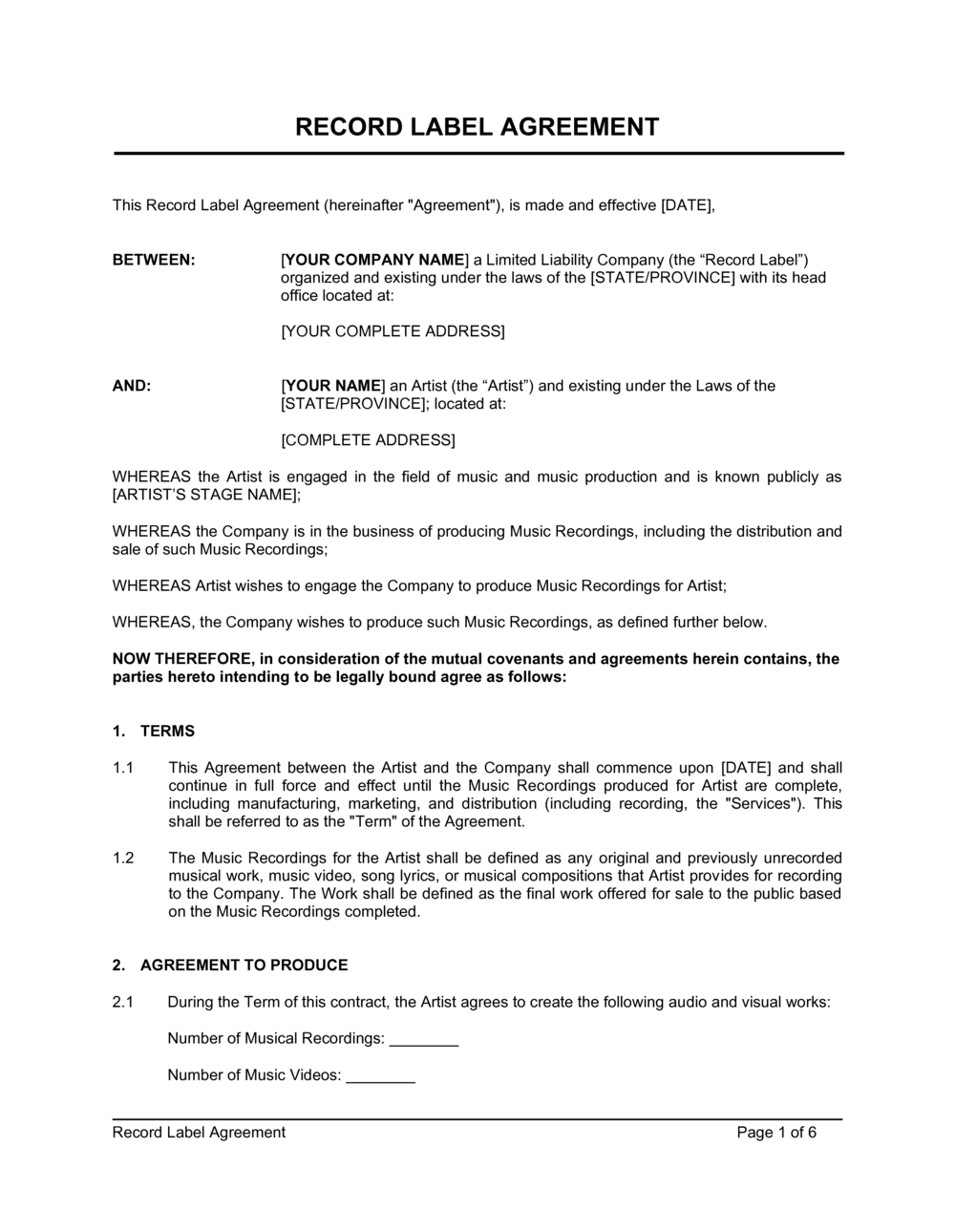
A Record Label Agreement is a legally binding contract between a record label and a recording artist that governs the full commercial relationship: what recordings the artist must deliver, what advance the label pays, how royalties are calculated and audited, who owns the master recordings and publishing rights, and how long the deal lasts. This free Word download gives you a structured, professionally formatted starting point you can edit online and export as PDF for review by both parties before signing.
When you need it
Use it when a label is signing a new artist to a recording deal, when an independent artist is entering a distribution or licensing arrangement with a label, or when an existing handshake arrangement needs to be formalized before the first release. Any advance payment or exclusive recording commitment should be governed by a signed written agreement.
What's inside
The template covers the recording commitment and delivery requirements, advance and recoupment mechanics, royalty rates and accounting periods, master recording and publishing ownership, marketing and promotional obligations, exclusivity and competitive-recording restrictions, term length and option periods, and termination rights. Each clause includes defined terms and placeholder fields you replace with the agreed commercial terms.

What is a Record Label Agreement?

A Record Label Agreement is a legally binding contract between a record label and a recording artist that governs every commercial dimension of the recording relationship: the recordings the artist must deliver and by when, the advance the label pays and how it is recouped, royalty rates across physical sales, downloads, streaming, and sync licensing, who owns the master recordings and for how long, exclusivity restrictions on the artist's recording services, and the term structure including the label's options to extend the deal for additional album cycles. Unlike an informal handshake arrangement or a basic letter of intent, a properly drafted record label agreement creates enforceable obligations and rights on both sides — including reversion rights, audit rights, and a termination framework that determines what happens to the masters if either party defaults.

Why You Need This Document

Without a signed record label agreement, the ownership of every master recording delivered to the label is legally ambiguous, advances can be paid without any documented recoupment framework, and an artist has no contractual mechanism to reclaim their recordings if the label shelves them indefinitely or becomes insolvent. The consequences of an unsigned or poorly drafted deal compound over time: master ownership disputes can block streaming registration, sync licensing, and catalog sales for years; uncapped recoupable costs can keep an artist unrecouped through multiple commercially successful releases; and options without exercise deadlines can trap an artist in exclusivity for far longer than either party intended. This template gives both labels and artists a structured, professionally formatted starting point — covering every material deal point in plain, negotiable language — so that a qualified music entertainment lawyer can focus on refining the commercial terms rather than building the document from scratch.

Which variant fits your situation?

If your situation is…Use this template
Label signing an artist for a full album with multiple option periodsRecord Label Agreement (Multi-Album)
Single-track or EP release with no long-term commitmentMusic Recording License Agreement
Artist retaining masters and licensing to a label for distribution onlyMusic Distribution Agreement
Label co-publishing or acquiring a share of the songwriter's publishingMusic Publishing Agreement
Producer delivering a finished master to an artist or labelMusic Producer Agreement
Two artists collaborating on a joint release with shared royaltiesMusic Collaboration Agreement
Sampling a third-party master recording for use in a new trackMaster Use License Agreement

Common mistakes to avoid

❌ No cap on recoupable costs

Why it matters: Without category caps, the label can charge unlimited marketing, promotion, and video costs to the artist's royalty account — artists can remain unrecouped indefinitely even on commercially successful releases.

Fix: Negotiate explicit dollar caps for each recoupable cost category and require written artist approval before any recoupable cost above the cap is incurred.

❌ Omitting a commercial release obligation

Why it matters: A label that accepts delivery of masters but has no contractual obligation to release them can shelve recordings, maintain exclusivity over the artist, and prevent the artist from recording for anyone else — all without releasing a single track.

Fix: Include a specific release deadline — typically 12 to 18 months from delivery — and a reversion right that returns master ownership to the artist if the deadline is missed.

❌ No deadline on option exercise

Why it matters: Without a fixed exercise window, a label can hold an artist in contractual limbo between terms — neither releasing the option nor committing to the next album — which effectively extends exclusivity for free.

Fix: Set a specific notice deadline of 30 to 60 days before expiration of the current term, and provide that failure to exercise within the window constitutes automatic release of the option.

❌ Naming only the artist's stage name in the agreement

Why it matters: A contract signed under a stage name may be unenforceable against the individual or entity that actually owns the IP rights, creating a chain-of-title defect that blocks sync licensing, streaming registration, and enforcement.

Fix: Always use the artist's full legal name or the name of their registered entity, and include the stage name as an alias in the recitals — for example, '[LEGAL NAME], professionally known as [STAGE NAME]'.

❌ Royalty rate agreed without defining the royalty base

Why it matters: A headline royalty percentage is meaningless without knowing what it is applied to — packaging deductions, free-goods provisions, and PPD versus SRLP calculations can reduce effective per-unit rates by 30 to 50%.

Fix: Define the royalty base in full for each income category and eliminate or cap packaging deductions and free-goods provisions in the agreement.

❌ No reversion right on label insolvency or sale

Why it matters: Without a reversion trigger tied to label insolvency or change of control, an artist's masters can be sold to a third-party acquirer or absorbed into a bankruptcy estate — potentially transferring to a label the artist never agreed to work with.

Fix: Add a reversion clause that automatically returns master ownership to the artist if the label becomes insolvent, is acquired, or materially changes its business without the artist's consent.

The 10 key clauses, explained

Parties, territory, and definitions

In plain language: Identifies the label and artist as legal entities, defines the geographic territory covered by the deal, and sets out the defined terms used throughout the agreement.

Sample language
This Recording Agreement is entered into as of [DATE] between [LABEL LEGAL NAME], a [STATE/COUNTRY] [ENTITY TYPE] ('Label'), and [ARTIST LEGAL NAME / BAND MEMBERS' FULL NAMES] ('Artist'). The Territory shall mean [WORLDWIDE / SPECIFIC TERRITORY]. Capitalized terms have the meanings set out in Section 1.

Common mistake: Naming only the artist's stage name rather than the legal name of each individual member or the entity holding the artist's rights — this makes the contract unenforceable against the actual rights-holder.

Recording commitment and delivery requirements

In plain language: Specifies the number of commercially acceptable masters the artist must deliver during the initial term and each option period, along with production quality standards and delivery deadlines.

Sample language
During the Initial Term, Artist shall record and deliver to Label [NUMBER] Masters meeting the Delivery Requirements set out in Schedule A. Delivery shall be completed no later than [DATE / X months after commencement]. Label shall provide written acceptance or rejection within [30] days of delivery.

Common mistake: Omitting a written acceptance standard for what constitutes a 'commercially acceptable' master, leaving the label with unilateral discretion to reject deliveries and stall the artist's royalty clock indefinitely.

Advance and recoupment

In plain language: States the advance amount the label will pay, the trigger for payment, and which costs are recoupable from the artist's royalties before any royalty payments are made.

Sample language
Label shall pay Artist an advance of $[AMOUNT] upon execution of this Agreement. The following costs are recoupable from Artist's royalties: recording costs up to $[AMOUNT], video production costs up to $[AMOUNT], and independent promotion costs up to $[AMOUNT]. No other costs shall be recoupable without Artist's prior written consent.

Common mistake: Failing to cap recoupable costs by category, leaving the artist exposed to unlimited marketing and promotional expenses charged against their royalty account without approval.

Royalty rates and royalty base

In plain language: Sets the royalty rate the artist earns on each income stream — physical sales, downloads, streaming, sync licensing, and foreign licensing — and defines the royalty base on which rates are applied.

Sample language
Label shall pay Artist royalties at the following rates: [X]% on physical sales (PPD basis), [X]% on permanent digital downloads, [X]% on net streaming receipts, [X]% on sync license income, and [X]% on foreign licensing income sublicensed through third parties. The royalty base for physical and download sales shall be [DEFINED PRICE].

Common mistake: Agreeing to a royalty rate without specifying the royalty base — a 20% royalty on a deeply discounted or packaging-deducted price can yield less per unit than a 12% royalty on full PPD.

Royalty accounting and audit rights

In plain language: Establishes the frequency of royalty statements, the accounting period, the deadline for payment, and the artist's right to audit the label's records to verify accuracy.

Sample language
Label shall render royalty statements within [60] days of the close of each semi-annual accounting period ending [JUNE 30] and [DECEMBER 31], accompanied by payment of royalties earned. Artist shall have the right, upon [30] days' written notice, to audit Label's books and records once per calendar year. Any claim of accounting error must be made within [2] years of the statement date.

Common mistake: Omitting an audit right entirely, or including one with a one-year limitation period — standard industry practice is two years, and some jurisdictions extend this by statute regardless of the contract language.

Ownership of master recordings

In plain language: States who owns the master recordings created under the agreement — typically the label for the duration of copyright — and any reversion rights that return ownership to the artist.

Sample language
All Masters recorded under this Agreement shall be the sole property of Label as works made for hire, and to the extent any Masters do not qualify as works made for hire, Artist hereby irrevocably assigns all right, title, and interest to Label. Label shall own the Masters for the full term of copyright. Artist shall have a right of reversion if Label fails to commercially release the Masters within [18] months of delivery.

Common mistake: No reversion clause — without one, the label can shelve recordings indefinitely without releasing them, and the artist has no mechanism to reclaim the masters or license them elsewhere.

Exclusivity and competitive recordings

In plain language: Restricts the artist from recording for any other label or releasing competing recordings during the term, and may extend to restricting the use of the artist's name and likeness in other recording contexts.

Sample language
During the Term, Artist shall record exclusively for Label and shall not perform for the purpose of making recordings for any other person or entity without Label's prior written consent. Artist shall not authorize the release of any Masters recorded prior to this Agreement without Label's prior written consent during the Term.

Common mistake: Drafting exclusivity language so broadly that it prevents the artist from recording live albums, film soundtracks, or charity recordings without realizing the clause covers those activities.

Marketing, promotion, and label obligations

In plain language: Defines the label's obligations to commercially release the recordings, the promotional budget committed (if any), and the artist's approval rights over artwork and marketing materials.

Sample language
Label shall use commercially reasonable efforts to release the first Master within [6] months of delivery. Label shall commit a minimum promotional budget of $[AMOUNT] for the Initial Release. Artist shall have [approval / consultation] rights over album artwork and official marketing materials, exercisable within [10] business days of submission.

Common mistake: No minimum release obligation or release timeline, leaving the label free to accept the masters, collect the rights assignment, and never release the recordings.

Term, option periods, and exercise notice

In plain language: Sets the initial contract term, the number of option periods the label can exercise, and the window within which the label must give written notice to exercise each option.

Sample language
The Initial Term shall commence on the date of execution and continue until [X months] after delivery and acceptance of the Initial Recording Commitment. Label shall have [NUMBER] options to extend the Term for additional periods of [X months each], exercisable by written notice no later than [30] days prior to expiration of the then-current Term.

Common mistake: No deadline on option exercise, allowing the label to keep the artist in contractual limbo indefinitely without formally exercising or releasing the option.

Termination, breach, and cure

In plain language: States the conditions that allow either party to terminate the agreement, the notice and cure period required before termination for breach, and the consequences of termination including rights reversion.

Sample language
Either party may terminate this Agreement upon [30] days' written notice if the other party materially breaches any provision and fails to cure such breach within the notice period. Upon termination for Label's uncured breach, all Master ownership rights shall revert to Artist immediately. Upon termination for Artist's breach, Label shall retain all rights in Masters delivered and accepted prior to termination.

Common mistake: Termination language that reverts masters to the label unconditionally upon any artist breach — including minor administrative failures — without a cure period, giving the label a permanent windfall from a technical violation.

How to fill it out

  1. 1

    Identify the parties with full legal names

    Enter the label's registered legal entity name and the artist's legal name — for bands, list every member individually or name the legal entity through which they contract. Verify the label's corporate registration before signing.

    💡 For bands with multiple members, clarify in the recitals whether one member is signing on behalf of all others and under what authority.

  2. 2

    Define the recording commitment and delivery schedule

    Specify the number of masters or albums required in the initial term and each option period. Set a realistic delivery deadline and attach a Schedule A defining technical delivery requirements — file format, metadata, mixing and mastering standards.

    💡 Include a 60-day cure window for the artist to redelivery rejected masters before the label can declare a material breach — rejection without a cure right is a common source of disputes.

  3. 3

    Set the advance amount and recoupable cost caps

    Enter the advance figure, the payment trigger (execution, delivery, or split), and explicit dollar caps for each recoupable cost category. List non-recoupable costs — tour support contributions and video production above the cap — separately.

    💡 Negotiate recoupable costs as a separate line item from the advance so the artist can track recoupment independently for each category.

  4. 4

    Specify royalty rates and the royalty base

    Enter a distinct royalty rate for each income stream: physical sales, permanent downloads, streaming, sync, and foreign sub-licensing. Define the royalty base (PPD, SRLP, or net receipts) for each category — the base matters as much as the rate.

    💡 If the deal includes a controlled-composition clause, cap the reduction at 75% of the statutory mechanical rate and exclude it from streaming income, where mechanicals are governed separately.

  5. 5

    Draft the ownership and reversion clause

    State clearly whether masters are owned by the label as works made for hire, assigned by the artist, or co-owned. Include a reversion clause with a specific release window — 12 to 18 months from delivery is industry standard for independent deals.

    💡 Add a reversion trigger for label insolvency or acquisition — without it, masters can be absorbed into a bankruptcy estate or sold to a third party the artist never agreed to work with.

  6. 6

    Configure the term and option structure

    Set the initial term length and the number of label options, with a hard deadline for option exercise. Ensure each option period is tied to a delivery commitment so options cannot be exercised without a corresponding recording obligation.

    💡 Limit total options to three unless the advance structure significantly increases per option — open-ended multi-option deals at flat advances are effectively indefinite exclusivity at a fixed low cost to the label.

  7. 7

    Include royalty accounting periods and audit rights

    Set semi-annual accounting periods with statements due within 60 days of period close. Include a two-year limitation period for audit claims and specify that audit costs are borne by the label if an underpayment exceeding 5% is found.

    💡 Require digital streaming statements on a monthly basis in a separate rider — DSP data is available in real time and semi-annual statements for streaming income are no longer standard in new deals.

  8. 8

    Have both parties sign before any recording begins or advance is paid

    Both the authorized label representative and all artist parties must execute the agreement before the first advance payment and before any recording sessions begin. Unsigned agreements create uncertainty over IP ownership for every master recorded.

    💡 Use Business in a Box eSign to timestamp execution and store the fully-executed copy securely — an undated or improperly executed agreement may be challenged in a royalty dispute.

Frequently asked questions

What is a record label agreement?

A record label agreement is a legally binding contract between a record label and a recording artist that governs the commercial recording relationship. It covers the recordings the artist must deliver, the advance the label pays and how it is recouped, royalty rates across all income streams, who owns the master recordings, exclusivity restrictions, the length of the deal, and how either party can terminate. It is the foundational document for any professional recording arrangement.

What is the difference between a record deal and a music publishing agreement?

A record label agreement covers the master recordings — the actual sound recordings delivered under the deal. A music publishing agreement covers the underlying composition rights — the melody and lyrics written by the songwriter. The same person can be both a recording artist and a songwriter, requiring separate agreements for each rights category. Some labels include a co-publishing clause in the recording deal, which artists should negotiate carefully with a music lawyer before accepting.

Who owns the masters under a typical record label agreement?

In most traditional label deals, the label owns the master recordings for the full term of copyright — typically 70 years after the recording was made in most jurisdictions. Independent deals and newer artist- friendly structures increasingly include reversion rights that return masters to the artist after a set number of years, after recoupment, or if the label fails to release the recordings within a defined window. Ownership terms are negotiable and should be reviewed carefully before signing.

What is a recoupable advance and how does it work?

An advance is a sum the label pays the artist before any royalties are earned. It is recoupable — meaning the label deducts it from the artist's future royalty earnings before paying any royalties. The artist does not repay the advance out of pocket if the recordings fail commercially, but they will not receive royalty checks until the advance and any other recoupable costs are fully covered by accumulated royalties. Labels can also charge approved recording costs and some marketing costs to the recoupment account, which is why capping recoupable costs by category is critical.

What royalty rates are typical in a record label agreement?

Royalty rates vary significantly by deal type, artist leverage, and label size. Traditional major-label deals have historically offered artists 12 to 20% of PPD on physical and download sales. Independent label deals range from 18 to 25% on physical and downloads, with net receipts splits of 50 to 60% being common for streaming income in newer deals. Profit-split arrangements — where artist and label split net receipts 50/50 after costs — are increasingly common for emerging artists with negotiating leverage. Any royalty rate must be evaluated alongside the royalty base, deductions, and recoupable cost structure.

What is an option period in a record label agreement?

An option period is a contractual right held by the label — not the artist — to extend the agreement for one or more additional recording cycles beyond the initial term. The label exercises the option unilaterally by giving written notice within a specified window before the current term expires. Multi-album deals typically include two to four options. Artists should insist that each option includes an increased advance and a defined recording commitment, and that a firm deadline for exercise is written into the agreement.

What is a 360 deal and should artists sign one?

A 360 deal gives the label a percentage of all the artist's revenue streams — not just recording income — including touring, merchandise, endorsements, and publishing. Labels justify 360 terms by pointing to their investment in breaking an artist's career across all income categories. Most independent labels and many artists' lawyers recommend limiting label participation to recording and related digital income, reserving touring and merchandise for the artist exclusively. Whether to sign a 360 deal depends on the level of advance, the label's genuine capacity to support non-recording income, and the artist's negotiating position.

Do I need a lawyer to sign a record label agreement?

Yes, in almost every situation. Record label agreements are complex, commercially consequential, and involve rights that can last for 70 years. A music entertainment lawyer — not a general business lawyer — can identify unfavorable recoupment structures, missing reversion rights, option traps, and controlled-composition clauses that significantly affect long-term income. Legal fees for reviewing and negotiating a recording deal typically run $500 to $3,000, which is modest relative to the value of the rights being transferred. This template is a useful starting point for understanding deal structure, but should not substitute for qualified legal advice before signing.

What happens if the label does not release my recordings?

Without a contractual release obligation, the label can legally accept delivery of your masters, maintain exclusivity over your recording services, and never release the recordings. To protect against this, include a specific release deadline — typically 12 to 18 months from delivery — and a reversion clause that automatically returns master ownership to you if the label misses the deadline. Reversion rights are negotiable in most independent deals and are increasingly standard in artist-friendly agreements.

How this compares to alternatives

vs Music Publishing Agreement

A music publishing agreement covers the underlying composition — the melody and lyrics — and governs mechanical royalties, sync licensing, and performance income from the written work. A record label agreement covers the master recording of that composition. The same release can involve both agreements simultaneously, with different ownership, royalty structures, and parties for each rights category.

vs Music Producer Agreement

A music producer agreement governs the relationship between a producer and an artist or label for the creation of a specific recording — covering the producer's fee, royalty points, and IP ownership of the produced track. A record label agreement is the overarching deal between the label and the artist covering the entire recording relationship, within which individual producer agreements operate.

vs Music Distribution Agreement

A music distribution agreement covers the delivery and sale of finished recordings to retailers and streaming platforms, without the label acquiring ownership of the masters or exclusivity over the artist's recording services. A record label agreement transfers master ownership to the label and restricts the artist exclusively — it is a far more comprehensive and commercially consequential arrangement.

vs Independent Contractor Agreement

An independent contractor agreement governs a work-for-hire service relationship between a business and a self-employed individual. While some recording arrangements can be structured as work-for-hire service contracts, a record label agreement is purpose-built for the music industry — covering advances, royalties, master ownership, reversion rights, and option periods that a generic contractor agreement does not address.

Industry-specific considerations

Independent music labels

Independent labels typically negotiate higher artist royalty rates (18–25%), smaller advances with tighter recoupable cost caps, and reversion rights — distinguishing their deals structurally from major-label agreements.

Entertainment and media

Major entertainment companies use recording agreements alongside publishing deals, sync licensing pipelines, and 360-degree revenue participation clauses that extend label rights across all artist income streams.

Film and television production

Film and TV studios entering recording arrangements for soundtrack albums require specific sync licensing carve-outs, favored-nations provisions for artist royalties, and clear division between master and synchronization rights.

Digital distribution and streaming platforms

Deals involving digital-first distribution require explicit net receipts definitions for streaming income, monthly accounting provisions, and clarity on which party registers recordings with DSPs and collects neighboring rights income.

Jurisdictional notes

United States

US copyright law grants sound recordings copyright protection for 95 years from publication or 120 years from creation, whichever is shorter — making master ownership clauses commercially significant for decades. California's 'seven-year rule' (Labor Code §2855) limits personal services contracts to seven years, which courts have applied to recording agreements to give artists a termination right after that period. The statutory mechanical rate for physical and download sales is set by the Copyright Royalty Board; the controlled-composition clause is a US-specific mechanism to cap payments below this rate. Consider whether New York or California law governs, as each has distinct enforcement approaches to restrictive covenants.

Canada

Canadian copyright in sound recordings runs for 70 years from publication under the Copyright Act. Canada's Copyright Modernization Act introduced neighboring rights for performers and makers of sound recordings, entitling them to equitable remuneration from broadcast and public performance — recording agreements should clarify which party registers and collects these rights from Re:Sound. Mechanical licensing in Canada operates through CMRRA and SOCAN rather than the US Harry Fox Agency model. Quebec's Civil Code applies to contracts formed in the province and may require French-language versions of key contractual provisions for parties subject to Quebec's language laws.

United Kingdom

UK copyright in sound recordings lasts 70 years from publication under the Copyright, Designs and Patents Act 1988, as amended by the Term Directive. UK courts have historically scrutinized long-term exclusive recording agreements under the restraint of trade doctrine — agreements that are unreasonably long or commercially one-sided can be declared unenforceable, as established in cases involving major artists challenging their label deals. PPL (Phonographic Performance Limited) collects neighboring rights income for master owners and featured artists in the UK; recording agreements should specify how PPL income is split and registered. Post-Brexit, the UK no longer automatically benefits from EU copyright directives, though the 70-year term has been retained domestically.

European Union

EU sound recording copyright lasts 70 years from publication under the Term Directive (2011/77/EU). The directive also introduced a 'use it or lose it' reversion right allowing featured artists to reclaim rights in recordings not commercially exploited by the label after 50 years — recording agreements should not attempt to contract out of this statutory right. GDPR applies to the processing of artist personal data in the course of the contractual relationship, particularly for royalty accounting systems that store financial and personal information. Neighboring rights income from EU broadcast and public performance is collected through national collecting societies (e.g., SCPP in France, GVL in Germany), and recording agreements should specify registration and collection responsibilities across member states.

Template vs lawyer — what fits your deal?

PathBest forCostTime
Use the templateUnderstanding deal structure, preparing for negotiation, or documenting a simple single-track release between known partiesFree1–2 hours to complete
Template + legal reviewIndependent label deals with advances under $10,000, emerging artists signing a first deal, or existing handshake arrangements being formalized$500–$1,500 for a music lawyer review and markup3–7 days
Custom draftedMulti-album deals with significant advances, 360-degree participation clauses, major-label negotiations, or deals involving publishing co-ownership$2,000–$8,000+ for full negotiation and drafting by a music entertainment lawyer2–6 weeks

Glossary

Master Recording
The original fixed recording of a song from which all copies and licensed versions are made — ownership of the master determines who controls streaming, sync, and physical licensing income.
Advance
A sum paid by the label to the artist before any royalties are earned, which must be recouped from the artist's future royalty share before any additional payments are made.
Recoupment
The process by which the label recoups its advance and approved recording costs from the artist's earned royalties before the artist receives any royalty payments.
Royalty Rate
The percentage of income from sales, streams, or licenses that the label pays to the artist, typically calculated on the published price to dealer or a defined royalty base.
Recording Commitment
The contractually required number of tracks or albums the artist must deliver to the label during the initial term or each option period.
Option Period
A contractual right held by the label to extend the agreement for an additional recording cycle, exercised unilaterally at the label's election within a defined window.
Exclusivity
A restriction requiring the artist to record exclusively for the label during the term, prohibiting the release of competing recordings on other labels.
Net Receipts
The label's actual income from a recording after deducting distribution fees, returns, and third-party licensing costs — sometimes used as the royalty base in profit-split deals.
360 Deal
A deal structure in which the label takes a percentage of all of the artist's revenue streams — including touring, merchandise, endorsements, and publishing — not just recording income.
Controlled Composition Clause
A provision that caps the mechanical royalty rate paid to an artist-songwriter for songs they wrote and recorded, typically at 75% of the statutory rate.
Audit Right
The artist's contractual right to inspect the label's books and records to verify that royalty accountings are accurate, usually exercisable once per year with notice.
Reversion
The contractual right allowing an artist to reclaim ownership of their master recordings if the label fails to commercially release them within a defined period or goes out of business.

Part of your Business Operating System

This document is one of 3,000+ business & legal templates included in Business in a Box.

  • Fill-in-the-blanks — ready in minutes
  • 100% customizable Word document
  • Compatible with all office suites
  • Export to PDF and share electronically

Create your document in 3 simple steps.

From template to signed document — all inside one Business Operating System.
1
Download or open template

Access over 3,000+ business and legal templates for any business task, project or initiative.

2
Edit and fill in the blanks with AI

Customize your ready-made business document template and save it in the cloud.

3
Save, Share, Send, Sign

Share your files and folders with your team. Create a space of seamless collaboration.

Save time, save money, and create top-quality documents.

★★★★★

"Fantastic value! I'm not sure how I'd do without it. It's worth its weight in gold and paid back for itself many times."

Managing Director · Mall Farm
Robert Whalley
Managing Director, Mall Farm Proprietary Limited
★★★★★

"I have been using Business in a Box for years. It has been the most useful source of templates I have encountered. I recommend it to anyone."

Business Owner · 4+ years
Dr Michael John Freestone
Business Owner
★★★★★

"It has been a life saver so many times I have lost count. Business in a Box has saved me so much time and as you know, time is money."

Owner · Upstate Web
David G. Moore Jr.
Owner, Upstate Web

Run your business with a system — not scattered tools

Stop downloading documents. Start operating with clarity. Business in a Box gives you the Business Operating System used by over 250,000 companies worldwide to structure, run, and grow their business.

Start free · No credit card required