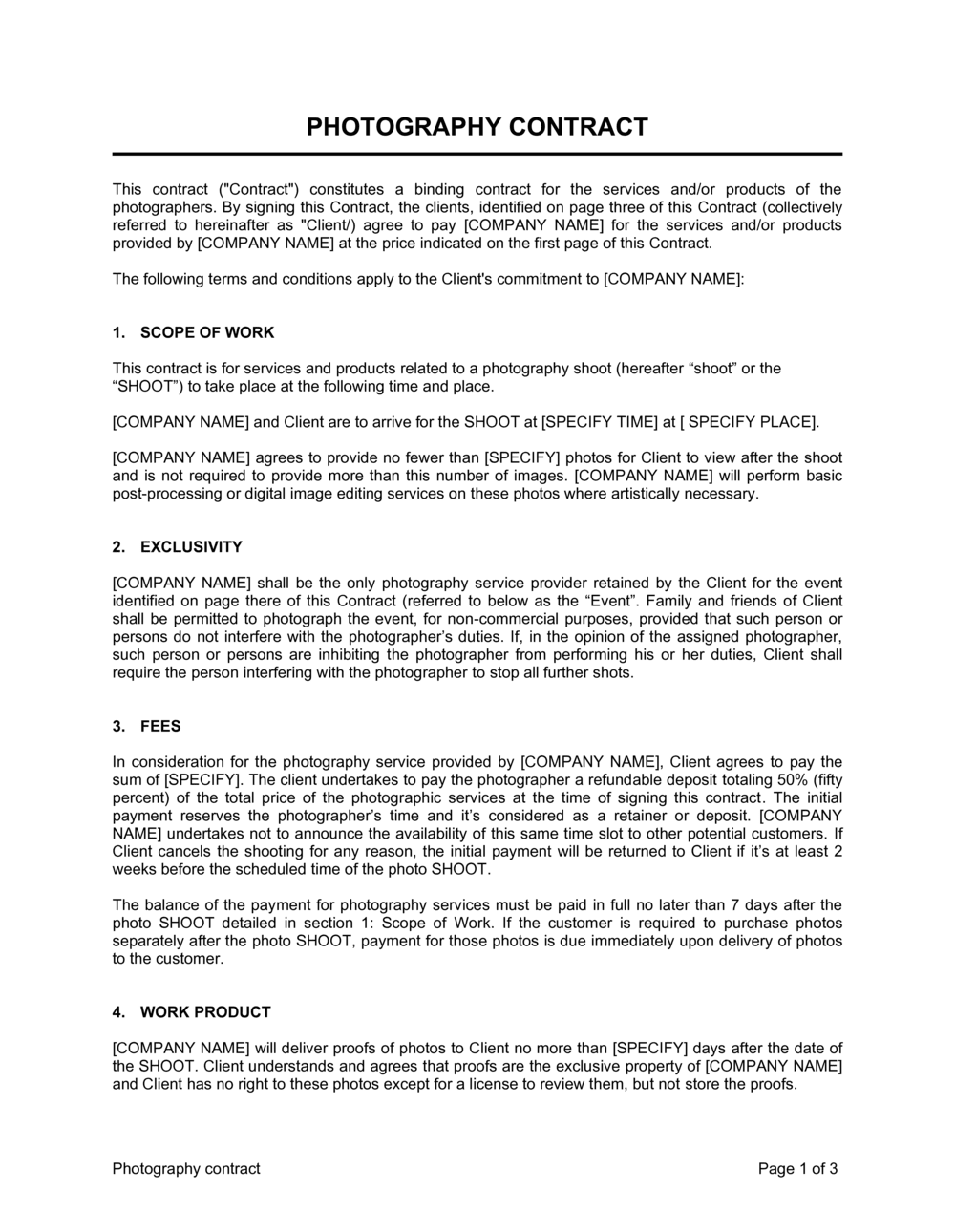
Photography Contract Template

Free Word download β€’ Edit online β€’ Save & share with Drive β€’ Export to PDF

3 pagesβ€’25–30 min to fillβ€’Difficulty: Complexβ€’Signature requiredβ€’Legal review recommended
Learn more ↓
FreePhotography Contract Template

At a glance

What it is
A Photography Contract is a legally binding agreement between a photographer and a client that defines the scope of services, deliverables, fees, payment schedule, image licensing rights, and cancellation terms. This free Word download gives you a professionally structured starting point you can edit online and export as PDF β€” covering every session type from weddings to commercial shoots.
When you need it
Use it before any paid photography engagement β€” portraits, events, weddings, commercial campaigns, real estate, or editorial work β€” where you need enforceable commitments from both parties in writing before the shoot date.
What's inside
Parties and session details, services and deliverables, fees and payment schedule, image licensing and usage rights, copyright ownership, model release provisions, cancellation and rescheduling terms, liability limitations, and governing law.

What is a Photography Contract?

A Photography Contract is a legally binding written agreement between a photographer (or photography studio) and a client that governs every material aspect of a photography engagement β€” from session logistics and deliverable specifications to copyright ownership, image licensing, and cancellation terms. It establishes what the photographer will deliver, when, at what price, and precisely how the client may use the resulting images, while protecting the photographer's creative work and income from the most common sources of dispute: vague expectations, last-minute cancellations, and unauthorized image use. Unlike a casual email exchange or invoice, a properly executed photography contract is generally enforceable in court and in small-claims proceedings in most jurisdictions.

Why You Need This Document

Operating without a signed photography contract exposes both photographers and clients to concrete financial and legal risk. A photographer who photographs a wedding without a written contract has no enforceable basis to retain a deposit when the client cancels the week before the date, no protection if equipment fails and the client demands compensation for the full cost of the event, and no clear answer when the client repurposes portrait images in a national advertising campaign the photographer was never paid to license. For clients, an unsigned booking provides no guaranteed delivery timeline, no defined number of images, and no recourse if the photographer simply does not show up. A signed photography contract eliminates these risks before the shoot date β€” locking in the deliverables the client is paying for and the payment and usage terms the photographer is relying on. This template gives photographers a professionally structured, enforceable starting point they can customize for any session type in under 30 minutes.

Which variant fits your situation?

If your situation is…Use this template
Photographing a wedding or engagement sessionWedding Photography Contract
Shooting commercial content for advertising or brand useCommercial Photography Contract
Providing headshots or portrait sessionsPortrait Photography Contract
Photographing real estate listings for agents or brokersReal Estate Photography Contract
Hiring a photographer as an independent contractor for ongoing workIndependent Contractor Agreement
Licensing existing images to a third partyPhoto Licensing Agreement
Engaging a photographer for editorial or journalism workEditorial Photography Agreement

Common mistakes to avoid

❌ Vague deliverable quantities

Why it matters: Promising 'all the best images' without a specific number regularly produces disputes where the client expected 300 images and the photographer delivered 60. Neither party has a clear benchmark to evaluate against.

Fix: State a specific minimum number of edited images in the deliverables clause β€” for example, 'no fewer than 75 fully edited digital images' β€” and note that additional images are available at a stated per-image rate.

❌ No copyright or licensing clause

Why it matters: Without an explicit clause, some clients assume that paying for a shoot transfers ownership of the images. This assumption has succeeded in informal disputes and leads to unauthorized commercial use that the photographer cannot easily stop.

Fix: Include a copyright-retention clause and a separate, clearly scoped license granting only the permitted uses agreed at the time of booking.

❌ Calling the retainer 'refundable' without conditions

Why it matters: A refundable deposit provides no protection against a last-minute cancellation. If a client cancels a wedding four days before the date, a refundable deposit means the photographer held the most valuable date of the year for nothing.

Fix: Label the retainer as non-refundable at the time of signing, and include a sliding-scale cancellation schedule that specifies what portion of the total fee is owed at each cancellation window.

❌ No limitation-of-liability clause

Why it matters: Equipment failure, card corruption, or a venue fire can prevent delivery. Without a liability cap, a photographer can face claims for the full cost of a client's wedding or commercial campaign β€” far exceeding anything the photography fee could cover.

Fix: Cap total liability at the fees paid under the contract and expressly exclude consequential, indirect, and punitive damages. Consider also requiring the client to maintain their own event insurance.

❌ Omitting a governing-law clause for cross-state or cross-border work

Why it matters: A photographer based in Texas who shoots a wedding in New York for a client in California has no contractual answer to the question of which state's law governs a dispute β€” courts may apply rules the photographer never anticipated.

Fix: Specify the governing jurisdiction β€” typically the photographer's home state or province β€” and a dispute-resolution mechanism such as mediation before litigation.

❌ No editing-rights or style clause

Why it matters: Clients who heavily alter delivered images and then publicly credit the photographer can damage the photographer's professional reputation and brand, with no contractual recourse available.

Fix: Include a clause confirming that delivered images reflect the photographer's established style, and prohibiting material alterations or the public attribution of altered images to the photographer without consent.

The 10 key clauses, explained

Parties, session details, and engagement

In plain language: Identifies the photographer (or studio) and the client as legal parties, states the type of session, shoot date, location, and duration.

Sample language
This Photography Contract is entered into on [DATE] between [PHOTOGRAPHER / STUDIO NAME], ('Photographer'), and [CLIENT FULL NAME], ('Client'). Photographer agrees to provide photography services at [LOCATION] on [DATE] from [START TIME] to [END TIME] for [SESSION TYPE].

Common mistake: Using only a first name or social media handle instead of the photographer's legal name or business entity β€” making enforcement or small-claims action unnecessarily complicated.

Services and deliverables

In plain language: Specifies exactly what the photographer will provide β€” the number of edited images, file format, resolution, delivery method, and deadline.

Sample language
Photographer shall deliver a minimum of [NUMBER] professionally edited digital images in JPEG format at full resolution via an online gallery within [X] days of the session date. Raw files are expressly excluded from delivery.

Common mistake: Leaving deliverable quantities vague β€” promises like 'all the best shots' routinely lead to disputes when the client expects 500 images and the photographer delivers 80.

Fees, payment schedule, and retainer

In plain language: States the total fee, the non-refundable retainer amount due at signing, the balance due date, and accepted payment methods.

Sample language
The total fee for services is $[AMOUNT]. A non-refundable retainer of $[AMOUNT] is due upon signing to confirm the booking date. The remaining balance of $[AMOUNT] is due no later than [X] days before the session date. Accepted payment methods: [METHODS].

Common mistake: Calling the deposit 'refundable' without any conditions β€” if the client cancels, the photographer loses a held date with no compensation.

Copyright ownership

In plain language: Confirms that the photographer retains full copyright in all images created, unless the contract explicitly transfers copyright as a work-for-hire arrangement.

Sample language
Photographer retains full copyright ownership of all images produced under this Agreement. No transfer of copyright is granted unless separately agreed in writing and signed by both parties.

Common mistake: Omitting a copyright clause entirely and assuming ownership is obvious β€” clients sometimes assert ownership based on payment alone, a claim that has succeeded in informal disputes.

Image licensing and usage rights

In plain language: Grants the client a defined license to use the delivered images for specified purposes, channels, territories, and duration β€” and prohibits all other uses.

Sample language
Photographer grants Client a [exclusive / non-exclusive] license to use the delivered images for [PERMITTED USES β€” e.g., personal use, social media, print advertising] within [TERRITORY] for [DURATION / perpetuity]. Resale, sublicensing, or use in AI training datasets is expressly prohibited.

Common mistake: Granting unlimited usage rights for a flat fee when the images end up in a national advertising campaign β€” the commercial value can be orders of magnitude higher than the session fee.

Model release and third-party consents

In plain language: Addresses whether the photographer may use delivered images for portfolio, marketing, or competition purposes, and confirms the client's responsibility to obtain releases from identifiable subjects.

Sample language
Client grants Photographer the right to use images from this session for portfolio, website, and social media promotion unless Client opts out in writing at the time of signing. Client is solely responsible for obtaining signed model releases from all identifiable subjects.

Common mistake: Assuming consent from people who appear in the photos β€” without a written model release, commercial use of identifiable subjects can trigger right-of-publicity or GDPR claims.

Cancellation, rescheduling, and force majeure

In plain language: Sets out what happens if the client or photographer cancels or needs to reschedule β€” specifying notice periods, refund eligibility, and force-majeure exceptions.

Sample language
Cancellations made more than [X] days before the session date forfeit the retainer. Cancellations within [X] days of the session date forfeit the full balance. Rescheduling requests made more than [X] days in advance will be accommodated subject to availability at no penalty. Neither party is liable for cancellations caused by events of force majeure.

Common mistake: No cancellation clause at all β€” without one, the photographer has no contractual basis to retain a deposit when a client cancels a week before a wedding.

Limitation of liability

In plain language: Caps the photographer's total liability for any failure of performance β€” equipment failure, illness, or lost files β€” at the total fees paid under the contract.

Sample language
In the event Photographer is unable to perform due to equipment failure, illness, or other cause, Photographer's total liability to Client shall not exceed the total fees paid under this Agreement. Photographer is not liable for consequential, indirect, or punitive damages.

Common mistake: No liability cap at all β€” a wedding photographer without a liability limitation clause could face claims for the full cost of the wedding if equipment fails on the day.

Editing, alterations, and style

In plain language: Defines the photographer's editing style, whether the client may request specific edits, and whether the client is permitted to apply third-party filters or heavy alterations to delivered images.

Sample language
Photographer will edit images consistent with Photographer's established portfolio style. Client may request up to [X] additional retouched images at $[PRICE] per image. Client agrees not to apply filters, heavy cropping, or alterations that materially alter Photographer's work without prior written consent.

Common mistake: No editing-rights clause β€” clients who apply heavy Instagram filters or AI edits to delivered images and then display the photographer's name can damage the photographer's professional reputation.

Governing law and dispute resolution

In plain language: States which jurisdiction's law governs the contract and how disputes are resolved β€” small claims, mediation, or arbitration β€” before litigation.

Sample language
This Agreement is governed by the laws of [STATE / PROVINCE / COUNTRY]. Any dispute arising under this Agreement shall first be submitted to mediation administered by [ORGANIZATION / agreed mediator] in [CITY] before either party may initiate litigation or arbitration.

Common mistake: No governing-law clause for photographers working across state or country lines β€” without one, a client can file a dispute in a distant and inconvenient jurisdiction.

How to fill it out

  1. 1

    Enter the parties' legal names and contact details

    Use your full legal name or registered business name in the photographer field, and the client's legal name as they would appear on a billing document. Include email and phone for both parties.

    πŸ’‘ If you operate under a trade name, include both your legal entity name and your trade name β€” e.g., 'Jane Smith Photography LLC, doing business as Jane Smith Photo.'

  2. 2

    Define the session details precisely

    Specify the shoot date, start and end time, location address, and session type (wedding, portrait, commercial, etc.). If the shoot spans multiple locations or days, list each separately.

    πŸ’‘ For wedding contracts, include both the ceremony venue and the reception venue as separate locations β€” travel time between sites often affects overtime clauses.

  3. 3

    Set the deliverables with specific numbers and deadlines

    State the minimum number of edited images, the file format and resolution, the delivery method (online gallery, USB, download link), and the delivery deadline from shoot date.

    πŸ’‘ Include a clause explicitly excluding raw files unless you intend to deliver them β€” this is one of the most common client expectation mismatches.

  4. 4

    Complete the fee and payment schedule

    Enter the total fee, the non-refundable retainer amount, the due date for the balance, and accepted payment methods. Clearly label the retainer as non-refundable.

    πŸ’‘ For high-value shoots, split the balance into two installments β€” 50% at signing and 50% one week before the shoot β€” to reduce financial exposure.

  5. 5

    Define the image license scope

    Select exclusive or non-exclusive, specify permitted uses (personal, editorial, commercial), territorial scope (local, national, global), and duration. Prohibit AI training use explicitly if that matters to you.

    πŸ’‘ For commercial clients, charge a separate licensing fee on top of the session fee β€” usage rights for national advertising are worth far more than the shoot itself.

  6. 6

    Set cancellation and rescheduling terms

    Enter specific notice periods in days (not vague terms like 'reasonable notice'), specify which payments are forfeited at each cancellation window, and address force-majeure events explicitly.

    πŸ’‘ Include a substitute-photographer clause for weddings β€” allowing you to send a qualified colleague if you are incapacitated β€” so the client has recourse without you bearing full liability.

  7. 7

    Add the model release and portfolio rights

    Confirm whether you retain the right to use images in your portfolio. If the session involves identifiable third parties, require the client to confirm written releases have been or will be obtained.

    πŸ’‘ Include an opt-out checkbox at the signature block for clients who want full privacy β€” a clear opt-out prevents arguments later about whether you were given permission.

  8. 8

    Sign before the shoot date

    Both parties must sign the contract β€” and the retainer must be received β€” before the session date is confirmed as booked. An unsigned contract does not reserve the date.

    πŸ’‘ Use a digital signature tool to timestamp execution and automatically store the signed copy β€” this removes any ambiguity about whether or when the client accepted the terms.

Frequently asked questions

What is a photography contract?

A photography contract is a legally binding written agreement between a photographer and a client that defines the scope of services, session details, deliverables, fees, image licensing terms, copyright ownership, and cancellation policy. It creates enforceable obligations on both sides and is generally enforceable when properly executed by both parties before the shoot date.

What should a photography contract include?

At minimum: the parties' legal names and contact information, session date and location, a specific deliverables description with quantities and deadline, total fee and payment schedule with a clearly labeled non-refundable retainer, copyright ownership, image licensing scope, model release terms, cancellation and rescheduling policy, limitation of liability, and governing law. Missing any of these creates gaps that commonly lead to disputes over payment, image use, or refunds.

Do photographers legally own their photos?

Yes β€” in most jurisdictions, including the United States, Canada, the United Kingdom, and the European Union, copyright in a photograph vests automatically in the creator at the moment of capture. The photographer retains copyright unless the contract explicitly transfers it as a work-for-hire arrangement or through a signed copyright assignment. Clients who pay for photography services are typically purchasing a license to use the images, not ownership of the copyright itself.

What is the difference between a photography contract and a model release?

A photography contract governs the commercial relationship between the photographer and the client β€” services, payment, and image licensing. A model release is a separate consent document signed by any identifiable person appearing in the photographs, authorizing the use of their likeness in specified contexts. A photography contract does not substitute for a model release when identifiable subjects are photographed for commercial use.

Can a photographer keep a deposit if the client cancels?

Yes β€” if the contract clearly labels the deposit as non-refundable and includes a cancellation policy specifying forfeiture upon cancellation. Without an explicit non-refundable clause, some jurisdictions may treat a forfeited deposit as an unenforceable penalty. A well-drafted cancellation schedule with tiered forfeiture windows (e.g., 25% if cancelled 60+ days out, 100% if cancelled within 14 days) is generally more defensible than a flat non-refundable deposit.

What usage rights should a photographer grant to a commercial client?

Commercial usage rights should be explicitly scoped by medium (print, digital, broadcast), geography (local, national, global), duration (one year, three years, perpetual), and exclusivity. Commercial clients typically require broader rights β€” national advertising use, for example β€” and photographers should charge a separate licensing fee proportionate to that scope. Unlimited usage rights for a flat session fee is one of the most financially costly mistakes a photographer can make.

Is a photography contract enforceable without notarization?

Yes β€” in most jurisdictions, a photography contract is generally enforceable when both parties have signed it, regardless of whether it is notarized. Notarization is not required for service contracts in the US, Canada, the UK, or the EU. A timestamped digital signature is typically sufficient evidence of execution for small-claims or civil court proceedings.

What happens if a photographer cannot perform due to illness or equipment failure?

If the contract includes a limitation-of-liability clause, the photographer's exposure is typically capped at the total fees paid by the client. Without such a clause, the photographer may face claims for consequential damages β€” such as the full cost of a ruined wedding. A well-drafted contract should also include a force-majeure clause and, for weddings, a substitute-photographer provision allowing a qualified colleague to cover the event.

Do I need a separate contract for every photography session?

Yes β€” each new client engagement should be covered by a signed contract specific to that session. For recurring commercial clients, a master services agreement with session-specific work orders attached is a common alternative that avoids re-signing the full contract each time while still documenting each booking's scope, deliverables, and fees.

How this compares to alternatives

vs Independent Contractor Agreement

An independent contractor agreement governs an ongoing service relationship between a business and a self-employed individual, covering payment terms, IP ownership, and termination across multiple projects. A photography contract is session-specific β€” it governs one engagement from booking through final delivery. Use a contractor agreement when a photographer is engaged on a recurring basis; use a photography contract for discrete, one-off sessions.

vs Model Release Form

A model release is a consent document signed by photographed subjects authorizing specific uses of their likeness β€” it does not govern the commercial relationship between photographer and client. A photography contract governs the entire engagement including payment, deliverables, and copyright. Both documents are required for commercial shoots involving identifiable people; neither substitutes for the other.

vs Service Agreement

A general service agreement can theoretically cover photography services, but it lacks the photography-specific provisions that matter most β€” deliverable quantity, raw-file exclusions, licensing scope, editing style rights, and substitute-photographer clauses. A purpose-built photography contract addresses these gaps with appropriate defaults and language specific to the industry.

vs Copyright Assignment Agreement

A copyright assignment agreement permanently transfers ownership of specified images from the photographer to the client β€” appropriate for work-for-hire commercial arrangements where the client needs full ownership. A standard photography contract retains copyright with the photographer and grants only a defined usage license. Photographers should use a copyright assignment only when a client explicitly requires it and the fee reflects the full commercial value of ownership.

Industry-specific considerations

Wedding and events

High-stakes single-day events where rescheduling is impossible require retainer forfeiture clauses, substitute-photographer provisions, and liability caps that reflect the emotional and financial weight of the occasion.

Commercial and advertising

Usage licensing is the dominant commercial consideration β€” fees for national advertising campaigns, exclusivity windows, and AI training prohibitions must all be explicitly scoped to protect the photographer's long-term income.

Real estate and architecture

Tight delivery timelines, multiple listing platforms as permitted uses, and restrictions on image resale to competing agents are the key contract provisions for this volume-based segment.

Media, editorial, and journalism

Editorial licenses are typically narrower and lower-cost than commercial licenses; contracts must specify that images may not be repurposed for advertising without a separate commercial license agreement.

Jurisdictional notes

United States

Copyright vests automatically in the photographer under the Copyright Act of 1976, with no registration required for the right to exist β€” but registration is required before filing an infringement lawsuit and enables statutory damages up to $150,000 per work. Work-for-hire requires either an employment relationship or a written agreement signed by both parties. Non-compete clauses are rarely included in photography contracts but, where present, are subject to state-level enforceability rules.

Canada

Under the Copyright Act (Canada), copyright vests in the photographer as creator, with one notable exception: where a photograph is commissioned for personal or domestic purposes and the client pays valuable consideration, the client may own the copyright in some circumstances β€” making an explicit copyright-retention clause essential. Quebec civil law governs contracts for Quebec-based clients and may impose additional consumer-protection obligations for B2C photography engagements.

United Kingdom

Copyright in photographs is protected for 70 years from the end of the calendar year of the photographer's death under the Copyright, Designs and Patents Act 1988. UK contracts must comply with the Consumer Rights Act 2015 for B2C engagements β€” unfair terms, including unreasonable liability exclusions, may be struck down. Moral rights (the right to be identified as author and to object to derogatory treatment) apply and cannot be fully waived for consumer clients.

European Union

GDPR applies when photographs include identifiable individuals β€” the photographer and client must each consider their role as data controller or processor, and model releases should reference GDPR consent as the legal basis for processing. Copyright term is life plus 70 years across most member states. Moral rights are strongly protected in France and Germany and generally cannot be waived. Consumer contract regulations across member states may restrict penalty-style cancellation clauses in B2C photography agreements.

Template vs lawyer β€” what fits your deal?

PathBest forCostTime
Use the templateFreelance photographers and studios handling standard portrait, event, or real estate sessionsFree15–30 minutes per contract
Template + legal reviewWedding photographers, commercial shoots with broad licensing, or clients requesting copyright transfer$200–$500 for a one-time attorney review of your standard template3–7 days
Custom draftedHigh-value commercial campaigns, celebrity or editorial work, multi-territory licensing, or ongoing brand partnerships$500–$2,500+1–2 weeks

Glossary

Copyright
The exclusive legal right of the photographer, as creator, to reproduce, distribute, display, and license their images β€” arising automatically upon creation in most jurisdictions.
Image License
A grant of permission from the copyright holder to a client specifying exactly how, where, and for how long the client may use the photographs.
Usage Rights
The specific permitted uses of delivered images β€” such as print, web, social media, or billboard advertising β€” defined in the contract to limit unauthorized exploitation.
Model Release
A signed consent form from any identifiable person photographed, authorizing the photographer and client to use their likeness in specified contexts.
Retainer / Booking Fee
A non-refundable upfront payment made by the client to reserve the photographer's date and time β€” typically applied toward the total fee.
Deliverables
The specific outputs the photographer promises β€” such as a defined number of edited digital images, an online gallery, or print products β€” by an agreed deadline.
Force Majeure
A clause excusing both parties from performance obligations caused by events outside their control, such as natural disasters, illness, or venue closure.
Work for Hire
A contractual arrangement in which the client, not the photographer, owns the copyright to images from the moment of creation β€” requires an explicit written agreement.
Cancellation Policy
The contractual terms governing what happens β€” including whether deposits are forfeited and what notice period is required β€” when either party cancels the engagement.
Indemnification
A clause requiring one party to compensate the other for losses, damages, or legal costs arising from a specified breach or event.
Raw Files
Unedited, unprocessed image files straight from the camera sensor β€” most photographer contracts explicitly exclude delivery of raw files unless separately agreed.

Part of your Business Operating System

This document is one of 3,000+ business & legal templates included in Business in a Box.

  • Fill-in-the-blanks β€” ready in minutes
  • 100% customizable Word document
  • Compatible with all office suites
  • Export to PDF and share electronically

Create your document in 3 simple steps.

From template to signed document β€” all inside one Business Operating System.
1
Download or open template

Access over 3,000+ business and legal templates for any business task, project or initiative.

2
Edit and fill in the blanks with AI

Customize your ready-made business document template and save it in the cloud.

3
Save, Share, Send, Sign

Share your files and folders with your team. Create a space of seamless collaboration.

Save time, save money, and create top-quality documents.

β˜…β˜…β˜…β˜…β˜…

"Fantastic value! I'm not sure how I'd do without it. It's worth its weight in gold and paid back for itself many times."

Managing Director Β· Mall Farm
Robert Whalley
Managing Director, Mall Farm Proprietary Limited
β˜…β˜…β˜…β˜…β˜…

"I have been using Business in a Box for years. It has been the most useful source of templates I have encountered. I recommend it to anyone."

Business Owner Β· 4+ years
Dr Michael John Freestone
Business Owner
β˜…β˜…β˜…β˜…β˜…

"It has been a life saver so many times I have lost count. Business in a Box has saved me so much time and as you know, time is money."

Owner Β· Upstate Web
David G. Moore Jr.
Owner, Upstate Web

Run your business with a system β€” not scattered tools

Stop downloading documents. Start operating with clarity. Business in a Box gives you the Business Operating System used by over 250,000 companies worldwide to structure, run, and grow their business.

Start freeΒ Β·Β No credit card required