Contract for Logistics Services Template

Free Word download • Edit online • Save & share with Drive • Export to PDF

13 pages30–40 min to fillDifficulty: ComplexSignature requiredLegal review recommended
Learn more ↓
FreeContract for Logistics Services Template

At a glance

What it is
A Contract for Logistics Services is a legally binding agreement between a shipper and a third-party logistics provider (3PL) that defines the full scope of transportation, warehousing, and fulfillment services. This free Word download covers service levels, pricing, liability limits, cargo insurance, claims procedures, and contract term — giving both parties an enforceable framework before the first shipment moves.
When you need it
Use it whenever you engage a 3PL, freight broker, or carrier for recurring logistics services — before handing over inventory, agreeing on rates, or committing to a service-level guarantee. It replaces informal email confirmations that leave both parties exposed on liability and performance.
What's inside
Scope of services and service locations, service-level KPIs and remedies, rate schedules and invoicing terms, liability caps and cargo claims procedures, insurance requirements, intellectual property and data confidentiality, term, renewal, and termination provisions, and governing law.

What is a Contract for Logistics Services?

A Contract for Logistics Services is a legally binding agreement between a shipper and a third-party logistics provider (3PL) that governs the full scope of an outsourced supply chain relationship — transportation, warehousing, pick-and-pack fulfillment, returns management, and any supporting services. It establishes measurable service-level KPIs with defined remedies, a rate schedule with adjustment mechanics, liability caps for cargo loss and damage, insurance mandates, and termination provisions that protect both parties throughout the contract term. Unlike a one-time freight quote or an informal email confirmation, this contract creates enforceable obligations on both sides before the first shipment moves or the first pallet enters the provider's warehouse.

Why You Need This Document

Operating without a signed logistics services contract exposes your business on every dimension that matters. If cargo is lost or damaged, the provider's default liability under most carrier tariffs is as low as $0.50 per pound — a fraction of the actual value of most commercial shipments. Without contractual KPIs and remedies, a provider who consistently misses delivery windows or ships incorrect orders faces no financial consequence and no contractual basis for termination. Without defined insurance requirements, you cannot verify that the provider carries adequate cargo coverage until after a claim. Without a rate-adjustment clause, the provider can revise pricing at renewal with no notice and no cap. This template resolves all four gaps: it caps liability at a commercially reasonable level, ties SLA targets to service credits, mandates insurance certificates, and locks in a rate structure with defined adjustment mechanics — giving you an enforceable framework that protects your inventory, your customers, and your operating budget.

Which variant fits your situation?

If your situation is…Use this template
Engaging a carrier for one-time or spot freight shipmentsFreight Agreement
Outsourcing warehousing only, with no transportation componentWarehousing Agreement
Hiring a freight broker to arrange transport on your behalfFreight Broker Agreement
Contracting last-mile or courier delivery servicesCourier Services Agreement
Cross-border logistics with customs and import/export dutiesInternational Freight Agreement
Outsourcing full e-commerce fulfillment including returns managementFulfillment Services Agreement
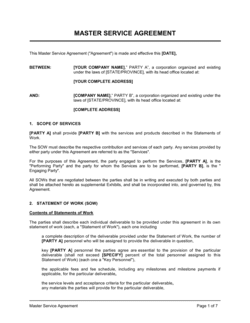
Engaging a carrier under a master services framework with individual work ordersMaster Services Agreement

Common mistakes to avoid

❌ KPIs with no financial remedy

Why it matters: Service-level targets that carry no penalty for non-performance are unenforceable in practice — providers will deprioritize the account when capacity is tight, and the shipper has no contractual basis to demand improvement or exit.

Fix: Attach a service credit table: for each percentage point below the KPI floor, the provider credits a defined dollar amount or percentage of that month's invoice. Cap total credits at 15–20% of monthly fees to keep the provision commercially reasonable.

❌ Accepting an industry-standard liability cap without checking cargo value

Why it matters: Most 3PL standard contracts cap liability at $0.50 per pound — a 1,000 lb shipment of electronics worth $80,000 would recover $500. The shipper absorbs the remainder unless they carry their own cargo insurance or negotiate a higher cap.

Fix: Calculate the maximum value of any single shipment or inventory lot you will entrust to the provider, then negotiate a per-occurrence cap that covers it — or buy shippers' interest insurance to fill the gap.

❌ No minimum insurance coverage requirements

Why it matters: Without contractual minimums, a provider can satisfy the insurance clause with a policy too small to cover a major loss. A warehouse fire that destroys $500,000 of inventory is devastating if the provider carries only $100,000 of cargo coverage.

Fix: Set specific dollar minimums for each coverage type and require the provider to furnish updated Certificates of Insurance annually. Include a clause allowing you to terminate for cause if coverage lapses.

❌ Auto-renewal with no advance notice tracking

Why it matters: A 90-day notice-to-exit clause in an auto-renewing contract means missing the notice window locks you into another full term — often at higher rates — even if you have identified a better provider.

Fix: Calendar the notice deadline immediately upon signing — 90 days before the renewal date — and assign a named person internally to review the relationship before that date each year.

❌ Vague data breach notification language

Why it matters: A 3PL holding customer shipping addresses and order data is a GDPR, CCPA, and PIPEDA-regulated data processor. Contracts that say 'prompt notification' without a defined window leave the shipper unable to meet its own 72-hour regulatory reporting obligations.

Fix: Specify a 48-hour notification window from the provider's confirmation of a breach, require a written incident report within 5 business days, and include the minimum content the report must contain (scope, affected data types, remediation steps).

❌ Governing law with no connection to either party's operations

Why it matters: Selecting an arbitrary governing-law jurisdiction — sometimes done to favor one party's in-house counsel — can result in courts declining jurisdiction or applying transport laws that override the contract's terms, particularly under the US Carmack Amendment or EU CMR Convention.

Fix: Choose a governing law jurisdiction where at least one party is incorporated or where the majority of services are performed. Confirm with counsel whether mandatory transport regulations (Carmack, CMR, COGSA) override the contract's liability provisions regardless of the chosen law.

The 10 key clauses, explained

Scope of services and service locations

In plain language: Defines exactly which logistics services the provider will perform — transportation modes, warehousing, fulfillment, returns — and at which facilities or lanes.

Sample language
Provider shall perform the following services for Shipper: [LIST OF SERVICES] at the facilities located at [ADDRESS(ES)] and for the transportation lanes described in Schedule A. Any services outside this scope require a written amendment signed by both parties.

Common mistake: Describing scope in vague terms like 'transportation and related services.' When a dispute arises over whether a service was included, vague scope language almost always favors the party that did not perform, leaving the other with no remedy.

Service levels and KPIs

In plain language: Sets measurable performance targets — on-time delivery rate, order accuracy, damage rate, dock-to-stock time — and specifies what happens if the provider misses them.

Sample language
Provider shall achieve the following minimum service levels: (a) on-time delivery: [X]% of shipments within the committed transit window; (b) order accuracy: [X]% of orders shipped without error; (c) cargo damage rate: no greater than [X]% of shipments. Failure to meet any KPI for [TWO] consecutive months entitles Shipper to [REMEDY].

Common mistake: Including KPIs with no defined remedy for non-performance. A target without a consequence is aspirational, not contractual — providers have no financial incentive to meet it.

Rates, invoicing, and payment terms

In plain language: States the agreed rate schedule for each service, invoicing frequency, payment terms, and the process for adjusting rates over the contract term.

Sample language
Provider shall invoice Shipper [weekly / monthly] for services rendered at the rates set out in Schedule B. Payment is due within [30] days of invoice date. Rates may be adjusted no more than once per [12-month] period upon [60] days' written notice, subject to Shipper's written acceptance.

Common mistake: Omitting rate adjustment mechanics. Without a cap or notice requirement, the provider can revise rates unilaterally at renewal, forcing the shipper to renegotiate under time pressure or scramble for an alternative.

Liability limits and cargo claims

In plain language: Sets the provider's maximum liability for cargo loss, damage, or delay, and defines the claims process — notice period, documentation, and dispute resolution timeline.

Sample language
Provider's liability for loss of or damage to cargo shall not exceed $[X] per pound / per shipment / per occurrence. Shipper must file written notice of loss or visible damage within [5] business days of delivery, and a formal cargo claim with supporting documentation within [9] months of the delivery date.

Common mistake: Accepting a liability cap without verifying the provider's cargo insurance limit equals or exceeds it. If the provider's policy sublimit is lower than the contractual cap, the shipper is left with an uninsured gap on high-value shipments.

Insurance requirements

In plain language: Specifies the minimum insurance coverage the provider must maintain — cargo, general liability, auto liability, workers' compensation — and the shipper's right to be named as an additional insured.

Sample language
Provider shall maintain throughout the term: (a) cargo insurance of not less than $[X] per occurrence; (b) commercial general liability of not less than $[X] per occurrence / $[X] aggregate; (c) auto liability of not less than $[X]; (d) workers' compensation as required by applicable law. Provider shall furnish Certificates of Insurance naming Shipper as additional insured within [10] days of execution.

Common mistake: Failing to require certificates of insurance at signing and annually thereafter. A provider whose policy lapses mid-contract leaves the shipper with no coverage on outstanding claims.

Confidentiality and data security

In plain language: Prohibits the provider from disclosing the shipper's customer data, pricing, inventory volumes, or trade secrets — and sets minimum data security standards for any systems holding shipper data.

Sample language
Provider shall treat as confidential all Shipper Data, including customer information, order volumes, pricing, and inventory records. Provider shall implement and maintain security measures no less protective than [ISO 27001 / SOC 2 Type II / industry standard] and shall notify Shipper within [48] hours of any confirmed data breach.

Common mistake: No data breach notification obligation. A 3PL often holds customer PII (names, addresses, order histories) — a breach without prompt notice can trigger regulatory penalties under GDPR, CCPA, and provincial privacy laws.

Intellectual property ownership

In plain language: Confirms that any proprietary systems, branding, or data the shipper provides remain the shipper's property, and that the provider's platform IP remains the provider's property.

Sample language
All Shipper IP, including trademarks, product data, and customer databases, remains the sole property of Shipper. All Provider IP, including warehouse management system software and proprietary processes, remains the sole property of Provider. Neither party acquires any right in the other's IP by virtue of this Agreement.

Common mistake: Ignoring IP ownership when the provider builds custom integrations or labeling solutions for the shipper. Without a clear work-for-hire or assignment clause, ownership of custom-built tools is ambiguous.

Term, renewal, and termination

In plain language: Sets the initial contract duration, auto-renewal conditions, notice required to exit, and the grounds for termination for cause or convenience.

Sample language
This Agreement commences on [START DATE] and continues for an initial term of [1 YEAR / 3 YEARS], renewing automatically for successive [1-YEAR] periods unless either party provides [90] days' written notice of non-renewal. Either party may terminate for cause upon [30] days' written notice if the other party materially breaches and fails to cure within the notice period. Shipper may terminate for convenience upon [90] days' written notice.

Common mistake: Short or no cure periods before termination for cause. Triggering termination without giving the provider a chance to cure minor breaches can expose the shipper to a wrongful termination claim and disrupt operations while a replacement provider is sourced.

Force majeure

In plain language: Excuses non-performance by either party caused by events beyond their reasonable control — storms, strikes, port closures, government orders — and sets a maximum excuse period before the other party may terminate.

Sample language
Neither party shall be liable for failure to perform obligations caused by events beyond its reasonable control, including natural disasters, labor strikes, government actions, or port closures ('Force Majeure Event'). The affected party shall notify the other within [48] hours. If a Force Majeure Event continues for more than [30] days, either party may terminate this Agreement on [15] days' written notice.

Common mistake: No maximum duration on the force majeure excuse. A provider claiming force majeure indefinitely can suspend service while the shipper remains unable to engage an alternative — capping the excuse period at 30 days protects both parties.

Governing law and dispute resolution

In plain language: Specifies which jurisdiction's law governs the contract and how disputes are resolved — arbitration, mediation, or litigation — and where proceedings take place.

Sample language
This Agreement is governed by the laws of [STATE / PROVINCE / COUNTRY], without regard to conflict-of-law principles. Any dispute not resolved within [30] days of written notice shall be submitted to binding arbitration administered by [AAA / JAMS / ICC] in [CITY]. Claims for injunctive relief may be brought in any court of competent jurisdiction.

Common mistake: Choosing a governing law state or country with no nexus to either party's operations. Courts in the selected jurisdiction may decline to hear disputes, and applicable transport regulations — such as the Carmack Amendment in the US — may override the contractual choice of law regardless.

How to fill it out

  1. 1

    Identify the parties and service locations

    Enter both parties' full legal entity names, registered addresses, and the contact designated for contract notices. List every facility address where services will be performed in Schedule A.

    💡 Confirm the provider's legal entity name matches their operating authority certificate (MC number in the US) — discrepancies create coverage gaps in cargo claims.

  2. 2

    Define the scope of services in precise terms

    List each service category — inbound receiving, storage, pick and pack, outbound freight, returns processing — with enough specificity that both parties agree on what is and isn't included before operations begin.

    💡 Attach a separate Schedule A for service locations and lanes so the body of the contract doesn't need to be amended when you add a new facility.

  3. 3

    Set measurable KPIs with defined remedies

    Agree on specific performance targets for on-time delivery, order accuracy, and damage rate. For each KPI, specify the measurement method, reporting frequency, and the remedy if the target is missed for two or more consecutive months.

    💡 Express KPIs as percentages with a floor, not as aspirations — 'at least 98.5% on-time' is enforceable; 'best efforts' is not.

  4. 4

    Complete the rate schedule

    Build Schedule B with a line item for every billable service: base transportation rate, storage rate per pallet per week, pick-and-pack fee per order, fuel surcharge formula, and accessorial charges. Include the rate-adjustment notice period and any cap.

    💡 Tie fuel surcharges to a published index — the US DOE weekly retail on-highway diesel price is common — rather than leaving them to the provider's discretion.

  5. 5

    Negotiate and document liability limits

    Agree on the per-pound, per-shipment, or per-occurrence liability cap and confirm it aligns with the provider's cargo insurance policy limit. Enter the claims notice period and the documentation required to file a valid claim.

    💡 For high-value goods, negotiate a declared-value option allowing the shipper to pay a higher freight rate in exchange for full-value cargo liability.

  6. 6

    Specify insurance requirements and collect certificates

    Enter the minimum coverage amounts for each insurance type in the insurance clause. Collect Certificates of Insurance from the provider at signing and set a calendar reminder to request updated certificates at each annual renewal.

    💡 Require the provider's insurer to give you 30 days' written notice of policy cancellation — standard certificates are silent on this unless you ask.

  7. 7

    Set the term and termination notice periods

    Choose an initial term length appropriate to the relationship — 1 year for a new provider, 2–3 years for a proven partner. Set auto-renewal and exit notice periods that give both parties enough lead time to transition operations without service disruption.

    💡 For 3PL agreements involving significant capital investment by the provider (racking, WMS integration), a 2–3 year minimum term is standard — shorter terms increase rates because the provider cannot amortize setup costs.

  8. 8

    Execute before the first shipment or inventory transfer

    Both authorized signatories should sign before any goods are tendered to the provider. Ensure the signatory on each side has actual authority to bind the entity — a warehouse supervisor's signature may not be legally sufficient.

    💡 Use a dated signing block that captures the date of execution separately from the agreement's start date — the two do not have to be the same day.

Frequently asked questions

What is a contract for logistics services?

A contract for logistics services is a binding agreement between a shipper and a third-party logistics provider (3PL) that defines the scope of transportation, warehousing, and fulfillment services, the rates and payment terms, performance standards, liability limits, and the duration of the relationship. It replaces informal email confirmations and verbal agreements with enforceable obligations that protect both parties when shipments are lost, damaged, or delayed.

What should a logistics services contract include?

At minimum: scope of services and service locations, measurable KPIs with remedies for non-performance, a rate schedule with adjustment mechanics, liability caps and cargo claims procedures, insurance requirements, data confidentiality obligations, term and termination provisions including exit notice periods, force majeure, and governing law. Missing any of these sections leaves one or both parties without a remedy when problems arise.

What is a reasonable liability cap for a logistics contract?

Standard carrier liability under the US Carmack Amendment can be as low as $0.50 per pound for general commodities — far below the value of most commercial shipments. A well-negotiated 3PL contract typically sets a per-occurrence cap equal to the maximum value of any single inventory lot the provider will hold, or requires the provider to carry cargo insurance at full replacement value. For high-value goods, shippers should also carry their own shippers' interest insurance as a backstop.

Does a logistics contract need to be reviewed by a lawyer?

For straightforward domestic 3PL relationships with established providers, a high-quality template reviewed by an operations manager familiar with the rate schedule and KPIs may be sufficient. Legal review is recommended when the contract involves cross-border shipments subject to multiple transport regimes, inventory values above $500,000, custom technology integration, or a provider whose standard terms materially limit liability below your cargo values. A 1–2 hour review typically costs $300–$800 and is worthwhile for any multi-year commitment.

How does US Carmack Amendment law affect a logistics contract?

The Carmack Amendment is the federal law governing carrier liability for interstate cargo loss and damage in the US. It generally preempts state-law claims and sets a default liability standard based on the cargo's actual loss. Carriers can limit liability below Carmack defaults through a separately signed written agreement — which is why a logistics contract's liability cap must be explicitly agreed to and documented. Shippers who do not sign a rate agreement with a liability cap retain full Carmack protection on most shipments.

What insurance should a logistics provider carry?

At minimum: cargo insurance covering the full value of goods in their custody, commercial general liability (typically $1M–$2M per occurrence), auto liability for any vehicles operated (typically $1M), and workers' compensation as required by law. For providers operating bonded warehouses or handling hazardous materials, additional specialized coverage applies. Shippers should require Certificates of Insurance at signing and annually thereafter, and should be named as additional insured on cargo and liability policies.

What is the difference between a logistics contract and a freight agreement?

A freight agreement typically governs a single transportation relationship — a carrier moving goods from point A to point B — and focuses on rates, transit time, and liability for that lane. A logistics services contract governs a broader, ongoing outsourcing relationship with a 3PL that may include warehousing, fulfillment, returns management, and multiple transportation modes under one agreement. The logistics contract is typically longer in term, more complex in scope, and carries greater operational and financial exposure for both parties.

How long should a logistics services contract term be?

One to three years is the standard range. A one-year term suits new provider relationships where performance is unproven or where the shipper's volume commitments are uncertain. Two- to three-year terms are typical when the provider invests in dedicated racking, a warehouse management system integration, or branded packaging — they need enough term to amortize that investment. Auto-renewal with a 60–90 day exit notice window is standard practice and gives both parties operational continuity while preserving the ability to renegotiate or exit annually.

Can I terminate a logistics contract early if the provider misses KPIs?

Yes, if the contract includes a termination-for-cause clause tied to KPI non-performance. A well-drafted logistics contract typically allows the shipper to terminate for cause if the provider misses a defined KPI threshold for two or more consecutive measurement periods after receiving written notice and a cure period. Without this language, early termination may constitute a breach by the shipper, triggering a damages claim by the provider for lost revenue over the remaining term.

How this compares to alternatives

vs Warehousing Agreement

A warehousing agreement covers the storage of goods at a defined facility — receipt, handling, storage fees, and release — without a transportation component. A logistics services contract governs the full end-to-end supply chain relationship, including transportation, fulfillment, and multiple service modes. Use a warehousing agreement when you need storage only; use a logistics services contract when your 3PL manages both movement and storage.

vs Master Services Agreement

A master services agreement establishes the overarching legal terms for an ongoing commercial relationship — liability, IP, confidentiality, payment — and is paired with individual statements of work for each project. A logistics services contract combines the master terms and service scope into a single document, which is typical for 3PL relationships where the scope and rates are stable and defined upfront rather than project-by-project.

vs Independent Contractor Agreement

An independent contractor agreement engages an individual or small provider for defined deliverables, without the scope complexity of a multi-modal logistics relationship. A logistics services contract is appropriate when engaging a licensed carrier or 3PL entity with operating authority, dedicated facilities, and ongoing service obligations that require KPIs, insurance mandates, and cargo liability provisions.

vs Service Level Agreement

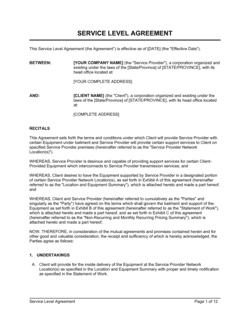
A standalone SLA documents performance targets and remedies but typically does not include commercial terms, liability limits, or insurance requirements. A logistics services contract incorporates SLA-level KPIs within a full binding agreement that also governs rates, claims, insurance, and termination. For logistics relationships, a standalone SLA without a governing contract leaves the commercial and liability framework undefined.

Industry-specific considerations

E-commerce and retail

Peak-season volume commitments, order accuracy SLAs measured at the SKU level, returns processing rates, and carrier compliance requirements for Amazon and major retailers.

Manufacturing and industrial

Just-in-time delivery windows, inbound freight from multiple suppliers, hazardous materials handling certification requirements, and cross-dock arrangements.

Food and beverage

Temperature-controlled storage and transport requirements, FDA and FSMA compliance obligations, lot traceability obligations, and shortened claims periods for perishable cargo.

Healthcare and life sciences

GDP (Good Distribution Practice) and DEA compliance for pharmaceutical logistics, chain-of-custody documentation, cold-chain temperature excursion reporting, and product recall procedures.

Jurisdictional notes

United States

The Carmack Amendment (49 U.S.C. § 14706) governs carrier liability for interstate cargo loss and generally preempts state tort claims. Carriers and 3PLs can contractually limit liability below Carmack defaults only through a separately signed written agreement — making the liability clause in this contract critical. The FMCSA requires interstate carriers to hold a minimum of $750,000 in cargo liability insurance for general freight; shippers should verify this against their actual shipment values. California's AB5 and similar state laws may affect how drivers engaged by the 3PL are classified.

Canada

Interprovincial trucking is federally regulated under the Canada Transportation Act; intraprovincial trucking falls under provincial transport acts, which vary by province. Quebec's Civil Code governs contracts differently from the common-law provinces — francophone freight contracts in Quebec must be available in French under the Charter of the French Language. Cargo liability limits for regulated carriers are set by tariff and may be lower than the contract's negotiated cap; confirm which regime applies. PIPEDA (and Quebec's Law 25) impose breach notification obligations on 3PLs handling customer personal data.

United Kingdom

Road freight within the UK is governed by the Carriage of Goods by Road Act 1965 for international journeys under the CMR Convention, and by common law and the Unfair Contract Terms Act 1977 for domestic carriage. The UKCA post-Brexit regime means EU CMR documentation requirements apply to cross-Channel shipments. The ICO (Information Commissioner's Office) enforces UK GDPR for any 3PL processing shipper customer data — include a data processing agreement or addendum if the 3PL handles UK consumer data.

European Union

Cross-border road freight within the EU is governed by the CMR Convention, which sets mandatory liability limits of approximately 8.33 SDR per kilogram of gross weight — parties cannot contractually reduce this floor. GDPR Article 28 requires a written data processing agreement whenever a 3PL processes personal data on the shipper's behalf; this contract should incorporate or reference a compliant DPA. Member states have varying VAT treatment for logistics services — confirm with local counsel whether the provider's invoices should show VAT and which country's rules apply to bonded or customs warehousing.

Template vs lawyer — what fits your deal?

PathBest forCostTime
Use the templateDomestic 3PL relationships with established providers, standard shipment values, and straightforward scopeFree1–2 hours
Template + legal reviewMulti-year contracts, inventory values above $250,000, cross-border logistics, or providers whose standard terms limit liability significantly$400–$9002–5 days
Custom draftedEnterprise logistics outsourcing, pharmaceutical or cold-chain providers, customs-bonded warehousing, or contracts involving dedicated facility investment$2,000–$8,000+2–6 weeks

Glossary

3PL (Third-Party Logistics Provider)
A company that manages transportation, warehousing, or fulfillment on behalf of a shipper, typically under a multi-year services contract.
Service Level Agreement (SLA)
A contractual commitment to specific performance metrics — such as on-time delivery rate, order accuracy, or dock-to-stock time — with defined remedies for non-compliance.
Shipper
The party that owns or has custody of goods and contracts with a logistics provider to move or store them.
Carrier
A company licensed to physically transport goods by road, rail, air, or sea — distinct from a broker, who arranges transport without operating vehicles.
Liability Cap
A contractual ceiling on the maximum amount a logistics provider owes for loss, damage, or delay to cargo, typically expressed as a dollar amount per pound, per shipment, or per occurrence.
Cargo Claim
A formal written demand by the shipper against the carrier or 3PL for reimbursement of loss or damage to goods while in the provider's custody.
Freight Charge
The fee charged by a carrier or 3PL for transporting goods from origin to destination, typically based on weight, volume, distance, or a flat rate.
Incoterms
Standardized international trade terms published by the International Chamber of Commerce that define where risk and cost transfer between buyer and seller during shipment.
Bill of Lading (BOL)
A legal shipping document issued by the carrier to the shipper that serves as a receipt for goods, a contract of carriage, and (in some forms) a document of title.
Force Majeure
A clause excusing a party from performance obligations caused by events outside their reasonable control — such as natural disasters, strikes, or government actions.
Accessorial Charges
Additional fees beyond the base freight rate charged for services such as liftgate delivery, residential delivery, inside pickup, or fuel surcharges.
Claims Period
The contractually defined window within which a shipper must file a cargo claim — typically 9 months for loss and 60–90 days for visible damage under US law.

Part of your Business Operating System

This document is one of 3,000+ business & legal templates included in Business in a Box.

  • Fill-in-the-blanks — ready in minutes
  • 100% customizable Word document
  • Compatible with all office suites
  • Export to PDF and share electronically

Create your document in 3 simple steps.

From template to signed document — all inside one Business Operating System.
1
Download or open template

Access over 3,000+ business and legal templates for any business task, project or initiative.

2
Edit and fill in the blanks with AI

Customize your ready-made business document template and save it in the cloud.

3
Save, Share, Send, Sign

Share your files and folders with your team. Create a space of seamless collaboration.

Save time, save money, and create top-quality documents.

★★★★★

"Fantastic value! I'm not sure how I'd do without it. It's worth its weight in gold and paid back for itself many times."

Managing Director · Mall Farm
Robert Whalley
Managing Director, Mall Farm Proprietary Limited
★★★★★

"I have been using Business in a Box for years. It has been the most useful source of templates I have encountered. I recommend it to anyone."

Business Owner · 4+ years
Dr Michael John Freestone
Business Owner
★★★★★

"It has been a life saver so many times I have lost count. Business in a Box has saved me so much time and as you know, time is money."

Owner · Upstate Web
David G. Moore Jr.
Owner, Upstate Web

Run your business with a system — not scattered tools

Stop downloading documents. Start operating with clarity. Business in a Box gives you the Business Operating System used by over 250,000 companies worldwide to structure, run, and grow their business.

Start free · No credit card required