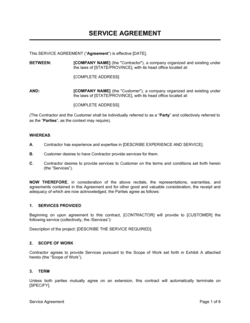
Transport Contract Template

Free Word download β€’ Edit online β€’ Save & share with Drive β€’ Export to PDF

7 pagesβ€’30–40 min to fillβ€’Difficulty: Complexβ€’Signature requiredβ€’Legal review recommended
Learn more ↓
FreeTransport Contract Template

At a glance

What it is
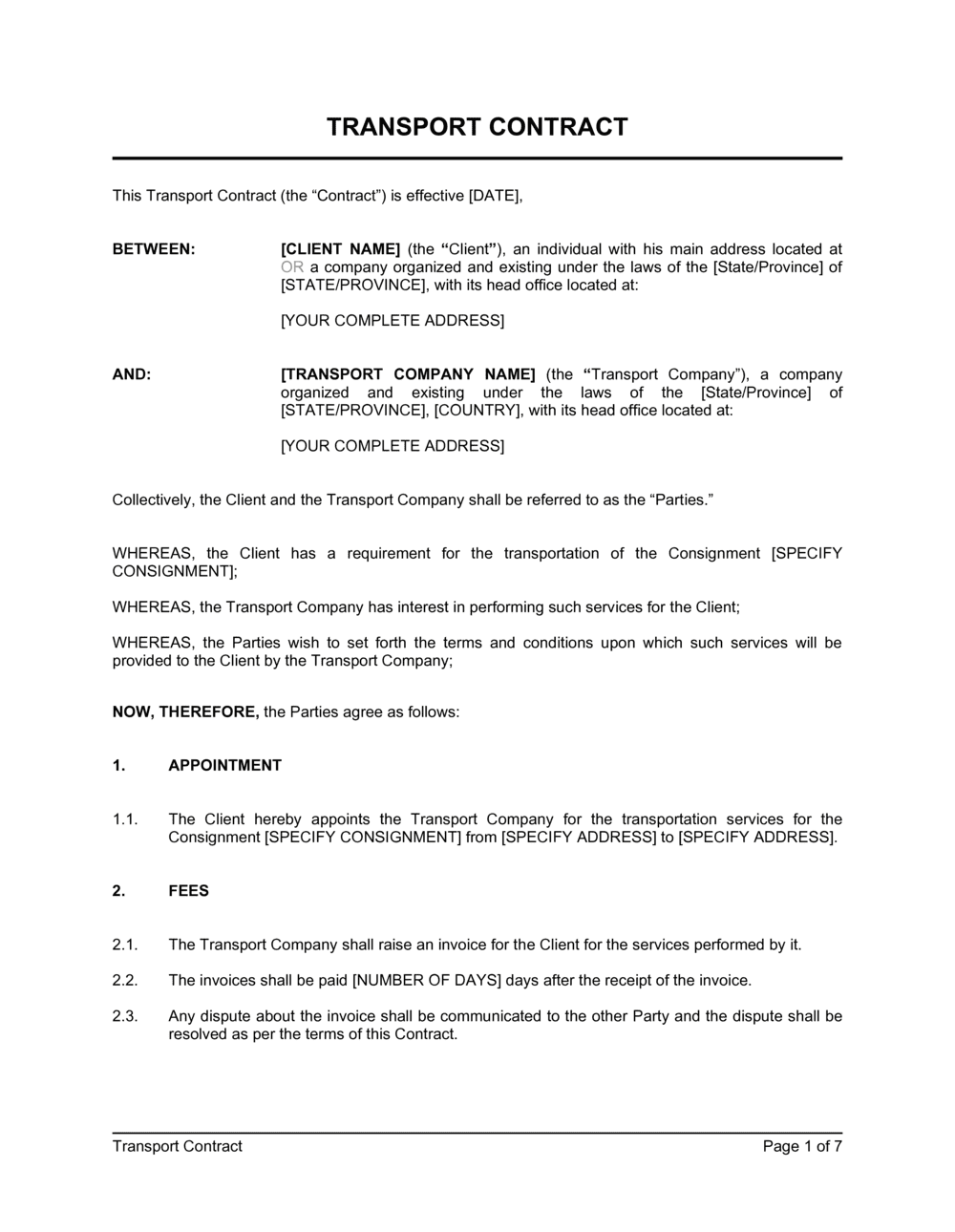
A Transport Contract is a legally binding agreement between a shipper (the cargo owner or sender) and a carrier (the transport operator) that governs the carriage of goods from an origin point to a destination. This free Word download covers route, mode, freight rates, transit time, liability limits, insurance obligations, declared cargo value, and force majeure β€” and can be adapted for road, sea, air, or multimodal shipments.
When you need it
Use it whenever you are engaging a carrier to move goods commercially, whether as a one-off shipment or an ongoing freight arrangement. It is essential when the cargo value, transit risk, or cross-border complexity makes a verbal arrangement or standard bill of lading insufficient on its own.
What's inside
Shipper and carrier identification, shipment description and declared value, route and mode of transport, freight rates and payment terms, transit time and delivery obligations, liability caps and exclusions, insurance requirements, force majeure, and governing law.

What is a Transport Contract?

A Transport Contract is a legally binding agreement between a shipper (the cargo owner or sender) and a carrier (the transport operator) that governs the movement of goods from an origin point to a destination. It sets out the route, mode of transport, freight rates, transit time obligations, carrier liability limits, insurance requirements, and claims procedure β€” creating enforceable commercial obligations that go well beyond what a standard bill of lading provides. Depending on the mode and route, the contract operates alongside mandatory international conventions such as CMR (road), COGSA or Hague-Visby (sea), or the Montreal Convention (air), which set baseline liability rules that cannot be contracted away.

Why You Need This Document

Relying on a carrier's standard bill of lading without a separate transport contract leaves shippers exposed in four concrete ways: convention-minimum liability caps that may be a fraction of actual cargo value, no enforceable delivery window to claim against in the event of delay, no agreed claims procedure so disputes become protracted correspondence battles, and no clarity on whether the carrier can hand your shipment to an unknown sub-carrier mid-route. A properly drafted transport contract closes all four gaps before the first shipment departs. For high-value, temperature-sensitive, or cross-border cargo, the cost of a missing clause is typically measured in the full value of the lost or damaged goods β€” not the cost of the freight.

Which variant fits your situation?

If your situation is…Use this template
Moving goods by road within a single countryDomestic Road Transport Contract
International road freight across CMR signatory countriesInternational Road Freight Contract (CMR)
Ocean freight for containerized or break-bulk cargoSea Freight / Bill of Lading Agreement
Air freight subject to Montreal ConventionAir Cargo Transport Agreement
Ongoing freight arrangement with a single carrier across multiple shipmentsMaster Transport Agreement
Third-party logistics provider managing multiple carriers3PL Service Agreement
Moving household goods or personal effectsMoving Services Agreement

Common mistakes to avoid

❌ Accepting the carrier's standard bill of lading as the whole contract

Why it matters: A standard BOL typically contains only convention-minimum liability limits, broad carrier exclusions, and no freight rate or delivery commitment. Shippers who rely solely on a BOL have no contractual basis to recover costs from late delivery or to hold the carrier to an agreed rate.

Fix: Execute a standalone transport contract before the first shipment and reference it on every subsequent bill of lading β€” the contract governs; the BOL evidences receipt.

❌ Omitting a declared value clause for high-value cargo

Why it matters: Without a declared value, COGSA limits sea freight carrier liability to $500 per package β€” a pallet of electronics worth $50,000 recovers $500. CMR road freight caps liability at approximately 8.33 SDRs per kilogram.

Fix: Declare the full cargo value in the contract and on the bill of lading, pay the applicable ad valorem freight surcharge, and purchase independent all-risk cargo insurance for the balance.

❌ No written condition record at pickup

Why it matters: If cargo arrives damaged and there is no endorsed notation on the bill of lading at origin, the carrier is presumed to have received the goods in good condition β€” shifting the burden of proof entirely to the shipper to demonstrate the damage occurred in transit.

Fix: Require the carrier to inspect and sign off on cargo condition at every pickup, and retain a copy of the endorsed bill of lading before the vehicle departs.

❌ Choosing a governing law that conflicts with mandatory conventions

Why it matters: CMR, COGSA, and the Montreal Convention apply as mandatory law on their respective transport modes regardless of the contractual governing-law clause β€” drafting a clause that says otherwise creates false expectations and may invalidate parts of the contract.

Fix: Identify the applicable international convention for the mode and route at the outset, and draft the contract to work within that framework rather than attempting to override it.

❌ Permitting unlimited subcontracting without retained liability

Why it matters: When an unknown sub-carrier loses or damages cargo, the shipper must chase a company it has no contract with while the original carrier denies responsibility β€” claims take months to resolve and insurers dispute coverage.

Fix: Require prior written consent for subcontracting and include an explicit clause confirming the original carrier remains fully liable for any sub-carrier's acts as if they were its own.

❌ Missing the claims notification window

Why it matters: Under CMR, visible damage must be noted at delivery; concealed damage must be reported within 7 days. Under COGSA, the window is 3 days. Failure to notify in time is an absolute bar to recovery in most jurisdictions, regardless of the merits of the claim.

Fix: Include the exact notification deadlines in the contract and brief your warehouse and logistics staff on the procedure β€” cargo claims are lost in warehouses, not courtrooms.

The 10 key clauses, explained

Parties, shipment description, and declared value

In plain language: Identifies the shipper and carrier by legal name, describes the cargo (type, quantity, weight, dimensions), and records the shipper's declared value for liability and insurance purposes.

Sample language
This Transport Contract is entered into between [SHIPPER LEGAL NAME] ('Shipper') and [CARRIER LEGAL NAME] ('Carrier'). The Cargo consists of [DESCRIPTION], comprising [QUANTITY] units with a gross weight of [WEIGHT] kg and declared value of [CURRENCY][AMOUNT].

Common mistake: Describing cargo vaguely as 'general merchandise.' If a claim arises, courts and insurers require specific descriptions β€” vague entries can void coverage or limit the carrier's liability to convention minimums regardless of actual value.

Route, mode of transport, and transit time

In plain language: Specifies the origin and destination, the mode of transport (road, sea, air, or rail), any permitted transshipment points, and the contracted delivery window.

Sample language
Carrier shall transport the Cargo from [ORIGIN ADDRESS] to [DESTINATION ADDRESS] by [MODE] via [ROUTE / TRANSSHIPMENT POINT]. Estimated transit time is [X] days. Delivery is required no later than [DATE / DAYS AFTER PICKUP].

Common mistake: Omitting transshipment points on multimodal shipments. When cargo changes hands between carriers mid-route, the contract must clarify which carrier bears liability during each leg.

Freight rates, surcharges, and payment terms

In plain language: States the agreed freight rate, any applicable surcharges (fuel, security, peak season), the invoicing currency, and when payment is due.

Sample language
Shipper shall pay Carrier a freight rate of [CURRENCY][RATE] per [UNIT]. Additional surcharges: fuel surcharge [X]%, security surcharge [X]%. Payment is due [Net 30 / prepaid before loading] from invoice date. Late payment accrues interest at [X]% per month.

Common mistake: Quoting rates without specifying which surcharges are included. A rate agreed verbally as 'all-in' frequently excludes fuel and security surcharges in the carrier's invoice, creating disputes on every shipment.

Carrier liability limits and exclusions

In plain language: Sets the maximum amount the carrier is liable for in the event of cargo loss, damage, or delay β€” and lists the exclusions (acts of God, inherent vice, shipper's packing failures).

Sample language
Carrier's liability for loss or damage to Cargo shall not exceed [CURRENCY][AMOUNT] per [unit / kg / package], or the applicable convention limit if lower. Carrier is not liable for loss caused by: (a) improper packing by Shipper; (b) inherent vice of the Cargo; (c) force majeure events as defined herein.

Common mistake: Accepting a standard bill of lading's liability cap without specifying a higher limit for high-value cargo. COGSA defaults to $500 per package regardless of actual value β€” shippers with cargo worth tens of thousands per pallet must declare excess value or purchase cargo insurance.

Insurance obligations

In plain language: Allocates responsibility for insuring the cargo in transit β€” whether the carrier maintains cargo insurance, the shipper must obtain their own policy, or both β€” and specifies minimum coverage amounts.

Sample language
Shipper shall maintain all-risk cargo insurance with a minimum insured value of [CURRENCY][AMOUNT] for the duration of transit. Carrier shall maintain third-party liability insurance of not less than [CURRENCY][AMOUNT]. Each party shall provide the other with certificates of insurance upon request.

Common mistake: Assuming the carrier's liability insurance covers the full cargo value. Carrier liability policies cover the carrier's legal exposure β€” capped at convention or contractual limits β€” not the replacement value of the goods. Shippers need independent cargo insurance.

Loading, packaging, and condition at handover

In plain language: Defines each party's responsibility for packing, labelling, loading, and securing cargo β€” and establishes how condition is verified and recorded at handover.

Sample language
Shipper is responsible for packaging Cargo in accordance with [APPLICABLE STANDARDS] to withstand normal transit conditions. Carrier shall inspect Cargo at pickup and note any visible damage on the bill of lading. Unchecked goods are deemed received in apparent good condition.

Common mistake: No written condition record at pickup. If damage is noticed at delivery and there is no endorsed bill of lading noting pre-existing issues, the carrier is presumed liable β€” even if the shipper's packing caused the damage.

Force majeure

In plain language: Defines the events that excuse either party from performance obligations and sets the procedure for notification and mitigation when such an event occurs.

Sample language
Neither party shall be liable for delay or failure to perform caused by events beyond its reasonable control, including acts of God, war, strikes, government orders, port closures, or pandemic restrictions ('Force Majeure Event'). The affected party shall notify the other within [48] hours and use reasonable efforts to mitigate the impact.

Common mistake: Listing force majeure events so broadly that ordinary carrier congestion or equipment failure qualifies. Courts treat such clauses narrowly β€” if the list includes 'weather' or 'traffic delays,' carriers may invoke it to excuse avoidable late deliveries.

Claims procedure and time limits

In plain language: Sets the deadline for the shipper to notify the carrier of visible and concealed damage, and the time limit for filing a formal claim or legal action.

Sample language
Shipper must notify Carrier of visible damage at delivery and of concealed damage within [7] days of delivery. Formal claims must be submitted in writing within [30] days of delivery. No action shall be brought against Carrier after [1] year from the date of delivery or scheduled delivery date.

Common mistake: Missing the claims notification window. Under CMR and COGSA, failure to notify within the statutory period can bar a claim entirely β€” contractual windows are often shorter than statutory defaults, so shippers must act immediately on any suspected damage.

Subcontracting and substitution

In plain language: States whether the carrier may subcontract the carriage to a third-party carrier and, if so, under what conditions and with what retained liability.

Sample language
Carrier may not subcontract carriage of the Cargo without Shipper's prior written consent, except where [PERMITTED EXCEPTION]. If subcontracting is permitted, Carrier remains fully liable to Shipper for the acts and omissions of any subcontractor as if they were Carrier's own.

Common mistake: Permitting unlimited subcontracting without preserving the carrier's back-to-back liability. Once goods pass to an unknown sub-carrier, tracing liability for a loss becomes significantly harder and insurers may challenge coverage.

Governing law and dispute resolution

In plain language: Specifies which country or state's law governs the contract and the mechanism for resolving disputes β€” arbitration, mediation, or litigation β€” including jurisdiction and language.

Sample language
This Agreement is governed by the laws of [COUNTRY / STATE]. Any dispute shall be referred first to mediation under [INSTITUTION] rules. If unresolved within [30] days, disputes shall be resolved by binding arbitration in [CITY], conducted in [LANGUAGE], with each party bearing its own costs.

Common mistake: Choosing a governing law that conflicts with mandatory international conventions. CMR, COGSA, and the Montreal Convention override contractual choice-of-law on liability issues in their respective domains β€” a domestic law clause cannot contract out of convention-mandated liability limits.

How to fill it out

  1. 1

    Identify both parties with full legal names

    Enter the shipper's and carrier's registered legal entity names, addresses, and contact details. For the carrier, include their transport operating licence number or DOT/MC number where applicable.

    πŸ’‘ Verify the carrier's legal name against their operating licence β€” trade names and legal entities often differ, and using the wrong name creates enforcement problems.

  2. 2

    Describe the cargo precisely

    List commodity type, number of units, gross weight, dimensions, and any hazardous materials classification (UN number, packing group). Enter the declared value the shipper will use for insurance and liability purposes.

    πŸ’‘ If cargo is temperature-sensitive, fragile, or high-value, state the specific handling requirements in this clause rather than relying on a separate instruction document that may not travel with the shipment.

  3. 3

    Specify route, mode, and delivery window

    Enter origin and destination addresses, the mode of transport, any permitted transshipment points, and the contracted transit time with a specific latest-delivery date.

    πŸ’‘ For multimodal shipments, identify the liability regime for each leg β€” CMR for road, COGSA or Hague-Visby for sea, Montreal Convention for air β€” and note which applies where.

  4. 4

    Set freight rates, surcharges, and payment terms

    State the base rate per unit (tonne, container, pallet, or km), enumerate all applicable surcharges by name and percentage, specify the invoicing currency, and set a precise due date β€” Net 30 from invoice date, prepaid, or collect.

    πŸ’‘ Include a rate-validity period for ongoing arrangements. Fuel and congestion surcharges can change monthly β€” a validity clause of 30 or 90 days prevents disputes on long-term lanes.

  5. 5

    Set liability limits and declare excess value if needed

    Enter the contractual liability cap per unit or per kg. If the cargo value exceeds the applicable convention limit (e.g., $500 per package under COGSA), declare excess value in this clause and confirm whether an additional freight charge applies.

    πŸ’‘ Compare your declared value against your cargo insurance policy limit β€” they should align. A gap between them means either you are over-insured or the carrier's liability won't cover your actual loss.

  6. 6

    Allocate insurance obligations

    State which party carries cargo insurance, the minimum insured amount, the policy type (all-risk vs. named perils), and the obligation to provide certificates of insurance before loading.

    πŸ’‘ All-risk cargo insurance is not the same as the carrier's liability insurance. Make this distinction explicit in the clause to prevent the shipper from assuming they are covered by the carrier's policy.

  7. 7

    Set the claims notification deadlines

    Enter specific day-counts for reporting visible damage at delivery, concealed damage after delivery, and filing a formal written claim. Confirm these are consistent with the applicable international convention minimums.

    πŸ’‘ Set your internal claims deadline reminder for at least 48 hours before the contractual notification window closes β€” waiting until the last day frequently results in missed deadlines.

  8. 8

    Sign before the first shipment departs

    Both parties must sign the contract before the first shipment moves. Exchanging bills of lading on unsigned contract terms creates ambiguity about which document governs in the event of a dispute.

    πŸ’‘ For ongoing arrangements, execute a master transport agreement first, then reference it on each bill of lading β€” this avoids re-executing the full contract for every shipment.

Frequently asked questions

What is a transport contract?

A transport contract is a legally binding agreement between a shipper and a carrier that governs the movement of goods from an origin to a destination. It sets out the route, mode, freight rate, transit time, liability limits, insurance obligations, and claims procedure. Unlike a standard bill of lading, a transport contract gives both parties enforceable commercial obligations beyond the bare minimum set by international conventions.

What is the difference between a transport contract and a bill of lading?

A bill of lading is a transport document that acknowledges receipt of cargo and evidences the contract of carriage β€” but its terms are usually the carrier's standard conditions with convention-minimum liability limits. A transport contract is a separately negotiated agreement that sets specific rates, liability caps, delivery commitments, and claims procedures. The two documents should be used together, with the contract governing commercial terms and the BOL evidencing each individual shipment.

Which international convention applies to my shipment?

The applicable convention depends on the mode of transport and the route. CMR applies to international road freight between signatory countries (most of Europe and several others). COGSA or the Hague-Visby Rules apply to sea freight depending on the country. The Montreal Convention applies to international air cargo. For multimodal shipments, different conventions may apply to different legs of the journey. Identifying the correct convention is essential before setting liability caps in the contract.

Can I contract out of convention liability limits?

In most cases, no β€” at least not downward. CMR, COGSA, and the Montreal Convention set mandatory minimum liability floors that cannot be reduced by contract. However, shippers can contract for higher liability by declaring excess value and paying an ad valorem surcharge. Any clause in a transport contract that purports to reduce the carrier's liability below the convention minimum is generally void.

What insurance do I need when shipping goods?

You typically need two types of coverage: cargo insurance (covering the value of your goods in transit, ideally all-risk) and awareness of the carrier's third-party liability insurance (which covers only the carrier's legal exposure, capped at convention or contractual limits). Carrier liability insurance does not cover the full replacement value of your goods β€” shippers should obtain independent cargo insurance for any shipment where the cargo value exceeds the applicable convention liability cap.

What happens if cargo is damaged or lost in transit?

You must notify the carrier of visible damage at delivery, and concealed damage within the contractual or statutory window (7 days under CMR, 3 days under COGSA). After notification, submit a formal written claim with supporting documents β€” bill of lading, commercial invoice, packing list, and survey report. If the carrier rejects the claim, your options are negotiation, arbitration (if contracted), or litigation within the applicable limitation period β€” typically 1 year under CMR and COGSA.

Is a transport contract required by law?

A formal written transport contract is not legally required in most jurisdictions β€” the bill of lading or a verbal agreement can technically constitute a contract of carriage. However, without a written contract, the governing terms default to the carrier's standard conditions and mandatory convention rules, which rarely favour the shipper. For any shipment of meaningful commercial value, a written transport contract is strongly advisable.

What is a master transport agreement?

A master transport agreement (MTA) is a framework contract that sets out the commercial terms governing all shipments between a shipper and a carrier over a defined period β€” typically 12 months. Each individual shipment is then booked by reference to the MTA without re-executing the full contract. MTAs are standard practice for shippers with regular freight volumes and reduce the administrative burden of contracting on a shipment-by-shipment basis.

Do I need a lawyer to draft a transport contract?

For standard domestic or intra-regional shipments with established carriers, a high-quality template is typically sufficient. Engage a transport lawyer when the cargo is high-value or hazardous, when the route crosses jurisdictions with conflicting legal regimes, when the contract involves significant liability exposure or custom indemnity terms, or when you are negotiating a multi-year master agreement with a major carrier. A template review by a specialist typically costs $400–$800 and is worthwhile for any recurring high-value lane.

How this compares to alternatives

vs Bill of Lading

A bill of lading is a transport document that acknowledges cargo receipt and evidences the basic contract of carriage on the carrier's standard terms. A transport contract is a separately negotiated agreement that governs the commercial relationship β€” rates, liability, delivery obligations, and claims procedure β€” with far greater specificity. Both documents should be used together for any commercial shipment.

vs Freight Broker Agreement

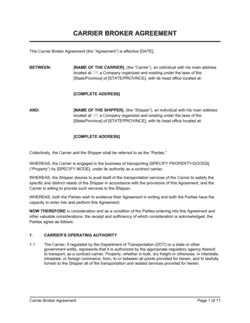
A freight broker agreement governs the relationship between a shipper and an intermediary who arranges carriers but does not take custody of the cargo. A transport contract governs the relationship with the actual carrier who moves the goods. When a broker is involved, shippers typically need both documents β€” the broker agreement for the intermediary and a transport contract or carrier terms for the underlying carrier.

vs Logistics Services Agreement

A logistics services agreement is a broader contract covering warehousing, order fulfilment, inventory management, and distribution β€” not just the movement of a specific shipment. A transport contract focuses narrowly on the carriage of defined cargo from origin to destination. Businesses with outsourced supply chains typically need both.

vs Independent Contractor Agreement

An independent contractor agreement engages a self-employed driver or operator for ongoing services without covering the specific terms of individual shipments. A transport contract governs a specific consignment β€” cargo description, route, liability, and delivery terms. Owner-operators may need both: a contractor agreement to establish the working relationship and a transport contract for each load.

Industry-specific considerations

Manufacturing

Inbound raw material and outbound finished-goods lanes require mode-specific liability terms, packaging standards, and carrier performance KPIs tied to production schedules.

Retail and e-commerce

High shipment volumes and tight delivery windows mean master transport agreements with rate-validity clauses and service-level penalties are standard practice.

Food and beverage

Temperature and humidity control requirements must be written into the contract as carrier obligations, with liability for spoilage damage expressly allocated.

Pharmaceuticals and healthcare

GDP (Good Distribution Practice) compliance obligations, cold chain documentation requirements, and enhanced cargo security clauses are typically mandatory in pharma transport contracts.

Construction

Oversized and heavy-lift cargo requires route survey obligations, permit responsibilities, and liability for site access damage to be explicitly allocated in the contract.

Technology and electronics

High declared values relative to package count mean COGSA's $500-per-package default is almost always inadequate β€” excess value declarations and all-risk cargo insurance are essential.

Jurisdictional notes

United States

COGSA governs ocean freight liability to and from US ports, defaulting to $500 per package unless higher value is declared. The Carmack Amendment applies to domestic rail and road interstate freight, providing a federal liability framework that preempts most state claims. Air cargo is governed by the Montreal Convention for international flights. Carriers must hold active FMCSA operating authority (DOT/MC number) for interstate road transport β€” verify this before execution.

Canada

Canada is a CMR non-signatory, but domestic road freight is governed by provincial transport acts and the standard bill of lading conditions prescribed under each province's Highway Traffic Act. The Marine Liability Act incorporates the Hamburg Rules for sea freight. Montreal Convention applies to international air cargo. Quebec-based carriers and shippers should note that contracts may need to comply with the Civil Code of Quebec in addition to federal transport statutes.

United Kingdom

The UK is a CMR signatory; CMR applies to all international road freight moving between the UK and other CMR countries. The Carriage of Goods by Sea Act 1992 and the Hague-Visby Rules govern sea freight liability. The Montreal Convention applies to international air cargo. Post-Brexit, UK courts apply these conventions independently of EU implementation β€” contracts should confirm whether UK or EU governing law is intended for cross-Channel shipments.

European Union

CMR applies mandatorily to all international road freight between EU member states and other CMR signatories β€” contractual terms that derogate from CMR liability minimums are void. Hague-Visby Rules apply to sea freight for most member states. The Montreal Convention applies to air cargo. The EU Mobility Package (2020) introduced new rules on driver posting and cabotage that may affect carrier compliance obligations written into transport contracts for EU road freight.

Template vs lawyer β€” what fits your deal?

PathBest forCostTime
Use the templateStandard domestic or intra-regional shipments with established carriers where cargo value is moderate and the applicable convention is straightforwardFree30–45 minutes per contract
Template + legal reviewCross-border shipments, high-value or hazardous cargo, or ongoing carrier relationships with material volume$400–$800 (transport lawyer review)2–5 days
Custom draftedMulti-year master transport agreements, multimodal international supply chains, or regulated cargo such as pharmaceuticals or dangerous goods$2,000–$8,000+2–4 weeks

Glossary

Shipper
The party who owns or sends the cargo and engages the carrier to transport it from origin to destination.
Carrier
The company or individual that physically transports the goods and assumes custody during the transit period.
Bill of Lading (BOL)
A transport document issued by the carrier that acknowledges receipt of goods, describes shipment details, and serves as evidence of the contract of carriage.
CMR Convention
The Convention on the Contract for the International Carriage of Goods by Road, which governs liability and documentation for road freight across its signatory countries in Europe and beyond.
COGSA
The Carriage of Goods by Sea Act β€” US federal law (and a parallel UK statute) that sets carrier liability limits for ocean freight, defaulting to $500 per package unless higher value is declared.
Montreal Convention
The international treaty governing air carrier liability for cargo damage, loss, or delay, setting limits in Special Drawing Rights (SDRs) per kilogram of cargo.
Declared Value
The cargo value stated by the shipper at booking, which determines the carrier's maximum liability and the applicable freight rate surcharge.
Liability Cap
The maximum amount the carrier is obligated to pay for loss or damage to cargo, set either by contract or by applicable international convention.
Force Majeure
A contractual clause excusing a party from performance obligations when an extraordinary event beyond its control β€” such as a natural disaster, strike, or government action β€” makes performance impossible.
Freight Rate
The price charged by the carrier for transporting a defined unit of cargo β€” typically quoted per tonne, per container, per pallet, or per kilometre.
Incoterms
A set of standardized international trade terms (published by the ICC) that define when risk and cost of goods transfers from seller to buyer during transit.
Consignee
The party named in the transport document as the recipient of the cargo at the destination point.

Part of your Business Operating System

This document is one of 3,000+ business & legal templates included in Business in a Box.

  • Fill-in-the-blanks β€” ready in minutes
  • 100% customizable Word document
  • Compatible with all office suites
  • Export to PDF and share electronically

Create your document in 3 simple steps.

From template to signed document β€” all inside one Business Operating System.
1
Download or open template

Access over 3,000+ business and legal templates for any business task, project or initiative.

2
Edit and fill in the blanks with AI

Customize your ready-made business document template and save it in the cloud.

3
Save, Share, Send, Sign

Share your files and folders with your team. Create a space of seamless collaboration.

Save time, save money, and create top-quality documents.

β˜…β˜…β˜…β˜…β˜…

"Fantastic value! I'm not sure how I'd do without it. It's worth its weight in gold and paid back for itself many times."

Managing Director Β· Mall Farm
Robert Whalley
Managing Director, Mall Farm Proprietary Limited
β˜…β˜…β˜…β˜…β˜…

"I have been using Business in a Box for years. It has been the most useful source of templates I have encountered. I recommend it to anyone."

Business Owner Β· 4+ years
Dr Michael John Freestone
Business Owner
β˜…β˜…β˜…β˜…β˜…

"It has been a life saver so many times I have lost count. Business in a Box has saved me so much time and as you know, time is money."

Owner Β· Upstate Web
David G. Moore Jr.
Owner, Upstate Web

Run your business with a system β€” not scattered tools

Stop downloading documents. Start operating with clarity. Business in a Box gives you the Business Operating System used by over 250,000 companies worldwide to structure, run, and grow their business.

Start freeΒ Β·Β No credit card required