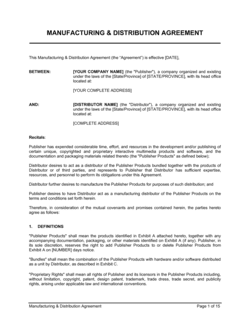
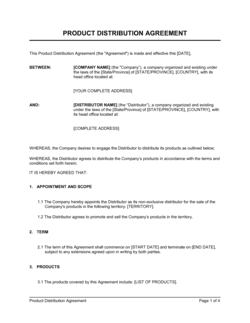
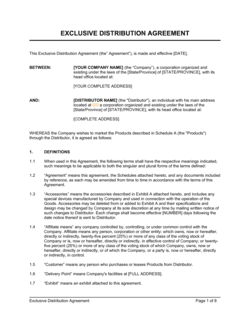
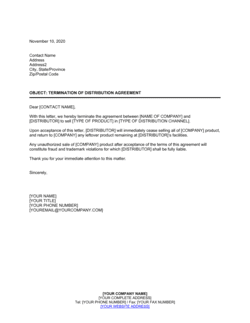
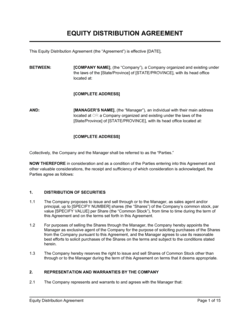
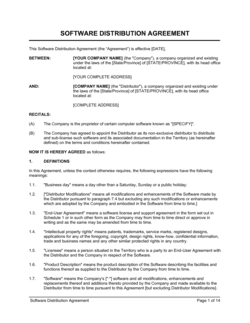
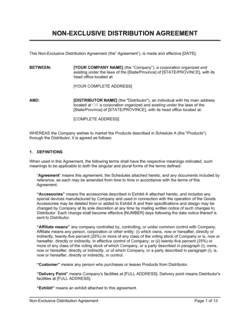
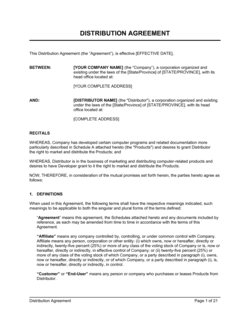
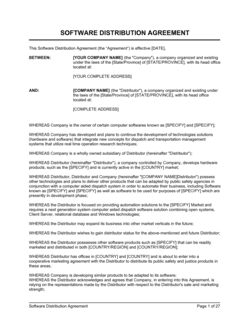
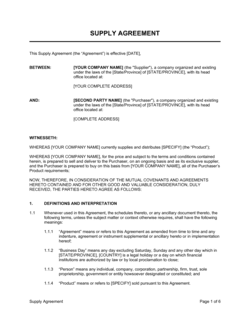
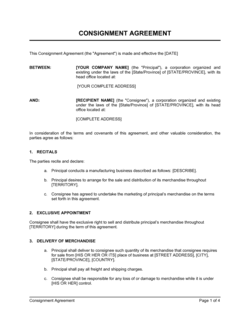
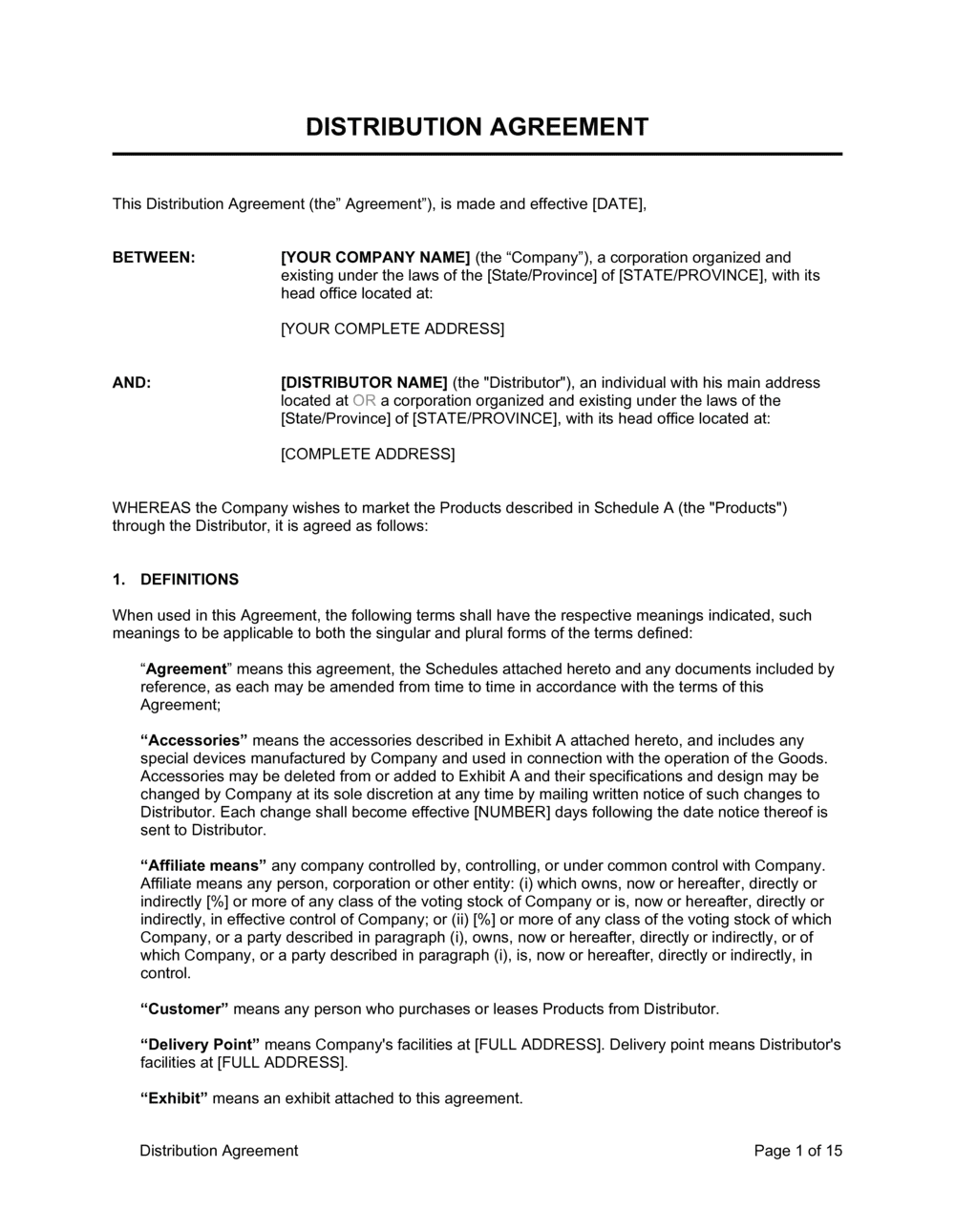
Distribution Agreement Template

Free Word download • Edit online • Save & share with Drive • Export to PDF

15 pages35–45 min to fillDifficulty: ComplexSignature requiredLegal review recommended
Learn more ↓
FreeDistribution Agreement Template

At a glance

What it is
A Distribution Agreement is a legally binding contract between a supplier and a distributor that authorizes the distributor to resell the supplier's products within a defined territory. This free Word download covers exclusivity, pricing, minimum purchase commitments, marketing support, IP licensing, term, and termination — giving both parties a clear, enforceable framework before the first order is placed.
When you need it
Use it whenever you appoint a third party to sell your products in a specific region, channel, or customer segment — whether you are a manufacturer expanding into new markets or a distributor formalizing a new supplier relationship. It is equally necessary for domestic channel partnerships and cross-border distribution arrangements.
What's inside
Territory definition and exclusivity grant, product scope and pricing terms, minimum purchase commitments and sales targets, marketing and promotional obligations, intellectual property licensing, confidentiality, term and renewal, and termination rights including post-termination inventory handling.

What is a Distribution Agreement?

A Distribution Agreement is a legally binding contract between a supplier and a distributor that authorizes the distributor to purchase and resell the supplier's products within a defined territory, under agreed commercial terms. It establishes whether the appointment is exclusive or non-exclusive, sets the transfer price and minimum purchase commitments, licenses the supplier's trademarks for promotional use, and defines what happens at the end of the relationship — including how unsold inventory is handled. Unlike a simple supply arrangement, a distribution agreement governs the entire commercial and legal framework of the channel relationship, giving both parties clear, enforceable rights before the first order ships.

Why You Need This Document

Operating a distributor relationship on a handshake or a purchase order chain creates four categories of serious risk. Without an agreed territory definition, distributors and suppliers routinely end up in disputes over cross-border online sales, grey-market product flows, and channel conflicts that erode margins on both sides. Without a minimum purchase commitment, exclusivity becomes a unilateral restriction on the supplier's sales freedom with no commercial return. Without clear termination and post-termination rules, a distributor holding six months of inventory when a relationship ends faces write-offs with no recourse — and suppliers face brand damage from a channel partner with nothing to lose. Without an IP license clause, the distributor may have no clear right to use your trademarks at all, or may continue using them long after the agreement ends. This template closes all four gaps, giving both parties a professionally structured framework that is ready to execute, adaptable to exclusivity or non-exclusivity, and aligned with standard commercial practice across the US, Canada, the UK, and the EU.

Which variant fits your situation?

If your situation is…Use this template
Granting one distributor sole rights in a defined territoryExclusive Distribution Agreement
Appointing multiple distributors in the same territoryNon-Exclusive Distribution Agreement
Engaging a sales agent who earns commission rather than buying for resaleSales Agency Agreement
Authorizing a party to manufacture and sell under your brandLicense Agreement
Supplying goods to a retailer for sale on consignmentConsignment Agreement
Wholesale supply without territorial or exclusivity restrictionsSupply Agreement
Appointing a master distributor who sub-appoints regional partnersMaster Distribution Agreement

Common mistakes to avoid

❌ Vague or channel-silent territory definition

Why it matters: Without clarity on whether online sales, cross-border orders, or specific channels are included, distributors and suppliers regularly end up in disputes over whether a sale was inside or outside the territory.

Fix: Define territory by named countries or states, specify whether e-commerce sales to customers in the territory are included, and add an active-versus-passive sales clause for cross-border situations.

❌ No ramp-up period on minimum purchase commitments

Why it matters: Requiring full MPC volumes from Month 1 ignores the 6–12 months a new distributor needs to establish channel coverage — setting the distributor up to miss targets and lose exclusivity before the relationship has a chance to develop.

Fix: Set Year 1 MPC at 50–60% of the steady-state annual commitment and increase to full volume in Year 2, with a mutual review of the MPC at each anniversary.

❌ Using 'best efforts' for marketing obligations

Why it matters: Courts in the US, UK, and Canada have interpreted 'best efforts' as near-absolute — meaning any deviation from maximum possible effort can constitute breach, even when commercial performance is strong.

Fix: Replace every instance of 'best efforts' with 'commercially reasonable efforts,' which is the accepted standard for discretionary performance obligations in commercial contracts.

❌ No post-termination sell-off period

Why it matters: A distributor holding 6 months of inventory when a contract is terminated without a sell-off right faces write-offs with no recourse — leading directly to arbitration or litigation over the termination itself.

Fix: Include a 90-day post-termination sell-off period and a supplier obligation to repurchase unsold inventory at transfer price if termination is without cause.

❌ Omitting a cure period for breach

Why it matters: Immediate termination rights for any breach — no matter how minor or disputed — destroy otherwise viable commercial relationships and are frequently challenged as unreasonable in arbitration.

Fix: Require written notice of breach and a 30-day cure period before termination rights arise, except for non-curable events such as insolvency or fraudulent conduct.

❌ Attempting to fix resale prices in the distributor's market

Why it matters: Resale price maintenance — requiring the distributor to sell at or above a specified end-customer price — is a per se antitrust violation in some jurisdictions and heavily regulated in others, exposing both parties to competition authority fines.

Fix: Limit pricing provisions to the transfer price (what the distributor pays the supplier) and use non-binding suggested retail price guidance rather than mandatory floor prices.

The 10 key clauses, explained

Appointment and territory

In plain language: Identifies the distributor, specifies whether the appointment is exclusive or non-exclusive, and defines the territory precisely by country, region, channel, or customer type.

Sample language
Supplier hereby appoints Distributor as its [exclusive / non-exclusive] distributor for the Products in [TERRITORY] (the 'Territory'), and Distributor accepts such appointment, subject to the terms of this Agreement.

Common mistake: Defining territory by vague language such as 'the region' without specifying countries, states, or channels — creating disputes about whether online sales into the territory constitute a breach.

Product scope and pricing

In plain language: Lists the specific products covered by the agreement, sets the transfer price or pricing formula, and establishes how and when prices may be revised.

Sample language
The Products covered by this Agreement are set out in Schedule A. Supplier shall sell Products to Distributor at the transfer prices listed in Schedule B, which may be revised by Supplier on not less than [60] days' written notice.

Common mistake: Omitting a price-change notice period — allowing the supplier to revise pricing immediately, which can render the distributor's existing customer contracts unprofitable overnight.

Minimum purchase commitments

In plain language: Sets the minimum quantity or dollar value of products the distributor must purchase in each contract year to retain the appointment — particularly important where exclusivity is granted.

Sample language
Distributor shall purchase a minimum of [QUANTITY / $VALUE] of Products during each Contract Year ('Minimum Purchase Commitment'). Failure to meet the MPC in any year shall entitle Supplier, at its option, to convert the appointment to non-exclusive or terminate on [30] days' notice.

Common mistake: Setting the MPC without accounting for ramp-up periods — requiring full-volume commitments from Month 1 when the distributor needs 6–12 months to build channel coverage.

Marketing, promotion, and sales targets

In plain language: Specifies the distributor's obligations to actively market the products, sets any annual sales targets, and defines what marketing support or co-op funds the supplier will provide.

Sample language
Distributor shall use commercially reasonable efforts to promote and sell the Products throughout the Territory. Supplier shall provide [MARKETING MATERIALS / CO-OP FUNDS OF $X PER YEAR]. Annual sales targets are set out in Schedule C and reviewed each [CONTRACT ANNIVERSARY].

Common mistake: Using 'best efforts' rather than 'commercially reasonable efforts' for marketing obligations — 'best efforts' has been interpreted by courts as a near-absolute obligation, exposing the distributor to breach claims for any underperformance.

Intellectual property license

In plain language: Grants the distributor a limited, non-transferable license to use the supplier's trademarks, trade names, and marketing materials solely to promote and sell the products in the territory.

Sample language
Supplier grants Distributor a non-exclusive, non-transferable, royalty-free license to use Supplier's trademarks and trade names solely for the purpose of promoting and selling the Products in the Territory during the term of this Agreement.

Common mistake: No restriction on sub-licensing or use after termination — allowing the distributor to continue using the supplier's brand in marketing materials indefinitely after the agreement ends.

Confidentiality

In plain language: Prohibits both parties from disclosing pricing, customer data, product roadmaps, and business information shared during the relationship to third parties.

Sample language
Each party agrees to keep confidential all Confidential Information received from the other party and not to disclose or use such information except as necessary to perform its obligations under this Agreement. This obligation survives termination for [3] years.

Common mistake: A one-sided confidentiality clause protecting only the supplier's information — distributors share market intelligence, customer lists, and pricing strategy that equally warrant protection.

Term and renewal

In plain language: Sets the initial contract duration, the mechanism for renewal (automatic, on notice, or by mutual agreement), and any conditions the distributor must satisfy to qualify for renewal.

Sample language
This Agreement shall commence on [START DATE] and continue for an initial term of [X] years ('Initial Term'). Thereafter, it shall renew automatically for successive [1-year] periods unless either party gives [90] days' written notice of non-renewal prior to the end of the then-current term.

Common mistake: Automatic renewal with a short notice window — a 30-day non-renewal notice buried in a multi-year agreement regularly causes unintended renewals when either party misses the deadline.

Termination rights

In plain language: Defines the events that allow either party to terminate — breach, insolvency, failure to meet MPCs, change of control — and the notice periods and cure rights that apply.

Sample language
Either party may terminate this Agreement immediately on written notice if the other party (a) commits a material breach and fails to cure within [30] days of notice; (b) becomes insolvent or enters into administration; or (c) undergoes a Change of Control without prior written consent.

Common mistake: No cure period for breach — allowing immediate termination for minor or disputed breaches, which destroys the commercial relationship and invites litigation over whether the breach was truly material.

Post-termination obligations

In plain language: Governs what happens to existing inventory, customer commitments, and trademark use after the agreement ends — including a sell-off period and any buy-back obligation.

Sample language
Upon expiry or termination, Distributor shall (a) cease using Supplier's trademarks within [30] days; (b) have [90] days to sell existing inventory at normal prices; and (c) upon Supplier's request, return or destroy any remaining inventory against a [CREDIT / REFUND] at the original transfer price.

Common mistake: No sell-off period at all, leaving the distributor with unsellable inventory and no recourse — a common source of post-termination disputes and arbitration claims.

Governing law and dispute resolution

In plain language: Specifies which jurisdiction's law governs the agreement and the mechanism — arbitration, mediation, or litigation — for resolving disputes.

Sample language
This Agreement is governed by the laws of [GOVERNING JURISDICTION]. Any dispute arising out of or in connection with this Agreement shall be finally resolved by binding arbitration administered by [ICC / AAA / LCIA] in [CITY], conducted in [LANGUAGE], except that either party may seek interim injunctive relief in any court of competent jurisdiction.

Common mistake: Choosing a governing law with no connection to either party's place of business, which can void the choice-of-law clause in some jurisdictions and leave the governing law uncertain.

How to fill it out

  1. 1

    Identify the parties and describe the relationship

    Enter the full legal names and registered addresses of the supplier and the distributor. Confirm whether the appointment is exclusive or non-exclusive before drafting the appointment clause.

    💡 Use registered entity names exactly as they appear on incorporation documents — a mismatch between the contract name and the signing entity can make the agreement unenforceable against the right party.

  2. 2

    Define the territory precisely

    Specify territory by country, state or province, named channel (e.g., e-commerce, retail, foodservice), or customer type. If online sales are intended, state explicitly whether they fall inside or outside the territory.

    💡 For cross-border agreements, add a clause confirming the distributor will not actively solicit or fulfill orders from outside the territory — passive sales rules differ significantly across the EU, US, and other jurisdictions.

  3. 3

    List the products and set the pricing structure

    Attach a Schedule A listing each product by SKU or product line, and a Schedule B setting out the transfer price per unit. Specify the notice period required to change prices and whether price increases are capped annually.

    💡 A 60-day minimum price-change notice period protects distributors who have already quoted customers; 90 days is the norm for consumer goods with seasonal purchase cycles.

  4. 4

    Set minimum purchase commitments and ramp-up periods

    Specify the annual MPC in units or dollar value and the consequence of missing it — conversion to non-exclusive, or termination on notice. Include a Year 1 ramp-up at 50–60% of full MPC to allow market development time.

    💡 Tie the MPC directly to the exclusivity grant — if exclusivity is the consideration for the MPC, state this explicitly so courts understand the bargain.

  5. 5

    Define marketing obligations and co-op support

    List the distributor's minimum marketing activities (trade shows, digital spend, sales team size) and the supplier's corresponding support commitments — marketing materials, co-op funds, or product training.

    💡 Replace 'best efforts' with 'commercially reasonable efforts' for all marketing obligations — the former sets an unworkably high standard that creates breach risk for normal underperformance.

  6. 6

    Draft the IP license and brand usage rules

    Grant a limited license for trademarks and marketing materials, specify approved uses and required brand guidelines, and state that the license terminates with the agreement.

    💡 Attach brand guidelines as a schedule rather than embedding them in the contract body — guidelines change annually and updating them should not require a contract amendment.

  7. 7

    Set the term, renewal mechanism, and notice windows

    Choose an initial term of 1–3 years for new distributor relationships. Set automatic renewal with a 90-day non-renewal notice window — short windows cause missed deadlines and unintended renewals.

    💡 Calendar a reminder 120 days before each renewal deadline as soon as the contract is signed — missed notice windows are one of the most common and costly distribution agreement mistakes.

  8. 8

    Specify termination triggers and post-termination inventory handling

    List termination triggers — material breach with a 30-day cure period, insolvency, change of control, and MPC failure. Confirm the post-termination sell-off period (typically 90 days) and whether unsold inventory is refundable.

    💡 A supplier buy-back obligation at transfer price for unsold inventory on termination significantly reduces distributor risk and is often the deciding factor in whether a strong distributor accepts the appointment.

Frequently asked questions

What is a distribution agreement?

A distribution agreement is a contract between a supplier and a distributor that authorizes the distributor to purchase and resell the supplier's products within a defined territory. It sets out the terms of the commercial relationship — including exclusivity, pricing, minimum purchase commitments, IP licensing, and termination rights — and creates enforceable obligations on both sides before the first order is placed.

What is the difference between an exclusive and a non-exclusive distribution agreement?

An exclusive distribution agreement grants one distributor the sole right to sell the supplier's products in a defined territory — the supplier commits not to appoint other distributors or sell directly in that territory. A non-exclusive agreement allows the supplier to appoint multiple distributors or sell directly alongside them. Exclusivity is almost always tied to a minimum purchase commitment to justify the supplier's restriction on its own sales freedom.

What is a minimum purchase commitment and why does it matter?

A minimum purchase commitment (MPC) is a contractual obligation requiring the distributor to buy a specified quantity or dollar value of products within each contract year. It matters because it is usually the commercial justification for granting exclusivity — the supplier gives up the right to sell to others in the territory in exchange for a guaranteed baseline volume. Failure to meet the MPC typically allows the supplier to convert the appointment to non-exclusive or terminate.

What should a distribution agreement include?

A complete distribution agreement should cover: the appointment and territory (exclusive or non-exclusive), products and transfer pricing, minimum purchase commitments, marketing and promotional obligations, IP licensing and brand usage, confidentiality, term and renewal mechanism, termination rights with cure periods, post-termination inventory handling, and governing law and dispute resolution. Omitting any of these areas creates gaps that courts fill with jurisdiction-specific defaults, which typically favor neither party as clearly as a well-drafted clause would.

Is a distribution agreement the same as an agency agreement?

No. A distributor buys products from the supplier and resells them at its own risk — taking title to the goods, setting its own resale prices, and bearing the inventory and credit risk. An agent never takes title; it introduces customers or negotiates contracts on the supplier's behalf and earns a commission on sales. The distinction matters significantly for tax, VAT, employment law, and competition law compliance.

Are exclusivity clauses in distribution agreements enforceable?

Yes, in most jurisdictions, exclusive territorial restrictions are generally enforceable when they are proportionate and time-limited. In the EU, however, vertical distribution agreements must comply with the Vertical Block Exemption Regulation — which permits exclusivity but restricts absolute territorial protection and prohibits hard-core restrictions such as fixed resale prices. In the US, exclusive dealing arrangements are assessed under a rule of reason, considering market share and the duration of the restriction.

Can a supplier fix the prices at which a distributor resells its products?

Generally, no. Resale price maintenance — requiring a distributor to sell at or above a specified minimum price — is a per se antitrust violation in the US under certain circumstances and heavily regulated under EU competition law. Suppliers can set recommended resale prices and maximum prices, but mandatory minimum or fixed resale prices expose both parties to competition authority fines. Transfer prices (what the supplier charges the distributor) are entirely within the supplier's control and raise no competition law concerns.

What happens to inventory when a distribution agreement is terminated?

Without specific contractual language, the outcome is uncertain and frequently litigated. A well-drafted agreement provides a 90-day post-termination sell-off period during which the distributor may sell existing inventory at normal prices, and a supplier obligation to repurchase unsold stock at the original transfer price if termination was without cause. These provisions protect the distributor's investment and reduce the financial disruption that often triggers post-termination disputes.

Do I need a lawyer to draft a distribution agreement?

For straightforward domestic arrangements with an established distributor, a high-quality template is usually a solid starting point. Legal review is strongly recommended for exclusive arrangements covering a significant territory, cross-border agreements involving EU competition law compliance, agreements with material minimum purchase commitments, or any arrangement where the supplier's brand or IP is central to the distributor's market position. A 2–4 hour template review by a commercial lawyer typically costs $600–$1,500 and is worthwhile given the multi-year financial commitments involved.

How this compares to alternatives

vs Sales Agency Agreement

A sales agent introduces customers or negotiates sales on the supplier's behalf, never taking title to goods and earning a commission rather than a margin. A distributor buys products outright, takes inventory and credit risk, and resells at its own price. The agent model reduces channel risk for the supplier; the distributor model scales faster because the distributor funds its own inventory.

vs Supply Agreement

A supply agreement governs the ongoing purchase and sale of goods between supplier and buyer but does not grant distribution rights, territorial exclusivity, or resale obligations. A distribution agreement builds on a supply relationship by adding territory, exclusivity, marketing commitments, and brand licensing. If resale, territory, and channel control matter, the distribution agreement is the appropriate document.

vs License Agreement

A license agreement grants the licensee the right to use the licensor's IP — trademark, patent, or know-how — typically to manufacture or create derivative works, not merely to resell finished goods. A distribution agreement grants a narrower resale right bundled with a limited trademark license for promotional use. If the party will manufacture under your brand or process, a license or franchise agreement is more appropriate.

vs Consignment Agreement

Under a consignment arrangement, the supplier retains title to goods until the end-customer sale occurs, and the consignee remits proceeds minus a commission. Under a distribution agreement, the distributor purchases goods outright and takes full title and risk. Consignment suits high-value or slow-moving inventory; distribution suits faster-moving products where the supplier prefers upfront payment and the distributor accepts inventory risk.

Industry-specific considerations

Consumer goods and FMCG

Shelf-placement obligations, promotional compliance, sell-through deadlines tied to product shelf life, and co-op advertising fund structures are standard additions.

Technology hardware and electronics

Channel tier structures, authorized reseller certification requirements, warranty pass-through obligations, and restrictions on bundling with competing products are common.

Food and beverage

Temperature-controlled distribution requirements, import and food safety certification obligations, country-of-origin labeling compliance, and short sell-off windows tied to perishability.

Industrial and manufacturing

Technical training and certification requirements for distributor staff, spare-parts stocking obligations, warranty service authorization, and safety compliance documentation.

Jurisdictional notes

United States

US distribution agreements are governed primarily by state contract and UCC Article 2 principles. Exclusive dealing arrangements are assessed under a rule of reason under federal antitrust law — market share and duration are the key factors. Several states, including New Jersey and Wisconsin, have dealer protection statutes that limit a supplier's right to terminate or non-renew a distributor without good cause and advance notice, regardless of what the contract says. Resale price maintenance (minimum resale prices) can constitute a per se antitrust violation under certain circumstances following the Leegin decision.

Canada

Canadian distribution agreements are governed by provincial contract law, with Quebec following civil law principles that differ from the common-law provinces. The Competition Act governs exclusive dealing, tied selling, and market restriction arrangements — exclusive distribution is generally permissible but may be reviewable if it substantially lessens competition. Quebec's Civil Code imposes good faith obligations on both parties throughout the contract lifecycle. There is no federal dealer protection statute equivalent, but court-implied duties of good faith can limit abrupt termination.

United Kingdom

Following Brexit, UK distribution agreements are no longer governed by EU Vertical Block Exemption Regulations — the UK has adopted its own Vertical Agreements Block Exemption Order 2022 (VABEO), which largely mirrors the EU framework but applies only to agreements affecting UK markets. Exclusive territorial restrictions and selective distribution systems are permissible within the VABEO's safe harbor, provided market share thresholds are met. Commercial agents, if used, are protected by the Commercial Agents Regulations 1993, which grant compensation or indemnity rights on termination.

European Union

EU distribution agreements must comply with the Vertical Block Exemption Regulation (VBER 2022), which provides a safe harbor for vertical agreements where both supplier and distributor hold less than 30% market share. The VBER permits exclusive territories and customer restrictions but prohibits hard-core restrictions including minimum resale prices, absolute territorial protection that prevents passive sales between EU member states, and restrictions on internet sales. GDPR applies if customer data is shared between the parties. Agreements falling outside the safe harbor must be individually assessed for compatibility with Article 101 TFEU.

Template vs lawyer — what fits your deal?

PathBest forCostTime
Use the templateDomestic non-exclusive arrangements with established distributors for straightforward product linesFree1–2 hours
Template + legal reviewExclusive arrangements, cross-border agreements, or deals with significant minimum purchase commitments and IP exposure$600–$1,5003–5 days
Custom draftedMulti-territory master distribution networks, EU competition law compliance, regulated product categories, or distributor arrangements central to the business model$2,500–$8,000+2–4 weeks

Glossary

Territory
The geographic region, sales channel, or customer segment within which the distributor is authorized to sell the supplier's products.
Exclusive Distribution
An arrangement in which the supplier commits not to appoint any other distributor — or sell directly — within the defined territory during the agreement term.
Non-Exclusive Distribution
An arrangement in which the supplier retains the right to appoint additional distributors or sell directly in the same territory alongside the distributor.
Minimum Purchase Commitment (MPC)
A contractual obligation requiring the distributor to purchase a specified quantity or dollar value of products within a defined period, typically used to justify exclusivity.
Transfer Price
The price at which the supplier sells products to the distributor, distinct from the end-customer price the distributor charges in its market.
Resale Price Maintenance (RPM)
A supplier's attempt to control the prices at which a distributor resells products — generally prohibited or restricted under competition law in most jurisdictions.
Shelf Life / Sell-Through Obligation
A requirement for the distributor to sell existing inventory within a specified period, often triggered by contract expiry or product discontinuation.
Grey Market
The unauthorized import or resale of genuine products outside the territory for which they were intended, undermining territorial exclusivity.
Right of First Refusal
A contractual right giving the distributor the opportunity to match any competing offer before the supplier appoints a new distributor in the territory.
Termination for Convenience
A right allowing either party to end the agreement without cause by giving a specified notice period, as distinct from termination for breach or cause.
Post-Termination Tail
A defined period after contract expiry during which the distributor may sell remaining inventory and the supplier may not appoint a replacement in the territory.
Parallel Import
A genuine product imported into a territory by a party other than the authorized distributor, typically to exploit price differentials across markets.

Part of your Business Operating System

This document is one of 3,000+ business & legal templates included in Business in a Box.

  • Fill-in-the-blanks — ready in minutes
  • 100% customizable Word document
  • Compatible with all office suites
  • Export to PDF and share electronically

Create your document in 3 simple steps.

From template to signed document — all inside one Business Operating System.
1
Download or open template

Access over 3,000+ business and legal templates for any business task, project or initiative.

2
Edit and fill in the blanks with AI

Customize your ready-made business document template and save it in the cloud.

3
Save, Share, Send, Sign

Share your files and folders with your team. Create a space of seamless collaboration.

Save time, save money, and create top-quality documents.

★★★★★

"Fantastic value! I'm not sure how I'd do without it. It's worth its weight in gold and paid back for itself many times."

Managing Director · Mall Farm
Robert Whalley
Managing Director, Mall Farm Proprietary Limited
★★★★★

"I have been using Business in a Box for years. It has been the most useful source of templates I have encountered. I recommend it to anyone."

Business Owner · 4+ years
Dr Michael John Freestone
Business Owner
★★★★★

"It has been a life saver so many times I have lost count. Business in a Box has saved me so much time and as you know, time is money."

Owner · Upstate Web
David G. Moore Jr.
Owner, Upstate Web

Run your business with a system — not scattered tools

Stop downloading documents. Start operating with clarity. Business in a Box gives you the Business Operating System used by over 250,000 companies worldwide to structure, run, and grow their business.

Free Forever Plan · No credit card required