Employee Referral Program Policy Template

Free Word download β€’ Edit online β€’ Save & share with Drive β€’ Export to PDF

3 pagesβ€’20–25 min to fillβ€’Difficulty: Standard
Learn more ↓
FreeEmployee Referral Program Policy Template

At a glance

What it is
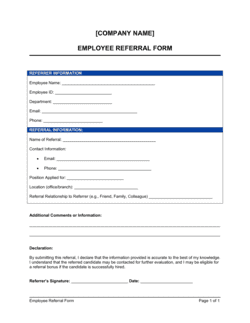
An Employee Referral Program Policy is an internal HR document that defines how employees can recommend candidates for open roles, what bonuses are available, who is eligible to refer, and when and how bonuses are paid. This free Word download gives you a ready-to-edit structure you can customize with your own bonus amounts, eligibility rules, and referral submission process, then export as PDF for your employee handbook or intranet.
When you need it
Use it when your company is scaling headcount and wants to formalize an ad-hoc referral culture into a documented, consistently administered program. It is also essential before launching or relaunching a referral bonus to ensure employees, HR, and payroll are aligned on the same rules.
What's inside
Program purpose and scope, employee eligibility criteria, referral submission process, candidate eligibility requirements, bonus structure and amounts by role tier, payout schedule and conditions, tax treatment guidance, and program administration responsibilities.

What is an Employee Referral Program Policy?

An Employee Referral Program Policy is an internal HR document that formalizes the process by which employees recommend external candidates for open positions and receive a cash bonus when their referral is hired and meets a defined retention threshold. It establishes who is eligible to refer, which candidates qualify, how submissions must be submitted and tracked, what bonus amounts apply at each role tier, when and how bonuses are paid, and how disputes β€” such as duplicate referrals β€” are resolved. Without a written policy, referral bonuses are distributed inconsistently, disputes go unresolved, and the program's motivational impact fades quickly.

Why You Need This Document

Companies without a documented referral policy consistently overpay agency fees for roles that their own employees could fill β€” and then wonder why an informal referral culture isn't generating results. A formal policy does three things at once: it removes ambiguity so employees know exactly what to do and what to expect; it protects HR from bonus disputes when two employees claim credit for the same hire; and it gives payroll the tax withholding language it needs to process bonuses correctly. Referral hires typically onboard faster, perform better in their first year, and stay longer than hires sourced through job boards or agencies β€” but only when employees are genuinely motivated to refer. A clear, consistently enforced policy with meaningful, well-structured bonus amounts is what turns occasional word-of-mouth into a reliable sourcing channel.

Which variant fits your situation?

If your situation is…Use this template
Company with tiered bonuses based on role seniority or hard-to-fill positionsTiered Employee Referral Program Policy
Small business with a simple flat referral bonus for all rolesEmployee Referral Program Policy (Standard)
Organization that wants a full internal recruitment policy covering all sourcing channelsRecruitment Policy
Company documenting the end-to-end hiring process including referralsHiring Process SOP
HR team building a complete employee handbook that embeds referral program rulesEmployee Handbook
Company using a referral program specifically to support a diversity hiring initiativeDiversity Recruiting Policy

Common mistakes to avoid

❌ No formal submission channel or timestamp

Why it matters: Without a documented, timestamped submission process, two employees can both claim credit for the same candidate with no objective way to resolve the dispute β€” creating lasting resentment.

Fix: Designate a single submission path (ATS portal or dedicated email) and confirm it logs a timestamp before the policy goes live.

❌ Flat bonus regardless of role seniority

Why it matters: A $500 bonus for a senior engineer referral that would have cost $20,000 through an agency motivates almost no one β€” and signals that leadership has not thought through the program's economics.

Fix: Set tiered bonus amounts benchmarked at 5–10% of the role's annual salary, with elevated amounts for roles on a hard-to-fill list updated quarterly.

❌ Single payout at 6 or 12 months retention

Why it matters: When the reward is 6–12 months away, employees stop connecting their referral action to the eventual payout, and participation rates drop sharply after the first few months.

Fix: Split the bonus into two installments β€” 50% at hire and 50% at 90 days β€” to maintain incentive momentum without eliminating a retention check.

❌ Not reserving the right to amend bonus amounts

Why it matters: A bonus amount written into a policy with no amendment clause can be interpreted as a standing promise, limiting your ability to adjust when hiring priorities or budgets change.

Fix: Include an explicit clause stating the company may amend or suspend the program with 30 days' notice, and communicate any changes through the same channel used to announce the original policy.

❌ Omitting tax withholding disclosure

Why it matters: Employees who expect a gross $1,000 bonus and receive $703 after withholding often file HR complaints, damaging trust in the program and in HR generally.

Fix: State clearly in the policy that the bonus is a taxable supplemental wage, subject to income tax and payroll tax withholding, with a worked example showing approximate net amounts.

❌ No conflict-of-interest exclusion for hiring managers

Why it matters: A manager who financially benefits from referring a candidate they also evaluate and select faces a direct conflict of interest that can compromise hiring quality and expose the company to bias claims.

Fix: Explicitly exclude the direct hiring manager for each specific requisition from earning a referral bonus for that role β€” while keeping them eligible to refer for other open positions.

The 9 key sections, explained

Program purpose and scope

Employee eligibility to refer

Candidate eligibility requirements

Referral submission process

Referral bonus structure

Payout schedule and conditions

Tax treatment and payroll processing

Duplicate and disputed referrals

Program administration and amendments

How to fill it out

  1. 1

    Define program scope and effective date

    Enter your company's legal name, the business units or locations covered, and the date the policy takes effect. If rolling out to a specific division first, name it explicitly.

    πŸ’‘ If you have contractor or temporary worker populations, decide upfront whether they can refer β€” and document that decision, even if the answer is no.

  2. 2

    Set eligibility rules for referrers

    Specify which employee groups are excluded from submitting referrals. At minimum, exclude HR recruiters handling active requisitions and the direct hiring manager for each open role.

    πŸ’‘ Consider excluding employees in their first 60–90 days β€” new hires who refer before they understand the company culture often submit lower-quality candidates.

  3. 3

    Define candidate eligibility criteria

    State that candidates must be external, not already in your ATS within a defined lookback window, and not a recent contractor or agency placement. Set the specific time windows in months.

    πŸ’‘ A 12-month ATS lookback is the most common standard β€” long enough to catch recent applicants, short enough not to penalize candidates who applied well before the current opening.

  4. 4

    Set the referral submission channel

    Name the exact tool or process employees must use β€” your ATS portal, a dedicated email address, or an HR intake form. Make the submission channel a single, documented path.

    πŸ’‘ Add a timestamping mechanism to every submission channel before launch. Without timestamps, you cannot resolve duplicate referral disputes fairly.

  5. 5

    Fill in the bonus amounts by role tier

    Enter dollar amounts for each tier you define β€” individual contributor, manager, director, and any hard-to-fill roles. Cross-reference your average agency fee for equivalent roles as a ceiling check.

    πŸ’‘ A referral bonus set at 5–10% of the role's annual salary is a common benchmark that balances employee incentive with cost savings versus agency fees.

  6. 6

    Configure the payout schedule and retention conditions

    Decide whether to pay in one installment or two (typically at hire and at 90 days). Enter the exact retention period in days and the forfeiture condition if either party leaves before the period ends.

    πŸ’‘ Two-installment structures increase program participation by about 20% compared to single-payout structures with long retention windows, according to SHRM benchmarking data.

  7. 7

    Add tax and payroll language

    Confirm that bonuses are processed through payroll, identify the applicable withholding method (flat supplemental rate in the US is 22%), and note that amounts will appear on the employee's year-end tax form.

    πŸ’‘ Add a concrete example β€” 'A $1,000 bonus subject to 22% federal withholding and 7.65% FICA results in an approximate net payment of $703' β€” so employees are not surprised at payout.

  8. 8

    Reserve amendment rights and publish to employees

    Confirm the program administrator's contact details, add a clause reserving the right to amend or discontinue with notice, and post the finalized policy to your intranet or employee handbook.

    πŸ’‘ Send a brief announcement email when the policy goes live β€” programs that are actively communicated at launch generate 3–4 times more referrals in the first quarter than those quietly added to the handbook.

Frequently asked questions

What is an employee referral program policy?

An employee referral program policy is an internal HR document that formalizes how employees can recommend external candidates for open positions, what bonus amounts are available, who is eligible to refer, and when and under what conditions the bonus is paid. It replaces ad-hoc referral arrangements with a consistent, documented process that HR, payroll, and employees all work from.

How much should a referral bonus be?

A commonly used benchmark is 5–10% of the referred hire's annual base salary. For individual contributor roles, this typically falls in the $500–$2,000 range; for manager and director-level roles, $2,000–$5,000 is more common. Hard-to-fill technical or specialist roles often carry elevated bonuses of $5,000 or more. The bonus should be meaningful enough to motivate action but still represent a clear saving compared to the equivalent agency fee.

Who is typically excluded from earning a referral bonus?

Most policies exclude HR recruiters and talent acquisition staff actively working on the requisition, the direct hiring manager for the specific open role, employees in their first 60–90 days of employment, and senior executives in some programs. These exclusions address conflicts of interest and ensure the program is accessible to the broad employee population it is designed to incentivize.

When should the referral bonus be paid?

The most common and effective structure is a two-installment payout: 50% on the referred hire's first day and 50% upon completion of a retention period of 60–90 days. Single-payment structures tied to a 6- or 12-month retention period significantly reduce program participation because the reward feels too distant from the referring action.

Are employee referral bonuses taxable?

Yes, in most jurisdictions referral bonuses are taxable income. In the United States, they are classified as supplemental wages and subject to federal income tax withholding (typically at the 22% flat supplemental rate), Social Security, and Medicare. They appear on the employee's W-2 at year end. Similar treatment applies in Canada (T4) and the UK (P60). The policy should disclose this clearly so employees are not surprised by the net payout amount.

What happens if two employees refer the same candidate?

The policy should specify that the bonus goes to the employee whose referral submission was received and timestamped first in the company's ATS or designated submission channel. Without a clear tie-breaking rule documented in advance, duplicate referral disputes are difficult to resolve fairly and can create lasting friction between employees and HR.

Can a contractor or temporary worker earn a referral bonus?

This depends on how the policy is written. Many companies limit referral bonuses to full-time and part-time employees on payroll and exclude contractors, because the bonus is paid through payroll and requires an employment relationship for tax withholding purposes. If you wish to include contractors, the policy should state this explicitly and address how the payment will be processed and reported.

How often should the referral bonus amounts be reviewed?

Bonus amounts should be reviewed at least annually, typically during the compensation planning cycle, and updated whenever time-to-fill data shows specific roles consistently going unfilled. A hard-to-fill designation list reviewed quarterly keeps elevated bonuses targeted at genuine recruiting bottlenecks rather than permanently inflating costs for roles that are no longer difficult to source.

How this compares to alternatives

vs Recruitment Policy

A recruitment policy covers the entire hiring process β€” job requisition approval, sourcing channels, interviewing standards, offer approval, and onboarding. An employee referral program policy is a focused sub-document that governs one specific sourcing channel. Many companies embed the referral policy within or alongside a broader recruitment policy.

vs Employee Handbook

An employee handbook is a comprehensive reference covering all workplace policies β€” conduct, benefits, leave, and HR procedures. A referral program policy is typically a standalone document that is either embedded in the handbook or linked from it. Using a standalone policy makes it easier to update bonus amounts without republishing the entire handbook.

vs Incentive Compensation Plan

An incentive compensation plan governs variable pay tied to individual or company performance metrics β€” sales commissions, profit-sharing, or annual bonuses. A referral program policy governs a one-time payment for a specific action (referring a hire) with no ongoing performance linkage. They are separate documents with different eligibility rules and payout triggers.

vs Job Offer Letter

A job offer letter is an external document sent to a candidate to confirm employment terms. A referral program policy is an internal policy governing the referring employee's bonus entitlement. The two documents operate on different sides of the same hire β€” the offer letter governs the new hire's terms; the referral policy governs the existing employee's reward.

Industry-specific considerations

Technology / SaaS

Elevated bonuses for engineering and product roles, which often carry agency fees of $20,000–$40,000, make referral programs especially high-ROI in tech companies.

Healthcare

Credential and licensing verification requirements for referred clinical candidates must be built into the eligibility section to avoid bonus disputes when a candidate clears interview but fails credentialing.

Professional Services

Client conflict-of-interest checks are a standard eligibility condition β€” a referred candidate who has worked for a major client may trigger ethical review before the hire can proceed.

Retail / Hospitality

High turnover means retention-period payout conditions must be calibrated carefully β€” 90-day retention windows are more realistic than 6-month windows in industries where average tenure is under a year.

Template vs pro β€” what fits your needs?

PathBest forCostTime
Use the templateSMBs and startups formalizing a referral program for the first time in a single locationFree1–2 hours to customize and launch
Template + professional reviewCompanies with multi-state or multi-country workforces or regulated industries requiring a compliance check$200–$500 (HR consultant or employment attorney review)2–5 business days
Custom draftedLarge enterprises integrating the referral policy with an ATS workflow, tiered compensation bands, and a formal DE&I sourcing strategy$1,000–$3,000 (HR consultant or specialist)2–4 weeks

Glossary

Referral Bonus
A cash payment made to an employee whose referred candidate is successfully hired and completes a defined retention period.
Retention Period
The minimum length of time a referred hire must remain employed β€” typically 30 to 180 days β€” before the referring employee receives the bonus payout.
Eligible Referrer
An employee who meets the program's criteria to submit a referral, typically excluding HR staff, direct hiring managers, and senior executives for a given requisition.
Active Requisition
An open job posting that has been formally approved for hiring and is currently accepting candidates.
Cost Per Hire
The total recruiting spend divided by the number of hires in a period, used to benchmark referral program savings against agency or job-board costs.
Duplicate Referral
A candidate submission where the same person has already been referred by another employee or is already in the applicant tracking system β€” typically resolved by awarding priority to the first submission.
Applicant Tracking System (ATS)
Software used to post jobs, collect applications, and manage candidate pipelines; the system of record for logging and tracking referral submissions.
Supplemental Wage
In the US, referral bonuses are classified as supplemental wages subject to federal income tax withholding, Social Security, and Medicare β€” typically withheld at the 22% flat rate.
Program Administrator
The HR or talent acquisition team member responsible for receiving referral submissions, confirming eligibility, tracking outcomes, and coordinating bonus payments with payroll.
Hard-to-Fill Role
A position with specialized requirements, long average time-to-fill, or persistent vacancy that often carries an elevated referral bonus to accelerate sourcing.

Part of your Business Operating System

This document is one of 3,000+ business & legal templates included in Business in a Box.

  • Fill-in-the-blanks β€” ready in minutes
  • 100% customizable Word document
  • Compatible with all office suites
  • Export to PDF and share electronically

Create your document in 3 simple steps.

From template to signed document β€” all inside one Business Operating System.
1
Download or open template

Access over 3,000+ business and legal templates for any business task, project or initiative.

2
Edit and fill in the blanks with AI

Customize your ready-made business document template and save it in the cloud.

3
Save, Share, Send, Sign

Share your files and folders with your team. Create a space of seamless collaboration.

Save time, save money, and create top-quality documents.

β˜…β˜…β˜…β˜…β˜…

"Fantastic value! I'm not sure how I'd do without it. It's worth its weight in gold and paid back for itself many times."

Managing Director Β· Mall Farm
Robert Whalley
Managing Director, Mall Farm Proprietary Limited
β˜…β˜…β˜…β˜…β˜…

"I have been using Business in a Box for years. It has been the most useful source of templates I have encountered. I recommend it to anyone."

Business Owner Β· 4+ years
Dr Michael John Freestone
Business Owner
β˜…β˜…β˜…β˜…β˜…

"It has been a life saver so many times I have lost count. Business in a Box has saved me so much time and as you know, time is money."

Owner Β· Upstate Web
David G. Moore Jr.
Owner, Upstate Web

Run your business with a system β€” not scattered tools

Stop downloading documents. Start operating with clarity. Business in a Box gives you the Business Operating System used by over 250,000 companies worldwide to structure, run, and grow their business.

Free Forever PlanΒ Β·Β No credit card required