Co-Habitation Agreement Template

Free Word download β€’ Edit online β€’ Save & share with Drive β€’ Export to PDF

5 pagesβ€’25–35 min to fillβ€’Difficulty: Complexβ€’Signature requiredβ€’Legal review recommended
Learn more ↓
FreeCo-Habitation Agreement Template

At a glance

What it is
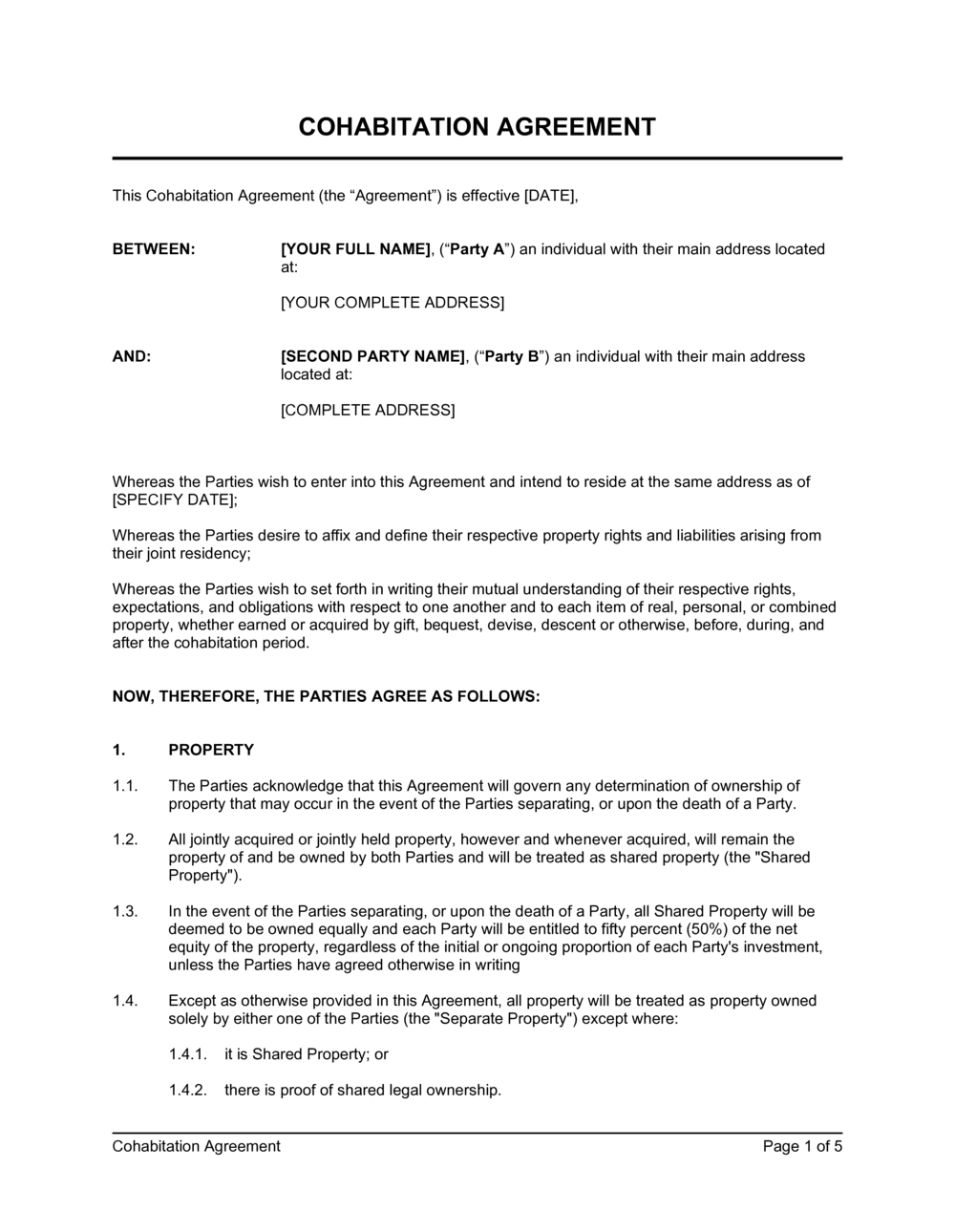
A Co-Habitation Agreement is a legally binding contract between two unmarried people who live together, setting out how they will manage finances, property, shared expenses, and obligations β€” and what happens to each if the relationship ends. This free Word download lets you customize terms for your living arrangement, edit online, and export as PDF for execution before or after moving in together.
When you need it
Use it before or shortly after moving in together when neither party is married and both want written clarity on property ownership, bill splitting, and separation rights. It is especially important when one partner owns the home, when significant assets are brought into the relationship, or when one partner will be financially supporting the other.
What's inside
Property ownership and contributions, shared living expenses and payment responsibilities, bank accounts and joint financial obligations, personal property identification, support arrangements, dispute resolution, and what happens to jointly acquired assets upon separation.

What is a Co-Habitation Agreement?

A Co-Habitation Agreement is a legally binding contract between two unmarried partners who share a residence, setting out each person's rights and obligations regarding property, finances, shared expenses, and what happens to jointly held assets if the relationship ends. Unlike a marriage or registered civil partnership, living together creates no automatic legal framework in most jurisdictions β€” meaning that without a written agreement, each partner's financial exposure and property entitlements are governed by default rules that rarely match what either person intended. A properly executed co-habitation agreement fills that gap, functioning as the practical equivalent of a prenuptial agreement for couples who choose to live together without marrying.

Why You Need This Document

Cohabiting couples who separate without a written agreement face some of the most unpredictable outcomes in family law. In most US states, each partner keeps only what is in their own name β€” leaving a financially dependent partner with nothing after years of shared contributions. In Canada, long-term cohabiting partners may acquire spousal-level property and support rights that neither anticipated. In England and Wales, there is no common-law marriage regardless of how long the couple lived together, and disputes over jointly used property end up as expensive civil litigation. A non-owning partner who contributed to a mortgage can sue for a beneficial interest under resulting trust doctrines, with outcomes that are difficult to predict and costly to litigate. This template closes those gaps before they become disputes β€” establishing clear ownership of separate property, an agreed expense-sharing formula, homeownership terms, and a workable separation process β€” so both partners know exactly where they stand from day one.

Which variant fits your situation?

If your situation is…Use this template
Two unmarried partners moving into a jointly rented apartmentCo-Habitation Agreement (Renters)
One partner owns the property and the other moves inCo-Habitation Agreement (Owner-Occupier)
Couple purchasing a home together without marryingJoint Property Ownership Agreement
Partners who also run a business togetherDomestic Partnership and Business Agreement
Couple wanting a document closer to a prenuptial agreementPrenuptial Agreement
Couple in a registered domestic partnership jurisdictionDomestic Partnership Agreement
Couple separating and dividing shared propertySeparation Agreement

Common mistakes to avoid

❌ Signing without financial disclosure

Why it matters: Courts in Canada, the UK, and many US states treat full financial disclosure as a precondition for enforceability. An agreement signed without it can be set aside entirely, leaving both partners exposed to default jurisdiction rules.

Fix: Attach a schedule listing each partner's assets, liabilities, and income before signing, and have both partners acknowledge receipt of the other's disclosure in the agreement body.

❌ Omitting the homeownership clause when one partner owns the property

Why it matters: Without explicit language, a non-owning partner who contributes to mortgage payments or renovations may successfully claim a beneficial interest under resulting trust or unjust enrichment doctrines β€” potentially for a significant share of the home's equity.

Fix: Include a clause stating clearly whether housing contributions create an equity interest or are payments for occupancy only. If equity sharing is intended, document the agreed formula.

❌ No separation vacating timeline

Why it matters: Evicting a live-in partner after a relationship breakdown can be legally complex β€” in many jurisdictions, a cohabiting partner has residential rights regardless of whose name is on the lease or title, and the process can take months.

Fix: Agree in advance on a specific number of days within which the departing partner will vacate, and which partner that will be. This single clause prevents some of the most contentious post-separation disputes.

❌ Using vague language on shared expenses

Why it matters: A clause that says 'expenses shall be shared fairly' or 'split equally' without defining which expenses are covered leaves enormous room for disagreement β€” partners routinely have different mental lists of what counts as a household expense.

Fix: List the specific expense categories (rent/mortgage, utilities, groceries, home maintenance, streaming services, pet costs) and the split formula for each, or group them with a clear definition of 'household expenses.'

❌ No independent legal advice for either partner

Why it matters: A cohabitation agreement signed by one or both partners without independent legal advice is the single most common ground on which courts set these agreements aside β€” particularly if the terms are later claimed to be unconscionable or signed under pressure.

Fix: Have each partner review the draft with their own separate lawyer before execution. A one-hour legal review per person ($150–$400) is inexpensive insurance against a voided agreement.

❌ Never updating the agreement after major financial changes

Why it matters: An agreement drafted when both partners rented an apartment becomes dangerously incomplete when one later inherits property, one stops working, or the couple purchases a home together. Stale agreements create gaps courts fill with default rules.

Fix: Build a review clause requiring both parties to revisit the agreement every two years or within 60 days of any material financial change β€” property purchase, inheritance, significant income shift, or the birth of a child.

The 10 key clauses, explained

Parties and recitals

In plain language: Identifies both partners by their full legal names, confirms they are not married to each other, states the address of the shared residence, and records the date cohabitation commenced.

Sample language
This Co-Habitation Agreement is entered into on [DATE] between [PARTNER 1 FULL NAME] ('Partner 1') and [PARTNER 2 FULL NAME] ('Partner 2'), who are not married to each other and have been cohabiting at [ADDRESS] since [START DATE].

Common mistake: Using a nickname or shortened name instead of the legal name. A mismatch with government ID can complicate enforcement, particularly for property-related provisions.

Financial disclosure

In plain language: Records that both partners have disclosed their respective assets, liabilities, and income to each other before signing, which supports the agreement's enforceability.

Sample language
Each party has disclosed to the other a fair and accurate summary of their respective assets and liabilities as set out in Schedule A (Partner 1) and Schedule B (Partner 2), attached hereto and incorporated by reference.

Common mistake: Skipping financial disclosure entirely. Courts in Canada, the UK, and several US states have voided cohabitation agreements where one party withheld material financial information.

Separate property

In plain language: Lists each partner's pre-existing assets that remain their sole property during and after cohabitation β€” including real estate, savings, investments, and personal property.

Sample language
Each party's separate property is set out in Schedule C. Separate property shall remain the sole property of the owning party and shall not become joint property by reason of cohabitation alone. Any increase in value of separate property during cohabitation shall also remain separate.

Common mistake: Failing to schedule separate property by item. A general statement that 'all prior assets remain separate' without an itemized schedule is difficult to enforce when a specific asset is disputed.

Jointly acquired property

In plain language: Defines how property purchased together during cohabitation is owned β€” specifying the percentage each partner holds and whether title is held as joint tenants or tenants in common.

Sample language
Property acquired jointly during cohabitation shall be owned as tenants in common in the proportions [PARTNER 1 %] / [PARTNER 2 %] unless a separate written agreement specifies otherwise at the time of purchase.

Common mistake: Defaulting to 50/50 without reflecting actual contribution ratios. When one partner contributes more to the purchase price, a 50/50 split can constitute an unintended gift and create tax or estate complications.

Shared living expenses

In plain language: Sets out how ongoing household costs β€” rent or mortgage, utilities, groceries, and maintenance β€” are divided between the partners.

Sample language
Monthly household expenses shall be divided as follows: [PARTNER 1] shall contribute [X]% and [PARTNER 2] shall contribute [Y]%, payable by the [DAY] of each month into the joint household account [ACCOUNT DETAILS]. Shared expenses include rent/mortgage, utilities, groceries, and home maintenance.

Common mistake: Leaving expense allocation vague by writing 'shared equally' without defining which expenses are included. Disputes about whether a streaming subscription or a home repair counts as a shared expense are extremely common.

Personal finances and separate accounts

In plain language: Confirms that income earned by each partner remains their own property, addresses whether joint bank accounts are used, and limits each partner's liability for the other's personal debts.

Sample language
Each party's individual income shall remain their separate property. Neither party shall be liable for the personal debts, loans, or credit obligations of the other incurred before or during cohabitation, unless both parties have signed the relevant obligation.

Common mistake: No clause on debt liability. Without it, a partner may face creditor claims based on informal financial interdependence β€” particularly for jointly held bank accounts or credit cards.

Homeownership provisions (owner-occupier)

In plain language: Addresses the situation where one partner owns the home. Specifies whether the non-owning partner's rent-equivalent payments build any equity entitlement, and confirms the owner's right to the property on separation.

Sample language
Partner 1 is the sole registered owner of the property at [ADDRESS]. Partner 2's monthly contribution of $[AMOUNT] toward housing costs constitutes a payment for occupancy only and does not create any ownership, equity, or beneficial interest in the property.

Common mistake: Omitting this clause when one partner owns the home. Without it, courts applying resulting trust or unjust enrichment doctrines may award the non-owning partner a beneficial interest based on their financial contributions.

Support and financial assistance

In plain language: Addresses whether either partner will provide financial support to the other during cohabitation or following separation β€” and if so, in what amount and for how long.

Sample language
The parties agree that [PARTNER 1 / neither party] shall pay support to [PARTNER 2 / the other party] in the amount of $[AMOUNT] per [month/week] for a period of [DURATION] in the event of separation, or as otherwise agreed in writing at the time of separation.

Common mistake: Promising open-ended support without a defined duration or cap. In jurisdictions that recognize cohabitation support obligations, an undefined commitment can expose the paying partner to claims far beyond their intent.

Separation and division of assets

In plain language: Sets out the process for separating finances and property if the relationship ends β€” including timelines, who vacates the shared home, and how jointly owned assets are valued and divided.

Sample language
Upon separation, the parties shall, within [30/60] days: (a) divide joint accounts equally or per contribution ratios in Schedule D; (b) agree on a buyout price for jointly owned property, failing which the property shall be listed for sale at fair market value; (c) [PARTNER 1 / the non-owning party] shall vacate the residence within [X] days.

Common mistake: No vacating timeline for a rented or jointly occupied home. Without one, either partner can remain indefinitely β€” and eviction of a live-in partner can be legally complex in many jurisdictions.

Dispute resolution and governing law

In plain language: Specifies whether disputes go to mediation, arbitration, or court, and which jurisdiction's law governs the agreement.

Sample language
This Agreement is governed by the laws of [STATE/PROVINCE/COUNTRY]. Any dispute arising under this Agreement shall first be submitted to mediation with a mutually agreed mediator before either party commences litigation or arbitration.

Common mistake: Selecting a governing law that has no connection to where the parties live. Several jurisdictions apply local family or property law regardless of what the contract specifies when the parties are resident there.

How to fill it out

  1. 1

    Enter both partners' full legal names and address

    Use each partner's name exactly as it appears on government-issued ID. Enter the full civic address of the shared residence and the date cohabitation began or will begin.

    πŸ’‘ If the cohabitation start date has already passed, use the actual date β€” backdating to a more convenient date can undermine enforceability.

  2. 2

    Complete the financial disclosure schedules

    Each partner should independently list their assets (property, savings, investments, vehicles), liabilities (mortgages, loans, credit cards), and approximate annual income. Attach these as Schedule A and Schedule B.

    πŸ’‘ Disclosure does not need to be audit-quality β€” it needs to be honest. A material omission discovered later is the most common reason courts void these agreements.

  3. 3

    Identify and schedule each partner's separate property

    List every significant asset that each partner is bringing into the relationship and wants to keep as separate property β€” real estate, retirement accounts, vehicles, and family heirlooms. Attach as Schedule C.

    πŸ’‘ Photograph and timestamp high-value items. A detailed inventory with approximate values at the cohabitation start date resolves future disputes about whether appreciation was earned jointly.

  4. 4

    Agree on the expense-sharing formula

    Decide whether household expenses are split equally or proportionately to income. Define the list of shared expenses and the payment method β€” a joint account funded by standing transfer on a fixed date each month is the most dispute-resistant approach.

    πŸ’‘ Review the expense split annually. Income changes make a static 50/50 split feel unfair quickly β€” build in a review clause.

  5. 5

    Address the home ownership situation

    If one partner owns the home, explicitly state whether the other's contributions create any ownership or equity interest. If both are purchasing together, record the ownership percentages and the form of co-ownership (joint tenancy or tenancy in common).

    πŸ’‘ If the non-owning partner will contribute to a mortgage, a resulting trust claim is a real legal risk β€” this clause is not optional.

  6. 6

    Set separation terms and timelines

    Agree on the process for dividing jointly held assets and specify a vacating timeline for the residence. Include a mechanism to value jointly owned property β€” mutual appraisal or listing at market value β€” and state what happens if the parties cannot agree.

    πŸ’‘ Mediation as a first step before litigation saves thousands in legal fees and months of dispute. Make it a contractual requirement, not an option.

  7. 7

    Select governing law and sign before a witness

    Insert the state, province, or country whose law will govern. Both partners should sign in the presence of an independent witness β€” not each other β€” and retain a copy each. Some jurisdictions require notarization for maximum enforceability.

    πŸ’‘ In Canada, having independent legal counsel review the agreement before signing dramatically reduces the risk of it being set aside on grounds of duress or unconscionability.

Frequently asked questions

What is a co-habitation agreement?

A co-habitation agreement is a legally binding contract between two unmarried people who live together, setting out how they will manage property, finances, and shared expenses β€” and what happens to each if the relationship ends. It functions similarly to a prenuptial agreement but applies to unmarried couples living together. Without one, separating partners are subject to default property and family law rules that may not reflect what either person intended.

Is a co-habitation agreement legally enforceable?

Co-habitation agreements are generally enforceable in most common-law jurisdictions when both parties entered into the agreement voluntarily, with full financial disclosure, and ideally with independent legal advice. Enforceability varies by jurisdiction β€” some US states, Canadian provinces, and the UK have specific statutory requirements. Courts are most likely to uphold agreements that are fair, clearly written, and supported by documented disclosure.

Do unmarried couples need a co-habitation agreement?

Unmarried couples have no automatic property or support rights in most jurisdictions β€” meaning that without a written agreement, either partner can walk away from a long relationship with only what is in their own name. A co-habitation agreement is especially important when one partner owns the home, when there is a significant income difference, when either partner has assets from a prior relationship, or when both partners are making financial contributions to the other's property.

What is the difference between a co-habitation agreement and a prenuptial agreement?

A prenuptial agreement is signed before marriage and governs the financial consequences of divorce. A co-habitation agreement governs the financial relationship of unmarried couples living together and addresses separation rather than divorce. If a cohabiting couple later marries, the co-habitation agreement typically does not automatically become a prenuptial agreement β€” a new agreement or formal amendment may be needed, depending on jurisdiction.

Can a co-habitation agreement cover child support or custody?

No. Courts retain exclusive jurisdiction over child custody and child support, and these matters cannot be contracted away in advance. A co-habitation agreement can address financial arrangements between the partners β€” including support for a financially dependent partner β€” but any provisions purporting to fix child support or custody are generally unenforceable and should be excluded from the agreement.

Does a co-habitation agreement need to be notarized?

Notarization requirements vary by jurisdiction. In most US states, two independent witnesses are sufficient and notarization is not strictly required, though it adds evidentiary weight. In some Canadian provinces, notarization or commissioning before a commissioner of oaths is standard practice. In the UK, the agreement does not need to be a deed, but independent legal advice for both parties significantly strengthens enforceability. Check local requirements before executing.

What happens if we separate and don't have a co-habitation agreement?

Without a written agreement, the division of property and financial obligations between separating cohabiting partners is governed by default law β€” which varies significantly by jurisdiction. In some Canadian provinces, long-term cohabiting partners acquire rights similar to married spouses. In most US states, each partner keeps only what is in their own name, which can leave a financially dependent partner with very little. The UK recognizes no automatic cohabitation rights regardless of duration. A court dispute to resolve these issues typically costs $5,000–$30,000 and takes 12–24 months.

When should we sign a co-habitation agreement?

The best time to sign is before moving in together, when both partners can negotiate from a neutral position without the pressure of a shared residence. Signing shortly after moving in is also acceptable, provided the agreement is not signed under duress. Courts are more skeptical of agreements signed after years of cohabitation, particularly when one partner claims they had no meaningful opportunity to negotiate terms.

Does a co-habitation agreement need to be reviewed by a lawyer?

Legal review is strongly recommended, especially for agreements involving real property, significant asset differences between partners, or jurisdictions with complex cohabitation law. Independent legal advice for each partner β€” not a single shared lawyer β€” is the most effective way to prevent the agreement from being challenged later on grounds of unconscionability or duress. A review typically costs $150–$500 per partner and is one of the most cost-effective forms of legal protection available to cohabiting couples.

How this compares to alternatives

vs Prenuptial Agreement

A prenuptial agreement is executed before marriage and governs the financial consequences of divorce or death of a spouse. A co-habitation agreement applies to unmarried partners and addresses separation rather than divorce. If cohabiting partners later marry, the co-habitation agreement may need to be replaced or supplemented with a prenuptial agreement, depending on jurisdiction.

vs Separation Agreement

A separation agreement is drafted after a relationship has ended and documents the agreed division of property, support, and parenting arrangements between partners who are separating. A co-habitation agreement is signed before or during the relationship to pre-emptively govern these issues. Having a co-habitation agreement in place dramatically simplifies the separation agreement process.

vs Domestic Partnership Agreement

A domestic partnership agreement applies to couples who have formally registered as domestic partners under a state or municipal registry, and may incorporate statutory rights that come with that status. A co-habitation agreement is used by any unmarried couple living together, regardless of whether they have registered a formal domestic partnership. The two documents can co-exist but should not conflict.

vs Joint Property Ownership Agreement

A joint property ownership agreement covers the specific rights and obligations of two or more people who co-own a single asset β€” typically real estate β€” including contribution ratios, decision-making, and exit rights. A co-habitation agreement is broader, covering the entire financial and living relationship. Couples buying a home together typically need both: a co-habitation agreement for the relationship and a joint ownership agreement for the specific property.

Industry-specific considerations

Real estate

Cohabitation agreements are central to any transaction where an unmarried couple purchases, refinances, or renovates property together β€” title companies and lenders often recommend them alongside joint purchase agreements.

Financial services

Wealth advisors and financial planners routinely recommend cohabitation agreements as part of estate and asset-protection planning for high-net-worth unmarried clients, particularly where there are pre-existing investment portfolios or trusts.

Legal services

Family law and estate planning firms use cohabitation agreement templates as a starting point for client engagements, customizing for jurisdiction-specific requirements, asset complexity, and support provisions.

Healthcare

Cohabiting partners who rely on each other for care or financial support β€” particularly where one partner has reduced earning capacity due to a health condition β€” benefit from explicit support and separation provisions tailored to their circumstances.

Jurisdictional notes

United States

Cohabitation agreements are governed by state contract law β€” there is no uniform federal framework. Most states will enforce them as ordinary contracts when both parties had full disclosure and entered voluntarily. A handful of states β€” including Louisiana β€” have historically restricted enforcement of cohabitation agreements on public policy grounds, though this has become less common. California, New York, and Washington have well-established case law supporting enforceability. Non-owning partners may claim a share of property under resulting trust or equitable remedies even without a written agreement in some states, making the contract critical protection for property owners.

Canada

Cohabitation agreements are explicitly recognized under provincial family law legislation in most provinces, including Ontario's Family Law Act. After a defined period of cohabitation β€” typically two to three years, or immediately upon having a child together β€” common-law partners in most provinces acquire rights similar to married spouses regarding property and support. A properly drafted cohabitation agreement can contract out of many of these default entitlements. Independent legal advice for each party is strongly recommended and significantly reduces the risk of the agreement being challenged. Quebec operates under civil law and has different rules β€” partners there do not acquire default rights regardless of duration.

United Kingdom

England and Wales do not recognize common-law marriage, and cohabiting partners have no automatic property or financial support rights regardless of how long they have lived together. Courts treat cohabitation agreements as ordinary contracts and will generally uphold them if there is no fraud, duress, or misrepresentation. Scotland has different rules under the Family Law (Scotland) Act 2006, which grants cohabiting partners limited financial claims on separation or death. The Law Commission has repeatedly recommended reform to provide greater cohabiting partner protections in England and Wales β€” check whether any legislative changes have been enacted after mid-2025.

European Union

EU member states vary widely in how they treat unmarried cohabiting couples. France offers a registered partnership (PACS) with defined rights; Germany and Spain recognize certain cohabiting arrangements with property consequences; the Netherlands has registered partnership options. GDPR does not apply directly to cohabitation agreements, but any financial disclosure schedules containing sensitive personal data should be handled carefully. Cross-border couples β€” where partners are nationals of different member states or where property is held in multiple countries β€” should seek advice in each relevant jurisdiction as EU private international law rules on family matters (Brussels IIa and successor regulations) may affect which courts have jurisdiction over separation disputes.

Template vs lawyer β€” what fits your deal?

PathBest forCostTime
Use the templateUnmarried renters with modest assets and similar financial positions seeking a straightforward expense and separation frameworkFree30–60 minutes
Template + legal reviewCouples where one partner owns property, there is a significant income gap, or either partner has children or assets from a prior relationship$300–$800 (independent review by a family law solicitor or attorney)3–7 days
Custom draftedHigh-net-worth individuals, couples purchasing property together, complex cross-border arrangements, or situations with business ownership and equity$1,500–$5,000+2–4 weeks

Glossary

Cohabitation
Two people living together in a shared residence in a domestic relationship without being legally married.
Separate Property
Assets owned exclusively by one partner β€” typically brought into the relationship before cohabitation or received as a gift or inheritance during it.
Joint Property
Assets purchased or held together by both partners, where both have an ownership interest.
Tenancy in Common
A form of joint property ownership where each partner holds a defined share that can be independently transferred or inherited β€” shares need not be equal.
Joint Tenancy
A form of co-ownership where both partners hold equal shares with a right of survivorship β€” on one partner's death, the other automatically inherits the full property.
Common-Law Relationship
A relationship in which two people live together as a couple for a defined period without formal marriage β€” recognized for certain legal purposes in many Canadian provinces and some other jurisdictions.
Unjust Enrichment
A legal doctrine allowing one party to claim compensation when the other has benefited financially at their expense without a contractual obligation to repay β€” commonly raised in cohabitation disputes.
Domestic Partnership
A legally recognized relationship status available in some jurisdictions to unmarried couples, conferring limited rights similar to marriage.
Resulting Trust
A legal mechanism courts use to recognize a beneficial ownership interest when one person contributes to property held in another's name β€” relevant when a non-titled partner has paid toward a home.
Financial Disclosure
The formal exchange of each party's asset, liability, and income information before executing the agreement β€” required in most jurisdictions for the contract to be enforceable.
Severability Clause
A provision stating that if one clause of the agreement is found unenforceable, the remaining clauses continue in full force.

Part of your Business Operating System

This document is one of 3,000+ business & legal templates included in Business in a Box.

  • Fill-in-the-blanks β€” ready in minutes
  • 100% customizable Word document
  • Compatible with all office suites
  • Export to PDF and share electronically

Create your document in 3 simple steps.

From template to signed document β€” all inside one Business Operating System.
1
Download or open template

Access over 3,000+ business and legal templates for any business task, project or initiative.

2
Edit and fill in the blanks with AI

Customize your ready-made business document template and save it in the cloud.

3
Save, Share, Send, Sign

Share your files and folders with your team. Create a space of seamless collaboration.

Save time, save money, and create top-quality documents.

β˜…β˜…β˜…β˜…β˜…

"Fantastic value! I'm not sure how I'd do without it. It's worth its weight in gold and paid back for itself many times."

Managing Director Β· Mall Farm
Robert Whalley
Managing Director, Mall Farm Proprietary Limited
β˜…β˜…β˜…β˜…β˜…

"I have been using Business in a Box for years. It has been the most useful source of templates I have encountered. I recommend it to anyone."

Business Owner Β· 4+ years
Dr Michael John Freestone
Business Owner
β˜…β˜…β˜…β˜…β˜…

"It has been a life saver so many times I have lost count. Business in a Box has saved me so much time and as you know, time is money."

Owner Β· Upstate Web
David G. Moore Jr.
Owner, Upstate Web

Run your business with a system β€” not scattered tools

Stop downloading documents. Start operating with clarity. Business in a Box gives you the Business Operating System used by over 250,000 companies worldwide to structure, run, and grow their business.

Start freeΒ Β·Β No credit card required