Sales Agency Agreement Template

Free Word download β€’ Edit online β€’ Save & share with Drive β€’ Export to PDF

7 pagesβ€’30–40 min to fillβ€’Difficulty: Complexβ€’Signature requiredβ€’Legal review recommended
Learn more ↓
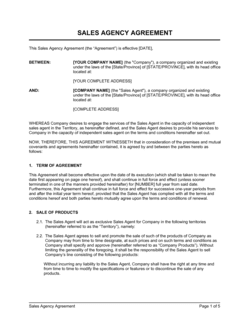
FreeSales Agency Agreement Template

At a glance

What it is
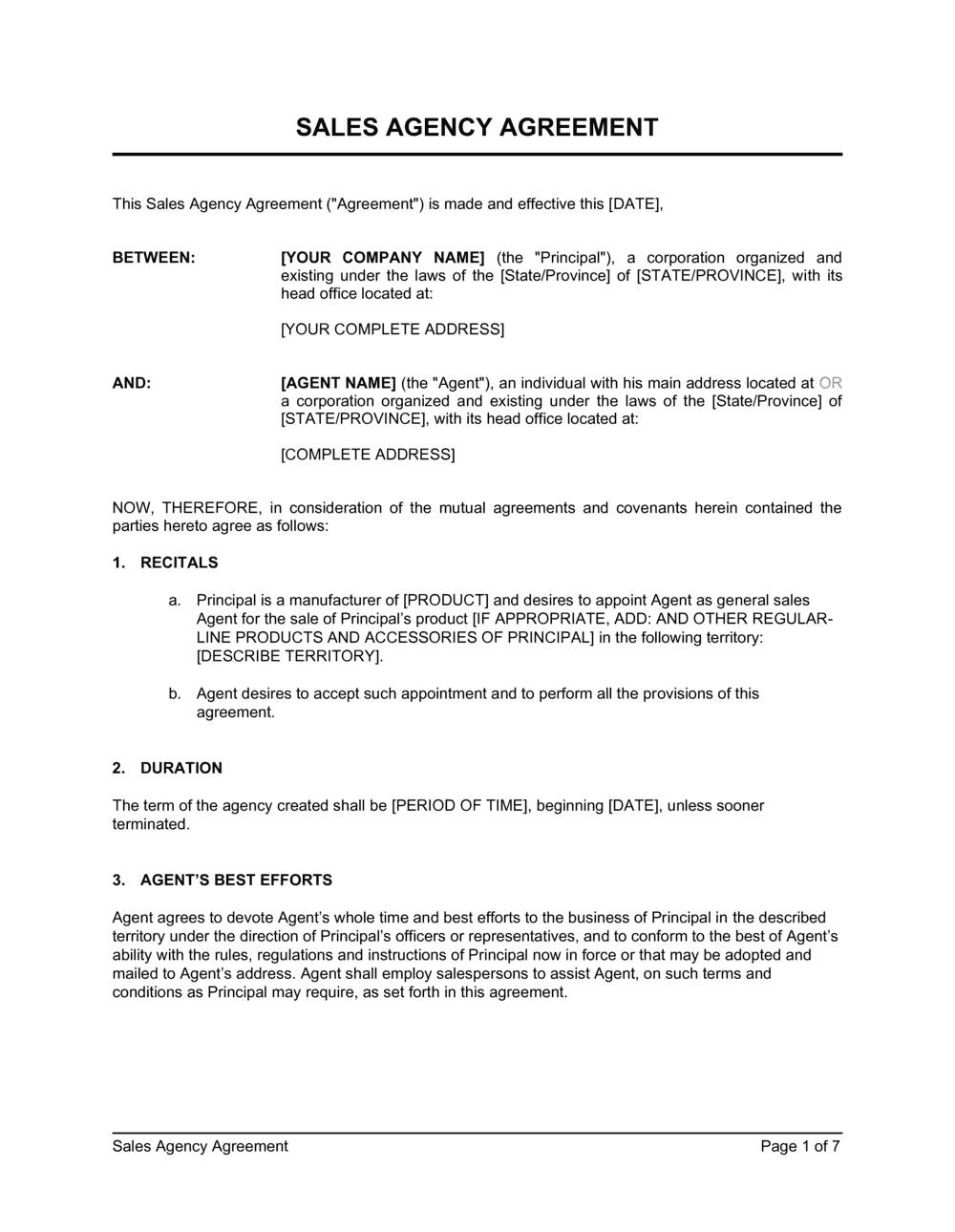
A Sales Agency Agreement is a legally binding contract appointing an independent sales agent to solicit orders for the principal's products or services within a defined territory. This free Word download covers exclusivity, commission rates and payment, expense reimbursement, term and renewal, post-termination indemnity, and governing law β€” in a single document you can edit online and export as PDF before execution.
When you need it
Use it whenever you engage an external sales representative or agency to sell your products in a specific region, and you need enforceable terms governing commission, territory exclusivity, and what happens when the arrangement ends.
What's inside
Appointment and territory definition, exclusivity provisions, products covered, commission structure and payment schedule, expense policy, obligations of each party, term and termination, post-termination commission tail and indemnity, confidentiality, IP ownership, and governing law.

What is a Sales Agency Agreement?

A Sales Agency Agreement is a legally binding contract in which a principal appoints an independent sales agent to solicit orders for its products or services within a defined territory, on a commission basis. Unlike a distributor, the agent never takes title to the goods β€” they find customers, forward orders to the principal, and earn a percentage of the net invoice value of accepted orders. The agreement defines the territory and whether the appointment is exclusive, the products in scope, the commission rate and payment trigger, minimum performance thresholds, term and notice periods, and what the agent is owed when the relationship ends β€” including any post-termination commission tail and statutory indemnity obligations that apply in the EU and UK regardless of what the contract says.

Why You Need This Document

Operating a sales agency arrangement without a written agreement exposes both sides to serious, concrete risk. A principal without a signed contract cannot enforce exclusivity conditions, hold the agent to minimum performance targets, or limit the agent's authority to accepting orders β€” meaning an overenthusiastic agent can bind the company to sales it never approved. An agent without a written agreement has no clear record of their commission rate, territory, or entitlement to commission on orders placed after termination by customers they introduced. In the EU and UK, the Commercial Agents Regulations impose mandatory indemnity rights of up to one year's average annual commission that the principal owes regardless of the contract β€” but without a written agreement, the calculation base and method are left entirely to a court. A properly drafted Sales Agency Agreement fixes the territory unambiguously, locks in commission mechanics, sets a performance floor for exclusive arrangements, and defines post-termination obligations before a dispute makes them far more expensive to resolve.

Which variant fits your situation?

If your situation is…Use this template
Agent sells exclusively in an assigned territory with no other principalsExclusive Sales Agency Agreement
Agent represents multiple principals and territory is non-exclusiveNon-Exclusive Sales Agency Agreement
Agent both purchases and resells products as principalDistribution Agreement
Individual consultant engaged to generate leads but not close salesIndependent Contractor Agreement
Agent operating across multiple countries under a single contractInternational Sales Agency Agreement
Real estate or property sales agent appointmentReal Estate Agent Agreement
Sales force employed directly by the company rather than as agentsEmployment Contract (Sales Representative)

Common mistakes to avoid

❌ Granting exclusivity without a minimum performance threshold

Why it matters: An exclusive agent who underperforms can lock the principal out of a territory indefinitely without any contractual breach β€” the principal loses the ability to appoint a replacement or sell directly.

Fix: Include a minimum net sales threshold in every exclusive agreement and state that failure to meet it for two consecutive measurement periods converts the appointment to non-exclusive or triggers a termination right.

❌ Vague territory description

Why it matters: Phrases like 'the Asia-Pacific region' or 'the Midwest' are contested in court β€” agents claim the largest possible interpretation while principals argue the narrowest, and neither is provably right.

Fix: List every country, state, or province covered in a signed schedule and explicitly carve out any named accounts or sub-territories the principal or another agent retains.

❌ Setting the commission payment trigger as full customer payment

Why it matters: Agents bear the risk of customer non-payment for obligations entirely outside their control. A single large bad debt can leave an agent unpaid for months of legitimate work.

Fix: Tie the payment trigger to shipment or delivery, or agree on a hybrid: commission paid at shipment but clawed back if the customer does not pay within a defined period.

❌ Ignoring the EU and UK Commercial Agents Directive

Why it matters: If the agent operates in an EU member state or the UK, the Commercial Agents Regulations apply regardless of what the contract says β€” including mandatory termination indemnity of up to one year's average commission that cannot be contracted out of.

Fix: Explicitly choose between the indemnity and compensation methods in the contract, budget for the potential liability, and take local legal advice before appointing any agent operating in the EU or UK.

❌ No post-termination commission tail

Why it matters: Customers introduced by the agent during the term will generate orders after termination. Silence on this point means the agent has a strong equitable claim β€” and a statutory claim in many jurisdictions β€” to commission on those orders.

Fix: Define a specific post-termination tail period (60–90 days is standard) and limit it clearly to customers whose first order was solicited by the agent before termination.

❌ Allowing the agent to accept orders on the principal's behalf

Why it matters: An agent who accepts an order binds the principal to its terms. Unauthorised acceptances at wrong prices, wrong delivery terms, or for products not in scope create enforceable obligations the principal did not intend.

Fix: State explicitly that the agent's authority is limited to soliciting orders and forwarding them to the principal for acceptance, and that no order is binding until confirmed in writing by the principal.

The 10 key clauses, explained

Appointment and territory

In plain language: Formally appoints the agent and defines the geographic or market territory within which they may solicit orders, and states whether the appointment is exclusive or non-exclusive.

Sample language
Principal hereby appoints Agent as its [exclusive / non-exclusive] sales agent in the territory of [TERRITORY DESCRIPTION] (the 'Territory') for the Products listed in Schedule A, commencing [START DATE]. Agent shall not solicit orders outside the Territory without prior written consent.

Common mistake: Defining territory in vague terms such as 'the region' or 'North America' without specifying exact countries, states, or postal code ranges. Ambiguity generates disputes over which orders fall inside the territory and therefore earn commission.

Products covered

In plain language: Identifies the specific products or product lines the agent is authorised to sell, and whether new products added later are automatically included.

Sample language
Agent is authorised to solicit orders solely for the products described in Schedule A ('Products'). Schedule A may be amended by written agreement of the parties. Products added to Principal's catalogue after the Effective Date are not covered unless Schedule A is updated by mutual written agreement.

Common mistake: Using a catch-all phrase like 'all products' without a schedule. If the principal later launches products the agent had no role in developing, commission disputes arise over whether those products were ever intended to be in scope.

Agent's obligations

In plain language: Sets out what the agent must do β€” actively promote the products, comply with the principal's pricing and brand guidelines, report regularly on market activity, and not exceed their authority by accepting orders or making binding promises on the principal's behalf.

Sample language
Agent shall: (a) actively promote and solicit orders for the Products in the Territory; (b) comply with Principal's current price lists and promotional guidelines; (c) provide monthly written activity reports by the [5th] of each month; and (d) not accept orders, grant discounts, or make representations beyond those authorised by Principal in writing.

Common mistake: Omitting a prohibition on the agent accepting orders on the principal's behalf. Agents who exceed authority can inadvertently bind the principal to orders at unauthorised prices or terms.

Principal's obligations

In plain language: Commits the principal to supply product information and samples, notify the agent promptly of accepted or rejected orders, and pay commission on time.

Sample language
Principal shall: (a) provide Agent with current product literature, price lists, and samples at no charge; (b) notify Agent within [10] business days of accepting or rejecting any order solicited by Agent; and (c) pay all commissions due within [30] days of the trigger event specified in Clause [X].

Common mistake: Leaving the principal's obligations entirely silent. Courts in many jurisdictions imply a duty of good faith and fair dealing β€” spelling out obligations explicitly reduces the scope of implied terms and limits disputes.

Commission rate and payment trigger

In plain language: States the commission percentage, the base on which it is calculated (typically net invoice value), and when it becomes payable β€” commonly on shipment or on receipt of customer payment.

Sample language
Principal shall pay Agent a commission of [X]% of the Net Invoice Value of each order solicited by Agent and accepted by Principal. Commission becomes due and payable within [30] days of [shipment of goods / receipt of full payment from the customer]. For partial payments, commission is payable pro rata.

Common mistake: Setting the payment trigger as 'receipt of full payment from the customer' without addressing what happens on partial payment or bad debt. An agent who has solicited a large order can be denied commission for months or indefinitely through customer non-payment that is entirely outside their control.

Minimum performance and exclusivity conditions

In plain language: Sets a sales target the agent must achieve to retain exclusivity or the appointment itself, and states the consequence of missing it β€” typically conversion to non-exclusive status or termination.

Sample language
As a condition of exclusivity, Agent shall achieve minimum net sales of $[AMOUNT] in the Territory during each consecutive [12]-month period of this Agreement ('Minimum Threshold'). Failure to meet the Minimum Threshold gives Principal the right, on [30] days' written notice, to convert this appointment to non-exclusive or terminate under Clause [X].

Common mistake: Granting exclusivity without any minimum performance threshold. A non-performing exclusive agent blocks the principal from developing the territory but faces no contractual consequence β€” a common and expensive oversight.

Term, renewal, and termination

In plain language: Sets the initial contract period, automatic renewal conditions, the notice period required to terminate without cause, and grounds for immediate termination for cause.

Sample language
This Agreement commences on [START DATE] and continues for an initial term of [12] months, renewing automatically for successive [12]-month periods unless either party gives [60] days' written notice before the end of the then-current term. Either party may terminate immediately for Cause, defined as material breach unremedied after [14] days' written notice, insolvency, or fraud.

Common mistake: Using short notice periods β€” 30 days or less β€” for established agency relationships. In the EU and UK, statutory notice minimums increase with the length of the agency, and contractual notice shorter than the statutory floor is void.

Post-termination commission tail and indemnity

In plain language: Defines the period after termination during which the agent earns commission on orders from introduced customers, and the formula for any termination indemnity payable to the agent for goodwill created.

Sample language
Following termination, Agent shall remain entitled to commission on orders placed within [90] days of the termination date by customers whose first order was solicited by Agent during the Agreement term. In addition, if applicable law entitles Agent to a termination indemnity, such indemnity shall be calculated as [one year's average annual commission over the preceding [3] years], subject to the statutory maximum.

Common mistake: Omitting the post-termination commission tail entirely. Agents who introduced customers that continue to generate revenue after termination have a strong equitable β€” and in many jurisdictions statutory β€” claim to commission on those orders. Silence on this point invites litigation.

Confidentiality and IP

In plain language: Prohibits the agent from disclosing or misusing the principal's confidential information β€” pricing, customer lists, product roadmaps β€” and confirms the principal retains all intellectual property.

Sample language
Agent shall hold all Confidential Information of Principal in strict confidence and shall not disclose or use it for any purpose other than performing its obligations under this Agreement. All IP, trade marks, and product data provided to Agent remain the sole property of Principal and shall be returned or destroyed on termination.

Common mistake: Failing to define 'Confidential Information' and relying on a general statement. Courts apply a reasonableness standard β€” undefined confidentiality clauses can be struck down as too vague to enforce, especially in restraint-of-trade disputes.

Governing law and dispute resolution

In plain language: Specifies which jurisdiction's law governs the contract and the mechanism for resolving disputes β€” arbitration, mediation, or litigation β€” and the chosen venue.

Sample language
This Agreement is governed by the laws of [STATE / PROVINCE / COUNTRY]. Any dispute shall be referred first to senior management of both parties for [15] business days of good-faith negotiation. If unresolved, disputes shall be determined by binding arbitration under the rules of [AAA / ICC / LCIA] in [CITY], except claims for injunctive relief, which may be brought in any court of competent jurisdiction.

Common mistake: Choosing a governing law with no connection to either party's location. Courts in the EU, UK, and several US states apply local mandatory agency laws regardless of contractual choice of law β€” particularly the EU Commercial Agents Directive and its UK equivalent.

How to fill it out

  1. 1

    Identify the parties and their legal entities

    Enter the principal's full registered company name, jurisdiction of incorporation, and registered address, and do the same for the agent. Do not use trade names or abbreviations.

    πŸ’‘ Confirm both entities are in good standing with their respective corporate registries before execution β€” an agreement signed by a dissolved entity is void.

  2. 2

    Define the territory precisely

    List the exact countries, states, provinces, or postal code ranges that constitute the territory. If the territory is a market segment rather than a geography, define it by customer type, industry code, or named account list.

    πŸ’‘ Attach a signed Schedule B listing any named accounts already known to the principal that are carved out of the agent's territory β€” this prevents commission disputes on existing relationships.

  3. 3

    List products in Schedule A

    Complete Schedule A with the exact product names, SKUs, or model numbers the agent is authorised to sell. State whether products added to the catalogue after the effective date are automatically included or require a signed amendment.

    πŸ’‘ Limiting Schedule A to current products protects the principal's right to launch new products through different channels without triggering commission obligations.

  4. 4

    Set the commission rate and payment trigger

    Enter the commission percentage, the base (net invoice value after deducting returns, discounts, and taxes), and the exact event that makes commission payable β€” shipment, customer payment, or a defined number of days after invoice.

    πŸ’‘ If you are selling on long payment terms (Net 60 or Net 90), set the trigger at shipment rather than customer payment β€” otherwise the agent funds your working capital gap for free.

  5. 5

    Set the minimum performance threshold

    Enter the minimum net sales figure the agent must achieve in each 12-month period to retain exclusivity, and the consequence of missing it. Express the threshold in the same currency as the commission calculation.

    πŸ’‘ Set the threshold at 70–80% of the agent's own projected sales forecast from their proposal β€” this keeps it achievable while providing a floor below which inaction is not tolerable.

  6. 6

    Set notice periods appropriate to the jurisdiction

    Enter the termination notice period. For EU and UK agreements, check the Commercial Agents Directive minimums: 1 month in the first year, 2 months in the second, 3 months from the third year onward.

    πŸ’‘ Always set contractual notice at or above the statutory minimum β€” a shorter period is void and replaced by the statutory floor, which may be far longer than intended.

  7. 7

    Address post-termination commission and indemnity

    State the length of the post-termination commission tail (typically 60–90 days) and the formula for any goodwill indemnity. If operating in the EU or UK, the Commercial Agents Regulations mandate a minimum indemnity of up to one year's average annual remuneration.

    πŸ’‘ Expressly state whether the agreement opts for the 'indemnity' or 'compensation' method under the EU Commercial Agents Directive β€” failure to choose defaults to compensation, which can be harder to quantify and more expensive.

  8. 8

    Execute before the agent begins soliciting orders

    Both parties must sign before the agent approaches any customers on the principal's behalf. Orders solicited before execution create implied agency obligations that may be more generous than the written contract.

    πŸ’‘ Use Business in a Box eSign to capture timestamped signatures from both parties and store the fully executed copy automatically in BIB Drive.

Frequently asked questions

What is a sales agency agreement?

A sales agency agreement is a contract appointing an independent agent to solicit orders for the principal's products or services within a defined territory, on a commission basis. The agent does not buy and resell the products β€” they find customers and forward orders to the principal, who accepts or rejects them and fulfils directly. The agreement defines territory, commission, exclusivity, term, and what happens when the arrangement ends.

What is the difference between a sales agent and a distributor?

A sales agent solicits orders on behalf of the principal and earns commission β€” the principal contracts directly with the customer and bears the credit risk. A distributor buys the products outright, resells them as principal, and keeps the margin. The legal and tax treatment differs substantially: agents typically trigger fewer permanent establishment risks for the principal in foreign jurisdictions, but they attract statutory protections (particularly in the EU and UK) that distributors do not enjoy.

Does a sales agency agreement need to be in writing?

In most jurisdictions a sales agency agreement is valid whether oral or written, but oral arrangements create serious practical and legal problems. In the EU, either party can require the agreement to be reduced to writing at any time. In practice, a written agreement is essential to define territory, commission rates, exclusivity, and termination obligations clearly β€” without one, courts or regulators will fill the gaps with statutory defaults that are typically more favourable to the agent.

What commission rate is standard for a sales agency agreement?

Commission rates vary widely by industry and product margin. Typical ranges are 5–15% of net invoice value for manufactured goods and industrial products, 10–25% for technology and software, and up to 30–40% for high-value professional services. The rate should reflect the agent's cost of sale, the expected volume, and the level of support the principal provides. Exclusive arrangements with higher performance requirements often carry higher commission rates.

What is a post-termination indemnity under a sales agency agreement?

A post-termination indemnity compensates the agent for the goodwill and customer relationships they created for the principal during the agency. In the EU and UK, the Commercial Agents Regulations entitle agents to an indemnity of up to one year's average annual commission on termination β€” this right cannot be waived in advance. In other jurisdictions the indemnity is purely contractual. It is separate from the post-termination commission tail, which covers orders placed by introduced customers after termination.

Can I appoint multiple agents for the same territory?

Yes β€” a non-exclusive appointment allows you to engage several agents in the same territory simultaneously or appoint a new agent when an existing one underperforms. An exclusive appointment prohibits this and gives the agent a claim for damages if you sell directly or through a third party in their territory. Always include a minimum performance threshold in exclusive arrangements so you have a contractual basis to terminate or convert to non-exclusive status if the agent does not deliver.

What notice period is required to terminate a sales agency agreement?

Notice requirements depend on jurisdiction and the length of the relationship. The EU Commercial Agents Directive sets statutory minimums of one month in the first year, two months in the second, and three months from the third year onward β€” these floors cannot be contracted away. In the US and Canada, notice is purely contractual; 30–90 days is typical. Always set contractual notice at or above the statutory minimum for the agent's jurisdiction to avoid the clause being void and replaced by an implied reasonable notice period.

Does a sales agency agreement create an employment relationship?

Not typically β€” a properly structured sales agency agreement is a commercial arrangement between independent businesses, not an employment relationship. However, if the principal exercises excessive control over how, when, and where the agent works β€” setting daily hours, requiring exclusive dedication, or providing all equipment and leads β€” tax authorities and employment tribunals may reclassify the agent as an employee or worker, triggering payroll taxes, benefits, and unfair dismissal protections. The agreement should preserve the agent's commercial independence to avoid misclassification.

Do I need a lawyer to draft a sales agency agreement?

For domestic appointments involving straightforward products and no exclusivity, a well-drafted template reviewed by a commercial solicitor or attorney is usually sufficient. Engage a lawyer when the agent operates in the EU or UK (where the Commercial Agents Directive applies), when the territory covers multiple jurisdictions with different agency laws, when the commission exposure exceeds $50,000 per year, or when non-compete or non-solicitation restrictions are commercially critical. A one-to-two hour review typically costs $300–$800 and is worthwhile for any exclusive or cross-border appointment.

How this compares to alternatives

vs Distribution Agreement

A distribution agreement appoints a distributor who buys the products outright and resells them as principal, bearing full credit and inventory risk. A sales agency agreement appoints an agent who only solicits orders β€” the principal contracts with the end customer directly and retains credit risk. Distributors earn a margin; agents earn commission. Agents attract statutory protections in the EU and UK that distributors generally do not.

vs Independent Contractor Agreement

An independent contractor agreement covers a broad range of service arrangements β€” consulting, development, project work. A sales agency agreement is purpose-built for the specific commercial structure of soliciting orders on commission, with clauses for territory, exclusivity, minimum performance, commission tails, and statutory indemnity that a generic contractor agreement does not address.

vs Reseller Agreement

A reseller agreement gives the reseller the right to market and sell the principal's products under their own contracts with end customers. Unlike a sales agent, a reseller typically takes title, sets their own price, and manages customer relationships directly. Sales agents never take title and have no authority to set price or accept orders without principal approval.

vs Franchise Agreement

A franchise agreement grants the franchisee the right to operate a business under the franchisor's brand and system, with ongoing royalties and operational controls. A sales agency agreement is a narrower commercial arrangement focused solely on soliciting product orders for commission, with no brand licensing, operational standards, or territory development obligations of the kind a franchise imposes.

Industry-specific considerations

Manufacturing and industrial

Territory mapped to distributor networks, commission on net invoice after freight and duty deductions, and agent authority limited to forwarding orders for principal acceptance.

Technology and SaaS

Commission calculated on first-year licence or subscription value, with residual rates for renewals and clear rules on whether the agent earns on upsells to introduced accounts.

Consumer goods and retail

Seasonal minimum performance thresholds aligned to buyer order cycles, exclusivity tied to key retail chains, and agent brand-compliance obligations for in-store presentations.

Professional services and financial products

Regulatory authorisation requirements for the agent, FCA or SEC registration cross-references, and commission structures that comply with inducement and fee-disclosure rules.

Jurisdictional notes

United States

The US has no single federal commercial agency statute equivalent to the EU Directive. Several states β€” including California, Illinois, and New York β€” have Sales Representative Acts that impose mandatory commission payment timelines and treble-damage penalties for late payment after termination. California additionally restricts post-termination non-competes. Choice of governing state should be made with reference to both parties' locations and the applicable state's agent-protection statutes.

Canada

Agency law in Canada is primarily common law with province-specific variations. Ontario and British Columbia courts have implied duties of good faith and fair dealing in commercial agency relationships. Quebec applies civil law principles under the Civil Code. There is no statutory post-termination indemnity equivalent to the EU Directive, but courts award reasonable notice periods for established agency relationships β€” typically 1–6 months depending on the length and exclusivity of the arrangement.

United Kingdom

The Commercial Agents (Council Directive) Regulations 1993 (as retained in UK law post-Brexit) impose mandatory protections that cannot be contracted out of: minimum notice periods scaling from 1 to 3 months by year of agency, and a post-termination right to either compensation or indemnity of up to one year's average annual remuneration. The agreement must expressly elect between the compensation and indemnity methods β€” failing to choose defaults to compensation, which English courts have awarded generously. These rules apply whenever the agent operates in Great Britain regardless of governing law chosen.

European Union

The EU Commercial Agents Directive (86/653/EEC), implemented in all member states, sets mandatory floors for notice periods, commission payment rights, and post-termination indemnity or compensation. The indemnity method caps the payment at one year's average annual commission over the preceding five years; the compensation method is uncapped and has produced larger awards in French and German courts. GDPR applies to any personal data about customers the agent processes on behalf of the principal, requiring a data processing addendum. Local counsel is strongly recommended before appointing agents in France, Germany, or Spain, which have particularly agent-protective implementations.

Template vs lawyer β€” what fits your deal?

PathBest forCostTime
Use the templateDomestic appointments in a single jurisdiction, non-exclusive arrangements, annual commission exposure under $30,000Free30–45 minutes
Template + legal reviewExclusive appointments, agents operating in the EU or UK, or commission exposure between $30,000 and $150,000 per year$300–$800 (commercial solicitor or attorney review)2–5 days
Custom draftedMulti-jurisdiction appointments, regulated industries (financial products, pharmaceuticals), or annual commission exposure above $150,000$2,000–$6,000+2–4 weeks

Glossary

Principal
The company or individual that owns the products and appoints the agent to solicit orders on its behalf.
Agent
The independent individual or company appointed to solicit orders from customers within a defined territory on a commission basis.
Exclusive Territory
A defined geographic or market area within which no other agent may be appointed by the principal during the agreement's term.
Commission
A percentage of the net invoice value of orders solicited and accepted by the principal, paid to the agent upon defined trigger events such as shipment or customer payment.
Post-Termination Commission Tail
The period after the agreement ends during which the agent continues to earn commission on orders placed by customers the agent introduced before termination.
Commercial Agency Indemnity
A statutory or contractual payment owed to the agent upon termination, compensating for goodwill or customer relationships developed during the agency.
Minimum Performance Threshold
A contractually defined sales target the agent must meet within a set period; failure typically gives the principal grounds to terminate or convert an exclusive appointment to non-exclusive.
Del Credere Agency
A special agency arrangement where the agent guarantees payment by customers it introduces, in exchange for a higher commission rate.
Net Invoice Value
The price actually invoiced to the customer after deducting returns, discounts, and taxes β€” the base on which commission is typically calculated.
Force Majeure
A clause that suspends obligations when performance is prevented by events outside a party's reasonable control, such as natural disasters, war, or government-mandated restrictions.
Non-Circumvention
A provision preventing the principal from bypassing the agent to deal directly with customers the agent introduced, thereby denying earned commission.
Restraint of Trade
A post-termination restriction limiting the agent's ability to represent competing products or contact former customers β€” enforceable only if reasonable in scope and duration.

Part of your Business Operating System

This document is one of 3,000+ business & legal templates included in Business in a Box.

  • Fill-in-the-blanks β€” ready in minutes
  • 100% customizable Word document
  • Compatible with all office suites
  • Export to PDF and share electronically

Create your document in 3 simple steps.

From template to signed document β€” all inside one Business Operating System.
1
Download or open template

Access over 3,000+ business and legal templates for any business task, project or initiative.

2
Edit and fill in the blanks with AI

Customize your ready-made business document template and save it in the cloud.

3
Save, Share, Send, Sign

Share your files and folders with your team. Create a space of seamless collaboration.

Save time, save money, and create top-quality documents.

β˜…β˜…β˜…β˜…β˜…

"Fantastic value! I'm not sure how I'd do without it. It's worth its weight in gold and paid back for itself many times."

Managing Director Β· Mall Farm
Robert Whalley
Managing Director, Mall Farm Proprietary Limited
β˜…β˜…β˜…β˜…β˜…

"I have been using Business in a Box for years. It has been the most useful source of templates I have encountered. I recommend it to anyone."

Business Owner Β· 4+ years
Dr Michael John Freestone
Business Owner
β˜…β˜…β˜…β˜…β˜…

"It has been a life saver so many times I have lost count. Business in a Box has saved me so much time and as you know, time is money."

Owner Β· Upstate Web
David G. Moore Jr.
Owner, Upstate Web

Run your business with a system β€” not scattered tools

Stop downloading documents. Start operating with clarity. Business in a Box gives you the Business Operating System used by over 250,000 companies worldwide to structure, run, and grow their business.

Start freeΒ Β·Β No credit card required