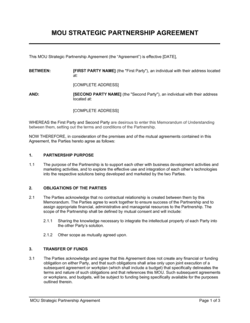
Silent Partner Agreement Template

Free Word download β€’ Edit online β€’ Save & share with Drive β€’ Export to PDF

8 pagesβ€’30–40 min to fillβ€’Difficulty: Complexβ€’Signature requiredβ€’Legal review recommended
Learn more ↓
FreeSilent Partner Agreement Template

At a glance

What it is
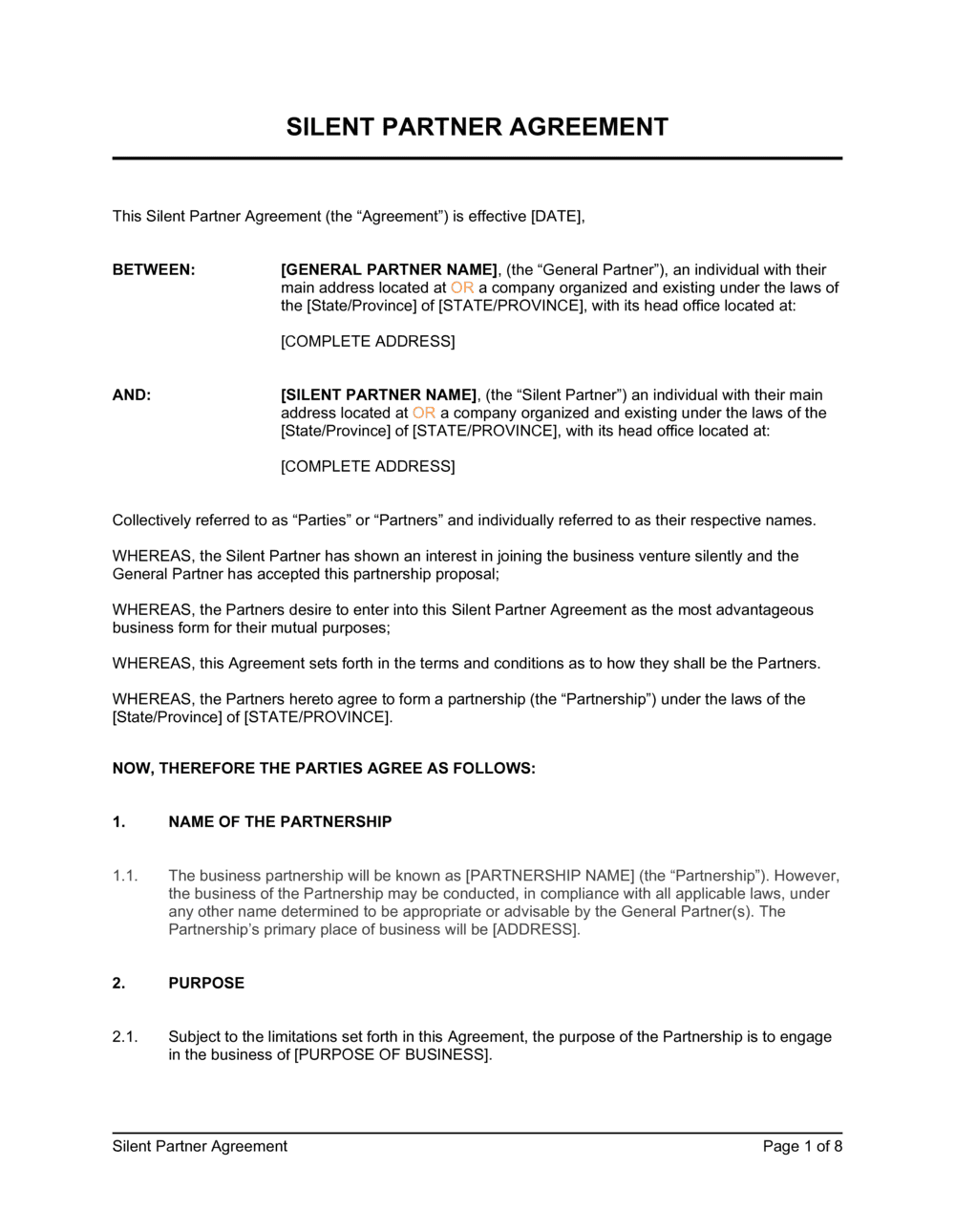
A Silent Partner Agreement is a legally binding contract between an active business operator and a passive investor who contributes capital but takes no role in day-to-day management. This free Word download covers profit and loss allocation, liability limitations, information rights, transfer restrictions, and exit provisions β€” giving both parties an enforceable framework before money changes hands.
When you need it
Use it when a business owner accepts funding from an investor who wants a share of returns without operational involvement. It is equally important when the investor wants documented proof that their liability is limited to their capital contribution and that they will receive regular financial reporting without needing management access.
What's inside
Capital contribution schedule, profit and loss sharing formula, management exclusion clause, liability cap, information and inspection rights, restrictions on transferring the silent partner's interest, and a defined exit or buyout mechanism. The agreement also covers confidentiality, dispute resolution, and governing law.

What is a Silent Partner Agreement?

A Silent Partner Agreement is a legally binding contract that formalizes the relationship between an active business operator and a passive investor β€” the silent partner β€” who contributes capital in exchange for a share of profits and losses but plays no role in managing or operating the business. The agreement defines the exact capital contribution, the ownership percentage, the formula for calculating and distributing profits, the limit on the silent partner's personal liability, and the conditions under which either party can exit the arrangement. Unlike a handshake deal or a casual loan, it creates enforceable obligations on both sides and establishes a documented paper trail that protects each party if the relationship sours.

The term "silent" refers specifically to the investor's absence from operational decision-making β€” not to secrecy about the investment itself. A well-drafted agreement makes clear that the silent partner has no authority to hire staff, sign contracts, set prices, or direct daily operations, because any crossing of that line risks reclassifying the investor as a general partner under partnership law, potentially eliminating their liability protection entirely.

Why You Need This Document

Without a written silent partner agreement, both parties are exposed in ways that only become apparent when something goes wrong. The active operator faces the risk that an undocumented investor later claims management authority, demands access to operations, or disputes the profit calculation with no agreed formula to settle it. The silent partner faces the far greater risk: in most jurisdictions, an undocumented passive investment in an unregistered business defaults to a general partnership by law β€” meaning the investor's personal assets are fully exposed to every debt and judgment the business incurs, regardless of what either party privately understood.

A signed agreement, executed before capital is transferred, fixes both problems. It caps the silent partner's liability to their contributed amount, sets a clear distribution schedule so profits are calculated on agreed terms, grants information rights that let the investor verify their returns without needing operational access, and provides a defined buyout path so neither party is trapped indefinitely. This template gives you the structure to accomplish all of that in a single document β€” ready to customize, review with counsel where the stakes warrant it, and execute before the first dollar moves.

Which variant fits your situation?

If your situation is…Use this template
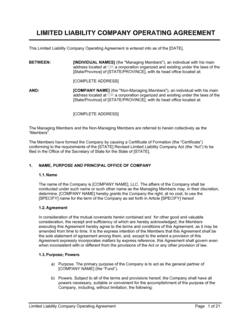
Passive investor in an LLC wanting statutory liability protectionLLC Operating Agreement
Two or more active co-founders sharing management and profitGeneral Partnership Agreement
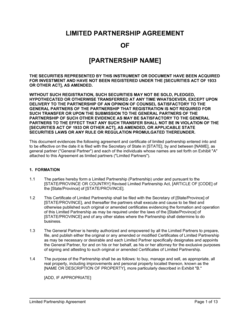
Formal limited partnership with a registered LP structureLimited Partnership Agreement
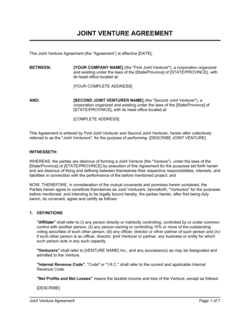
Short-term joint venture with a defined project end dateJoint Venture Agreement
Silent investor who also wants a convertible debt optionConvertible Note Agreement
Investor contributing services instead of cashSweat Equity Agreement
Single investor funding a specific real estate dealReal Estate Joint Venture Agreement

Common mistakes to avoid

❌ No management exclusion clause

Why it matters: Without explicit language prohibiting management participation, a court may find that the silent partner functionally acted as a general partner β€” exposing their personal assets to full business liability regardless of the contract's intent.

Fix: Include a specific, enumerated list of management activities from which the silent partner is excluded, and add an acknowledgment that the silent partner accepted this limitation in exchange for liability protection.

❌ Relying on a contractual liability cap without a proper legal structure

Why it matters: The agreement's liability cap binds the two parties but not third-party creditors, judgment holders, or tax authorities β€” who can pursue the silent partner's personal assets if the arrangement is treated as a general partnership.

Fix: Structure the arrangement through an LLC, limited partnership, or other statutory entity that provides liability protection at law, then use this agreement to define the economic terms within that structure.

❌ Undefined 'net profit' in the distribution clause

Why it matters: If the active partner deducts an owner's salary, management fee, or capital reserves before calculating profit, the silent partner may receive far less than the headline percentage suggests β€” with no contractual basis to object.

Fix: Add a definitions section that specifies the accounting basis for net profit, lists permitted pre-distribution deductions, and caps discretionary reserves at a stated dollar amount or percentage of revenue.

❌ No buyout valuation method specified

Why it matters: When a buyout is triggered β€” by either party β€” and the method is undefined, a price dispute almost inevitably follows. Without a mechanism, the only resolution is negotiation, mediation, or litigation β€” all of which are slower and more expensive than an agreed formula.

Fix: Select a valuation method at signing (EBITDA multiple, independent appraiser, or book value formula) and include a deadlock procedure for cases where the parties cannot agree on an appraiser.

❌ Signing after capital has already been transferred

Why it matters: A contribution made before the agreement is signed creates an undocumented partnership that courts may classify as a general partnership by conduct β€” stripping the silent partner of their liability cap and giving them implied management authority.

Fix: Execute the signed agreement and receive confirmation of the deposit into the business account in the same transaction β€” or as close to simultaneously as possible, with the signed agreement always preceding the transfer.

❌ No information rights clause

Why it matters: A silent partner with no contractual right to financial statements has no practical way to verify that distributions are calculated correctly, detect misappropriation of funds, or assess the health of their investment before the situation becomes irreversible.

Fix: Include a minimum reporting standard β€” monthly P&L statements delivered within 15 business days of month end, annual reviewed financials within 60 days β€” and specify a remedy (right to appoint an independent auditor) if reporting obligations are not met.

The 10 key clauses, explained

Parties, recitals, and business description

In plain language: Identifies the active partner and silent partner as legal entities or individuals, describes the business being funded, and states the purpose of the agreement.

Sample language
This Silent Partner Agreement is entered into on [DATE] between [ACTIVE PARTNER LEGAL NAME] ('Active Partner') and [SILENT PARTNER LEGAL NAME] ('Silent Partner'). The Active Partner operates a [BUSINESS DESCRIPTION] under the trade name [BUSINESS NAME] ('Business').

Common mistake: Using trade names instead of registered legal entity names. If the active partner is an LLC, the LLC β€” not the individual owner's name β€” should be the contracting party; otherwise personal liability protections blur.

Capital contribution and payment schedule

In plain language: States the exact dollar amount the silent partner will invest, the form of contribution (cash, asset, or phased installments), and the deadline for each payment.

Sample language
Silent Partner agrees to contribute [AMOUNT] to the Business on or before [DATE], payable by [wire transfer / certified cheque] to [ACCOUNT DETAILS]. No further capital contributions shall be required without the Silent Partner's prior written consent.

Common mistake: Leaving the contribution amount vague or subject to a future agreement. An unspecified amount gives the active partner grounds to request additional funds β€” or leaves the silent partner with no enforceable claim to their ownership percentage.

Ownership interest and profit/loss allocation

In plain language: Defines the silent partner's percentage stake in the business and the formula for distributing net profit and absorbing net loss each fiscal year.

Sample language
In consideration of the Capital Contribution, the Silent Partner shall hold a [X]% interest in the net profits and net losses of the Business. Distributions shall be made within [30] days following the close of each fiscal quarter, subject to the Active Partner retaining a minimum operating reserve of $[AMOUNT].

Common mistake: Failing to define 'net profit' β€” whether it is calculated before or after the active partner's management fee, owner's draw, or debt service materially changes what the silent partner actually receives.

Management exclusion and non-interference

In plain language: Explicitly bars the silent partner from participating in day-to-day business decisions, hiring, contracts, or customer relations, preserving the active partner's sole authority over operations.

Sample language
The Silent Partner shall have no authority to manage, direct, or bind the Business, execute contracts on its behalf, or participate in any operational, hiring, or strategic decisions. Violation of this clause may, at the Active Partner's election, constitute a material breach.

Common mistake: Omitting this clause entirely because both parties 'have an understanding.' If a silent partner gives operational instructions that employees follow β€” even informally β€” courts in some jurisdictions may reclassify them as an active general partner, eliminating their liability protection.

Liability limitation

In plain language: Caps the silent partner's financial exposure to the amount of their capital contribution, protecting personal assets from the business's debts, judgments, and obligations.

Sample language
The Silent Partner's liability for the debts, obligations, and liabilities of the Business shall not exceed the amount of their Capital Contribution as set out in Section [X]. Nothing in this Agreement shall expose the Silent Partner to personal liability beyond that amount.

Common mistake: Relying solely on this contractual cap without structuring the arrangement through an appropriate legal entity (LLC or LP). A contractual liability cap is not a substitute for statutory limited liability β€” creditors are not bound by the private agreement.

Information rights and reporting obligations

In plain language: Requires the active partner to provide the silent partner with regular financial statements β€” typically monthly or quarterly β€” and grants inspection rights for the underlying books and records.

Sample language
Active Partner shall deliver to Silent Partner: (a) unaudited monthly profit and loss statements within [15] business days of each month end; (b) annual reviewed financial statements within [60] days of fiscal year end; and (c) access to books and records upon [10] business days' written notice, no more than once per calendar year.

Common mistake: Granting no information rights at all, or granting them without a response deadline. A silent partner with no contractual right to financials has no practical way to verify their distributions are correctly calculated or to detect mismanagement early.

Transfer restrictions and right of first refusal

In plain language: Prevents the silent partner from selling or assigning their interest without the active partner's consent, and gives the active partner a right to match any third-party offer before an outside buyer can acquire the stake.

Sample language
The Silent Partner shall not sell, assign, pledge, or otherwise transfer their interest without the Active Partner's prior written consent, not to be unreasonably withheld. Before accepting any third-party offer, Silent Partner shall provide written notice to Active Partner, who shall have [30] days to elect to purchase the interest on the same terms.

Common mistake: No transfer restriction at all β€” meaning the active partner could find an unknown third party acquiring the silent stake overnight. This is particularly damaging in businesses where the silent partner's identity was part of the original trust relationship.

Buyout and exit mechanism

In plain language: Defines the conditions under which either party can trigger a buyout, the valuation method used to price the interest, and the payment terms for the purchase.

Sample language
Either party may elect to trigger a buyout by providing [90] days' written notice after [DATE / YEAR X of the Agreement]. The buyout price shall be determined by [EBITDA multiple of [X] / independent appraiser / agreed formula], payable over [X] months at [RATE]% interest.

Common mistake: Defining a buyout right without defining the valuation method. When parties disagree on price β€” which is almost always β€” an undefined method leads to a stalemate that can only be resolved through litigation or arbitration.

Confidentiality

In plain language: Requires both parties to keep the terms of the agreement and the business's financial information, customer data, and trade secrets confidential during and after the partnership.

Sample language
Each party shall keep strictly confidential all Confidential Information of the other party and of the Business, and shall not disclose it to any third party without prior written consent, except as required by law or to professional advisors bound by equivalent confidentiality obligations.

Common mistake: A confidentiality clause that binds only the silent partner. The active partner also has access to the silent partner's financial capacity and investment strategy β€” mutual confidentiality protects both sides.

Governing law, dispute resolution, and entire agreement

In plain language: Specifies which jurisdiction's law governs the contract, how disputes are resolved (arbitration, mediation, or litigation), and confirms this document supersedes all prior understandings.

Sample language
This Agreement is governed by the laws of [STATE / PROVINCE / COUNTRY]. Any dispute shall be resolved by binding arbitration administered by [AAA / JAMS / applicable institution] in [CITY], except that either party may seek injunctive relief in a court of competent jurisdiction. This Agreement constitutes the entire agreement between the parties.

Common mistake: Selecting a governing jurisdiction with no connection to where the business operates or where the parties reside. Several states and provinces apply local partnership law regardless of the contractual choice β€” a mismatch can invalidate key provisions.

How to fill it out

  1. 1

    Identify both parties using their legal entity names

    Enter the full registered legal name of the active partner (individual or entity) and the silent partner. If either party operates through an LLC, corporation, or trust, use that entity's name β€” not the owner's personal name.

    πŸ’‘ Request a copy of the silent partner's government-issued ID or entity registration certificate before finalizing. Misidentifying a party makes the agreement harder to enforce.

  2. 2

    Define the capital contribution amount and payment method

    State the exact dollar amount, the payment method (wire transfer, certified cheque, or phased installments), and the deadline for each payment. If the contribution is in assets rather than cash, attach a Schedule A describing and valuing those assets.

    πŸ’‘ For phased contributions, tie each installment to a specific date β€” not a business milestone β€” to prevent disputes over whether the trigger has been met.

  3. 3

    Set the ownership percentage and profit/loss formula

    Agree on the silent partner's percentage interest and whether distributions are calculated on gross profit, net profit after management fees, or EBITDA. Document the minimum operating reserve the active partner may retain before distributions are required.

    πŸ’‘ Define 'net profit' in the definitions section with a specific accounting standard (e.g., accrual-basis GAAP) so both parties calculate distributions from the same number.

  4. 4

    Draft the management exclusion clause carefully

    Explicitly list the categories of decisions the silent partner is excluded from β€” hiring, vendor contracts, pricing, financing, and strategic partnerships. The more specific the list, the harder it is for courts to find implied management participation.

    πŸ’‘ Add a sentence confirming the silent partner has reviewed and accepted this limitation in exchange for their liability cap. This acknowledgment strengthens the clause if challenged.

  5. 5

    Specify the information rights schedule

    Set the frequency of financial reports (monthly P&L, quarterly summary, annual reviewed statements), the delivery deadline after each period closes, and the scope of inspection rights including how much notice is required and how often.

    πŸ’‘ Monthly reporting is standard for businesses under $5M in revenue. For larger or more complex businesses, quarterly reporting supplemented by annual audited statements is typical.

  6. 6

    Configure the transfer restriction and right of first refusal

    State that the silent partner's interest is non-transferable without written consent, then set the ROFR notice period and the timeline within which the active partner must exercise or waive the right.

    πŸ’‘ A 30-day ROFR window is the market standard. Shorter windows disadvantage the active partner; longer windows make the silent partner's interest effectively illiquid.

  7. 7

    Agree on the buyout valuation method before signing

    Select one of three common methods: a fixed multiple of trailing EBITDA, an independent appraiser appointed by mutual agreement, or a formula tied to audited book value. Document the method in the agreement itself β€” do not leave it to be 'agreed at the time.'

    πŸ’‘ Include a deadlock provision: if the parties cannot agree on an appraiser within 30 days, each appoints one appraiser and the two appointees select a third whose determination is binding.

  8. 8

    Execute before any capital is transferred

    Both parties must sign the agreement before the capital contribution is made. Contributions made before signing create an undocumented relationship that courts may treat as a general partnership β€” eliminating the silent partner's liability cap.

    πŸ’‘ Use a digital signature platform with a timestamp to create an audit trail. Store the fully executed agreement and the wire transfer confirmation together in the same folder.

Frequently asked questions

What is a silent partner agreement?

A silent partner agreement is a legally binding contract between a business operator and a passive investor who contributes capital in exchange for a share of profits and losses but takes no active role in management. It documents the ownership percentage, distribution formula, liability cap, information rights, transfer restrictions, and exit mechanism β€” creating an enforceable framework for the relationship before any money changes hands.

What is the difference between a silent partner and a limited partner?

A limited partner holds a formal statutory interest in a registered limited partnership (LP) entity, with liability protection provided by partnership law. A silent partner is a contractual arrangement that can exist in any business structure β€” a sole proprietorship, general partnership, or LLC β€” and relies on the agreement itself (plus the underlying entity's structure) for liability protection. In practice, most well-advised silent partner arrangements are structured through an LLC or LP to provide statutory liability coverage on top of the contractual terms.

Is a silent partner personally liable for business debts?

A silent partner's liability is typically limited to the amount of their capital contribution under a well-drafted agreement. However, this contractual cap does not bind third-party creditors unless the arrangement is structured through a legal entity (such as an LLC or LP) that provides statutory limited liability. A silent partner who crosses into active management β€” even informally β€” risks being reclassified as a general partner by a court, exposing personal assets to full business liability.

What should a silent partner agreement include?

At minimum: the parties' legal names and entity types, the exact capital contribution amount and payment schedule, the silent partner's ownership percentage and profit/loss allocation formula, an explicit management exclusion clause, a liability cap, information and inspection rights, transfer restrictions with a right of first refusal, a buyout mechanism with a defined valuation method, confidentiality obligations, and governing law with a dispute resolution process.

Does a silent partner need to be disclosed to customers or vendors?

In most jurisdictions, there is no general legal obligation to disclose a silent partner's identity to customers or vendors. However, regulated industries β€” financial services, real estate brokerage, and healthcare, for example β€” may require disclosure of beneficial owners under anti-money-laundering or licensing rules. The US Corporate Transparency Act also requires disclosure of beneficial owners with 25% or more equity to FinCEN. Confirm applicable disclosure requirements with a lawyer before finalizing the structure.

Can a silent partner be forced out of the business?

Only if the agreement includes a buyout or forced-transfer provision that specifies the triggering conditions and the valuation method. Without such a clause, a silent partner cannot be compelled to sell their interest against their will. This is why a well-drafted buyout mechanism β€” including a deadlock procedure and a defined valuation formula β€” is one of the most critical provisions in the agreement.

What happens if the silent partner starts participating in management?

In most common-law jurisdictions, a silent partner who participates in active management risks being reclassified as a general partner β€” which eliminates the liability cap and may expose personal assets to the business's creditors. The agreement should include an explicit management exclusion clause and a consequence clause (e.g., buyout right for the active partner or deemed breach) to deter and address this scenario.

Do I need a lawyer to draft a silent partner agreement?

For a straightforward arrangement between two domestic parties in a single jurisdiction, a high-quality template is a solid starting point. Engage a lawyer when the investment exceeds $100,000, when the business operates in a regulated industry, when the parties are in different countries, or when the profit allocation involves complex structures such as preferred returns, carried interest, or convertible provisions. A 1–3 hour template review typically costs $400–$900 and is worthwhile for any material investment.

How are silent partner distributions taxed?

Tax treatment depends on the legal structure of the arrangement and the jurisdiction. In the US, a silent partner in a general partnership or LLC taxed as a partnership receives a K-1 and is taxed on their allocable share of income regardless of whether a distribution is actually made β€” potentially triggering a tax liability without a corresponding cash payment. Structuring through an entity and carefully drafting the distribution clause (including a tax distribution provision) can prevent this outcome. Consult a tax advisor before finalizing the structure.

How this compares to alternatives

vs General Partnership Agreement

A general partnership agreement establishes a relationship where all partners share management authority, unlimited personal liability, and joint decision-making. A silent partner agreement explicitly removes management rights and caps liability for the passive investor. If your investor wants any operational say, a general partnership or LLC operating agreement is the appropriate document β€” not this one.

vs Limited Partnership Agreement

A limited partnership (LP) is a registered statutory entity providing codified liability protection for passive limited partners. A silent partner agreement is a contractual arrangement that can overlay any business structure. The LP provides stronger statutory protection but requires formal registration; the silent partner agreement is faster to execute but relies on the underlying entity structure for liability coverage.

vs LLC Operating Agreement

An LLC operating agreement governs all members of an LLC, including passive ones, with statutory liability protection built in. A silent partner agreement is a standalone contract that can be used when the business is not yet an LLC or when the parties prefer a simpler bilateral document. For multi-investor arrangements or ongoing businesses, an LLC operating agreement with a passive member class is typically more appropriate.

vs Joint Venture Agreement

A joint venture agreement structures a temporary, project-specific collaboration between two or more active parties β€” each contributing effort, resources, or capital and sharing decision-making. A silent partner agreement is a long-term passive investment structure where one party has no management role. If both parties will contribute labor and expertise as well as capital, a joint venture agreement is the right document.

Industry-specific considerations

Food and beverage / restaurants

High startup capital requirements and thin margins make silent backing common for new locations; the agreement must address how pre-opening costs are treated in the profit calculation.

Real estate

Silent partners frequently fund acquisition and development deals; profit allocation often includes a preferred return to the investor before the active operator receives any share.

Retail and e-commerce

Inventory financing by a silent partner requires careful drafting of the capital contribution schedule and a reserve mechanism to prevent distributions during high-stock periods.

Professional services

Silent partners in law firms, accounting practices, or consulting firms must comply with professional licensing rules that restrict non-professional ownership β€” verify jurisdiction-specific restrictions before signing.

Jurisdictional notes

United States

There is no standalone 'silent partnership' statute in the US β€” the arrangement is governed by general partnership law (UPA or RUPA in most states) unless the business is structured as an LLC or LP. A silent partner who participates in management may be treated as a general partner with unlimited personal liability. California, New York, and Delaware each apply nuanced rules on management participation; confirm local law before relying solely on contractual liability caps. The Corporate Transparency Act requires disclosure of beneficial owners with 25% or more equity to FinCEN.

Canada

Canada does not have a single federal partnership statute β€” each province has its own Partnerships Act. A contractual silent partner arrangement in an unregistered general partnership typically does not shield the silent partner from liability; structuring through a limited partnership or corporation is strongly recommended. Quebec's Civil Code treats partnership arrangements differently from common-law provinces and requires special attention to obligation and mandate provisions. Ontario and BC both apply RUPA-derived rules that look at conduct, not just the contract, when classifying partners.

United Kingdom

The UK Partnership Act 1890 governs general partnerships and imposes joint and several unlimited liability on all partners, including silent ones, unless a formal limited partnership is registered under the Limited Partnerships Act 1907. The UK's reformed limited partnership regime (2017 onwards) provides a more accessible structure for passive investors. A contractual silent partner arrangement without LP registration carries significant liability risk in the UK. The Economic Crime and Corporate Transparency Act 2023 introduced enhanced transparency requirements for Scottish limited partnerships in particular.

European Union

Partnership law is not harmonized across the EU β€” each member state has its own classification of silent or dormant partnerships (e.g., 'stille Gesellschaft' in Germany, 'association en participation' in France). In Germany, a typical silent partnership (stille Gesellschaft) is a well-recognized contractual structure with codified rules on profit participation and liability limitation. In France, the arrangement is less formalized and courts examine economic substance heavily. GDPR considerations arise if the agreement involves sharing personal data of customers or employees with the silent partner during information rights inspections.

Template vs lawyer β€” what fits your deal?

PathBest forCostTime
Use the templateDomestic arrangements under $100,000 between known parties in a straightforward single-jurisdiction businessFree30–60 minutes
Template + legal reviewInvestments of $100,000–$500,000, regulated industries, or arrangements involving preferred returns or a complex profit formula$400–$9002–5 days
Custom draftedInvestments above $500,000, cross-border arrangements, convertible structures, or businesses in regulated industries such as financial services or healthcare$1,500–$5,000+1–3 weeks

Glossary

Silent Partner
An investor who contributes capital to a business and shares in its profits and losses but takes no active role in management or operations.
Capital Contribution
The specific dollar amount or asset value the silent partner agrees to invest in the business, as documented in the agreement.
Profit and Loss Allocation
The contractual formula dividing the business's net income or net loss between the active operator and the silent partner, expressed as a percentage or ratio.
Information Rights
Contractual entitlements that require the active operator to provide the silent partner with regular financial statements and, in some cases, the right to inspect books and records.
Transfer Restriction
A clause preventing the silent partner from selling or assigning their interest to a third party without the active partner's written consent or a right-of-first-refusal process.
Right of First Refusal (ROFR)
A provision giving the active partner the option to purchase the silent partner's interest at the same price offered by any third-party buyer before the sale proceeds.
Liability Cap
A contractual and statutory limit confining the silent partner's financial exposure to the amount they actually contributed, shielding personal assets from business debts.
Buyout Provision
A pre-agreed mechanism specifying how and at what price one party can purchase the other's interest, typically triggered by a defined event such as a set anniversary or a sale of the business.
Passive Investor
A party who provides capital and holds an economic interest in a business but does not participate in its daily management β€” the functional equivalent of a silent partner.
Deemed Liquidation Event
A defined trigger β€” such as a sale of substantially all assets, a merger, or an IPO β€” that activates distribution or exit provisions in the agreement.
Pro Rata
Proportional to ownership percentage β€” used to describe how additional capital calls, distributions, or dilution are applied relative to each partner's stake.

Part of your Business Operating System

This document is one of 3,000+ business & legal templates included in Business in a Box.

  • Fill-in-the-blanks β€” ready in minutes
  • 100% customizable Word document
  • Compatible with all office suites
  • Export to PDF and share electronically

Create your document in 3 simple steps.

From template to signed document β€” all inside one Business Operating System.
1
Download or open template

Access over 3,000+ business and legal templates for any business task, project or initiative.

2
Edit and fill in the blanks with AI

Customize your ready-made business document template and save it in the cloud.

3
Save, Share, Send, Sign

Share your files and folders with your team. Create a space of seamless collaboration.

Save time, save money, and create top-quality documents.

β˜…β˜…β˜…β˜…β˜…

"Fantastic value! I'm not sure how I'd do without it. It's worth its weight in gold and paid back for itself many times."

Managing Director Β· Mall Farm
Robert Whalley
Managing Director, Mall Farm Proprietary Limited
β˜…β˜…β˜…β˜…β˜…

"I have been using Business in a Box for years. It has been the most useful source of templates I have encountered. I recommend it to anyone."

Business Owner Β· 4+ years
Dr Michael John Freestone
Business Owner
β˜…β˜…β˜…β˜…β˜…

"It has been a life saver so many times I have lost count. Business in a Box has saved me so much time and as you know, time is money."

Owner Β· Upstate Web
David G. Moore Jr.
Owner, Upstate Web

Run your business with a system β€” not scattered tools

Stop downloading documents. Start operating with clarity. Business in a Box gives you the Business Operating System used by over 250,000 companies worldwide to structure, run, and grow their business.

Start freeΒ Β·Β No credit card required