Professional Development Reimbursement Policy Template

Free Word download β€’ Edit online β€’ Save & share with Drive β€’ Export to PDF

3 pagesβ€’20–30 min to fillβ€’Difficulty: Standard
Learn more ↓
FreeProfessional Development Reimbursement Policy Template

At a glance

What it is
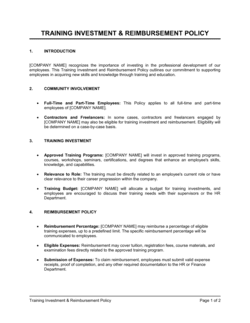
A Professional Development Reimbursement Policy is an internal HR document that defines which learning expenses the company will fund, how much it will pay per employee per year, what approval steps are required before and after spending, and under what conditions repayment may be clawed back. This free Word download gives HR teams and managers a ready-to-edit policy they can tailor to their budget, headcount, and culture, then publish to the employee handbook or intranet.
When you need it
Use it when formalizing a benefit that has been paid informally, when building out an employee handbook for the first time, or when audit or payroll teams need a documented standard to apply consistently across departments and locations.
What's inside
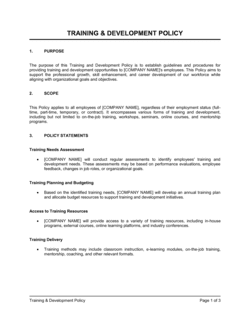
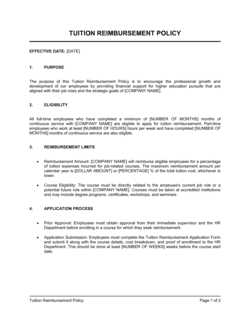
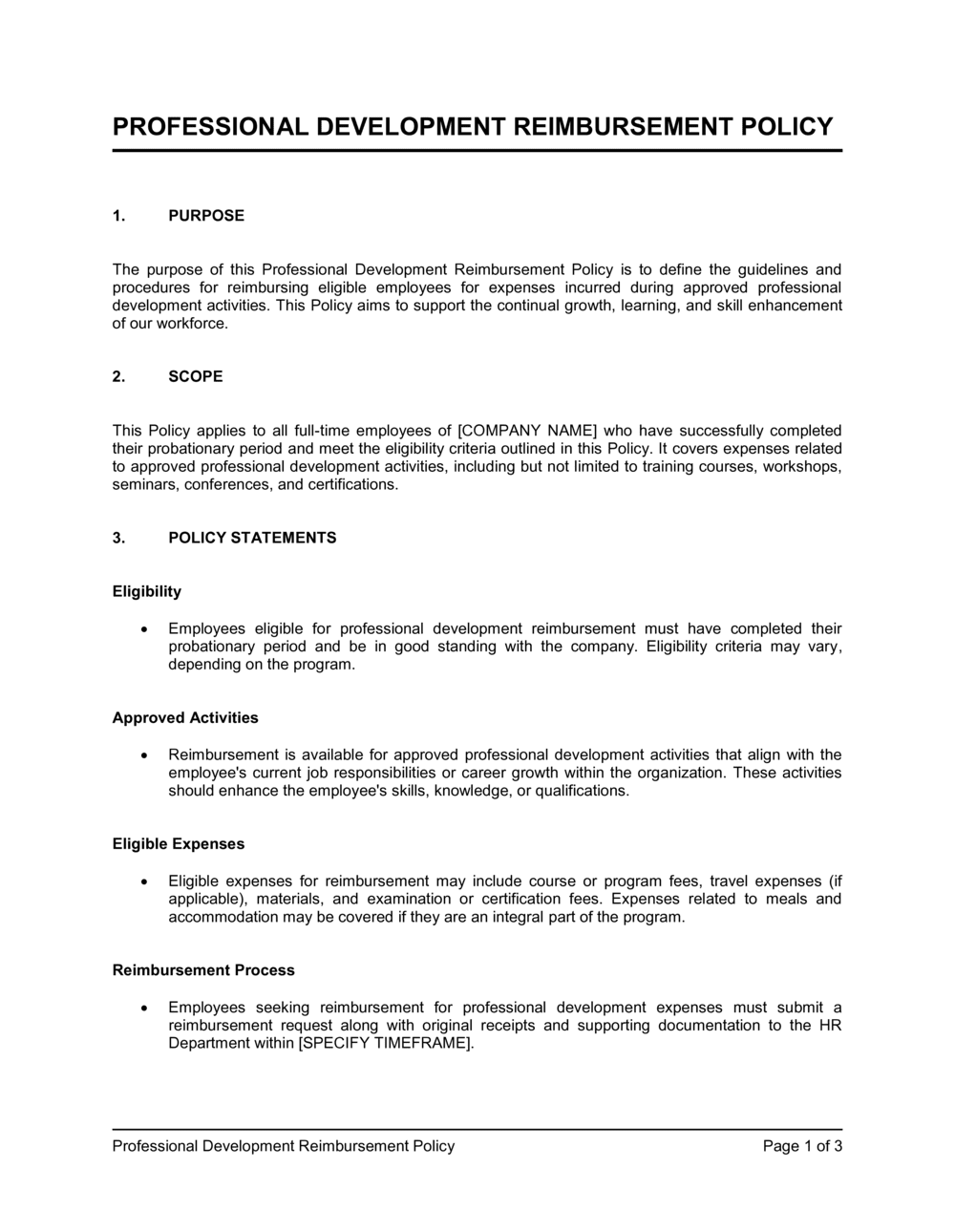
The template covers purpose and scope, eligibility criteria, a defined list of covered and excluded expense types, per-employee spending caps, the pre-approval and reimbursement request workflow, grade or performance conditions, repayment (clawback) provisions for departing employees, and tax treatment guidance for managers.

What is a Professional Development Reimbursement Policy?

A Professional Development Reimbursement Policy is an internal HR document that establishes the rules under which a company funds employee learning and growth outside of company-directed training programs. It defines which expense categories qualify β€” course tuition, certification exam fees, professional association dues, required textbooks β€” sets an annual spending cap per employee, specifies the pre-approval and reimbursement request workflow, and includes clawback provisions that protect the company if a newly-certified employee departs shortly after receiving the benefit. Without a written policy, reimbursement decisions are made informally by individual managers, leading to inconsistent outcomes, perceived favoritism, and finance reconciliation problems at year-end.

Why You Need This Document

Paying for employee development without a documented policy creates four compounding problems. First, inconsistent approvals β€” different managers applying different standards β€” expose the company to discrimination claims when similarly situated employees receive different benefits. Second, without a pre-approval requirement, employees enroll in expensive programs and submit receipts the company has no budget or obligation to cover. Third, absent a clawback clause, the company funds certifications that employees immediately use to join a competitor. Fourth, reimbursements above $5,250 per year are taxable to the employee under US law; without a policy that flags this threshold to payroll, year-end W-2 corrections and under-withholding penalties follow. A clearly written, consistently applied policy closes all four gaps, makes the benefit a credible recruiting differentiator, and gives Finance the documentation needed to budget and reconcile L&D spending accurately each year.

Which variant fits your situation?

If your situation is…Use this template
Covering full or partial tuition for degree programs at accredited universitiesTuition Reimbursement Policy
Formalizing a broader employee benefits package including wellness and lifestyle spendingEmployee Benefits Policy
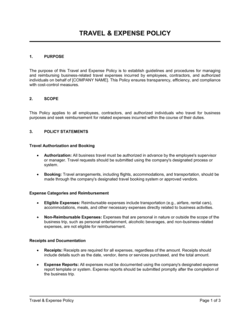
Documenting reimbursements for travel to conferences and off-site training eventsTravel and Expense Policy
Setting rules for a company-funded learning platform subscription (Coursera, LinkedIn Learning)Software and Tools Expense Policy
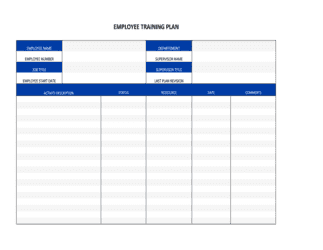
Establishing a broader employee training calendar and delivery frameworkEmployee Training Plan
Documenting the full suite of HR policies in a single reference documentEmployee Handbook
Tracking individual employee training completion and certification recordsEmployee Training Record

Common mistakes to avoid

❌ No pre-approval requirement

Why it matters: Without pre-approval, employees register for expensive programs on the assumption they will be reimbursed, then submit receipts the company has no budget or intention to cover β€” creating conflict and potential legal exposure.

Fix: Require written pre-approval before any registration or payment, with a clear form and a documented response-time commitment from HR.

❌ Vague eligible expense language

Why it matters: Phrases like 'job-related development activities' produce inconsistent approvals across managers and departments, leading to complaints of favoritism and discrimination in benefit access.

Fix: Replace open-ended language with a specific, enumerated list of covered categories and a matching list of explicit exclusions.

❌ No clawback provision for departing employees

Why it matters: Without a repayment clause, employees can collect a $5,000 certification reimbursement in January and resign in March to take a competitor role β€” at no cost to themselves.

Fix: Include a tiered repayment schedule tied to a 12-month service commitment, and ensure the clause is acknowledged in writing by the employee at the time of reimbursement.

❌ Ignoring the IRC §127 tax threshold

Why it matters: Reimbursements above $5,250 per year are taxable to the employee. Failing to flag this to payroll results in year-end W-2 corrections, employee frustration, and potential under-withholding penalties.

Fix: Include a tax treatment section in the policy and confirm with payroll that any amounts above $5,250 are automatically added to the employee's taxable wages.

❌ No grade or completion requirement

Why it matters: Reimbursing based on enrollment rather than completion means the company pays for courses employees abandon after the provider's refund deadline, with no learning outcome delivered.

Fix: Require submission of a completion certificate, transcript, or official exam result β€” and define a minimum grade threshold for graded programs β€” before releasing reimbursement.

❌ Publishing the policy without a review or amendment clause

Why it matters: If economic conditions require cutting the L&D budget, the absence of an amendment clause can expose the company to claims that the benefit has become a contractual entitlement.

Fix: Include a clause stating that the company may amend or suspend the policy with reasonable written notice, and review the policy at least annually against budget and headcount changes.

The 10 key sections, explained

Purpose and scope

Eligible expenses

Excluded expenses

Spending limits and budget allocation

Pre-approval process

Reimbursement request and payment

Performance and grade conditions

Clawback and repayment provisions

Tax treatment and reporting

Policy administration and amendments

How to fill it out

  1. 1

    Define the scope and eligibility threshold

    Enter your company name and specify which employee types are covered. Set a minimum tenure β€” typically 90 days to 6 months β€” before an employee can access the benefit.

    πŸ’‘ Aligning the eligibility period with your standard probationary period is the simplest approach and avoids a separate policy decision.

  2. 2

    Build the eligible and excluded expense lists

    Draft a specific list of covered categories β€” tuition, exam fees, textbooks, membership dues β€” and a parallel list of explicitly excluded items. Review a sample of past ad hoc reimbursements to identify categories that need explicit inclusion or exclusion.

    πŸ’‘ If in doubt whether to include a category, exclude it from the eligible list and add a discretionary exception process handled by HR rather than leaving it ambiguous.

  3. 3

    Set the annual spending cap and any level-based differentials

    Enter the maximum annual reimbursement per employee. Add proration rules for mid-year hires and, if applicable, higher caps for manager-level employees. Confirm the total budget with Finance before publishing.

    πŸ’‘ Common caps range from $1,500 per year for small businesses to $5,250 (the IRS tax-free threshold) for companies optimizing for tax efficiency.

  4. 4

    Design the pre-approval workflow

    Specify the request form employees must use, the minimum lead time before registration, required manager approval, and the HR confirmation step. Enter your target response time β€” 5 business days is a reasonable standard.

    πŸ’‘ Link the pre-approval form directly in the policy document so employees and managers can find it without a support ticket.

  5. 5

    Set the grade and completion requirements

    Choose a minimum passing grade for graded programs and define what happens at each outcome: full reimbursement, partial reimbursement, or no reimbursement. Include the post-completion submission deadline β€” 60 days is standard.

    πŸ’‘ For certifications with pass/fail scoring, require submission of the official exam result letter rather than a self-reported outcome.

  6. 6

    Draft the clawback clause and confirm payroll deduction legality

    Set the service commitment period β€” 12 months is typical β€” and the repayment schedule. Before finalizing, confirm with HR legal counsel whether paycheck deductions for clawback are permitted in every state or province where you employ staff.

    πŸ’‘ California, New York, and several Canadian provinces restrict involuntary wage deductions β€” use a promissory note structure instead for employees in those locations.

  7. 7

    Confirm tax reporting obligations with payroll

    Share the draft policy with your payroll team before publishing. Confirm that the $5,250 IRC Β§127 threshold is flagged in your payroll system and that any excess reimbursements will be added to taxable wages automatically.

    πŸ’‘ If your workforce is international, add a brief note directing non-US employees to HR for local tax guidance rather than citing only US rules.

  8. 8

    Publish, communicate, and set a review date

    Add the finalized policy to the employee handbook and intranet. Send an announcement with a summary of key limits and the pre-approval process. Set a calendar reminder for an annual policy review aligned to the start of your budget cycle.

    πŸ’‘ A one-page employee summary sheet covering the cap, eligible categories, and how to submit a request reduces HR inbox volume significantly.

Frequently asked questions

What is a professional development reimbursement policy?

A professional development reimbursement policy is an internal HR document that defines which learning and training expenses a company will fund for employees, the maximum annual amount it will pay, the pre-approval steps required before spending, and any conditions β€” such as a minimum grade or a service commitment β€” that apply to receiving and keeping the benefit. It replaces informal, manager-by-manager decisions with a consistent, documented standard applied equally across the organization.

What expenses are typically covered by a professional development reimbursement policy?

Most policies cover course tuition at accredited institutions, professional certification exam fees (such as PMP, CPA, AWS, or CFA), required textbooks and course materials, professional association membership dues, and conference registration fees. Some policies also cover online learning platform subscriptions. Personal development courses, non-accredited providers, and expenses already covered by a scholarship or grant are typically excluded.

How much should a company reimburse for professional development?

Common annual caps range from $1,500 to $5,250 per employee. The $5,250 figure aligns with the US IRS threshold under IRC Β§127, above which employer- provided educational assistance becomes taxable income to the employee. Many mid-sized companies set the cap exactly at $5,250 to maximize the tax-free benefit. Larger organizations or those in talent-competitive industries sometimes set higher caps for senior employees, accepting the additional tax complexity.

What is a clawback provision in a reimbursement policy?

A clawback provision requires an employee who leaves the company β€” voluntarily or for cause β€” within a defined period after receiving reimbursement to repay part or all of the amount funded. A typical structure requires 100% repayment if the employee departs within 6 months and 50% repayment if they depart between 6 and 12 months. Clawbacks protect the company from funding certifications that employees immediately use to move to a competitor.

Is professional development reimbursement taxable?

In the United States, employer-provided educational assistance up to $5,250 per year is excluded from an employee's gross income under IRC Β§127, meaning neither the employee nor the employer pays tax on that amount. Reimbursements above $5,250 are treated as taxable wages and must be included in the employee's W-2. Tax treatment varies in other countries β€” Canadian employees should refer to CRA guidance, and UK employees to HMRC rules on work-related training exemptions.

Do employees need pre-approval before enrolling in a course?

Yes β€” a pre-approval requirement is the single most important control in a reimbursement policy. Without it, employees register and pay for programs on the assumption the company will cover the cost, creating disputes when the request is denied after the fact. Pre-approval confirms that the expense is job-related, that budget is available, and that both the employee and manager agree the course serves a business need.

What happens if an employee fails a course the company reimbursed?

Most policies provide no reimbursement for a failed course, and if the company pre-paid tuition, the employee is typically required to repay the full amount. Some policies offer partial reimbursement for grades below the minimum threshold but above outright failure. The policy should define each outcome clearly β€” pass, minimum grade, below minimum, fail, and withdrawal β€” to avoid ad hoc decisions when these situations arise.

Can a company deduct clawback repayments from a departing employee's final paycheck?

This depends on jurisdiction. In many US states, paycheck deductions for debt repayment require prior written employee consent, and some states β€” including California and New York β€” restrict involuntary deductions even with consent. In Canada, provincial employment standards acts limit what may be deducted from wages. The safest approach is to have employees sign a promissory note at the time of reimbursement authorizing repayment, and to confirm with HR legal counsel before deducting from final pay.

How often should a professional development reimbursement policy be reviewed?

Annual review is standard, typically timed to the start of the fiscal year or budget cycle when L&D allocations are set. Reviews should check whether the spending cap reflects current market rates for relevant certifications, whether the eligible expense categories still match the company's skill priorities, and whether any legal changes β€” such as updates to the IRC Β§127 threshold or provincial wage deduction rules β€” require policy amendments.

How this compares to alternatives

vs Employee Training Plan

An employee training plan is a forward-looking calendar that schedules specific courses, instructors, and learning objectives for a team or individual. A reimbursement policy is the financial and procedural framework that governs what the company will pay for when employees seek external learning on their own. Organizations need both: the plan drives company-directed development, while the policy governs employee-initiated spending.

vs Travel and Expense Policy

A travel and expense policy covers costs incurred while traveling for business β€” flights, hotels, meals, and ground transport. A professional development reimbursement policy covers the learning costs themselves, such as tuition and exam fees. When an employee travels to attend a conference, both policies apply: the T&E policy governs travel costs and the development policy governs registration fees.

vs Employee Handbook

An employee handbook is a comprehensive reference document covering all workplace policies β€” conduct, benefits, leave, and procedures. A professional development reimbursement policy is a standalone document that can be incorporated into the handbook as a section or referenced as an appendix. Maintaining it as a standalone document makes it easier to update annual caps and eligible categories without republishing the full handbook.

vs Employee Benefits Policy

An employee benefits policy covers the full range of non-wage compensation β€” health insurance, retirement contributions, PTO, and ancillary perks. A professional development reimbursement policy is narrower in scope, focusing exclusively on learning and growth investments. In companies with a broad benefits policy, the development reimbursement section can be extracted into a standalone document to allow more detailed procedural guidance than a general benefits summary permits.

Industry-specific considerations

Technology / SaaS

Cloud certification reimbursements (AWS, GCP, Azure) dominate requests; policies often set higher caps for engineers and include online platform subscriptions as an eligible category.

Financial Services

CFA, CPA, and Series licensing exam fees are common eligible expenses; regulatory training requirements mean some reimbursements are mandatory rather than discretionary.

Healthcare

Clinical licensing renewals, CME credits, and state-mandated continuing education hours create structured eligibility criteria distinct from discretionary professional development.

Professional Services

CPA, PMP, and bar exam prep are core eligible costs; many firms tie reimbursement to the employee's billable-role progression rather than a flat annual cap.

Manufacturing

Lean Six Sigma, safety certifications, and technical trade credentials are the most common requests; policies often distinguish between company-mandated training (fully funded) and employee-initiated development (capped reimbursement).

Retail / Hospitality

High turnover makes clawback provisions especially important; eligibility thresholds of 6–12 months' tenure are common to reduce reimbursement risk on short-tenure employees.

Template vs pro β€” what fits your needs?

PathBest forCostTime
Use the templateHR teams and small business owners creating a first formal policy for a straightforward domestic workforceFree2–4 hours to customize and publish
Template + professional reviewCompanies with employees in multiple US states or Canadian provinces where clawback and payroll deduction rules vary$300–$700 for an HR attorney or employment law advisor review3–5 business days
Custom draftedEnterprises with international workforces, unionized employees, or complex multi-tier reimbursement structures requiring bespoke legal drafting$1,500–$4,0002–4 weeks

Glossary

Eligible Expense
A learning or development cost the policy explicitly covers β€” such as course tuition, exam fees, or professional membership dues β€” that an employee may submit for reimbursement.
Pre-Approval
A required sign-off from a manager or HR before an employee registers or pays for a course, confirming the expense qualifies and budget is available.
Spending Cap
The maximum dollar amount the company will reimburse per employee per calendar or fiscal year across all covered expenses.
Clawback Provision
A contractual clause requiring an employee who leaves within a defined period after receiving reimbursement to repay part or all of the amount funded.
Taxable Benefit
In the US, employer-paid educational assistance above $5,250 per year is treated as taxable income to the employee under IRC Β§127; amounts at or below that threshold are excluded from gross income.
Accredited Institution
A school or training provider recognized by a national or regional accrediting body β€” a common eligibility requirement for tuition reimbursement programs.
Job-Related Requirement
The standard that a course or certification must be reasonably connected to the employee's current role or a defined career path within the company to qualify for reimbursement.
Reimbursement Request
The formal submission an employee makes after completing a course, attaching receipts and proof of passing grade or attendance, to receive payment.
Proration
Reducing the reimbursement amount proportionally β€” for example, paying 50% if an employee passes with a grade below the minimum threshold, or if employment ends mid-year.
Learning and Development (L&D) Budget
The annual allocation of funds dedicated to employee training, professional development, and skill-building across the organization.

Part of your Business Operating System

This document is one of 3,000+ business & legal templates included in Business in a Box.

  • Fill-in-the-blanks β€” ready in minutes
  • 100% customizable Word document
  • Compatible with all office suites
  • Export to PDF and share electronically

Create your document in 3 simple steps.

From template to signed document β€” all inside one Business Operating System.
1
Download or open template

Access over 3,000+ business and legal templates for any business task, project or initiative.

2
Edit and fill in the blanks with AI

Customize your ready-made business document template and save it in the cloud.

3
Save, Share, Send, Sign

Share your files and folders with your team. Create a space of seamless collaboration.

Save time, save money, and create top-quality documents.

β˜…β˜…β˜…β˜…β˜…

"Fantastic value! I'm not sure how I'd do without it. It's worth its weight in gold and paid back for itself many times."

Managing Director Β· Mall Farm
Robert Whalley
Managing Director, Mall Farm Proprietary Limited
β˜…β˜…β˜…β˜…β˜…

"I have been using Business in a Box for years. It has been the most useful source of templates I have encountered. I recommend it to anyone."

Business Owner Β· 4+ years
Dr Michael John Freestone
Business Owner
β˜…β˜…β˜…β˜…β˜…

"It has been a life saver so many times I have lost count. Business in a Box has saved me so much time and as you know, time is money."

Owner Β· Upstate Web
David G. Moore Jr.
Owner, Upstate Web

Run your business with a system β€” not scattered tools

Stop downloading documents. Start operating with clarity. Business in a Box gives you the Business Operating System used by over 250,000 companies worldwide to structure, run, and grow their business.

Start freeΒ Β·Β No credit card required