- TAM (Total Addressable Market)
- The total annual revenue opportunity available for a product or service if it captured 100% of its target market with no competitive constraint.
- SAM (Serviceable Addressable Market)
- The portion of the TAM that a company can realistically reach given its current business model, geographic focus, and product scope.
- SOM (Serviceable Obtainable Market)
- The share of the SAM a company can realistically capture in the near term, accounting for competition, sales capacity, and go-to-market constraints.
- Market Penetration Rate
- The percentage of a target market currently using a product or service — used as a baseline when projecting growth potential.
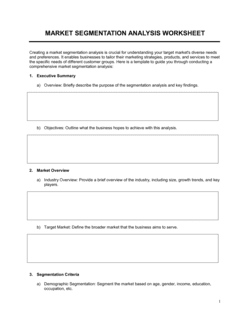
- Customer Segmentation
- The process of dividing a target market into distinct groups based on shared characteristics — such as industry, company size, geography, or behavior — to identify the highest-priority buyers.
- Competitive Moat
- A durable structural advantage — such as switching costs, network effects, or proprietary data — that makes a competitive position difficult for others to replicate.
- Market CAGR
- Compound Annual Growth Rate — the annualized rate at which a market's value is projected to grow over a defined period, used to compare attractiveness across opportunities.
- Whitespace
- An unserved or underserved segment of a market where no competitor currently offers a strong solution, representing a potential entry point.
- Porter's Five Forces
- A framework for evaluating industry attractiveness based on competitive rivalry, threat of new entrants, threat of substitutes, buyer power, and supplier power.
- Go-to-Market Fit
- The degree to which a company's sales channels, pricing, and messaging are aligned with how target customers in a given market actually discover and buy solutions.
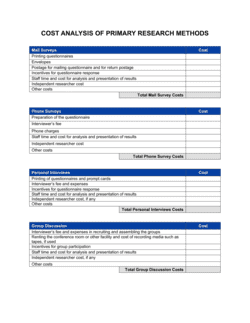
- Primary Research
- Market data collected directly from target customers through surveys, interviews, or focus groups — as opposed to secondary research from published reports.