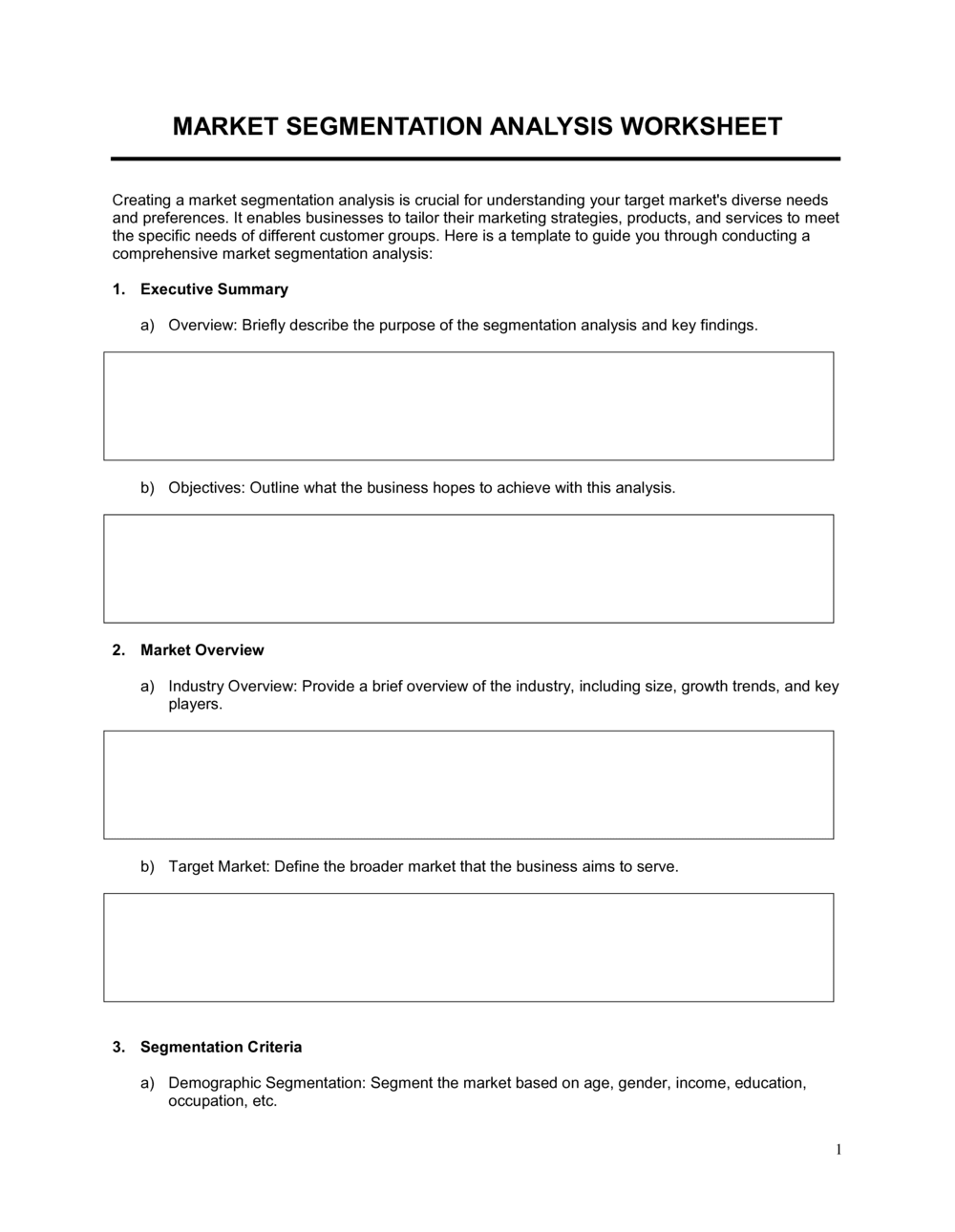
Worksheet Market Segmentation Analysis

Free download β€’ Use as a template β€’ Print or share

5 pagesβ€’20–30 min to useβ€’Difficulty: Standard
Learn more ↓
FreeWorksheet Market Segmentation Analysis Template

At a glance

What it is
A Market Segmentation Analysis Worksheet is a structured operational document that divides a total addressable market into distinct, actionable customer groups based on shared characteristics β€” demographics, firmographics, psychographics, behavior, or geography. This free Word download walks you through each segmentation dimension, prompts the supporting data you need, and produces a prioritized segment map you can act on immediately.
When you need it
Use it when launching a new product or entering a new market, when existing marketing spend is underperforming, or when leadership needs a common framework for which customers to pursue and in what order. It is also the first analytical step before writing a go-to-market plan, pricing strategy, or ICP definition.
What's inside
Segmentation criteria definitions, a data-collection inventory, segment profiling tables, attractiveness scoring, a prioritization matrix, positioning notes per segment, and an action-planning section that connects each segment to a specific next step.

What is a Market Segmentation Analysis Worksheet?

A Market Segmentation Analysis Worksheet is a structured operational document that guides a business through dividing its total addressable market into distinct, actionable customer groups based on shared characteristics β€” demographics, firmographics, psychographics, buying behavior, or geography. It combines qualitative segment profiling with quantitative attractiveness scoring so marketing, sales, and product teams arrive at a shared, evidence-based answer to the question every growth plan depends on: which customers should we pursue first, and why? Unlike a high-level market overview, this worksheet produces a ranked segment map with positioning notes and a concrete action plan attached to each priority group.

Why You Need This Document

Without a completed segmentation analysis, marketing budgets get spread evenly across audiences with very different conversion rates, sales teams pursue deals that look alike on the surface but close at wildly different rates, and product roadmaps get pulled in every direction by customer requests that represent minority segments. The cost of skipping it is real and measurable: campaigns that address everyone address no one effectively, and pricing set without segment-level willingness-to-pay data leaves revenue on the table in high-value segments while pricing the business out of cost-sensitive ones. This worksheet forces the analytical discipline that turns a general market definition into a focused, prioritized target list β€” giving every downstream plan, from go-to-market to product strategy, a factual foundation to build on rather than an assumption to defend.

Which variant fits your situation?

If your situation is…Use this template
Segmenting a B2C consumer market by lifestyle and valuesPsychographic Segmentation Worksheet
Segmenting a B2B market by company size, industry, and budgetFirmographic Segmentation Worksheet
Mapping segments to a full go-to-market launch planGo-to-Market Strategy Template
Defining a single ideal customer profile in detailIdeal Customer Profile (ICP) Template
Sizing each segment's revenue potentialMarket Analysis Template
Translating segment insights into a marketing planMarketing Plan Template
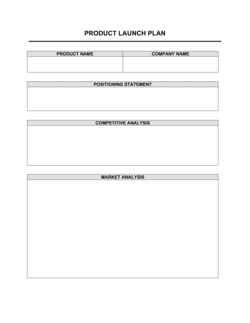
Prioritizing segments for a new product launchProduct Launch Plan Template

Common mistakes to avoid

❌ Defining the market too broadly

Why it matters: Segments derived from an overwide market definition are too large to target meaningfully β€” every segment becomes a mass-market play that requires resources most companies do not have.

Fix: Narrow the market definition to the specific use case, geography, or buyer type your current product and sales capacity can realistically serve in the next 12–24 months.

❌ Choosing segmentation criteria based on data availability, not buying behavior

Why it matters: Segmenting by the variables that happen to be in your CRM β€” rather than the variables that predict purchase decisions β€” produces groups that look different on a spreadsheet but respond identically to your campaigns.

Fix: Start by asking which customer characteristics actually explain why someone buys, stays, or churns. Then find or collect data for those variables, even if it requires primary research.

❌ Treating all segments as Priority A

Why it matters: A segmentation that refuses to deprioritize anything delivers no focus. Every segment gets a partial effort and none gets a winning one.

Fix: Force a ranking by applying the attractiveness scoring rigorously and committing to active investment in no more than two to three segments per planning cycle.

❌ Completing the analysis without assigning action owners

Why it matters: Segment analysis with no named owners and deadlines sits in a shared folder and influences nothing. Strategy documents without execution accountability have a near-zero conversion rate to actual market activity.

Fix: Before the worksheet is finalized, every Priority A segment must have at least one named next step with an owner, a due date, and a measurable output.

The 10 key sections, explained

Market overview and scope

Segmentation criteria selection

Data inventory and sources

Segment identification and profiles

Segment sizing and revenue potential

Segment attractiveness scoring

Competitive landscape per segment

Positioning and messaging notes

Segment prioritization and resource allocation

Action plan and next steps

How to fill it out

  1. 1

    Define the market scope and boundaries

    Start by writing a one-sentence description of the total market, the product or service being analyzed, and the geographic and time scope of the analysis. Be specific enough that two people reading the scope would make identical decisions about what data to include.

    πŸ’‘ If you find yourself describing a market broader than what your sales team could realistically close in 24 months, narrow the scope before proceeding.

  2. 2

    Select segmentation criteria based on buying behavior

    Choose the two to three dimensions that best predict different purchasing decisions in your market. For B2B, start with firmographics (company size, industry, budget). For B2C, start with demographics and behavioral patterns.

    πŸ’‘ The best segmentation criterion is one that explains why two groups would need a meaningfully different product, message, or channel β€” not just a different ad creative.

  3. 3

    Inventory your data sources and note gaps

    List every internal and external data source you will use, its publication or export date, and the sample size. Flag any gaps that could materially affect the analysis and note how you plan to fill them.

    πŸ’‘ A gap log forces the team to make deliberate decisions about data quality rather than silently using weak sources.

  4. 4

    Build a profile for each identified segment

    Complete a profile row for every segment: size estimate, key demographic or firmographic characteristics, primary unmet need, current solution, and the trigger that would prompt a switch. Aim for four to six distinct segments.

    πŸ’‘ If two segments have the same trigger and the same current solution, merge them β€” the distinction is not actionable.

  5. 5

    Size each segment using bottoms-up logic

    Estimate TAM, SAM, and SOM for each segment by counting reachable buyers and multiplying by average contract value and realistic win rate. Cross-check against any available top-down market data.

    πŸ’‘ If your bottom-up SOM and top-down market share calculation differ by more than 40%, revisit your win rate or ACV assumptions.

  6. 6

    Score each segment on attractiveness criteria

    Rate every segment on size, growth rate, competitive intensity, fit with your product, channel reachability, and gross margin potential. Use a 1–5 scale for each criterion and sum the scores. Adjust criteria weights to reflect your strategic context.

    πŸ’‘ Run the scoring with two or three team members independently, then discuss divergent scores β€” the disagreements reveal hidden assumptions about strategy.

  7. 7

    Write differentiated positioning for each priority segment

    For your Priority A and B segments, write a distinct value proposition that addresses their specific trigger and differentiates you from the competitors active in that segment.

    πŸ’‘ Test each positioning statement by asking: could a competitor claim this same sentence? If yes, it is not differentiated enough.

  8. 8

    Assign owners and deadlines in the action plan

    For each priority segment, record at least two concrete next steps with a named owner, a due date, and a success metric. Schedule a review checkpoint no more than 90 days out.

    πŸ’‘ The action plan section is the only part of the worksheet that directly generates revenue β€” treat it with as much rigor as the analysis itself.

Frequently asked questions

What is a market segmentation analysis worksheet?

A market segmentation analysis worksheet is a structured document that guides a team through dividing a total market into distinct customer groups, sizing each group's revenue potential, scoring their relative attractiveness, and translating those findings into a prioritized action plan. It combines qualitative profiling with quantitative scoring so marketing, sales, and product teams share a single, evidence-based view of which customers to pursue and why.

What are the main types of market segmentation?

The five most common segmentation types are demographic (age, income, occupation), firmographic (industry, company size, revenue band), psychographic (values, lifestyle, attitudes), behavioral (purchase frequency, usage rate, loyalty), and geographic (region, city size, climate). Most effective analyses combine two or three of these dimensions rather than relying on a single variable to predict meaningfully different buying behavior.

How many market segments should I identify?

Four to six distinct segments is the practical range for most businesses. Fewer than four typically means the market has not been divided finely enough to produce actionable differences in messaging or channel. More than six often means the team lacks the resources to pursue each segment with a differentiated approach, and the analysis becomes a list rather than a strategy.

What data do I need to complete a market segmentation analysis?

You need a combination of internal data β€” CRM records, sales call notes, win/loss reports, and customer surveys β€” and external data such as industry research reports, government census or trade data, and competitor pricing information. Identify data gaps at the start of the process and decide explicitly whether to fill them with primary research or to flag them as assumptions in the analysis.

How is a market segmentation worksheet different from a buyer persona?

A market segmentation worksheet produces a map of all meaningful customer groups in a market, sized and scored for strategic prioritization. A buyer persona is a detailed narrative profile of a single representative individual within one of those segments. The worksheet comes first and tells you which segments to pursue; the persona comes second and gives your team a concrete human to design messaging and product decisions around.

How often should a market segmentation analysis be updated?

A full segmentation refresh is typically warranted annually or whenever the business enters a new market, launches a significantly different product, or observes a material shift in competitive dynamics or customer behavior. Segment attractiveness scores should be reviewed quarterly against pipeline data to confirm that prioritized segments are actually converting at the expected rate.

Can a small business use this worksheet, or is it only for large companies?

Small businesses benefit from segmentation analysis as much as large ones β€” arguably more, because limited marketing and sales resources make focus even more critical. A small business does not need a 50-page research report; a completed worksheet built from CRM data, a handful of customer interviews, and one or two industry data sources is sufficient to drive meaningfully better targeting decisions.

What is segment attractiveness scoring and how do I weight the criteria?

Attractiveness scoring assigns a numeric rating β€” typically 1 to 5 β€” to each segment across criteria such as market size, growth rate, competitive intensity, product fit, and channel reachability, then sums the scores to rank segments. Weights should reflect your strategic situation: a business with limited distribution should weight channel reachability higher than one with an established direct sales team. There is no universal weighting; make your weights explicit and document the rationale so the team can debate them openly.

How does market segmentation connect to pricing strategy?

Different segments typically have different willingness to pay, driven by the value they receive, their budget constraints, and the alternatives available to them. A segmentation worksheet that captures these differences β€” particularly gross margin profiles and competitive pricing in each segment β€” provides the direct inputs for a tiered or segment-specific pricing model. Pricing a single offer uniformly across segments with very different WTP leaves revenue on the table in high-value segments and prices you out of cost-sensitive ones.

How this compares to alternatives

vs Market Analysis Template

A market analysis covers macroeconomic trends, industry size, growth drivers, and competitive forces at the total-market level. A segmentation analysis worksheet goes one level deeper β€” it divides that market into distinct customer groups, scores their attractiveness, and produces a prioritized target list. Use the market analysis to establish context, then use this worksheet to identify which slice of that market to pursue first.

vs Ideal Customer Profile (ICP) Template

An ICP template describes a single target customer type in high detail β€” industry, company size, budget, decision-maker title, and pain point. A segmentation worksheet produces the map of all possible segments from which the ICP is then chosen. Complete the segmentation analysis first to determine which segment to prioritize, then build the ICP as the detailed specification of the winner.

vs Marketing Plan Template

A marketing plan defines campaigns, channels, budgets, and timelines for reaching and converting customers. It assumes you already know which customers to target. A segmentation worksheet is the analytical input that answers that question β€” without it, a marketing plan is built on assumption rather than evidence.

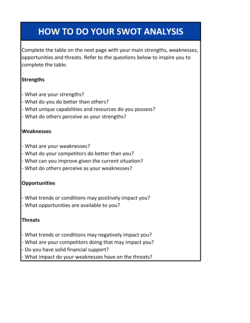
vs SWOT Analysis Template

A SWOT analysis evaluates internal strengths and weaknesses against external opportunities and threats at the company level. A segmentation worksheet focuses specifically on the external demand side β€” who the customers are, how they differ, and which groups represent the best opportunity. They are complementary: SWOT frames the strategic context; segmentation identifies where to act within it.

Industry-specific considerations

SaaS / Technology

Segments built on firmographic variables (company size, tech stack, growth rate) and behavioral data (trial conversion, feature usage, churn patterns) directly feed ICP definitions and product-led growth targeting.

Retail / E-commerce

Behavioral and demographic segmentation drives catalog personalization, email flow logic, and paid media audience targeting β€” each segment mapped to a distinct average order value and repeat-purchase rate.

Professional Services

Firmographic segmentation by industry vertical and company revenue band informs service packaging, pricing tiers, and the decision of which practice areas to invest in or exit.

Healthcare / MedTech

Segments defined by care setting (hospital, clinic, home), payer type, and patient population determine reimbursement strategy, regulatory pathway, and sales channel β€” making rigorous segmentation a prerequisite for commercial planning.

Template vs pro β€” what fits your needs?

PathBest forCostTime
Use the templateMarketing managers, founders, and product teams running segmentation for an existing business with internal data availableFree4–8 hours to complete with existing data
Template + professional reviewTeams entering a new market with limited internal data who need external research validation$500–$2,000 for a market research or strategy advisor session1–2 weeks including research
Custom draftedEnterprise teams, PE-backed companies, or businesses making acquisition or major market-entry decisions requiring primary research$5,000–$25,000 for a full custom segmentation study4–8 weeks

Glossary

Market Segmentation
The process of dividing a broad target market into smaller, homogeneous groups whose members share common needs or responses to marketing stimuli.
Demographic Segmentation
Grouping customers by measurable personal characteristics such as age, gender, income, education level, or occupation.
Firmographic Segmentation
B2B equivalent of demographics β€” grouping businesses by industry, company size, revenue band, or geographic location.
Psychographic Segmentation
Grouping customers by personality traits, values, attitudes, interests, or lifestyle patterns rather than observable demographics.
Behavioral Segmentation
Grouping customers by how they interact with a product or category β€” purchase frequency, usage rate, brand loyalty, or buying occasion.
Geographic Segmentation
Dividing a market by physical location β€” country, region, city size, climate zone, or urban versus rural setting.
Segment Attractiveness
A scored assessment of how desirable a segment is to pursue, typically weighing size, growth rate, competitive intensity, and fit with company capabilities.
ICP (Ideal Customer Profile)
A detailed description of the hypothetical company or person who would get the most value from your product and is most likely to buy and retain.
Positioning
The deliberate choice of how a product or brand is perceived relative to competitors in the mind of a specific customer segment.
Segment Persona
A semi-fictional representative of a customer segment, used to make abstract segment data concrete enough to inform messaging, product, and sales decisions.
TAM / SAM / SOM
Total Addressable Market, Serviceable Addressable Market, and Serviceable Obtainable Market β€” three nested measures used to size each segment's revenue potential.

Part of your Business Operating System

This document is one of 3,000+ business & legal templates included in Business in a Box.

  • Fill-in-the-blanks β€” ready in minutes
  • 100% customizable Word document
  • Compatible with all office suites
  • Export to PDF and share electronically

Create your document in 3 simple steps.

From template to signed document β€” all inside one Business Operating System.
1
Download or open template

Access over 3,000+ business and legal templates for any business task, project or initiative.

2
Edit and fill in the blanks with AI

Customize your ready-made business document template and save it in the cloud.

3
Save, Share, Send, Sign

Share your files and folders with your team. Create a space of seamless collaboration.

Save time, save money, and create top-quality documents.

β˜…β˜…β˜…β˜…β˜…

"Fantastic value! I'm not sure how I'd do without it. It's worth its weight in gold and paid back for itself many times."

Managing Director Β· Mall Farm
Robert Whalley
Managing Director, Mall Farm Proprietary Limited
β˜…β˜…β˜…β˜…β˜…

"I have been using Business in a Box for years. It has been the most useful source of templates I have encountered. I recommend it to anyone."

Business Owner Β· 4+ years
Dr Michael John Freestone
Business Owner
β˜…β˜…β˜…β˜…β˜…

"It has been a life saver so many times I have lost count. Business in a Box has saved me so much time and as you know, time is money."

Owner Β· Upstate Web
David G. Moore Jr.
Owner, Upstate Web

Run your business with a system β€” not scattered tools

Stop downloading documents. Start operating with clarity. Business in a Box gives you the Business Operating System used by over 250,000 companies worldwide to structure, run, and grow their business.

Start freeΒ Β·Β No credit card required