Manufacturer Representative Agreement Template

Free Word download • Edit online • Save & share with Drive • Export to PDF

4 pages25–35 min to fillDifficulty: ComplexSignature requiredLegal review recommended
Learn more ↓
FreeManufacturer Representative Agreement Template

At a glance

What it is
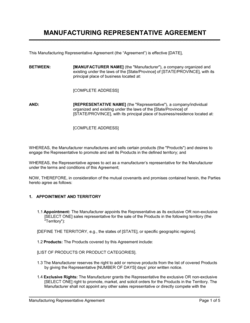
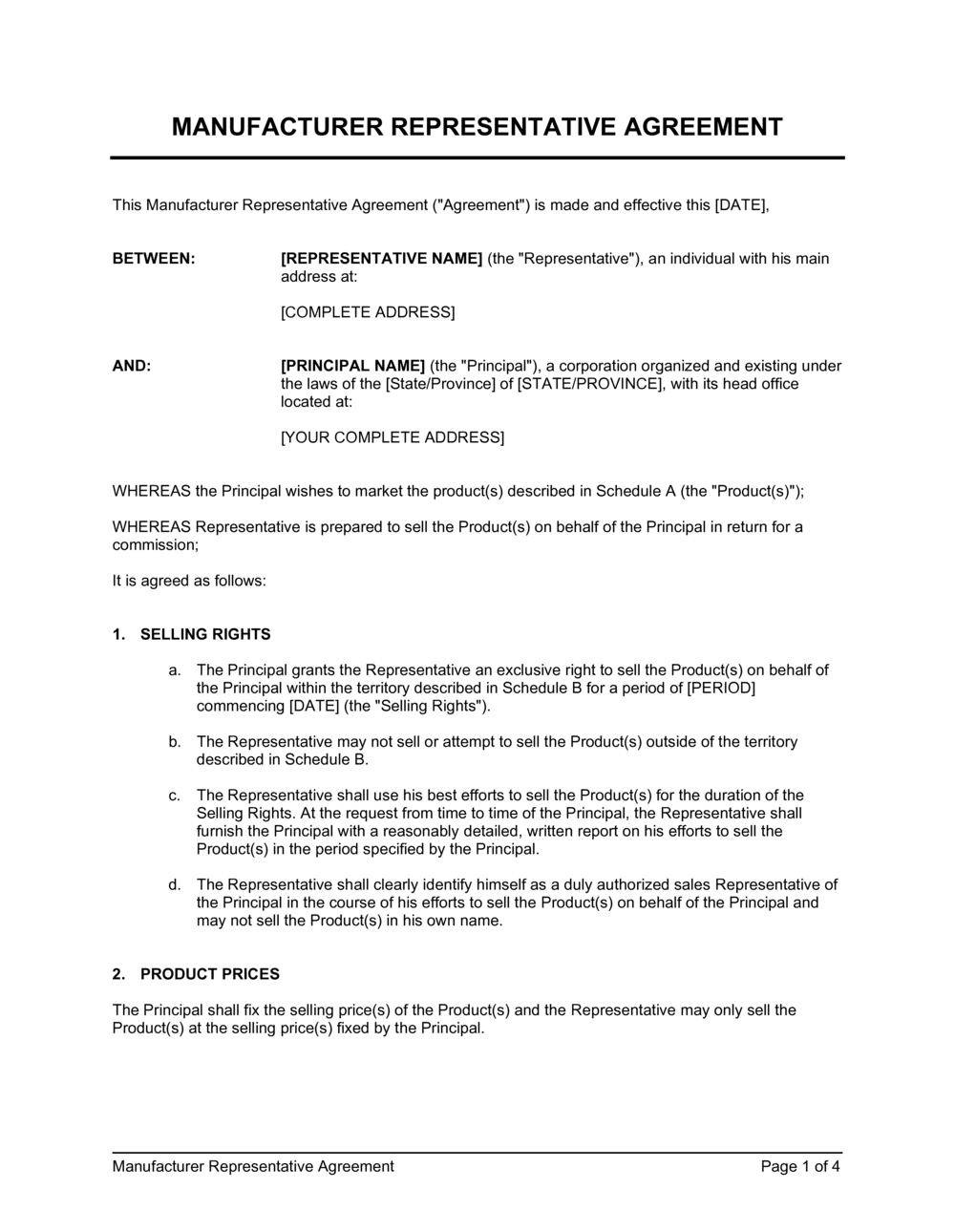
A Manufacturer Representative Agreement is a legally binding contract between a manufacturer or supplier and an independent sales representative who promotes and sells the manufacturer's products within a defined territory in exchange for a commission. This template is a free Word download you can edit online and export as PDF — covering territory, commission rates, exclusivity, performance targets, IP use, confidentiality, and termination in a single structured document.
When you need it
Use it whenever you engage an independent sales rep or agency to sell your products on your behalf, or whenever you take on a sales representative role for a manufacturer without a formal agreement in place. It is also required before granting territory exclusivity or agreeing to commission structures that differ from your standard terms.
What's inside
Appointment and territory definition, products covered, commission rates and payment schedule, performance benchmarks, exclusivity terms, intellectual property and trademark use, confidentiality obligations, and termination conditions including tail commission and non-compete provisions.

What is a Manufacturer Representative Agreement?

A Manufacturer Representative Agreement is a legally binding contract between a manufacturer or supplier (the "Principal") and an independent sales representative who solicits orders for the manufacturer's products within a defined territory in exchange for a commission. Unlike an employee or distributor, a manufacturer representative operates as an independent contractor — they do not take title to the goods, do not receive a salary, and bear their own business expenses. The manufacturer invoices customers directly and retains full pricing control; the rep earns a percentage of every order that ships to a customer within their territory. This template is a free Word download covering appointment and scope, territory rights, commission calculation, performance quotas, exclusivity, IP licensing, confidentiality, and termination — including tail commission provisions that determine what the rep earns after the agreement ends.

Why You Need This Document

Operating a manufacturer representative relationship without a written agreement is one of the most reliably expensive mistakes in B2B sales channel management. Without a signed contract, there is no agreed definition of territory — meaning two reps can each claim commission on the same order and leave you paying twice. There is no defined commission base, so every return, freight charge, or volume discount becomes a dispute. There is no tail commission period, giving terminated reps strong grounds to claim indefinite entitlement to commission on pipeline they developed. And in more than 35 US states, sales representative protection statutes impose statutory penalties — often double or triple the unpaid commission — on manufacturers who fail to pay on time after termination, regardless of what an informal arrangement said. A properly executed manufacturer representative agreement closes all of these exposures before the first sales call is made, and gives both parties a clear, enforceable record of exactly what was agreed.

Which variant fits your situation?

If your situation is…Use this template
Granting a rep exclusive rights to a defined territoryExclusive Manufacturer Representative Agreement
Appointing multiple reps in the same region without exclusivityNon-Exclusive Sales Representative Agreement
Engaging a distributor who takes title to the goods and resellsDistribution Agreement
Hiring a commission-only internal salesperson as an employeeSales Commission Agreement
Appointing a rep to sell internationally across multiple countriesInternational Sales Representative Agreement
Engaging a stocking rep who holds inventory on consignmentConsignment Agreement
Appointing an agent with authority to bind contracts on your behalfAgency Agreement

Common mistakes to avoid

❌ Vague or overlapping territory definitions

Why it matters: When two reps each believe they hold rights to a customer or region, commission disputes are inevitable — and litigation to resolve them can cost more than the commissions at stake.

Fix: List every state or named account explicitly in Schedule B and confirm no overlap with any other rep agreement before signing.

❌ No definition of when commission is earned

Why it matters: If the agreement is silent, a rep who introduces a customer and then gets terminated can argue commission is owed on every future order from that customer indefinitely — a claim courts have upheld in some jurisdictions.

Fix: State explicitly whether commission is earned on order placement, shipment, or customer payment, and define the tail period precisely.

❌ Treating the rep as an employee in practice

Why it matters: Requiring a rep to attend mandatory daily meetings, use company equipment, or follow a set schedule creates an employment relationship regardless of what the contract says — triggering tax withholding obligations, benefit liability, and misclassification penalties.

Fix: Limit manufacturer direction to outcomes (sales targets, reporting) rather than methods (how, when, and where to work). Review actual working practices against IRS and state-level contractor tests before signing.

❌ No rep protection statute compliance check

Why it matters: At least 35 US states have enacted sales representative protection statutes that override contract terms on commission payment timing and impose statutory damages — sometimes double or triple the unpaid commission — for non-compliance.

Fix: Identify every state where the rep operates and review applicable rep protection statutes before finalizing payment terms and termination provisions.

❌ Omitting chargebacks and returns language

Why it matters: Without chargeback provisions, manufacturers who pay commission on shipment have no contractual basis to recover those amounts when a customer later returns goods or cancels — creating a windfall for the rep at the manufacturer's expense.

Fix: Define chargebacks explicitly: commission paid on returned or cancelled orders is deducted from the next commission payment, with a detailed reconciliation statement provided.

❌ No tail commission clause

Why it matters: A rep who spent 12 months building a customer pipeline and gets terminated just before a major order ships has no protection without a tail commission clause — and will challenge the termination through every available legal channel.

Fix: Include a tail commission provision covering orders placed by introduced customers within 90 to 120 days of termination, conditioned on the rep not being terminated for cause.

The 10 key clauses, explained

Appointment and scope of authority

In plain language: Establishes the representative's role as an independent agent authorized to solicit orders for specified products — and clarifies what the rep is not authorized to do, such as binding contracts or extending credit.

Sample language
[MANUFACTURER NAME] hereby appoints [REP NAME] as its non-exclusive / exclusive sales representative for the Products listed in Schedule A within the Territory defined in Schedule B. Representative is authorized to solicit orders only and has no authority to accept orders, make representations, or extend credit on behalf of [MANUFACTURER NAME].

Common mistake: Failing to limit the rep's authority explicitly. Without a clear statement that the rep cannot bind contracts, third parties may argue the rep entered agreements on the manufacturer's behalf, creating unintended liability.

Territory definition

In plain language: Defines the geographic area or named accounts within which the rep is authorized to operate, and whether the territory is exclusive or non-exclusive.

Sample language
Territory: The states of [STATE LIST], as set out in Schedule B. This appointment is [exclusive / non-exclusive]. Manufacturer reserves the right to sell directly to House Accounts listed in Schedule C without commission obligation.

Common mistake: Defining territory vaguely as 'the Southeast' or 'the Midwest' without naming specific states. Ambiguous territory definitions are a leading cause of commission disputes and litigation.

Products covered

In plain language: Lists the specific product lines the rep is authorized to sell and carves out any products the manufacturer handles through other channels.

Sample language
Representative is authorized to solicit orders for the products listed in Schedule A ('Products') only. Manufacturer may add or remove Products from Schedule A on [30] days' written notice. Products not listed in Schedule A are excluded from this Agreement.

Common mistake: Using an open-ended products clause that covers 'all current and future products.' This prevents the manufacturer from launching new lines through different channels without triggering commission obligations.

Commission rate, calculation, and payment

In plain language: States the commission percentage, how it is calculated (on gross invoice, net invoice, or collected amounts), when it is earned, and the payment schedule.

Sample language
Manufacturer shall pay Representative a commission of [X]% of the Net Invoice Amount of each order shipped to a customer within the Territory and accepted by Manufacturer. Commission is earned upon shipment. Payment is due within [30] days of the end of the month in which the order is shipped. 'Net Invoice Amount' means the invoiced price less returns, allowances, and freight.

Common mistake: Not defining when commission is 'earned' — on order placement, shipment, or customer payment. Leaving this undefined means disputes arise every time a customer pays late or cancels after shipment.

Performance quotas and minimum sales targets

In plain language: Sets minimum sales volume or revenue thresholds the rep must achieve to retain exclusivity or the appointment, and the consequence of missing targets.

Sample language
Representative shall use commercially reasonable efforts to achieve minimum annual Net Sales of $[AMOUNT] within the Territory ('Quota'). Failure to achieve the Quota in any calendar year shall give Manufacturer the right to convert the appointment to non-exclusive or terminate this Agreement on [60] days' notice.

Common mistake: Setting a Quota with no defined consequence for missing it. Without a stated remedy, the manufacturer has no contractual basis to reduce the territory or end the exclusivity arrangement.

Independent contractor status and expenses

In plain language: Confirms the rep is an independent contractor, not an employee, and that the rep bears their own operating costs — travel, samples, trade shows — unless otherwise agreed.

Sample language
Representative is an independent contractor and not an employee, agent, partner, or joint venturer of Manufacturer. Representative is solely responsible for all taxes, insurance, and business expenses incurred in performing services under this Agreement. Manufacturer shall not withhold taxes on commission payments.

Common mistake: Omitting an independent contractor clause and then directing the rep's day-to-day activities — time, methods, and tools — in a way that creates an employee relationship. Misclassification triggers back taxes, benefits liability, and regulatory penalties.

Intellectual property and trademark use

In plain language: Grants the rep a limited right to use the manufacturer's trademarks and product materials for promotional purposes and restricts any other IP use.

Sample language
Manufacturer grants Representative a limited, non-exclusive, non-transferable license to use Manufacturer's trademarks, trade names, and product literature solely for soliciting orders under this Agreement. Representative shall not modify, sublicense, or use Manufacturer's IP for any other purpose. This license terminates automatically upon expiration or termination of this Agreement.

Common mistake: Granting a trademark license with no use guidelines or approval right. Reps using the manufacturer's brand inconsistently — wrong colors, wrong context — create trademark dilution risk and customer confusion.

Confidentiality

In plain language: Obligates the rep to protect the manufacturer's pricing, customer lists, product roadmaps, and trade secrets during and after the agreement.

Sample language
Representative shall keep confidential all Confidential Information of Manufacturer and shall not disclose or use it for any purpose other than performing under this Agreement. 'Confidential Information' includes pricing, customer data, product specifications, and business strategies. This obligation survives termination for [3] years.

Common mistake: No post-termination survival period on confidentiality. A rep who leaves can immediately share pricing and customer data with a competing line unless the clause explicitly survives the agreement's end.

Termination, notice, and tail commission

In plain language: States the notice periods for termination with and without cause, what happens to in-flight orders, and the tail commission period during which the rep earns commission on orders from introduced customers.

Sample language
Either party may terminate this Agreement without cause on [60] days' written notice. Manufacturer may terminate for Cause immediately. Following termination, Representative shall be entitled to commission on orders from Territory customers placed within [90] days of the termination date ('Tail Period'), provided the customer was introduced by Representative prior to termination.

Common mistake: No tail commission provision at all. Without one, a rep who spent months developing a customer relationship receives nothing if the manufacturer terminates just before a large order is placed — creating disputes and potential statutory claims in some US states.

Non-compete and non-solicitation

In plain language: Restricts the rep from representing competing product lines during the agreement and, for a limited period after termination, from soliciting the manufacturer's customers on behalf of a competitor.

Sample language
During the term of this Agreement, Representative shall not represent any Competing Product within the Territory without prior written consent. For [12] months following termination, Representative shall not solicit any customer of Manufacturer in the Territory to purchase a Competing Product. 'Competing Product' means [DESCRIPTION].

Common mistake: Defining 'Competing Product' so broadly it covers unrelated product categories. An overreaching definition prevents the rep from earning a living, making the clause likely to be struck down as unreasonable by a court.

How to fill it out

  1. 1

    Identify both parties with full legal names

    Enter the manufacturer's registered legal entity name — not a brand name — and the representative's full legal name or business entity name. Include addresses and, for corporate entities, the state of incorporation.

    💡 Confirm the manufacturer entity name matches the name on product invoices. Mismatches create downstream commission payment complications.

  2. 2

    Define the territory precisely in Schedule B

    List every state, province, or country covered. If the territory includes named accounts rather than geography, list each account by legal name. Specify whether the appointment is exclusive or non-exclusive and list any house accounts the manufacturer retains.

    💡 A map attachment is not a substitute for a written list — courts interpret geographic ambiguity against the drafter.

  3. 3

    List covered products in Schedule A

    Enumerate every product line by SKU range, product family, or category name. Add a clause allowing the manufacturer to amend Schedule A on 30 days' notice to preserve flexibility for new product launches.

    💡 If the rep will handle only part of the product catalog, a clear product schedule prevents commission disputes on lines they were never authorized to sell.

  4. 4

    Set the commission rate and define 'net invoice amount'

    Enter the commission percentage and spell out exactly how the base is calculated — gross invoice, net of returns, net of freight, or net of discounts. State when commission is earned (shipment vs. payment) and the payment cycle.

    💡 Defining the commission base in writing prevents the most common rep disputes. 'Net invoice amount' should exclude freight, taxes, and credits that the rep did not influence.

  5. 5

    Set performance quotas and consequences

    Enter annual minimum sales targets and specify what happens if they are missed — conversion from exclusive to non-exclusive, territory reduction, or right to terminate. Tie quotas to realistic market data, not aspirational targets.

    💡 Quotas set above realistic market potential breed resentment and early termination. Use Year 1 as a ramp year with a lower threshold.

  6. 6

    Confirm independent contractor status and expense responsibility

    Review the independent contractor clause and confirm the manufacturer's day-to-day working relationship with the rep is consistent with contractor status — no fixed hours, no direction of methods, no company equipment required.

    💡 If you will require the rep to attend weekly sales calls, use company tools, or follow a set schedule, consult an employment lawyer before signing — these factors point toward an employment relationship.

  7. 7

    Set termination notice periods and tail commission window

    Enter the notice period for termination without cause (60–90 days is standard for established rep relationships) and the tail commission period (typically 60–120 days). Define 'introduced customer' clearly to avoid tail period disputes.

    💡 Several US states — California, Illinois, and others — have rep protection statutes that require prompt post-termination commission payment and impose penalties for non-compliance regardless of what the contract says.

  8. 8

    Sign before the representative begins any sales activity

    Both parties must execute the agreement before the rep makes any customer contact on the manufacturer's behalf. Retroactive agreements create disputes over commission on early sales and complicate independent contractor classification.

    💡 Use Business in a Box eSign to timestamp execution and store the fully executed copy in BIB Drive alongside Schedule A and Schedule B.

Frequently asked questions

What is a manufacturer representative agreement?

A manufacturer representative agreement is a legally binding contract between a manufacturer or supplier and an independent sales representative who solicits orders for the manufacturer's products within a defined territory in exchange for a commission. Unlike an employee or distributor, a manufacturer rep does not take title to the goods and does not receive a salary — compensation is entirely commission-based. The agreement defines the territory, commission rate, exclusivity, performance targets, and termination conditions.

What is the difference between a manufacturer representative and a distributor?

A manufacturer representative solicits orders on the manufacturer's behalf but never takes title to the goods — the manufacturer invoices the customer directly and ships the product. A distributor purchases inventory from the manufacturer, takes title, and resells it to end customers at a markup. The distinction matters significantly for liability, credit risk, and tax treatment. If your channel partner is carrying and reselling your inventory, use a distribution agreement rather than a rep agreement.

Does a manufacturer representative agreement need to be in writing?

In most US states, no statute requires a manufacturer rep agreement to be written, but operating without one exposes both parties to serious risk. More than 35 states have enacted sales representative protection statutes that impose specific requirements on manufacturers regarding commission payments — and those statutes typically apply regardless of whether a written contract exists. A written agreement is the only reliable way to define territory, commission calculation, and termination rights before a dispute arises.

What commission rate is standard for manufacturer representatives?

Commission rates vary widely by industry and product type. Capital equipment and industrial products typically pay 3–10%. Consumer goods and apparel commonly range from 5–15%. Specialty products with high margins or complex technical sales can run 10–20%. The rate should reflect the rep's role — if they are doing significant technical presales, demonstrations, or post-sale support, a higher rate is justified. Always define the calculation base (gross invoice vs. net of returns and freight) alongside the rate.

Can a manufacturer terminate a rep agreement without paying commission on pending orders?

Generally, no — not without specific contractual language addressing in-flight orders and a tail commission provision. More than 35 US states have sales representative protection statutes that require prompt payment of all commissions earned at the time of termination, including on orders placed before termination that ship afterward. Some statutes impose double or triple damages for non-compliance. Review the statutes in each state where your rep operates before relying on any termination clause.

What is a tail commission and how long should it last?

A tail commission is the commission owed to a representative on orders placed by customers they introduced, for a defined period after the agreement ends. It compensates the rep for pipeline they developed that converts after termination. Typical tail periods range from 60 to 180 days depending on the sales cycle length of the product. For products with long procurement cycles — capital equipment, government contracts — a 6–12 month tail is common. The tail should not apply if the rep is terminated for cause.

How is a manufacturer representative agreement different from an employment contract?

A manufacturer representative agreement engages an independent contractor who operates their own business, sets their own schedule, and is compensated solely by commission. An employment contract creates an employer-employee relationship with corresponding obligations — tax withholding, benefits, overtime, and termination protections. The distinction is determined by the actual working relationship, not the label in the contract. Manufacturers who exercise significant control over a rep's methods risk having the relationship reclassified as employment by the IRS or state labor authorities.

Can a rep represent competing manufacturers?

Only if the agreement permits it. Most manufacturer representative agreements include a non-compete clause prohibiting the rep from representing competing product lines during the term. However, many reps represent multiple non-competing lines simultaneously — this is standard practice and often expected. If you require exclusivity across a broad product category, expect to pay a higher commission rate or a retainer to compensate the rep for the lost opportunity.

What happens to the rep agreement if the manufacturer is acquired?

Unless the agreement contains an assignment clause, a change-of-control event — acquisition, merger, or asset sale — may allow the acquiring entity to assume the agreement or may trigger termination rights for the rep. Manufacturers should include a clause permitting assignment to any successor entity without consent. Representatives should negotiate a change-of-control provision that triggers an extended tail period or enhanced severance payment if the new owner terminates the relationship within 12 months of the transaction.

How this compares to alternatives

vs Distribution Agreement

A distribution agreement engages a party who buys your product, takes title, and resells it at a markup — bearing inventory risk and customer credit risk themselves. A manufacturer representative agreement never involves title transfer; the manufacturer invoices customers directly and retains full pricing control. Use a distribution agreement when your channel partner carries stock; use a rep agreement when they solicit orders only.

vs Agency Agreement

An agency agreement grants the agent authority to bind contracts on the principal's behalf — creating direct legal obligations between the manufacturer and the customer. A manufacturer representative agreement explicitly limits the rep to soliciting orders only, with no authority to bind. The distinction is critical for liability: an agent's commitments are the manufacturer's commitments; a rep's commitments are not.

vs Sales Commission Agreement

A sales commission agreement typically governs an internal employee or contractor whose commission supplements a base salary. A manufacturer representative agreement is designed for a fully independent external party compensated entirely by commission, operating across a defined territory, often representing multiple lines. The rep agreement includes territory rights, IP licensing, and post-termination tail provisions that a standard commission agreement typically lacks.

vs Independent Contractor Agreement

An independent contractor agreement is a general-purpose engagement document for project-based or service work. A manufacturer representative agreement is a specialized contract covering ongoing sales representation with territory rights, exclusivity, performance quotas, chargebacks, and tail commission provisions specific to the rep relationship. Use a manufacturer rep agreement any time the engagement involves territory-based commission sales of physical products.

Industry-specific considerations

Industrial manufacturing

Technical rep agreements covering capital equipment often include application engineering support obligations, demo unit loan terms, and commission rates tied to project size rather than catalog price.

Consumer goods and apparel

Seasonal product lines require territory carve-outs by retail channel (e.g., specialty vs. mass market), chargebacks for markdown allowances, and show-sample expense reimbursement provisions.

Medical devices and healthcare

Rep agreements must address FDA sales compliance obligations, healthcare anti-kickback statute awareness, credentialing requirements for hospital access, and strict limitations on product claims.

Technology and electronics

Fast product-cycle industries require agile Schedule A amendment procedures, demo and evaluation unit tracking obligations, and IP use restrictions covering product specifications and pricing data.

Food and beverage

Broker rep agreements in food service cover depletion-based commission tracking, chain account vs. independent account splits, and slotting fee cost-sharing arrangements.

Professional services and consulting

Service-line rep agreements require careful scope definitions distinguishing commission-eligible referrals from direct client relationships, and often include co-branding and proposal participation terms.

Jurisdictional notes

United States

More than 35 states have enacted sales representative protection statutes — including California, Illinois, New York, and Florida — that impose specific deadlines for post-termination commission payment and statutory penalties (often double or triple damages) for non-compliance. These statutes override contract terms in favor of the rep. Governing law selection in the contract does not reliably avoid the statute of the state where the rep physically operates.

Canada

Canada has no federal equivalent to US state rep protection statutes, but provincial employment standards legislation may apply if the rep relationship is reclassified as employment. Quebec's Civil Code governs agency relationships differently from common-law provinces — Quebec-based rep agreements should be reviewed by Quebec-licensed counsel. GST/HST treatment of commission payments varies by province and should be addressed in the payment clause.

United Kingdom

The Commercial Agents (Council Directive) Regulations 1993 impose significant mandatory protections on commercial agents in the UK, including rights to compensation or indemnity on termination that cannot be contracted out of. These regulations apply broadly and override contract terms. A UK manufacturer rep agreement must be reviewed against the Regulations before execution — standard North American templates are not sufficient.

European Union

EU Council Directive 86/653/EEC on self-employed commercial agents provides mandatory minimum rights for agents across all member states, including a right to compensation or indemnity on termination equivalent to up to one year's average commission. Member state implementations vary — Germany, France, and Italy have particularly strong agent protections. Commission payments and termination notice periods must comply with the applicable member state's implementing legislation regardless of any choice-of-law clause.

Template vs lawyer — what fits your deal?

PathBest forCostTime
Use the templateManufacturers or reps formalizing a straightforward domestic rep relationship with a single territory and standard commission structureFree30–60 minutes
Template + legal reviewMulti-state or cross-border appointments, exclusive territory grants, or agreements where rep protection statute compliance is critical$400–$9002–5 days
Custom draftedRegulated industries (medical devices, pharmaceuticals), large national rep networks, or complex commission structures with tiered rates and multiple product schedules$1,500–$5,000+1–3 weeks

Glossary

Manufacturer Representative
An independent contractor who solicits orders for a manufacturer's products within a defined territory in exchange for a commission, without taking title to the goods.
Territory
The specific geographic area — states, countries, or named accounts — within which the representative is authorized to solicit sales.
Commission Rate
The percentage of net sales or gross profit paid to the representative as compensation for each order placed by a customer they introduced or managed.
Exclusivity
A contractual restriction preventing the manufacturer from appointing other representatives within the rep's defined territory for the covered product lines.
House Accounts
Specific named customers that the manufacturer retains the right to sell to directly, without paying commission to the representative even if the rep is active in that territory.
Tail Commission (Post-Termination Commission)
Commission owed to a representative on orders placed by customers they introduced, for a defined period after the agreement ends.
Performance Quota
A minimum sales volume or revenue target the representative must achieve within a defined period to maintain territory rights or exclusivity.
Chargebacks
Commission amounts previously paid to the representative that the manufacturer claws back due to order cancellations, returns, or non-payment by the customer.
Independent Contractor Status
The legal classification confirming that the representative operates as a self-employed party, not an employee — meaning the manufacturer does not withhold taxes or provide benefits.
Non-Solicitation Clause
A post-termination restriction preventing the representative from soliciting the manufacturer's customers for a competing product line for a defined period.
Principal
The manufacturer or supplier who appoints the representative and whose products are sold under the agreement.

Part of your Business Operating System

This document is one of 3,000+ business & legal templates included in Business in a Box.

  • Fill-in-the-blanks — ready in minutes
  • 100% customizable Word document
  • Compatible with all office suites
  • Export to PDF and share electronically

Create your document in 3 simple steps.

From template to signed document — all inside one Business Operating System.
1
Download or open template

Access over 3,000+ business and legal templates for any business task, project or initiative.

2
Edit and fill in the blanks with AI

Customize your ready-made business document template and save it in the cloud.

3
Save, Share, Send, Sign

Share your files and folders with your team. Create a space of seamless collaboration.

Save time, save money, and create top-quality documents.

★★★★★

"Fantastic value! I'm not sure how I'd do without it. It's worth its weight in gold and paid back for itself many times."

Managing Director · Mall Farm
Robert Whalley
Managing Director, Mall Farm Proprietary Limited
★★★★★

"I have been using Business in a Box for years. It has been the most useful source of templates I have encountered. I recommend it to anyone."

Business Owner · 4+ years
Dr Michael John Freestone
Business Owner
★★★★★

"It has been a life saver so many times I have lost count. Business in a Box has saved me so much time and as you know, time is money."

Owner · Upstate Web
David G. Moore Jr.
Owner, Upstate Web

Run your business with a system — not scattered tools

Stop downloading documents. Start operating with clarity. Business in a Box gives you the Business Operating System used by over 250,000 companies worldwide to structure, run, and grow their business.

Free Forever Plan · No credit card required