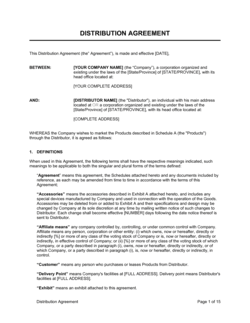
Manufacturing Agreement Template

Free Word download • Edit online • Save & share with Drive • Export to PDF

15 pages30–45 min to fillDifficulty: ComplexSignature requiredLegal review recommended
Learn more ↓
FreeManufacturing Agreement Template

At a glance

What it is
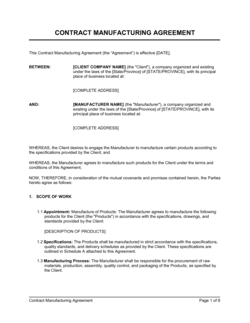
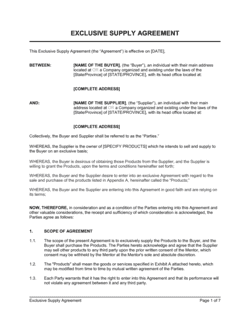
A Manufacturing Agreement is a legally binding contract between a brand owner (the buyer) and a contract manufacturer (the producer) that governs the production of goods to the buyer's specifications. This free Word download covers product specs, quality standards, lead times, IP ownership, tooling, exclusivity, minimum order quantities, and termination in a single document you can edit online and export as PDF.
When you need it
Use it any time you engage a third-party factory or production facility to manufacture goods under your brand or to your proprietary design — before the first purchase order is issued and before any tooling investment is made.
What's inside
Product specifications and approval process, quality control and rejection procedures, pricing and minimum order quantities, lead times and delivery terms, IP assignment and tooling ownership, confidentiality, exclusivity options, liability and indemnification, and termination conditions.

What is a Manufacturing Agreement?

A Manufacturing Agreement is a legally binding contract between a brand owner or buyer and a contract manufacturer that governs the production of goods to the buyer's proprietary specifications. Unlike a simple purchase order, it defines the entire production relationship: product specifications and approval procedures, quality standards and rejection rights, pricing and minimum order quantities, lead times, IP and tooling ownership, confidentiality obligations, exclusivity terms, and what happens when the relationship ends. It functions as the master document under which individual purchase orders are issued and provides the legal framework that protects both parties across every production cycle.

Why You Need This Document

Without a manufacturing agreement, your product's IP, tooling, and supply chain continuity are all at risk. Contract manufacturers who hold your molds without a written ownership clause have leverage you cannot match at the moment you need to switch suppliers. Specifications shared without a confidentiality agreement can end up in a competitor's product line. A manufacturer producing your goods for a rival — without an exclusivity clause to stop them — can erode your market position before you discover what is happening. And without a termination and transition clause, a departing manufacturer can halt your production line with no legal obligation to fill a single additional order. This template closes all four gaps in a single document, giving you a defensible foundation for any contract manufacturing relationship before the first purchase order is placed.

Which variant fits your situation?

If your situation is…Use this template
Full outsourced production of a branded consumer productManufacturing Agreement
Processing raw materials supplied by the buyer (toll manufacturing)Toll Manufacturing Agreement
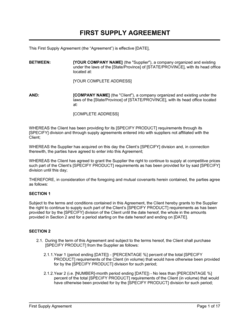
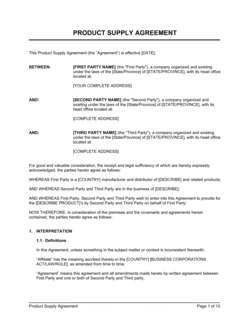
Sourcing finished goods from a supplier without specifying production methodsSupply Agreement
Manufacturer also distributes the finished productDistribution Agreement
Protecting confidential specifications before negotiations beginNon-Disclosure Agreement
Licensing a brand or technology to the manufacturer for productionLicense Agreement
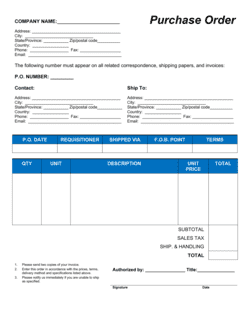
One-time production run without an ongoing relationshipPurchase Order

Common mistakes to avoid

❌ Vague or incomplete product specifications

Why it matters: Without precise written specs, there is no objective standard against which to measure a defective shipment — disputes become credibility contests rather than contract interpretation, and buyers routinely lose.

Fix: Attach a Schedule A with materials, dimensions, tolerances, finish standards, and reference photos before signing. Update it formally via written amendment if specs change.

❌ No tooling ownership clause

Why it matters: Manufacturers have withheld buyer-funded molds pending payment of disputed invoices — leaving the buyer unable to switch suppliers or resume production until the dispute resolves.

Fix: Include an explicit clause stating that buyer-funded tooling is buyer property, list it in a Schedule B, and require the manufacturer to label it accordingly.

❌ Granting unconditional exclusivity

Why it matters: A manufacturer locked into exclusive production with no minimum volume guarantee can be left with idle capacity and no revenue — they will breach informally, delay shipments, or refuse renewal.

Fix: Tie exclusivity to a binding minimum annual purchase quantity. If the buyer falls short, exclusivity lapses rather than the manufacturer being in breach.

❌ No defined acceptance window after delivery

Why it matters: Under the UCC and equivalent statutes in most jurisdictions, accepting goods without timely rejection is treated as acceptance — waiving defect claims after the window closes.

Fix: State a specific inspection period — typically 10 to 30 days after delivery — and document any rejection in writing within that window.

❌ No liability cap on indirect damages

Why it matters: Product liability and supply chain disruption claims can reach multiples of the contract value through consequential damages — lost profits, recall costs, and brand remediation expenses.

Fix: Include a mutual waiver of consequential, incidental, and punitive damages, and cap total liability at the fees paid in the preceding 12 months.

❌ No transition assistance obligation on termination

Why it matters: Qualifying a new contract manufacturer takes three to six months minimum. Without a contractual obligation to continue production during transition, a terminated manufacturer can halt supply immediately, leaving the buyer with no product and no leverage.

Fix: Add a transition assistance clause requiring the outgoing manufacturer to fill orders for a defined period — typically 90 to 180 days — and cooperate with the qualification of a replacement.

The 10 key clauses, explained

Parties, recitals, and definitions

In plain language: Identifies the brand owner and the manufacturer as legal entities, describes the purpose of the agreement, and defines key terms used throughout the document.

Sample language
This Manufacturing Agreement ('Agreement') is entered into as of [DATE] between [BRAND OWNER LEGAL NAME], a [STATE/COUNTRY] [ENTITY TYPE] ('Buyer'), and [MANUFACTURER LEGAL NAME], a [STATE/COUNTRY] [ENTITY TYPE] ('Manufacturer'). Manufacturer agrees to manufacture and supply the Products described herein in accordance with the Specifications.

Common mistake: Using trade names or DBA names instead of registered legal entity names. If the named party does not match the entity that owns the IP or signs the checks, enforcing IP assignment and payment obligations becomes legally complex.

Product specifications and approval

In plain language: Incorporates the detailed product specs by reference (as a Schedule), sets out the first-article inspection process, and requires written approval before mass production begins.

Sample language
Manufacturer shall produce the Products strictly in accordance with the Specifications set out in Schedule A. Prior to commencing any production run, Manufacturer shall submit [NUMBER] first-article samples to Buyer for written approval. Production shall not proceed until Buyer issues written approval or provides written comments within [X] business days.

Common mistake: Attaching vague or incomplete specifications and planning to 'work out the details later.' Disputes over whether a delivered product meets spec are the most common source of manufacturing litigation — detailed written specs are the only defense.

Purchase orders, pricing, and MOQ

In plain language: Sets the pricing structure, minimum order quantities, how orders are placed and confirmed, and any volume-based price adjustments.

Sample language
Buyer shall issue Purchase Orders specifying quantity, requested delivery date, and destination. The unit price for Products shall be $[PRICE] for orders of at least [MOQ] units ('Minimum Order Quantity'). Manufacturer shall confirm each Purchase Order in writing within [X] business days. Prices are fixed for [X] months and subject to renegotiation thereafter with [X] days' written notice.

Common mistake: Leaving pricing open to renegotiation at any time without a minimum notice period or cap on increases. Manufacturers have repriced mid-production run when raw material costs spike — a floor-and-ceiling clause with advance notice protects both parties.

Lead times and delivery terms

In plain language: Defines the production lead time from confirmed purchase order, the delivery point using Incoterms, and the consequences of late delivery.

Sample language
Manufacturer shall deliver Products within [X] days of Purchase Order confirmation ('Lead Time'). Delivery shall be made [FOB/CIF/DDP] [DELIVERY POINT] per Incoterms [YEAR]. Late delivery by more than [X] days shall entitle Buyer to a price reduction of [X]% per week of delay, up to [X]%, without prejudice to Buyer's other remedies.

Common mistake: Specifying lead time from order date rather than confirmed order date. Manufacturers start the clock on confirmation, not receipt — this gap routinely causes delivery disputes when confirmation is delayed.

Quality control and rejection

In plain language: Sets the inspection and acceptance procedure, defines acceptable defect rates, and specifies what happens to non-conforming goods — replacement, rework, or refund.

Sample language
Buyer shall inspect delivered Products within [X] days of receipt. Buyer may reject any shipment in which more than [X]% of units are Non-Conforming Goods. Manufacturer shall, at Buyer's election, replace or rework Non-Conforming Goods at no additional cost within [X] days, or issue a full credit for rejected units.

Common mistake: No defined acceptance window. Without a stated inspection period, buyers in many jurisdictions are deemed to have accepted goods simply by taking delivery — waiving the right to reject defective units after the fact.

Intellectual property and tooling ownership

In plain language: Assigns to the buyer all IP embedded in the product design, formulations, and any tooling created or paid for by the buyer, and restricts the manufacturer from using them for other customers.

Sample language
All Tooling purchased or funded by Buyer is and shall remain the sole property of Buyer. All product designs, formulations, molds, and other work product created specifically for Buyer ('Buyer IP') are hereby irrevocably assigned to Buyer. Manufacturer shall not use Buyer IP to manufacture goods for any third party without Buyer's prior written consent.

Common mistake: No tooling ownership clause at all. When a manufacturing relationship ends, manufacturers have held tooling hostage — refusing to release molds until disputed invoices are paid, regardless of who funded the tooling.

Confidentiality

In plain language: Prohibits the manufacturer from disclosing or using the buyer's product specifications, formulations, pricing, and business plans for any purpose other than performing the agreement.

Sample language
Manufacturer shall hold all Confidential Information of Buyer in strict confidence and shall not disclose it to any third party or use it for any purpose other than performing this Agreement. This obligation survives termination of this Agreement for [X] years.

Common mistake: A confidentiality clause that expires with the agreement term. Product formulations and manufacturing specifications have indefinite commercial value — a survivability period of at least three years, and ideally until the information enters the public domain, is standard.

Exclusivity

In plain language: Defines whether the manufacturer is restricted from producing the same or competing goods for other buyers, and whether the buyer is required to purchase exclusively from this manufacturer.

Sample language
During the Term, Manufacturer shall not manufacture, directly or indirectly, any product that is substantially similar to the Products for any third party within [TERRITORY/CATEGORY] without Buyer's prior written consent ('Exclusivity'). Exclusivity is conditioned on Buyer placing Purchase Orders totaling at least [X] units per [PERIOD].

Common mistake: Granting exclusivity to the manufacturer without tying it to a minimum purchase commitment from the buyer. Unconditional exclusivity locks a manufacturer into a single customer relationship with no guaranteed volume — they will either resist signing or breach informally.

Liability, indemnification, and insurance

In plain language: Caps each party's liability for indirect damages, sets out mutual indemnification obligations for IP infringement and product defects, and requires the manufacturer to maintain product liability insurance.

Sample language
Manufacturer shall indemnify, defend, and hold harmless Buyer from any third-party claims arising from defective Products or Manufacturer's negligence. Buyer shall indemnify Manufacturer against claims arising from Buyer's Specifications or Buyer IP. Each party's total liability shall not exceed [X times] the fees paid in the [X] months preceding the claim. Manufacturer shall maintain product liability insurance of at least $[AMOUNT] per occurrence, naming Buyer as an additional insured.

Common mistake: No cap on liability for indirect damages. Courts in product liability cases have awarded consequential damages — lost profits, brand damage — that dwarf the contract value. A mutual consequential-damages waiver is standard in commercial manufacturing agreements.

Term, termination, and transition

In plain language: Sets the agreement duration, renewal conditions, termination triggers for cause and without cause, and the obligations that apply on wind-down — including tooling return, inventory disposition, and work-in-progress.

Sample language
This Agreement commences on [DATE] and continues for [X] years, renewing automatically for successive [X]-year terms unless either party provides [X] days' written notice of non-renewal. Either party may terminate for cause upon [X] days' written notice if the other party materially breaches and fails to cure within [X] days. Upon termination, Manufacturer shall return all Buyer IP and Tooling within [X] days and deliver or destroy any remaining inventory at Buyer's election.

Common mistake: No transition assistance obligation. When a manufacturer is terminated, the buyer typically needs several months to qualify a new supplier. Without a contractual obligation to continue filling orders during the transition period, the buyer has no production and no leverage.

How to fill it out

  1. 1

    Identify both parties by their registered legal names

    Enter the full registered corporate name of the brand owner and the manufacturer — not trade names or DBA names. Include the state or country of incorporation and entity type for each.

    💡 Request a copy of the manufacturer's business registration or certificate of incorporation before finalizing the parties block. Misnamed parties create enforcement gaps.

  2. 2

    Attach a detailed product specification as Schedule A

    Prepare a written specification covering materials, dimensions, tolerances, performance requirements, labeling, and packaging. Attach it as Schedule A and reference it in the body of the agreement.

    💡 Include photos or engineering drawings in Schedule A. Visual references reduce interpretation disputes by giving both parties an unambiguous reference point.

  3. 3

    Set pricing, MOQ, and order procedures

    Enter the agreed unit price, minimum order quantity, purchase order confirmation window, and any volume-tier pricing. Specify the currency and whether prices are fixed or subject to adjustment, and on what terms.

    💡 Add a raw-material cost adjustment clause with a cap — for example, prices may increase by no more than 5% per year with 60 days' written notice — to avoid renegotiation conflicts.

  4. 4

    Define lead times and Incoterms

    Set the production lead time in calendar days from confirmed purchase order. Select the correct Incoterm (FOB, CIF, or DDP) and name the specific delivery point — port, warehouse address, or freight terminal.

    💡 For first-time orders, add a pilot-run lead time that is 20–30% longer than the standard lead time to allow for first-article inspection and approvals.

  5. 5

    Specify the quality control and rejection process

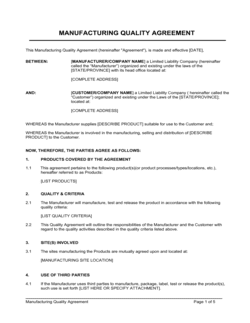
    Set the defect rate threshold, the inspection window after delivery, the remedies for non-conforming goods (replacement, rework, or credit), and how re-inspection costs are allocated.

    💡 Name a specific third-party inspection standard — for example, ISO 2859-1 AQL 1.5 — rather than drafting bespoke quality criteria. Internationally recognized standards are easier to apply and harder to dispute.

  6. 6

    Confirm tooling ownership and IP assignment

    List all tooling funded or to be funded by the buyer in a Schedule B. Insert the dollar value paid for each tool. Confirm that Buyer IP and all tooling are assigned to the buyer effective on creation or payment.

    💡 Add a clause requiring the manufacturer to label all buyer-owned tooling with a tag identifying the buyer as owner. This simple step prevents tooling disputes if the manufacturer becomes insolvent.

  7. 7

    Calibrate exclusivity to purchase commitments

    If exclusivity is granted, tie it to a binding minimum annual purchase quantity. If the buyer fails to meet the minimum, exclusivity lapses — giving the manufacturer the right to produce for others without breaching.

    💡 Set the minimum purchase quantity at 70–80% of your realistic annual forecast, not your optimistic one. Overcommitting triggers exclusivity loss at the worst moment.

  8. 8

    Set termination notice and transition obligations

    Choose a termination notice period — typically 60–180 days for manufacturing — and add an explicit transition assistance clause requiring the manufacturer to continue filling orders and cooperate with qualification of a replacement supplier.

    💡 Include a list of specific transition deliverables: return of tooling within 30 days, delivery of remaining WIP inventory, and provision of updated SOPs and quality records.

Frequently asked questions

What is a manufacturing agreement?

A manufacturing agreement is a legally binding contract between a brand owner or buyer and a contract manufacturer that governs the production of goods to the buyer's specifications. It covers product specs, quality standards, pricing, lead times, IP and tooling ownership, exclusivity, minimum order quantities, and termination. It replaces informal purchase orders as the authoritative governing document for the production relationship.

What should a manufacturing agreement include?

At minimum: the parties' legal names, a product specification schedule, pricing and minimum order quantities, lead times and delivery terms using Incoterms, a quality control and rejection procedure, IP assignment and tooling ownership, confidentiality, exclusivity terms, liability caps and indemnification, and termination with transition obligations. Missing any of these creates gaps that courts or arbitrators will fill with jurisdiction-specific defaults.

Who owns the tooling in a manufacturing agreement?

Tooling ownership depends on who paid for it and what the contract says. If the buyer funded the molds, dies, or jigs, the agreement should explicitly assign ownership to the buyer and list the tooling in a schedule. Without a written ownership clause, manufacturers in many jurisdictions are treated as the owner of tooling held at their facility, regardless of who paid for it. Always include a tooling ownership clause and require physical labeling of buyer-owned equipment.

What is the difference between a manufacturing agreement and a supply agreement?

A supply agreement governs the purchase of finished goods that the supplier produces using its own processes, materials, and IP — the buyer specifies what they want but not how it is made. A manufacturing agreement governs production to the buyer's proprietary specifications, using the buyer's IP, tooling, or formulations. The key distinction is control: manufacturing agreements grant the buyer significantly more oversight over the production process and impose corresponding IP and quality obligations on the manufacturer.

Is a purchase order enough, or do I need a manufacturing agreement?

A purchase order covers a single transaction — quantity, price, and delivery date. It does not govern IP ownership, tooling, exclusivity, confidentiality, quality standards, liability, or termination. For any ongoing manufacturing relationship, or any arrangement where you are sharing proprietary specifications or funding tooling, a manufacturing agreement is essential. Relying solely on purchase orders leaves your IP unprotected and your supply chain legally exposed.

What Incoterms should I use in a manufacturing agreement?

FOB (Free On Board) is the most common term for ocean shipments — the manufacturer bears risk until goods are loaded onto the vessel, and the buyer assumes risk from that point. DDP (Delivered Duty Paid) places all shipping, insurance, and customs costs on the manufacturer and is simpler for buyers unfamiliar with import logistics. CIF (Cost, Insurance, Freight) is a middle-ground term where the manufacturer arranges and pays for shipping to the destination port but risk transfers at origin. The right choice depends on your logistics capability and where you want risk to transfer.

How do I protect my product design from a contract manufacturer?

Three mechanisms work together: a non-disclosure agreement signed before sharing any specifications, an IP assignment clause in the manufacturing agreement that assigns all buyer-specific designs and work product to the buyer, and a non-compete or exclusivity clause preventing the manufacturer from using your specs or tooling for competing products. For designs with significant commercial value, also consider filing a patent or design registration before sharing specifications with any manufacturer.

Can a manufacturing agreement include exclusivity?

Yes, but exclusivity should always be mutual and conditional. The buyer may require the manufacturer not to produce substantially similar goods for competitors; in exchange, the manufacturer may require the buyer to commit to minimum annual purchase volumes. Unconditional exclusivity on either side creates imbalance — a manufacturer with no volume guarantee will eventually breach, and a buyer with no alternative source has no negotiating leverage.

What happens when a manufacturing agreement is terminated?

On termination, the agreement should require the manufacturer to return all buyer-owned tooling and IP materials within a defined period, deliver or destroy remaining finished goods and work-in-progress inventory at the buyer's election, and provide transition assistance — typically continuing to fill purchase orders for 90 to 180 days while the buyer qualifies a replacement manufacturer. Without an explicit transition clause, the buyer has no contractual basis to demand continued supply after notice of termination is issued.

How this compares to alternatives

vs Supply Agreement

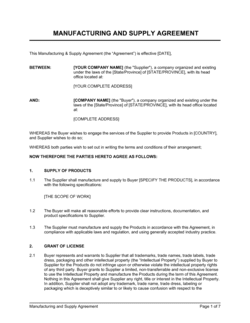
A supply agreement covers the purchase of goods produced using the supplier's own processes and IP — the buyer specifies what they want, not how it is made. A manufacturing agreement is used when the buyer is sharing proprietary specifications, funding tooling, or directing the production process. The key difference is whether the buyer's IP is embedded in the product; if it is, a manufacturing agreement is required.

vs Purchase Order

A purchase order is a transaction document covering quantity, price, and delivery for a single order. It does not address IP ownership, tooling, exclusivity, quality standards, or termination. For any ongoing manufacturing relationship or any arrangement involving proprietary specs, a manufacturing agreement must govern the relationship, with individual purchase orders issued under it.

vs Non-Disclosure Agreement

An NDA protects confidential information shared during pre-contract negotiations or evaluations. It does not govern production terms, quality, pricing, IP assignment, or tooling. An NDA is typically signed before sharing specifications; the manufacturing agreement then replaces or supplements it with a binding confidentiality clause once production begins.

vs Distribution Agreement

A distribution agreement governs how finished goods are sold and delivered through a reseller channel — it does not address production. A manufacturing agreement governs production. When the same party both manufactures and distributes the product, a combined manufacturing and distribution agreement or two separate documents covering each function are both viable approaches.

Industry-specific considerations

Consumer Packaged Goods

Formulation confidentiality for food, beverage, and personal care products; FDA or Health Canada compliance obligations; labeling approval integrated into the first-article process.

Electronics and Hardware

Component sourcing restrictions (approved vendor lists), RoHS and CE compliance obligations, firmware and software IP assignments, and serialization requirements for warranty tracking.

Apparel and Textile

Pattern and tech-pack ownership clauses, fabric and trim sourcing standards, social compliance audit requirements (SMETA, BSCI), and seasonal production calendar commitments.

Industrial and Automotive

Tight dimensional tolerances and PPAP (Production Part Approval Process) requirements, long-term supply commitments tied to vehicle model runs, and strict liability exposure for safety-critical components.

Jurisdictional notes

United States

Manufacturing agreements in the US are primarily governed by UCC Article 2, which sets default rules for the sale of goods including acceptance, rejection, and warranty. State law varies on non-compete enforceability and trade secret protections — the Defend Trade Secrets Act (DTSA) provides a federal cause of action for misappropriation of manufacturing specifications. Tooling ownership disputes are resolved under the UCC and state property law; a written assignment clause is the safest protection.

Canada

Canadian manufacturing agreements are governed by provincial sale of goods legislation (modeled on the UK Sale of Goods Act) and, in Quebec, the Civil Code. Common-law provinces follow UCC-adjacent rules for acceptance and rejection. Confidentiality and non-compete clauses must be reasonable in scope and duration to be enforceable. Cross-border agreements with US manufacturers should address which jurisdiction's law governs and name a dispute resolution venue explicitly.

United Kingdom

UK manufacturing agreements are governed by the Sale of Goods Act 1979 and the Supply of Goods and Services Act 1982, which imply terms of satisfactory quality and fitness for purpose. Post-Brexit, agreements with EU-based manufacturers require explicit Incoterms to address customs and VAT at the GB-EU border. IP assignment must be in writing and signed by the assignor to be valid under the Copyright, Designs and Patents Act 1988. Non-compete clauses must be reasonable to be enforceable.

European Union

EU manufacturing agreements must comply with the Commercial Agents Directive where agents are involved, and with GDPR if any personal data is processed by the manufacturer. IP assignment is governed by member state law — Germany, France, and the Netherlands each have distinct requirements for the validity of IP transfers. Exclusivity clauses in manufacturing agreements may attract scrutiny under EU competition law (Article 101 TFEU) if the buyer has significant market share. Agreements with manufacturers in Eastern EU member states should address enforcement mechanisms explicitly.

Template vs lawyer — what fits your deal?

PathBest forCostTime
Use the templateDomestic manufacturing relationships with straightforward specs and standard quality termsFree1–2 hours
Template + legal reviewCross-border manufacturing, products with significant IP value, or agreements with exclusivity and liability provisions$500–$1,5003–5 days
Custom draftedHigh-value tooling investments, regulated product categories (medical devices, food, pharmaceuticals), or complex multi-party supply chains$2,500–$8,000+2–6 weeks

Glossary

Contract Manufacturer
A third-party factory or production facility engaged to manufacture goods to a buyer's specifications, without owning the resulting brand or IP.
Product Specifications
A detailed written description of a product's materials, dimensions, tolerances, performance standards, and appearance requirements that the manufacturer must meet.
Minimum Order Quantity (MOQ)
The smallest production run a manufacturer will accept per order, typically driven by setup costs, material minimums, and production efficiency.
Tooling
Molds, dies, jigs, and fixtures created specifically to produce a buyer's product — often paid for by the buyer but held at the manufacturer's facility.
First Article Inspection (FAI)
A formal review of the first production units against the agreed specifications before the manufacturer proceeds with the full production run.
Lead Time
The elapsed time from the buyer's confirmed purchase order to delivery of finished goods at the agreed handoff point.
Exclusivity
A contractual restriction preventing the manufacturer from producing the same or substantially similar goods for the buyer's competitors during the agreement term.
Incoterms
Standardized international trade terms (published by the ICC) that define which party bears risk and cost for shipping at each point in the delivery chain — e.g., FOB, CIF, DDP.
Non-Conforming Goods
Finished units that fail to meet one or more agreed specifications or quality standards and are subject to rejection, rework, or replacement at the manufacturer's cost.
Intellectual Property Assignment
A clause transferring ownership of product designs, molds, formulations, or other IP developed specifically for the buyer to the buyer's legal entity.
Force Majeure
A provision excusing a party from performance obligations when production is disrupted by events outside their reasonable control, such as natural disasters, war, or government shutdowns.
Indemnification
A contractual obligation by one party to compensate the other for losses, claims, or damages arising from a defined set of events — such as defective goods or IP infringement.

Part of your Business Operating System

This document is one of 3,000+ business & legal templates included in Business in a Box.

  • Fill-in-the-blanks — ready in minutes
  • 100% customizable Word document
  • Compatible with all office suites
  • Export to PDF and share electronically

Create your document in 3 simple steps.

From template to signed document — all inside one Business Operating System.
1
Download or open template

Access over 3,000+ business and legal templates for any business task, project or initiative.

2
Edit and fill in the blanks with AI

Customize your ready-made business document template and save it in the cloud.

3
Save, Share, Send, Sign

Share your files and folders with your team. Create a space of seamless collaboration.

Save time, save money, and create top-quality documents.

★★★★★

"Fantastic value! I'm not sure how I'd do without it. It's worth its weight in gold and paid back for itself many times."

Managing Director · Mall Farm
Robert Whalley
Managing Director, Mall Farm Proprietary Limited
★★★★★

"I have been using Business in a Box for years. It has been the most useful source of templates I have encountered. I recommend it to anyone."

Business Owner · 4+ years
Dr Michael John Freestone
Business Owner
★★★★★

"It has been a life saver so many times I have lost count. Business in a Box has saved me so much time and as you know, time is money."

Owner · Upstate Web
David G. Moore Jr.
Owner, Upstate Web

Run your business with a system — not scattered tools

Stop downloading documents. Start operating with clarity. Business in a Box gives you the Business Operating System used by over 250,000 companies worldwide to structure, run, and grow their business.

Start free · No credit card required