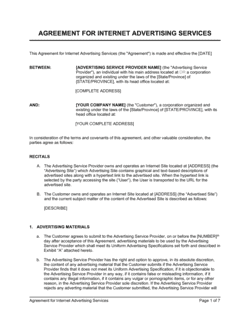
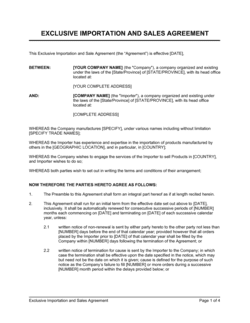
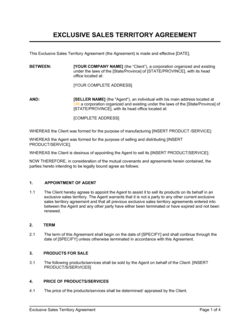
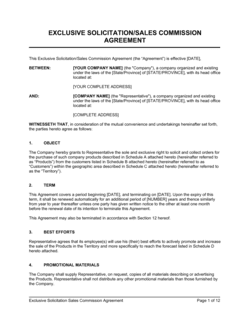
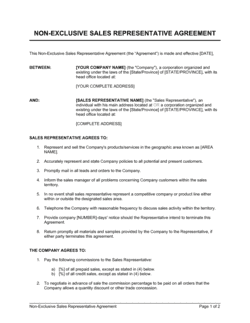
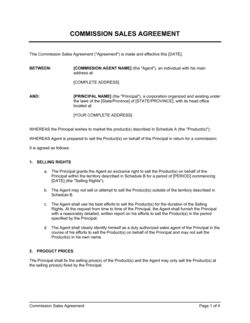
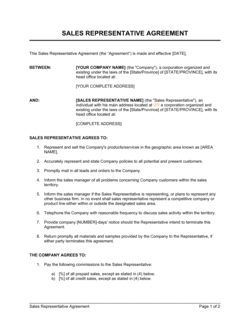
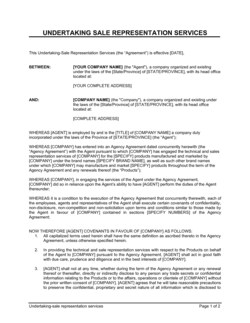
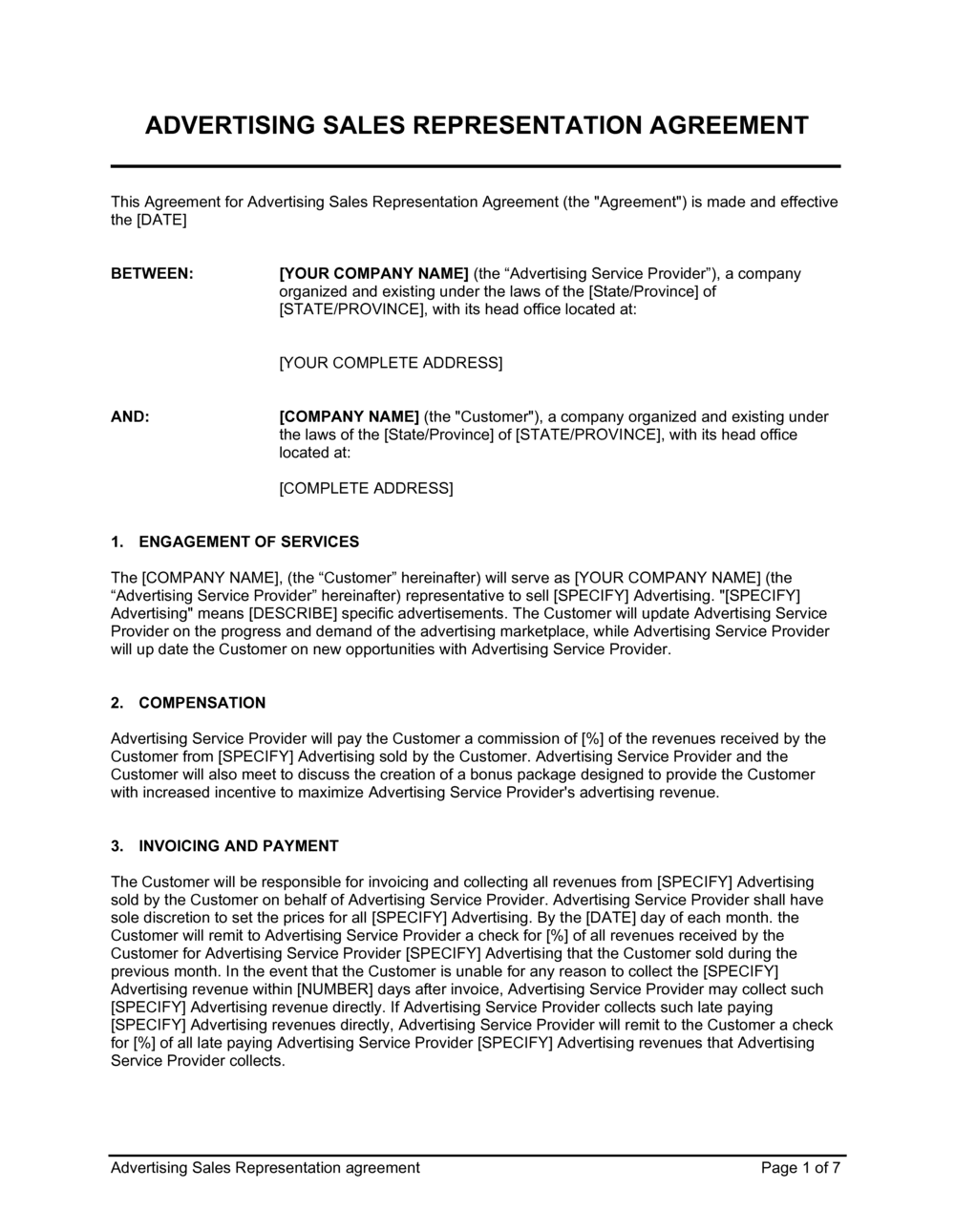
Advertising Sales Representation Agreement Template

Free Word download • Edit online • Save & share with Drive • Export to PDF

7 pages25–35 min to fillDifficulty: ComplexSignature requiredLegal review recommended
Learn more ↓
FreeAdvertising Sales Representation Agreement Template

At a glance

What it is
An Advertising Sales Representation Agreement is a legally binding contract between a media owner or publisher and an independent sales representative (or sales house) who is authorized to sell advertising inventory on the publisher's behalf. This free Word download sets out territory, commission structure, exclusivity, performance obligations, and termination terms in a single document you can edit online and export as PDF before execution.
When you need it
Use it whenever a media company, publisher, podcast network, website, or out-of-home operator engages an outside sales rep or agency to monetize advertising inventory — especially when granting exclusive territory rights or commission arrangements that create significant revenue exposure.
What's inside
Appointment and authority, territory and exclusivity, commission rates and payment schedule, rep duties and performance minimums, publisher obligations, intellectual property and brand usage, confidentiality, indemnification, termination and post-termination restrictions, and governing law.

What is an Advertising Sales Representation Agreement?

An Advertising Sales Representation Agreement is a legally binding contract between a media owner or publisher and an independent sales representative — or sales house — who is formally authorized to sell the publisher's advertising inventory to third-party advertisers. It defines the scope of the rep's authority, the territory or account list they control, whether that appointment is exclusive, the commission rate and payment mechanics, the performance obligations required to maintain the relationship, and the conditions under which either party may terminate. Without this document, the rep's authority to bind the publisher, the basis for commission payments, and the ownership of client relationships are all undefined — creating significant legal and financial risk on both sides.

Why You Need This Document

Operating an advertising sales rep relationship on a handshake or informal email chain exposes both publisher and rep to disputes that are difficult and expensive to resolve. Publishers face the risk of a rep claiming commission on accounts they did not originate, holding an exclusive territory without hitting revenue targets, or sharing confidential rate strategies with competing properties. Reps face the opposite risk: a publisher terminating the relationship days before a major campaign goes live and refusing to pay commission on months of pipeline work. A properly executed advertising sales representation agreement closes these gaps by tying exclusivity to measurable performance, defining commission on collected rather than invoiced revenue, and establishing a post-termination tail that fairly compensates the rep for bookings already in progress. For publishers operating internationally, this document also provides the framework for navigating EU commercial agent regulations that impose mandatory compensation rights on termination — rights that apply regardless of what an undrafted or informal arrangement says.

Which variant fits your situation?

If your situation is…Use this template
Appointing a single rep with exclusive rights across a national territoryAdvertising Sales Representation Agreement (Exclusive)
Appointing multiple reps in parallel for the same inventoryNon-Exclusive Sales Agency Agreement
Engaging a full-service media buying and planning agencyAdvertising Agency Agreement
Authorizing a rep to sell on a one-time project or campaign basisCommission-Based Sales Agreement
Hiring a salaried in-house advertising sales executiveEmployment Contract
Formalizing the terms under which ads will actually runAdvertising Agreement
Protecting proprietary rate cards and client lists shared with the repNon-Disclosure Agreement

Common mistakes to avoid

❌ Commission calculated on invoiced rather than collected revenue

Why it matters: If an advertiser fails to pay, the publisher pays commission on revenue it never received. This misaligns incentives — the rep closes bad-credit clients knowing the commission risk falls entirely on the publisher.

Fix: Define commission as a percentage of Net Advertising Revenue actually collected. Add a clawback clause allowing the publisher to recover previously paid commission if a receivable is reversed within 90 days.

❌ No performance minimum tied to exclusivity

Why it matters: Granting exclusive territory rights with no revenue floor can lock the publisher out of revenue for the entire agreement term if the rep underperforms or deprioritizes the property.

Fix: Set a quarterly revenue minimum and specify that failure to meet it for two consecutive quarters automatically converts the appointment to non-exclusive, without requiring an amendment or litigation.

❌ Undefined post-termination commission tail

Why it matters: Without a tail clause, a publisher can terminate just before a large campaign booked by the rep goes live, paying no commission on months of pipeline work. This creates a strong incentive for bad-faith terminations.

Fix: Define the tail as the period ending on the last flight date of any campaign originated by the rep and confirmed in writing before the termination date, with a hard cap of 90 to 180 days.

❌ Rep granted authority to approve credit and negotiate payment terms

Why it matters: Reps incentivized by commission will close orders regardless of advertiser creditworthiness. Unauthorized extended payment terms and verbal side agreements expose the publisher to uncollectable receivables and breach claims.

Fix: Include an express clause that credit approval, payment term modifications, and any commitment outside the rate card require prior written authorization from the publisher. All insertion orders must be on the publisher's standard form.

❌ Overly broad or underdefined territory

Why it matters: Vague territory definitions — 'the Eastern United States' for a digital publisher — generate constant disputes over whether a headquartered-in-New-York brand buying a national campaign is an in-territory account.

Fix: Define territory by specific state or country list for geographic appointments, or by named account list for account-based appointments. Add a conflict-resolution mechanism for multi-territory advertisers.

❌ No mutual confidentiality obligation

Why it matters: A confidentiality clause that binds only the rep leaves the publisher's advertiser budget data and pipeline intelligence exposed. Publishers share pricing strategy and audience data with reps; that information needs bilateral protection.

Fix: Draft the confidentiality clause as mutual, with identical obligations on both parties. Define Confidential Information broadly enough to cover rate cards, client lists, audience metrics, and the financial terms of the agreement itself.

The 10 key clauses, explained

Appointment and scope of authority

In plain language: Formally appoints the rep, states whether the appointment is exclusive or non-exclusive, and defines exactly what inventory the rep is authorized to sell.

Sample language
[PUBLISHER NAME] hereby appoints [REP NAME] as its [exclusive / non-exclusive] advertising sales representative for the inventory described in Schedule A within the Territory defined in Schedule B, for the Term of this Agreement.

Common mistake: Failing to attach or reference a Schedule A that lists the specific inventory or media properties covered. Without it, disputes arise over whether new platforms or formats fall within the rep's authority.

Territory

In plain language: Defines the geographic area, industry verticals, or named account list within which the rep has selling rights — and what happens to accounts that straddle territory lines.

Sample language
The Territory is defined as [GEOGRAPHIC AREA / ACCOUNT LIST / INDUSTRY VERTICAL]. Rep shall have no authority to solicit advertisers outside the Territory without prior written consent of Publisher.

Common mistake: Using broad geographic descriptions like 'North America' without clarifying whether digital advertisers headquartered outside the territory but buying into it count as in-territory. The ambiguity creates commission disputes on large multi-market buys.

Commission rate and payment schedule

In plain language: States the commission percentage, whether it applies to gross or net revenue, the payment trigger (invoice, collection, or booking), and the payment timeline.

Sample language
Publisher shall pay Rep a commission of [X]% of Net Advertising Revenue collected from advertisers originated by Rep within the Territory. Commission payments shall be made within [30] days following the end of each calendar month in which the revenue is collected.

Common mistake: Basing commission on 'invoiced revenue' rather than 'collected revenue.' If an advertiser defaults, the publisher ends up paying commission on money it never received.

Performance minimums and exclusivity conditions

In plain language: Sets the revenue floors the rep must hit to maintain exclusivity, and spells out exactly what happens — loss of exclusivity, notice period, or termination — if they miss the target.

Sample language
Rep shall generate minimum Net Advertising Revenue of $[AMOUNT] per calendar quarter ('Performance Minimum'). Failure to meet the Performance Minimum for two consecutive quarters entitles Publisher to convert the appointment to non-exclusive upon [30] days' written notice.

Common mistake: Setting a performance minimum without defining the measurement period or the remedy precisely. Reps contest whether a single missed quarter triggers anything; publishers interpret it as grounds for immediate termination.

Rep duties and obligations

In plain language: Lists what the rep must actively do — prospecting, reporting, attending sales calls, submitting insertion orders — and any conduct restrictions, such as not offering unauthorized discounts.

Sample language
Rep shall: (a) actively solicit advertisers within the Territory; (b) submit signed Insertion Orders using Publisher's standard forms; (c) not offer rates below the Rate Card without prior written approval; and (d) provide Publisher with a monthly pipeline report by the [5th] day of each calendar month.

Common mistake: Omitting a prohibition on the rep making credit approvals or granting extended payment terms unilaterally. Reps who accept orders from uncreditworthy advertisers without publisher sign-off create collection problems the publisher is left to absorb.

Publisher obligations

In plain language: States what the publisher must provide to the rep — rate cards, media kits, training, and timely confirmation of bookings — and the turnaround standards for responding to proposals.

Sample language
Publisher shall: (a) provide Rep with current Rate Cards and media kits within [5] business days of any material change; (b) confirm or reject Insertion Orders submitted by Rep within [3] business days; and (c) fulfill confirmed placements in accordance with each Insertion Order.

Common mistake: Leaving publisher obligations entirely blank or vague. When publishers are slow to confirm orders or change rate cards without notice, reps lose credibility with advertisers and miss targets — but have no contractual recourse.

Intellectual property and brand usage

In plain language: Grants the rep a limited license to use the publisher's logos, trademarks, and media kit materials solely for authorized sales activity, and prohibits any other use.

Sample language
Publisher grants Rep a limited, non-exclusive, non-transferable license to use Publisher's trademarks and marketing materials solely for authorized sales activities under this Agreement. Rep shall not modify Publisher's brand materials or use them in any manner not approved in writing by Publisher.

Common mistake: No IP clause at all — or one with no approval process for custom sales decks. Reps who modify rate cards, create unapproved co-branded materials, or use outdated logos can create brand and liability exposure for the publisher.

Confidentiality

In plain language: Restricts both parties from disclosing the other's confidential information — rate strategies, client lists, audience data, and contract terms — during and after the agreement.

Sample language
Each party shall keep confidential all Confidential Information received from the other party and shall not disclose it to any third party without prior written consent. 'Confidential Information' includes Rate Cards, client lists, audience data, pricing strategies, and the terms of this Agreement.

Common mistake: Defining confidentiality obligations only for the rep and not the publisher. Publishers receive sensitive advertiser budget information and competitive intelligence from the rep's pipeline reports — mutual obligations are essential.

Indemnification and liability

In plain language: Allocates risk between the parties: the rep indemnifies the publisher for unauthorized promises or misrepresentations to advertisers; the publisher indemnifies the rep for defects in the underlying ad inventory.

Sample language
Rep shall indemnify Publisher against any claims arising from Rep's unauthorized representations, discounts, or promises to advertisers. Publisher shall indemnify Rep against claims arising from defects in the ad inventory, publication errors, or Publisher's breach of confirmed Insertion Orders.

Common mistake: One-sided indemnification that only protects the publisher. Reps who face advertiser claims over publisher fulfillment failures — missed impressions, late placements — need a clear contractual basis to be held harmless.

Termination and post-termination commission tail

In plain language: Sets notice periods for termination with and without cause, and defines the tail period during which the rep earns commission on orders originated before the termination date.

Sample language
Either party may terminate this Agreement with [60] days' written notice. Publisher may terminate immediately for Cause. Following termination, Rep shall receive commission on Insertion Orders originated by Rep and confirmed in writing by Publisher prior to the termination date, for campaigns running within [90] days after termination ('Tail Period').

Common mistake: No tail period at all, or a tail period defined by booking date without reference to campaign flight dates. Reps who close multi-month campaigns weeks before termination lose all commission if the tail is not defined by flight end rather than booking date.

How to fill it out

  1. 1

    Identify both parties with full legal names

    Enter the publisher's registered legal entity name and the rep's legal name or business name exactly as they appear on government or corporate registration documents. Include principal addresses for both.

    💡 If the rep operates through an LLC or incorporated agency, use that entity name — not the individual's name — so indemnification and commission obligations attach to the correct legal entity.

  2. 2

    Define the territory and inventory in schedules

    Complete Schedule A (inventory: specific properties, platforms, or ad formats covered) and Schedule B (territory: geographic area, named accounts, or industry verticals). Be as specific as possible to avoid later disputes.

    💡 If digital advertisers can be headquartered outside the territory but run campaigns within it, add a sentence clarifying which rule applies — billing address or campaign delivery location.

  3. 3

    Set the exclusivity terms and conditions

    Choose exclusive or non-exclusive appointment. If exclusive, tie exclusivity to the performance minimum so the publisher can convert to non-exclusive if the rep underperforms.

    💡 Structure exclusivity as a default that reverts automatically on missed minimums rather than requiring a separate amendment — this avoids a negotiation at exactly the moment the relationship is under strain.

  4. 4

    Complete the commission rate and payment mechanics

    Enter the commission percentage, confirm whether it applies to net or gross revenue, and state the payment trigger (collection preferred over invoicing) and the monthly payment deadline.

    💡 Add a clawback provision: if an advertiser charge is reversed or disputed after commission has been paid, the publisher may deduct the corresponding commission from the next monthly payment.

  5. 5

    State the performance minimums precisely

    Enter the quarterly or annual revenue floor, the measurement period, and the specific consequence of missing it — loss of exclusivity after two consecutive misses is a common and enforceable standard.

    💡 Include a ramp period for new agreements: waive or reduce the performance minimum for the first two quarters while the rep builds a pipeline.

  6. 6

    List rep duties and prohibited conduct

    Enumerate the rep's active obligations (prospecting, reporting, using standard IO forms) and add express prohibitions on unauthorized discounts, credit approvals, and verbal commitments not confirmed in writing.

    💡 Require insertion orders to be submitted on the publisher's standard form — this controls legal terms on every booking and prevents reps from accepting non-standard agency paper unilaterally.

  7. 7

    Set termination notice periods and the tail

    Enter the notice period for termination without cause (60 days is typical for representation agreements), define what constitutes termination for cause, and specify the post-termination commission tail period tied to campaign flight end dates.

    💡 For multi-year agreements, consider a tiered notice period that lengthens with tenure — 30 days in Year 1, 60 days in Year 2+. This rewards long-term rep investment in the property.

  8. 8

    Execute before the rep contacts any advertiser

    Both parties must sign before the rep begins soliciting advertisers or sharing rate cards. Any sales activity before execution creates an implied agency relationship with no defined commission terms.

    💡 Use a countersignature block with date lines for both parties, and distribute fully executed copies immediately — commission disputes often hinge on whether a signed agreement was in place at the time a specific order was placed.

Frequently asked questions

What is an advertising sales representation agreement?

An advertising sales representation agreement is a legally binding contract between a media owner or publisher and an independent sales representative or sales house that authorizes the rep to sell advertising inventory on the publisher's behalf. It defines the territory, commission rate, exclusivity conditions, performance obligations, and termination terms — replacing informal arrangements with enforceable obligations on both sides.

What is the difference between an exclusive and non-exclusive advertising sales rep agreement?

An exclusive agreement gives the rep the sole right to sell within the defined territory or account list — the publisher cannot appoint other reps or sell directly into that territory without breaching the contract. A non-exclusive agreement allows the publisher to appoint multiple reps or sell directly in parallel. Exclusive appointments typically command higher rep commitment but should always include performance minimums to protect the publisher from a rep who holds the territory without actively selling.

What commission rate is typical for advertising sales representatives?

Commission rates for advertising sales reps typically range from 10% to 25% of net advertising revenue, depending on exclusivity, the rep's role in originating versus closing the sale, and the type of inventory. Exclusive reps handling the full sales cycle for premium inventory often earn 15–20%. Non-exclusive reps or those who support a publisher's own sales team typically earn 10–15%. Commission is generally calculated on collected net revenue rather than gross or invoiced amounts.

Does an advertising sales rep agreement need to specify a territory?

Yes — territory definition is one of the most critical clauses in the agreement, particularly when exclusivity is granted. Without a defined territory, disputes arise over which accounts or campaigns fall within the rep's scope, especially for digital publishers whose advertisers span multiple geographies. Territory can be defined geographically (specific states or countries), by industry vertical, or by a named account list, depending on how the publisher segments its sales coverage.

What happens to commission if the publisher terminates the agreement early?

In most well-drafted agreements, the rep retains the right to commission on orders they originated and that were confirmed in writing before the termination date — for campaigns running within an agreed post-termination tail period, typically 90 to 180 days. Without an express tail clause, courts in many jurisdictions may still award commission on sales that were in progress at termination, but the terms will be uncertain and require litigation to resolve.

Can the rep sign insertion orders on the publisher's behalf?

Only if the agreement expressly grants that authority. Most advertising sales representation agreements authorize the rep to solicit and deliver insertion orders but require the publisher to confirm or countersign before the order is binding. Granting the rep full authority to execute binding insertion orders creates significant financial exposure — the rep could commit the publisher to placements, pricing, or payment terms the publisher did not approve. The agreement should state clearly what the rep can and cannot do without written publisher authorization.

Do I need a lawyer to prepare an advertising sales representation agreement?

For straightforward domestic appointments with a single rep and standard commission terms, a high-quality template is typically sufficient with careful customization. Engage a lawyer when the agreement involves exclusive national or international territory rights, significant revenue exposure, complex commission structures (tiered rates, shared commissions, agency deductions), or when the rep will be operating in jurisdictions with specific agency law requirements, such as EU commercial agent regulations that mandate compensation on termination.

Is an advertising sales rep an employee or an independent contractor?

An advertising sales representative under this type of agreement is typically classified as an independent contractor — not an employee. The agreement should include express language confirming the rep's independent contractor status, specifying that the rep is responsible for their own taxes, insurance, and business expenses. Misclassifying a rep who works exclusively and under close direction as an independent contractor can trigger employment tax liability, benefits claims, and regulatory penalties in most jurisdictions.

What governs advertising sales representation agreements in the EU?

In the EU, commercial agents who habitually negotiate or conclude contracts on behalf of a principal are subject to the Commercial Agents Directive (86/653/EEC), implemented in each member state. This Directive gives qualifying agents the right to compensation or indemnity on termination, regardless of what the contract says. Publishers engaging EU-based reps should be aware that standard termination-for-convenience clauses may trigger a statutory compensation payment — typically one year's average annual commission — that cannot be contractually waived in advance.

How this compares to alternatives

vs Advertising Agency Agreement

An advertising agency agreement governs a publisher or brand's relationship with a creative or media-buying agency that plans and purchases advertising on the brand's behalf. An advertising sales representation agreement governs the publisher's relationship with a rep who sells the publisher's inventory to advertisers. The flow of authority runs in opposite directions: the agency acts for the buyer; the sales rep acts for the seller.

vs Independent Contractor Agreement

A general independent contractor agreement covers a broad range of freelance services for a flat fee or hourly rate. An advertising sales representation agreement is specific to commission-based inventory sales, with clauses tailored to territory, exclusivity, rate cards, insertion orders, and post-termination commission tails that a generic contractor agreement does not address.

vs Advertising Agreement

An advertising agreement is between a publisher and an advertiser — it governs the placement, pricing, and terms of specific ad campaigns. An advertising sales representation agreement is between a publisher and a sales rep — it governs how the rep is authorized to sell that inventory on the publisher's behalf. Both documents often coexist; the rep uses the advertising agreement form to book the campaigns they sell.

vs Non-Disclosure Agreement

A non-disclosure agreement protects confidential information shared in a specific context — rate cards, audience data, or client lists — but creates no ongoing sales relationship or commission obligations. An advertising sales representation agreement includes confidentiality provisions but goes further, establishing the full commercial framework for the rep relationship. Use an NDA when the parties are exploring a potential rep arrangement but have not yet agreed on terms.

Industry-specific considerations

Digital Media and Publishing

Territory defined by advertiser HQ location or campaign delivery region; commission applied to net CPM or CPC revenue after agency deductions and programmatic platform fees.

Out-of-Home and Digital Signage

Strict geographic territory tied to physical billboard or screen locations; performance minimums expressed as percentage of available inventory sold per quarter.

Podcast and Audio Networks

Inventory defined by specific shows or episode slots; commission structures distinguish host-read integrations from dynamically inserted pre-roll and mid-roll spots.

Trade and Specialty Publishing

Territory often defined by industry vertical rather than geography; rate cards cover print, digital, and event sponsorship inventory under a single representation mandate.

Jurisdictional notes

United States

No single federal statute governs advertising sales rep agreements; most disputes are resolved under state contract and agency law. California, Illinois, and several other states have Sales Representative Acts that impose specific payment timing requirements and penalties for late commission payments — even for independent contractors. Confirm whether the rep's state of operation has such a statute and adjust the payment timeline clause accordingly.

Canada

Canada has no federal commercial agents statute comparable to the EU Directive. Commission payment obligations are governed by provincial contract law. Quebec's Civil Code imposes specific good-faith obligations on commercial mandates that go beyond common-law provinces. Non-solicitation and confidentiality restrictions must be reasonable in scope and duration to be enforceable; courts are particularly skeptical of broad post-termination restrictions against independent contractors.

United Kingdom

The Commercial Agents (Council Directive) Regulations 1993 apply to agents who habitually negotiate or conclude contracts for the sale of goods on a principal's behalf. Where they apply, agents are entitled to compensation or an indemnity payment on termination — a right that cannot be waived in advance. Post-Brexit, UK courts continue to apply these Regulations. Publishers should confirm whether their rep arrangement meets the threshold for 'goods' versus 'services' to determine applicability.

European Union

The EU Commercial Agents Directive (86/653/EEC) gives qualifying agents a mandatory right to compensation or indemnity on termination, worth up to one year's average annual commission, regardless of contractual exclusion clauses. France applies the indemnity by default; Germany uses compensation calculated on the agent's portfolio value. GDPR also applies to any advertiser or audience data shared with the rep — the agreement should address data processing roles and restrictions explicitly.

Template vs lawyer — what fits your deal?

PathBest forCostTime
Use the templateDomestic appointments with a single rep, standard commission structure, and no exclusive national territory rightsFree30–60 minutes
Template + legal reviewExclusive territory appointments, tiered commission structures, or reps operating in multiple US states or Canadian provinces$400–$9002–5 days
Custom draftedInternational rep appointments subject to EU Commercial Agents Directive, multi-property media groups, or agreements with material exclusivity and large revenue exposure$1,500–$5,000+1–3 weeks

Glossary

Sales Representative
An independent individual or firm authorized to solicit and close advertising sales on behalf of a publisher in exchange for a commission.
Territory
The defined geographic area, industry vertical, or account list within which the rep is authorized — and sometimes exclusively entitled — to sell.
Exclusivity
A contractual restriction preventing the publisher from appointing other reps, or the rep from representing competing media properties, within the defined territory.
Commission Rate
The percentage of net advertising revenue paid to the rep for each sale they originate, typically ranging from 10% to 25% depending on exclusivity and inventory type.
Net Revenue
Gross advertising revenue collected from the advertiser after deducting agency commissions, cash discounts, and any advertiser credits or makegoods.
Performance Minimum
A contractual floor — expressed as a dollar amount of booked revenue per quarter or year — that the rep must meet to maintain exclusivity or avoid termination.
Rate Card
The published schedule of prices for advertising placements, formats, and audience packages that the rep is authorized to sell.
Makegood
A compensatory ad placement provided by the publisher to an advertiser when the original placement underdelivered on guaranteed audience or impression metrics.
Post-Termination Tail
A defined period after the agreement ends during which the rep continues to earn commission on revenue from orders they originated before termination.
Indemnification
A contractual obligation requiring one party to compensate the other for specified losses, claims, or liabilities arising from the indemnifying party's actions or omissions.
Insertion Order (IO)
A signed purchase document from an advertiser or agency that confirms campaign details — flight dates, placements, rates, and total spend — and legally commits the buyer to pay.

Part of your Business Operating System

This document is one of 3,000+ business & legal templates included in Business in a Box.

  • Fill-in-the-blanks — ready in minutes
  • 100% customizable Word document
  • Compatible with all office suites
  • Export to PDF and share electronically

Create your document in 3 simple steps.

From template to signed document — all inside one Business Operating System.
1
Download or open template

Access over 3,000+ business and legal templates for any business task, project or initiative.

2
Edit and fill in the blanks with AI

Customize your ready-made business document template and save it in the cloud.

3
Save, Share, Send, Sign

Share your files and folders with your team. Create a space of seamless collaboration.

Save time, save money, and create top-quality documents.

★★★★★

"Fantastic value! I'm not sure how I'd do without it. It's worth its weight in gold and paid back for itself many times."

Managing Director · Mall Farm
Robert Whalley
Managing Director, Mall Farm Proprietary Limited
★★★★★

"I have been using Business in a Box for years. It has been the most useful source of templates I have encountered. I recommend it to anyone."

Business Owner · 4+ years
Dr Michael John Freestone
Business Owner
★★★★★

"It has been a life saver so many times I have lost count. Business in a Box has saved me so much time and as you know, time is money."

Owner · Upstate Web
David G. Moore Jr.
Owner, Upstate Web

Run your business with a system — not scattered tools

Stop downloading documents. Start operating with clarity. Business in a Box gives you the Business Operating System used by over 250,000 companies worldwide to structure, run, and grow their business.

Start free · No credit card required