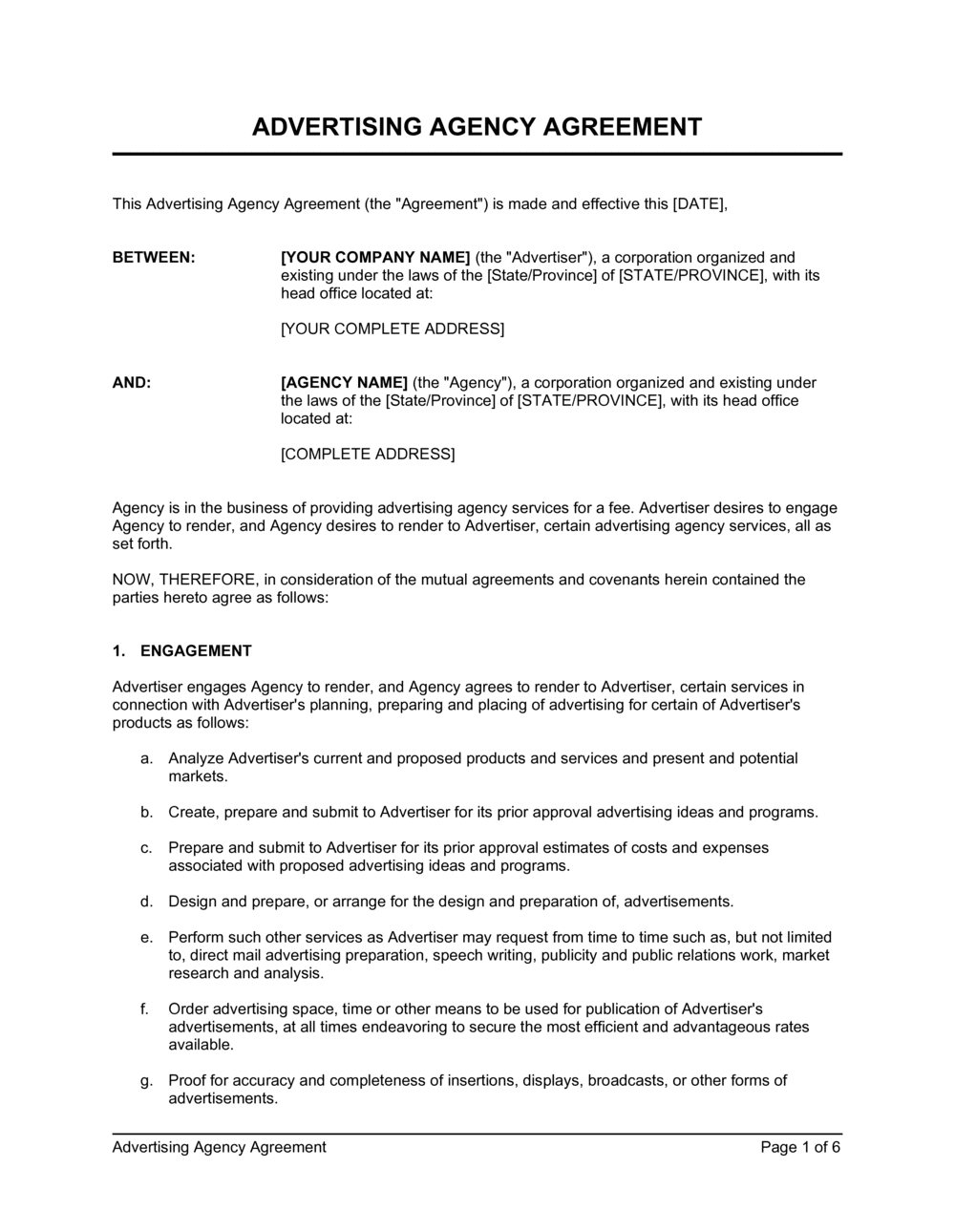
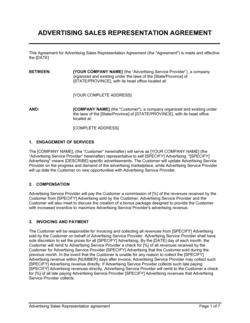
Advertising Agency Agreement Template

Free Word download β€’ Edit online β€’ Save & share with Drive β€’ Export to PDF

6 pagesβ€’25–35 min to fillβ€’Difficulty: Complexβ€’Signature requiredβ€’Legal review recommended
Learn more ↓
FreeAdvertising Agency Agreement Template

At a glance

What it is
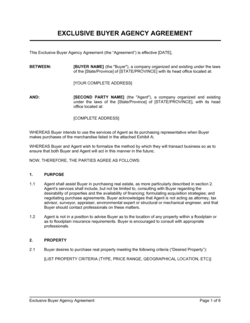
An Advertising Agency Agreement is a legally binding contract between a client and an advertising or marketing agency that governs the terms under which the agency will plan, create, and place advertising on the client's behalf. This free Word download covers scope of services, fees and commissions, IP ownership, approval workflows, confidentiality, and termination β€” in a single ready-to-edit document you can export as PDF and execute in minutes.
When you need it
Use it before any agency begins paid media placement, creative development, or campaign strategy work on your behalf. It is equally essential for agencies formalizing new client engagements where deliverables, billing, and IP rights need to be unambiguous from day one.
What's inside
Scope of services and campaign objectives, fee structure and commission rates, approval and revision procedures, intellectual property assignment, confidentiality obligations, representations and warranties, indemnification, and termination rights with notice periods.

What is an Advertising Agency Agreement?

An Advertising Agency Agreement is a legally binding contract between a client and an advertising or marketing agency that governs the terms under which the agency will plan, create, and place advertising on the client's behalf. It defines the scope of services, compensation structure β€” including retainer fees, project rates, and media commissions β€” approval workflows, intellectual property ownership, confidentiality obligations, and termination rights. Unlike a casual statement of work or email confirmation, a properly executed advertising agency agreement creates enforceable obligations on both sides and eliminates the ambiguity that routinely leads to billing disputes, ownership conflicts, and unauthorized media spend.

Why You Need This Document

Without a written advertising agency agreement, four categories of risk materialize simultaneously. First, IP ownership is undefined β€” courts in most jurisdictions default to the creator retaining copyright in the absence of a written assignment, meaning the creative your agency produced may legally belong to them even after you paid for it. Second, media spend is uncontrolled β€” agencies with open authority to buy media on your behalf can commit you to insertion orders and production invoices you had no opportunity to approve. Third, confidential campaign data, pricing intelligence, and customer insights shared with the agency have no contractual protection once the relationship ends. Fourth, termination becomes a negotiation rather than an exercise of a defined right, leaving you liable for months of fees you no longer want to pay. This template gives both parties a clear, professionally structured foundation β€” covering every material term from scope to severance β€” so the engagement starts on the right footing and ends without litigation.

Which variant fits your situation?

If your situation is…Use this template
Engaging an agency for a single defined campaign with a fixed budgetAdvertising Agency Agreement (Project-Based)
Retaining an agency for ongoing monthly marketing servicesMarketing Retainer Agreement
Hiring a freelance copywriter or designer rather than a full agencyIndependent Contractor Agreement
Commissioning a media buying agency for TV, radio, or out-of-home placementMedia Buying Agreement
Engaging a public relations firm alongside an advertising agencyPublic Relations Services Agreement
Formalizing influencer or social media campaign executionInfluencer Marketing Agreement
Licensing brand assets to an agency operating in a different territoryBrand Licensing Agreement

Common mistakes to avoid

❌ Vague or open-ended scope of services

Why it matters: Without specific deliverables and channels in a written schedule, the agency can claim additional fees for work the client assumed was included, and the client can demand work the agency never agreed to perform.

Fix: Attach a Schedule A listing every deliverable by type, channel, frequency, and format. Amend the schedule in writing for any scope change.

❌ No written approval threshold for third-party costs

Why it matters: Agencies authorized to incur costs 'at cost' have committed clients to large production, stock, or vendor invoices without prior sign-off β€” leaving the client liable with no contractual recourse.

Fix: Set an explicit dollar threshold above which any third-party cost requires the client's written approval before the agency proceeds.

❌ IP assignment with no payment condition

Why it matters: If creative ownership transfers upon delivery rather than upon full payment, the client can withhold fees while using the agency's work β€” leaving the agency with no practical leverage to collect.

Fix: State that IP assignment is conditioned on receipt of full payment for all amounts owed under the agreement.

❌ Auto-renewal clause with a short or absent notice period

Why it matters: Clients who miss a 30-day notice window are automatically bound to another full contract term β€” often months of retainer fees they had no intention of incurring.

Fix: Set the non-renewal notice period to at least 60 days and calendar a reminder 90 days before the end of each term.

❌ One-sided indemnification protecting only the client

Why it matters: Agencies that produce creative under client-supplied briefs or brand guidelines can face IP infringement claims from third parties β€” without mutual indemnification they bear that risk alone.

Fix: Include reciprocal indemnification: the client covers claims arising from materials it supplied; the agency covers claims arising from work it independently created.

❌ No exclusivity clause for competitive clients

Why it matters: Without an exclusivity provision, the same agency can simultaneously serve the client's direct competitors β€” sharing campaign insights, creative approaches, and media pricing across competing accounts.

Fix: Define the competitive category specifically and restrict the agency from serving named or categorically defined competitors for the duration of the engagement and a defined period post-termination.

The 9 key clauses, explained

Parties and recitals

In plain language: Identifies the client and the agency by their legal entity names and briefly states the purpose of the agreement.

Sample language
This Advertising Agency Agreement ('Agreement') is entered into as of [DATE] between [CLIENT LEGAL NAME], a [STATE/COUNTRY] [ENTITY TYPE] ('Client'), and [AGENCY LEGAL NAME], a [STATE/COUNTRY] [ENTITY TYPE] ('Agency').

Common mistake: Using a trade name or DBA instead of the registered legal entity name β€” this can make the contract unenforceable against the correct legal party or complicate invoicing and tax reporting.

Scope of services

In plain language: Defines precisely what advertising and marketing activities the agency will perform, in which channels, and across which geographic markets.

Sample language
Agency shall provide the following services on Client's behalf: (a) development of creative concepts for [CHANNELS]; (b) media planning and placement in [MARKETS]; and (c) campaign performance reporting on a [WEEKLY/MONTHLY] basis, as further detailed in Schedule A.

Common mistake: Keeping the scope vague to allow 'flexibility' β€” without specific deliverables and channels in a schedule, disputes over what is and isn't included are nearly impossible to resolve.

Fees, commissions, and expenses

In plain language: States the agency's compensation β€” whether a flat retainer, project fee, media commission, or hourly rate β€” and the policy for reimbursing third-party costs.

Sample language
Client shall pay Agency a monthly retainer of $[AMOUNT] plus a media commission of [X]% on all media placements. Third-party production costs shall be billed at cost plus [X]% handling fee, subject to prior written approval for any single expense exceeding $[THRESHOLD].

Common mistake: Omitting a written approval threshold for third-party costs β€” agencies have committed clients to five-figure production invoices under an ambiguous 'at cost' clause without prior sign-off.

Media authorization and approval workflow

In plain language: Requires the client's written approval before the agency places media buys or releases creative, and defines the revision and sign-off process.

Sample language
Agency shall obtain Client's written approval via [EMAIL/PORTAL] prior to placing any media insertion order or releasing any creative to a third party. Client shall respond within [X] business days; failure to respond shall be deemed approval.

Common mistake: No approval deadline or 'deemed approval' clause β€” without one, the client can delay indefinitely, and the agency has no contractual protection for missed placement windows.

Intellectual property ownership

In plain language: Allocates ownership of creative work produced under the agreement β€” typically assigning final approved deliverables to the client while the agency retains background IP.

Sample language
Upon receipt of full payment, Agency assigns to Client all right, title, and interest in final approved deliverables ('Work Product'). Agency retains ownership of all pre-existing tools, templates, and background IP ('Agency IP'). Agency IP incorporated into Work Product is licensed to Client on a non-exclusive, royalty-free basis.

Common mistake: Omitting the 'upon full payment' condition β€” without it, the client may assume ownership before paying, giving them leverage to withhold fees while still using the creative.

Confidentiality

In plain language: Prevents both parties from disclosing the other's business information β€” campaign data, pricing, customer lists, and strategies β€” to third parties during and after the engagement.

Sample language
Each party agrees to hold the other's Confidential Information in strict confidence and not to disclose it to any third party without prior written consent. This obligation survives termination of the Agreement for a period of [X] years.

Common mistake: No post-termination survival period β€” confidentiality obligations that expire the moment the agreement ends offer no protection for campaign strategies or customer data shared during the engagement.

Representations, warranties, and indemnification

In plain language: Each party confirms it has the authority and rights to enter the agreement, and each agrees to cover the other's losses if its own breach or infringement causes a claim.

Sample language
Agency represents that the Work Product will not infringe any third-party IP rights. Client represents that all materials provided to Agency are owned or licensed by Client. Each party shall indemnify, defend, and hold harmless the other from claims arising from its own breach of these representations.

Common mistake: One-sided indemnification that only protects the client β€” agencies that produce creative under client direction are exposed to IP claims from stock libraries, music licensors, and brand owners, and need mutual protection.

Term and termination

In plain language: Sets the initial contract period, renewal mechanics, notice required to terminate, and the consequences of termination β€” including kill fees and work-in-progress compensation.

Sample language
This Agreement commences on [START DATE] and continues for [X] months ('Initial Term'), renewing automatically for successive [X]-month periods unless either party provides [30] days' written notice of non-renewal. Either party may terminate for cause upon [15] days' written notice if a material breach is not cured within the notice period.

Common mistake: Auto-renewal with no notice period or a notice period shorter than the agency's media commitment cycle β€” clients have been bound to additional months of retainer because they missed a 30-day notice window.

Governing law and dispute resolution

In plain language: Specifies which jurisdiction's law governs the contract and how disputes will be resolved β€” through courts, arbitration, or mediation.

Sample language
This Agreement is governed by the laws of [STATE/PROVINCE/COUNTRY]. Any dispute arising under this Agreement shall first be submitted to non-binding mediation. If unresolved within [30] days, the dispute shall be resolved by binding arbitration in [CITY] under the rules of [AAA/JAMS/OTHER].

Common mistake: Choosing a governing law that has no connection to where either party operates β€” this can make enforcement impractical and may void specific clauses under local mandatory law.

How to fill it out

  1. 1

    Enter legal entity names and signing authority

    Insert the full registered legal names of both client and agency in the parties clause. Confirm the signatory's title and authority to bind the entity β€” an agency representative signing without authority cannot create an enforceable contract.

    πŸ’‘ Request the agency's certificate of incorporation or business registration to verify the legal name before execution.

  2. 2

    Define the scope of services in Schedule A

    Move specific deliverables, channels, platforms, and geographic markets into a Schedule A rather than embedding them in the body. This lets you update campaign scope without amending the main contract.

    πŸ’‘ Include response time standards for each deliverable type β€” creative revisions within 5 business days, media reports by the 5th of each month β€” so expectations are measurable from day one.

  3. 3

    Set the fee structure and approval thresholds

    Choose between retainer, project fee, commission, or a hybrid. State the media commission rate explicitly as a percentage of gross media spend. Set a written approval threshold for third-party costs β€” typically $500 to $2,000 depending on campaign scale.

    πŸ’‘ Include a late-payment fee of 1.5% per month on overdue balances β€” agencies often skip this and then have no leverage on slow-paying clients.

  4. 4

    Configure the approval and revision workflow

    Specify the approval channel (email, project management tool, or client portal), the number of included revision rounds per deliverable, and a deemed-approval period β€” typically 5 to 10 business days.

    πŸ’‘ A deemed-approval clause is critical for media placements with hard booking deadlines β€” without it, a non-responsive client can cause missed placements and cancellation penalties.

  5. 5

    Allocate intellectual property clearly

    Confirm that final approved deliverables assign to the client upon full payment. Identify any agency tools, fonts, templates, or software that remain agency property and will be licensed β€” not assigned β€” to the client.

    πŸ’‘ If the agency uses proprietary ad-tech platforms or analytics dashboards, clarify in Schedule A whether the client retains data access after termination.

  6. 6

    Set the term, renewal mechanics, and termination notice

    Choose an initial term that matches the campaign horizon β€” 6 or 12 months is standard. Set the auto-renewal notice period to at least 30 days and ensure it exceeds any media commitment cycle the agency operates on.

    πŸ’‘ Add a convenience termination right with a 60-day notice period β€” having no termination-for-convenience option locks both parties into a relationship that may no longer serve either one.

  7. 7

    Sign before any work or media spend begins

    Both parties must execute the agreement before the agency purchases media, develops creative, or incurs any third-party costs. Post-commencement signatures create disputes about which obligations were in effect before signing.

    πŸ’‘ Use a timestamped e-signature tool so the executed date is auditable β€” email chains confirming verbal agreement are not a substitute for a signed contract.

Frequently asked questions

What is an advertising agency agreement?

An advertising agency agreement is a legally binding contract between a client and an advertising or marketing agency that defines the terms under which the agency will plan, create, and place advertising on the client's behalf. It covers scope of services, compensation, IP ownership, approval rights, confidentiality, and termination β€” replacing informal email arrangements with enforceable obligations on both sides.

Who should sign an advertising agency agreement?

Both the client and the agency must sign before any work begins. On each side, the signatory should be an authorized officer or director with the legal authority to bind the entity. Junior marketing or account staff typically lack that authority. Confirming signing authority in advance prevents enforceability challenges if a dispute arises later.

What is the difference between an advertising agency agreement and a marketing retainer agreement?

An advertising agency agreement typically governs a broader relationship covering creative development, media planning, and campaign execution β€” often including media commission structures. A marketing retainer agreement generally covers ongoing advisory, strategy, or content services billed at a flat monthly fee without media spend. If the agency will be placing paid media on your behalf, an advertising agency agreement is the more appropriate document.

Who owns the creative work produced by the agency?

Ownership depends entirely on what the contract says. Under a properly drafted advertising agency agreement, final approved deliverables typically assign to the client upon full payment β€” a work-for-hire or assignment structure. Without an explicit assignment clause, the agency may retain copyright in creative it produces, even if the client paid for it. Always confirm IP ownership in writing before signing.

What happens if the client wants to cancel a campaign mid-way through?

The agreement should include a kill fee provision β€” typically a percentage of the remaining contracted fees β€” payable when the client terminates a project after work has begun. Without a kill fee clause, the agency must pursue damages under general contract law, which is slower and less predictable. Clients benefit from a defined termination cost too, since it caps their exit liability on a fixed-fee project.

Does an advertising agency agreement need to cover media buying separately?

Best practice is to address media authorization explicitly, requiring written client approval before the agency commits to any media insertion order. Some agreements reference a separate media authorization form for each campaign flight. This protects the client from unauthorized spend and protects the agency from liability on placements the client later disputes. For large media budgets, a separate media buying addendum with spending caps per channel is advisable.

Can the agency work for the client's competitors?

Unless the agreement includes an exclusivity clause, there is typically nothing stopping the agency from serving competitors. If competitive exclusivity matters to you, define the restricted category specifically β€” for example, 'direct-to-consumer athletic footwear brands in North America' β€” and include a defined post-termination tail period during which the restriction continues.

What notice period is standard for terminating an advertising agency agreement?

Thirty to ninety days is the typical range. The appropriate length depends on the complexity of the campaigns in flight and the agency's media commitment cycle. If the agency places quarterly media buys, a 30-day notice period may not give enough time to wind down placements without cancellation penalties. Match the notice period to the longest forward commitment the agency can make on your behalf.

Do I need a lawyer to draft an advertising agency agreement?

For straightforward campaign engagements, a well-structured template reviewed briefly by either party's counsel is typically sufficient. Engage a lawyer when the media budget exceeds $500K, when the agreement involves multinational media placement, when proprietary customer data is shared with the agency, or when the IP at stake β€” brand identity, product creative β€” is central to the business's valuation.

How this compares to alternatives

vs Marketing Retainer Agreement

A marketing retainer agreement covers ongoing strategy, content, and advisory services billed at a flat monthly fee. An advertising agency agreement is broader β€” it adds media placement authorization, commission structures, and campaign-specific IP assignment. If the agency will buy paid media on your behalf, you need an advertising agency agreement, not a retainer.

vs Independent Contractor Agreement

An independent contractor agreement governs a self-employed individual performing defined tasks. An advertising agency agreement governs an entity delivering integrated campaign services β€” creative, media, and reporting β€” with agency-level obligations around IP, indemnification, and media authorization. Using a contractor agreement for an agency engagement creates significant gaps around media spend liability and IP ownership.

vs Service Agreement

A general service agreement covers the delivery of professional services broadly but lacks advertising-specific provisions: media authorization, kill fees, commission structures, and competitive exclusivity. An advertising agency agreement builds on the service agreement foundation and adds the commercial and legal terms specific to paid advertising relationships.

vs Brand Licensing Agreement

A brand licensing agreement grants a third party the right to use a brand's trademarks and assets under defined conditions. An advertising agency agreement does not license the brand β€” it engages the agency as a service provider to create and place advertising using the client's brand. If the agency is operating in a territory where it effectively controls the brand locally, a licensing layer may be needed alongside the agency agreement.

Industry-specific considerations

Retail and e-commerce

Seasonal campaign schedules with hard launch dates, performance-based fee structures tied to ROAS, and product image IP ownership are the defining negotiation points.

Financial services

Regulatory compliance review rights over all creative before release β€” required under FCA, SEC, and FINRA rules β€” must be written into the approval workflow clause.

Healthcare and pharmaceuticals

Medical and legal review requirements, FDA and ASA copy approval standards, and strict data handling obligations for any patient-targeting campaigns need explicit contractual coverage.

SaaS and technology

Product positioning accuracy warranties, brand voice guidelines enforceable through the scope clause, and post-termination data access to ad account assets and analytics dashboards.

Jurisdictional notes

United States

US advertising agency agreements are primarily governed by state contract law, with no single federal statute controlling the agency-client relationship. IP assignment should reference 17 U.S.C. Β§ 101 (Copyright Act work-for-hire doctrine) to be explicit. FTC regulations on endorsements, disclosures, and substantiation of advertising claims should be addressed in the representations and warranties clause. State consumer protection statutes β€” particularly California's False Advertising Law β€” can create liability for the client even when the agency prepared the creative.

Canada

Canadian advertising law is regulated federally by the Competition Act and provincially by consumer protection statutes. Quebec requires French-language contracts for provincially regulated commercial relationships, and advertising directed at Quebec consumers must comply with the Consumer Protection Act's restrictions on advertising to children. CASL (Canada's Anti-Spam Legislation) imposes consent requirements for digital advertising and must be addressed when the agency manages email or digital campaigns on the client's behalf.

United Kingdom

UK advertising agency agreements must account for ASA (Advertising Standards Authority) compliance obligations, particularly the CAP Code for non-broadcast advertising. The agreement should allocate responsibility for ASA complaints and copy clearance between the parties. Post-Brexit, UK GDPR governs any personal data processed for targeting purposes β€” a data processing addendum is typically required when the agency handles audience data. IP assignment under the Copyright, Designs and Patents Act 1988 requires clear written language to transfer rights from creator to client.

European Union

EU GDPR applies to all personal data processed for targeting, retargeting, or analytics purposes β€” the agreement should include or reference a Data Processing Agreement (DPA) under Article 28 GDPR. The EU Digital Services Act and Digital Markets Act impose additional obligations on platforms and advertisers operating at scale. Advertising to minors is heavily restricted in several member states, including France and Germany. IP assignment language must be jurisdiction-specific in some member states β€” Germany, for example, applies the Urhebergesetz, which limits the transferability of moral rights regardless of contractual provisions.

Template vs lawyer β€” what fits your deal?

PathBest forCostTime
Use the templateSmall to mid-size businesses engaging a domestic agency for a defined campaign with a media budget under $100KFree30–45 minutes
Template + legal reviewCampaigns involving significant media spend, customer data sharing, or IP that is central to the brand's value$400–$8002–4 days
Custom draftedMultinational campaigns, regulated industries (financial services, healthcare, pharma), or media budgets above $500K$2,000–$6,000+2–4 weeks

Glossary

Agency Commission
A percentage of media spend β€” typically 15% β€” retained by the agency as compensation for planning and placing media on the client's behalf.
Scope of Services
The specific advertising and marketing activities the agency is contracted to perform, including deliverables, channels, and geographic markets.
Insertion Order
A formal document authorizing placement of a specific advertisement in a specific media outlet at a stated rate and schedule.
Creative Brief
A document the client provides to the agency summarizing campaign objectives, target audience, key message, tone, and constraints.
Work for Hire
A legal doctrine under which creative works produced by the agency under contract are owned by the client, not the creator, from the moment of creation.
Indemnification
A contractual obligation by one party to cover the other's losses, costs, or legal liability arising from a specified event β€” such as an IP infringement claim.
Media Authorization
Written client approval required before the agency commits to purchasing advertising inventory on the client's behalf.
Kill Fee
Compensation paid to the agency when the client cancels or substantially alters a project after work has begun but before final delivery.
Exclusivity
A restriction preventing the agency from simultaneously serving direct competitors of the client within a defined category or geographic market.
Net 30
Payment terms requiring the client to remit the full invoice amount within 30 days of the invoice date.
Third-Party Costs
Out-of-pocket expenses the agency incurs on the client's behalf β€” such as media placements, stock photography, or production vendors β€” typically billed at cost or with a stated markup.

Part of your Business Operating System

This document is one of 3,000+ business & legal templates included in Business in a Box.

  • Fill-in-the-blanks β€” ready in minutes
  • 100% customizable Word document
  • Compatible with all office suites
  • Export to PDF and share electronically

Create your document in 3 simple steps.

From template to signed document β€” all inside one Business Operating System.
1
Download or open template

Access over 3,000+ business and legal templates for any business task, project or initiative.

2
Edit and fill in the blanks with AI

Customize your ready-made business document template and save it in the cloud.

3
Save, Share, Send, Sign

Share your files and folders with your team. Create a space of seamless collaboration.

Save time, save money, and create top-quality documents.

β˜…β˜…β˜…β˜…β˜…

"Fantastic value! I'm not sure how I'd do without it. It's worth its weight in gold and paid back for itself many times."

Managing Director Β· Mall Farm
Robert Whalley
Managing Director, Mall Farm Proprietary Limited
β˜…β˜…β˜…β˜…β˜…

"I have been using Business in a Box for years. It has been the most useful source of templates I have encountered. I recommend it to anyone."

Business Owner Β· 4+ years
Dr Michael John Freestone
Business Owner
β˜…β˜…β˜…β˜…β˜…

"It has been a life saver so many times I have lost count. Business in a Box has saved me so much time and as you know, time is money."

Owner Β· Upstate Web
David G. Moore Jr.
Owner, Upstate Web

Run your business with a system β€” not scattered tools

Stop downloading documents. Start operating with clarity. Business in a Box gives you the Business Operating System used by over 250,000 companies worldwide to structure, run, and grow their business.

Start freeΒ Β·Β No credit card required