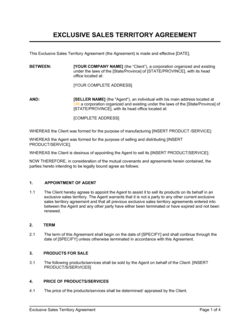
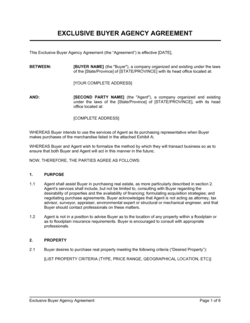
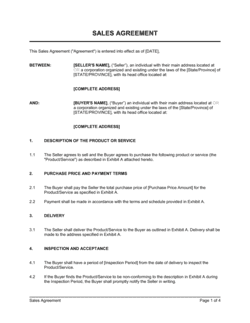
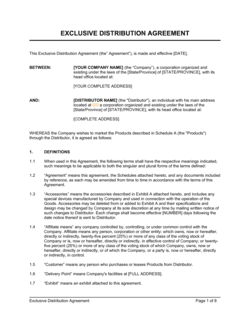
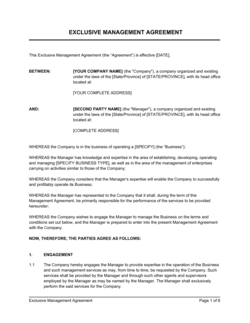
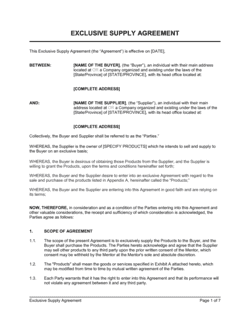
Exclusive Sales Agreement Template

Free Word download • Edit online • Save & share with Drive • Export to PDF

4 pages25–35 min to fillDifficulty: ComplexSignature requiredLegal review recommended
Learn more ↓
FreeExclusive Sales Agreement Template

At a glance

What it is
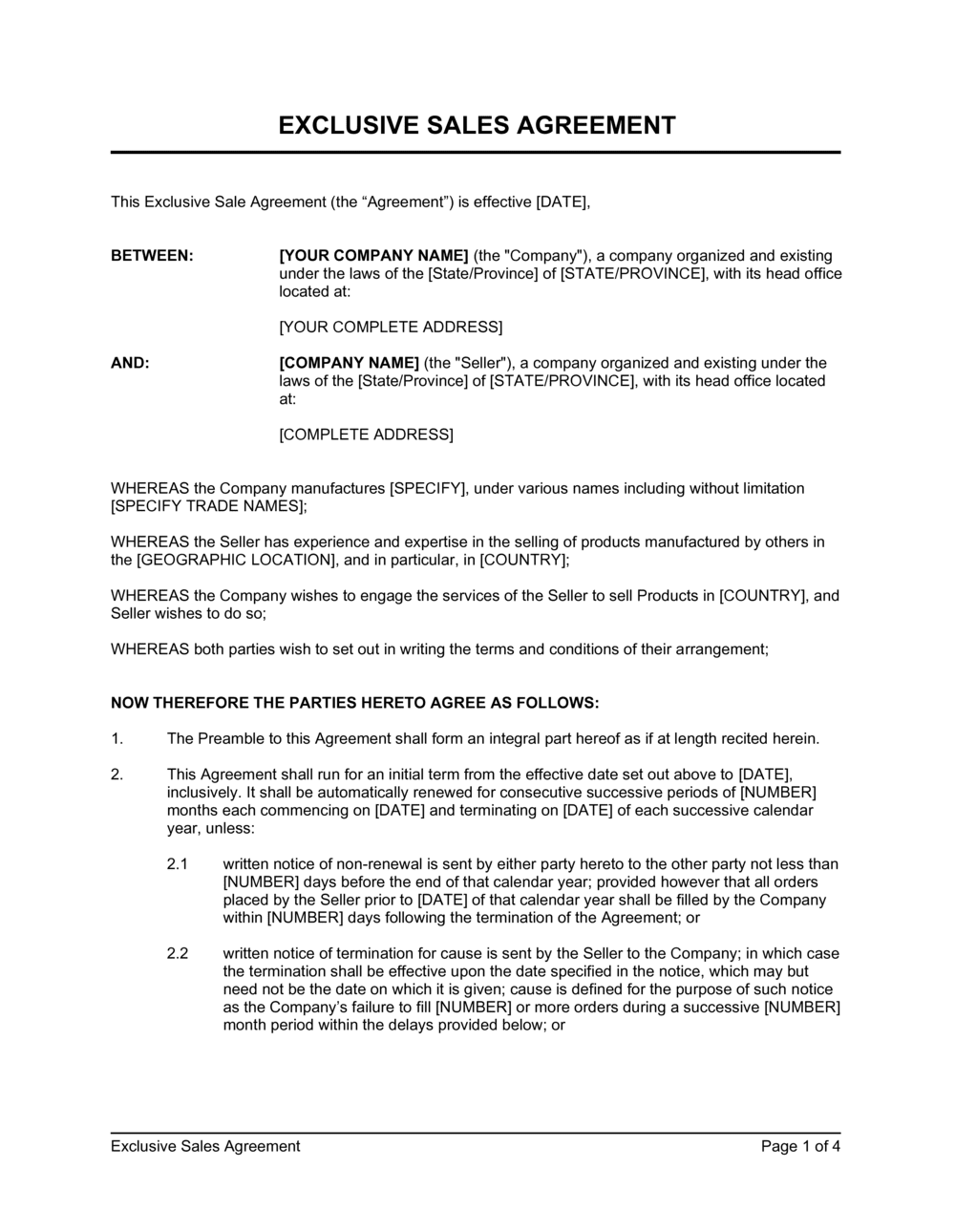
An Exclusive Sales Agreement is a legally binding contract in which a supplier or manufacturer grants a single distributor, reseller, or agent the sole right to sell its products or services within a defined territory, channel, or customer segment. This free Word download gives you a structured, attorney-reviewed starting point you can edit online and export as PDF — covering exclusivity scope, performance quotas, IP usage, pricing, and termination in a single document.
When you need it
Use it when you are granting — or receiving — the sole right to sell a product or service in a specific region or channel, and both parties need enforceable obligations around performance, pricing, and territory protection in writing before any sales activity begins.
What's inside
Parties and recitals, grant of exclusivity and territory definition, performance and minimum purchase quotas, pricing and payment terms, IP licensing and trademark usage, confidentiality, term and termination, non-compete and non-solicitation restrictions, representations and warranties, and governing law and dispute resolution.

What is an Exclusive Sales Agreement?

An Exclusive Sales Agreement is a legally binding contract in which a supplier or manufacturer grants a single distributor, reseller, or agent the sole right to sell specified products or services within a defined territory, channel, or customer category. In exchange for that territorial protection, the distributor typically commits to minimum purchase quotas, refrains from selling competing products, and invests in building the market. The agreement creates enforceable obligations on both sides: the supplier cannot appoint a competing distributor or sell directly into the protected territory, and the distributor cannot underperform without triggering defined consequences. Unlike a general distribution arrangement, exclusivity fundamentally alters the commercial risk profile for both parties — the distributor gains market certainty, and the supplier gains a committed partner with a financial stake in success.

Why You Need This Document

Operating an exclusive sales relationship on the basis of a handshake or an informal email chain exposes both parties to serious commercial and legal risk. Without a written agreement, the supplier can appoint a second distributor in the same territory the moment a competitor offers better terms — leaving the original distributor with inventory, infrastructure investment, and no recourse. For the supplier, an undocumented arrangement provides no enforceable minimum quota, no IP quality controls, and no defined exit mechanism if the distributor fails to perform. Courts will not imply exclusivity from conduct alone; an oral promise of territorial rights is typically unenforceable. A properly drafted Exclusive Sales Agreement locks in the territory definition, quota obligations, trademark usage rules, and termination procedure before the first sale is made — turning a relationship built on trust into one that can also be enforced.

Which variant fits your situation?

If your situation is…Use this template
Granting one distributor exclusive regional rights for physical goodsExclusive Distribution Agreement
Appointing an agent to sell on your behalf without taking title to goodsSales Agency Agreement
Allowing a non-exclusive reseller to carry your product alongside competitorsNon-Exclusive Reseller Agreement
Licensing software or digital products to a single reseller partnerSoftware Reseller Agreement
Appointing a master distributor who will sub-distribute to othersMaster Distribution Agreement
Selling products through a wholesaler with no territorial exclusivityWholesale Agreement
Engaging a manufacturer to produce goods exclusively for your brandExclusive Manufacturing Agreement

Common mistakes to avoid

❌ Ambiguous territory definition

Why it matters: Courts have invalidated exclusivity grants where the territory included some states but was silent on e-commerce sales originating from outside those states, effectively rendering the exclusivity unenforceable.

Fix: Define the territory clause to explicitly address online sales, cross-border orders, and any customer categories or accounts the supplier retains the right to serve directly.

❌ Quota clause without a stated remedy

Why it matters: A minimum purchase obligation with no consequence for missing it cannot be enforced — the distributor can underperform indefinitely while the supplier is locked out of appointing an alternative.

Fix: Specify in the same clause whether the remedy is automatic termination of exclusivity, conversion to non-exclusive status, or a cure period followed by termination, and make the election the supplier's at its option.

❌ No sell-off period on termination

Why it matters: A distributor holding six months of inventory with no right to sell it after contract termination faces a direct financial loss — a claim that courts regularly sustain against suppliers who fail to include this provision.

Fix: Include a sell-off period of 60–120 days, with the distributor's trademark license and exclusivity remaining in effect only for the purpose of liquidating existing stock.

❌ IP license with no quality-control mechanism

Why it matters: Trademark law in the US, UK, and EU requires the licensor to exercise real quality control over licensed use; a license without it risks invalidating the supplier's trademark registration through the doctrine of naked licensing.

Fix: Add a clause requiring the distributor to submit marketing materials and product presentations for prior written approval, and reserve the supplier's right to audit brand usage at least annually.

❌ Signing before confirming the other party's legal authority

Why it matters: An agreement signed by someone without authority to bind the company — a regional manager, for example — is voidable by that company, leaving the other party with no enforceable rights despite having relied on the deal.

Fix: Require the signing party to represent their authority in the signature block and attach a board resolution or power of attorney confirming authorization for agreements above a defined value threshold.

❌ No price-change notice period

Why it matters: Without a notice requirement, the supplier can raise transfer prices immediately and repeatedly, eliminating the distributor's margin and effectively forcing a renegotiation or termination the supplier controls entirely.

Fix: Include a minimum 30-day advance written notice requirement for any price increase, with the distributor's right to place a final order at the current price within that window.

The 10 key clauses, explained

Parties, recitals, and definitions

In plain language: Identifies the supplier and the exclusive distributor as legal entities, states the background context, and defines key terms used throughout the agreement.

Sample language
This Exclusive Sales Agreement ('Agreement') is entered into as of [DATE] between [SUPPLIER LEGAL NAME], a [STATE/COUNTRY] [ENTITY TYPE] ('Supplier'), and [DISTRIBUTOR LEGAL NAME], a [STATE/COUNTRY] [ENTITY TYPE] ('Distributor').

Common mistake: Using a trade name instead of the registered legal entity name. If the contracting party name does not match corporate registry records, enforcing the agreement — including non-compete and IP clauses — against the correct entity becomes procedurally complicated.

Grant of exclusivity and territory

In plain language: Specifies that the supplier appoints only the distributor to sell the listed products within the defined territory or channel, and confirms the supplier will not compete or appoint others in that space.

Sample language
Supplier hereby grants Distributor the exclusive right to market and sell the Products listed in Schedule A within the Territory defined as [GEOGRAPHIC AREA / CHANNEL / CUSTOMER SEGMENT]. Supplier shall not appoint any other distributor or sell directly to customers within the Territory during the Term.

Common mistake: Defining the territory as a country name without specifying whether it includes online channels, government sales, or existing direct accounts. Ambiguous territory definitions are the single most litigated clause in exclusive distribution disputes.

Products and pricing

In plain language: Lists the specific products covered by the exclusivity grant, the supplier's transfer price to the distributor, any price-floor requirements, and the process for price changes.

Sample language
The exclusive rights granted herein apply solely to the Products listed in Schedule A. Supplier shall supply Products at the transfer price set out in Schedule B, subject to revision with [30] days' written notice. Distributor shall not resell Products below the price floor of [AMOUNT] per unit without Supplier's prior written consent.

Common mistake: Omitting a price-change notice period. Without one, the supplier can raise transfer prices immediately, destroying the distributor's margin and creating a constructive termination claim.

Minimum purchase quotas

In plain language: Sets the minimum volume or revenue the distributor must achieve within each quota period — typically quarterly or annually — to retain exclusivity rights.

Sample language
Distributor shall purchase a minimum of [QUANTITY] units (or $[AMOUNT] in net sales) of Products per [QUARTER / YEAR] ('Minimum Quota'). Failure to meet the Minimum Quota in any period entitles Supplier to, at its option, terminate exclusivity or convert this Agreement to a non-exclusive arrangement with [30] days' notice.

Common mistake: Setting quotas without specifying the remedy for missing them. A quota clause without a stated consequence is unenforceable — it becomes an aspirational target rather than a binding obligation.

Trademark and IP license

In plain language: Grants the distributor a limited, non-transferable license to use the supplier's trademarks, logos, and marketing materials solely to promote and sell the products within the territory.

Sample language
Supplier grants Distributor a limited, non-exclusive, non-transferable license to use Supplier's trademarks, logos, and marketing materials ('Marks') solely to promote and sell the Products within the Territory during the Term. Distributor shall not alter, sublicense, or register any Marks without Supplier's prior written consent.

Common mistake: Granting IP rights without a quality-control clause. Courts have held that uncontrolled trademark licenses can result in 'naked licensing,' which can invalidate the supplier's trademark registrations.

Confidentiality

In plain language: Prohibits both parties from disclosing each other's pricing, customer data, trade secrets, and business information to third parties during and after the agreement term.

Sample language
Each party agrees to hold the other's Confidential Information in strict confidence and not to disclose it to any third party without prior written consent. 'Confidential Information' includes pricing schedules, customer lists, technical specifications, and any information marked as confidential. This obligation survives termination for [3] years.

Common mistake: A confidentiality clause that only covers the distributor's obligations and not the supplier's. Suppliers receive distributor customer lists and market intelligence — a mutual clause protects both sides.

Term and renewal

In plain language: States the initial duration of the agreement, the renewal mechanism (automatic or by written notice), and any performance conditions for renewal.

Sample language
This Agreement commences on [START DATE] and continues for an initial term of [X] years ('Initial Term'). Unless either party provides written notice of non-renewal at least [90] days before the end of the Initial Term, the Agreement shall automatically renew for successive [1]-year periods, provided Distributor has met all Minimum Quotas in the preceding term.

Common mistake: Automatic renewal without a quota-performance condition. This locks the supplier into exclusivity even when the distributor has consistently underperformed — often the exact scenario the quota clause was meant to prevent.

Termination and sell-off period

In plain language: Specifies the grounds for early termination — including termination for cause and termination for convenience — and grants the distributor a defined post-termination window to sell existing inventory.

Sample language
Either party may terminate this Agreement for material breach upon [30] days' written notice if the breaching party fails to cure within the notice period. Upon expiration or termination, Distributor shall have [90] days ('Sell-Off Period') to sell existing inventory of Products, after which all exclusivity rights and trademark licenses shall immediately terminate.

Common mistake: No sell-off period at all. Without one, the distributor may be left with unsellable inventory and no contractual basis for liquidating it — a common trigger for breach-of-contract claims against the supplier.

Non-compete and non-solicitation

In plain language: Restricts the distributor from selling directly competing products within the territory during the term, and prevents both parties from poaching each other's key personnel or customer accounts.

Sample language
During the Term, Distributor shall not, without Supplier's written consent, distribute, market, or sell any products that directly compete with the Products within the Territory. For [12] months following termination, neither party shall solicit the other's customers or employees with whom they had contact during the Agreement.

Common mistake: A non-compete that extends beyond the agreement territory. Restricting the distributor globally when the exclusivity only covered one region is disproportionate and routinely struck down as unreasonable.

Governing law and dispute resolution

In plain language: Designates the jurisdiction whose law governs the agreement and the mechanism — arbitration, mediation, or litigation — for resolving disputes.

Sample language
This Agreement is governed by the laws of [STATE / PROVINCE / COUNTRY], without regard to its conflict-of-law principles. Any dispute arising under this Agreement shall be submitted to binding arbitration under the rules of [AAA / ICC / LCIA] in [CITY], conducted in [LANGUAGE], except that either party may seek injunctive relief from a court of competent jurisdiction.

Common mistake: Choosing a governing law with no connection to either party's principal place of business. Several jurisdictions — including California and EU member states — apply local mandatory law regardless of the contract's choice-of-law clause, making a disconnected selection meaningless and confusing.

How to fill it out

  1. 1

    Identify the parties with their full legal entity names

    Enter the registered corporate name, entity type, and jurisdiction of incorporation for both the supplier and the distributor. Confirm names against corporate registry filings before execution.

    💡 Ask for a current certificate of good standing from the other party before signing — it confirms the entity is active and authorized to contract.

  2. 2

    Define the exclusivity scope and territory precisely

    Specify the exact geography (countries, states, or postal zones), sales channels (retail, e-commerce, government), and customer categories included in — and explicitly excluded from — the exclusivity grant.

    💡 List any accounts the supplier will continue to serve directly as 'Excluded Accounts' in Schedule A. Silence on existing accounts causes the most common territory disputes.

  3. 3

    List the covered products in Schedule A

    Enumerate every product SKU or product line covered by the exclusivity, including future product additions and the process for adding them. Products not listed are not exclusive.

    💡 Add a clause addressing new product lines the supplier launches during the term — specify whether they are automatically included or require a written amendment.

  4. 4

    Set minimum purchase quotas with clear consequences

    Define the quota amount (units or revenue), the measurement period (quarterly or annual), the grace period for cure, and the exact remedy for missing — typically a right to terminate exclusivity or convert to non-exclusive.

    💡 Negotiate a ramp-up schedule for the first 6–12 months if the distributor is building the market from scratch. Flat quotas from day one deter quality distributors.

  5. 5

    Complete the pricing and payment terms

    Enter the transfer price, any volume discount thresholds, payment terms (e.g., Net 30 from invoice date), accepted currencies, and the price-change notice period.

    💡 For cross-border agreements, specify which party bears currency conversion costs and which exchange rate source (e.g., ECB reference rate) governs.

  6. 6

    Tailor the IP license and quality-control provisions

    List every trademark and marketing asset licensed to the distributor, specify permitted and prohibited uses, and include a quality-review right allowing the supplier to inspect the distributor's use of the marks.

    💡 Require the distributor to submit samples of co-branded materials for approval before use — this satisfies the quality-control standard courts require to keep a trademark license valid.

  7. 7

    Set the term, renewal conditions, and termination notice periods

    Enter the initial term length, the non-renewal notice window (typically 60–90 days), and any performance conditions that must be met for automatic renewal to take effect.

    💡 Calendar a reminder 120 days before the agreement's anniversary to evaluate performance and decide on renewal before the notice window closes.

  8. 8

    Choose governing law and dispute resolution method

    Select the jurisdiction based on where both parties primarily operate, local contract enforcement strength, and whether arbitration or litigation is more practical given the contract value.

    💡 For cross-border agreements over $500K in annual value, institutional arbitration (ICC or AAA International) typically provides more predictable enforcement than litigation across multiple court systems.

Frequently asked questions

What is an exclusive sales agreement?

An exclusive sales agreement is a legally binding contract in which a supplier grants a single distributor, reseller, or agent the sole right to sell specified products or services within a defined territory or channel. In exchange, the distributor typically commits to minimum purchase quotas and refrains from selling competing products. The agreement protects the distributor from supplier side-selling and gives the supplier a committed commercial partner with skin in the game.

What is the difference between an exclusive sales agreement and a distribution agreement?

The terms are often used interchangeably, but they have a practical distinction. A distribution agreement covers the full logistics relationship — warehousing, shipping, title transfer, and returns — and may or may not include exclusivity. An exclusive sales agreement focuses specifically on the grant of sole selling rights within a territory and the performance obligations attached to that exclusivity. In practice, an exclusive distribution agreement combines both sets of provisions.

What should be included in an exclusive sales agreement?

At minimum: parties and definitions, the grant of exclusivity with precise territory and channel scope, covered products listed in a schedule, minimum purchase quotas with stated remedies, transfer pricing and payment terms, a trademark and IP license with quality controls, confidentiality obligations, term and renewal conditions, termination grounds and sell-off period, non-compete and non-solicitation restrictions, and governing law with a dispute-resolution mechanism.

How do minimum purchase quotas work in an exclusive sales agreement?

Minimum purchase quotas set the floor volume — typically in units or revenue — the distributor must purchase from the supplier in each measurement period, usually quarterly or annually. If the distributor misses the quota, the supplier typically has the option to terminate exclusivity, convert the arrangement to non-exclusive, or offer a cure period. Quotas protect the supplier from a distributor who locks up a territory but fails to develop it; they should be calibrated to realistic market-ramp expectations, especially in the first year.

Can an exclusive sales agreement be terminated early?

Yes, most exclusive sales agreements allow early termination on two grounds: termination for cause — typically a material breach such as missing minimum quotas, misusing IP, or violating confidentiality — and termination for convenience with a defined notice period, often 90 to 180 days. Some agreements also include automatic termination triggers such as insolvency or change of control of either party. The termination clause should always be read alongside the sell-off and wind-down provisions to understand the full exit pathway.

Are exclusive sales agreements enforceable in all jurisdictions?

Generally yes, but enforceability varies significantly by jurisdiction on specific provisions. Non-compete clauses face the same state-by-state restrictions in the US as employment non-competes — California effectively prohibits them between commercial parties in many contexts. In the EU, exclusivity arrangements between parties with significant market share can trigger competition law scrutiny under Article 101 TFEU. Cross-border agreements should be reviewed by counsel familiar with both the supplier's and distributor's home jurisdictions before execution.

What happens to existing inventory when an exclusive sales agreement ends?

A properly drafted agreement includes a sell-off period — typically 60 to 120 days after termination or expiry — during which the distributor retains the right to sell existing inventory and use the supplier's trademarks solely for that purpose. Without this clause, the distributor may be left holding unsellable stock with no contractual basis for liquidating it, a situation courts have treated as a supplier breach. Remaining unsold inventory at the end of the sell-off period should be addressed — either returned for a refund or written off per the agreement.

Does an exclusive sales agreement need to be notarized?

Notarization is not required for an exclusive sales agreement to be legally binding in most jurisdictions. A signed written contract between authorized representatives of both parties is generally sufficient. Some cross-border agreements benefit from notarization or apostille certification if they will be relied upon in court proceedings in civil law countries. When in doubt, consult a local attorney in each party's jurisdiction.

When should I hire a lawyer to draft or review an exclusive sales agreement?

Engage a lawyer when the agreement covers multiple countries, involves products subject to regulatory compliance (food, pharmaceuticals, medical devices), includes significant IP licensing obligations, grants exclusivity worth more than $250K in annual revenue, or contains non-compete clauses whose enforceability you intend to rely on. A template review by a commercial attorney typically costs $500–$1,500 and is cost-effective against the risk of an unenforceable exclusivity clause or an ambiguous territory definition.

How this compares to alternatives

vs Non-Exclusive Distribution Agreement

A non-exclusive distribution agreement allows the supplier to appoint multiple distributors in the same territory simultaneously. The distributor carries no quota obligation and the supplier retains full flexibility, but the distributor has no territorial protection and less incentive to invest in market development. An exclusive agreement is appropriate when the distributor is making a significant upfront investment in building the market.

vs Sales Agency Agreement

A sales agency agreement appoints an agent to solicit orders on the supplier's behalf without the agent ever taking title to or financial risk on the goods. An exclusive sales agreement transfers title and financial risk to the distributor, who buys and resells independently. The distinction affects tax treatment, liability exposure, and the applicability of commercial agent protection laws in the EU and UK.

vs Franchise Agreement

A franchise agreement grants the right to operate under the franchisor's full business system — brand, processes, training, and ongoing support — typically with a broader scope of IP and operational control. An exclusive sales agreement is narrower, covering selling rights for specific products without imposing a full operational system. Franchise agreements involve significantly more regulatory oversight in most jurisdictions.

vs Wholesale Agreement

A wholesale agreement covers bulk product purchases without granting territorial exclusivity. Multiple wholesalers can buy and resell the same products in the same region, and no minimum quota is typically required to maintain buying rights. An exclusive sales agreement is appropriate when the supplier wants committed territorial coverage; a wholesale agreement suits open-market, volume-driven sales relationships.

Industry-specific considerations

Consumer Goods and FMCG

Regional exclusivity tied to retailer distribution networks, strict price-floor clauses to protect brand positioning, and short annual terms with quota-based renewal to maintain market pressure.

Technology and Software

Country or vertical exclusivity for SaaS resellers, sublicense controls on end-user agreements, and performance metrics defined in ARR or new logo counts rather than unit volumes.

Manufacturing and Industrial

Long initial terms (3–5 years) reflecting distributor investment in tooling and service infrastructure, warranty pass-through obligations, and spare-parts stocking requirements as quota components.

Food and Beverage

Regulatory compliance obligations (import licenses, labeling standards) embedded as distributor conditions precedent, cold-chain handling requirements, and short sell-off periods due to product expiry dates.

Jurisdictional notes

United States

Exclusive dealing arrangements are generally permissible under US federal law but can attract antitrust scrutiny under Section 1 of the Sherman Act and Section 3 of the Clayton Act when the supplier holds significant market share. Non-compete clauses in commercial agreements face the same state-by-state enforceability issues as employment non-competes — California, Minnesota, and Oklahoma are particularly restrictive. Certain industries, including alcoholic beverages and motor vehicles, are governed by state-level distributor protection statutes that can override contract termination clauses.

Canada

Exclusive dealing arrangements may be reviewed under the Competition Act if they substantially lessen competition — the Competition Bureau focuses on foreclosure effects in concentrated markets. Unlike the US, Canada has no equivalent of state-level distributor protection statutes for most industries, giving suppliers more contractual flexibility on termination. Quebec agreements should be drafted in French or bilingual form if the distributor is a Quebec-based entity subject to the Charter of the French Language.

United Kingdom

Post-Brexit, the UK operates under its own retained competition law framework (Chapter I prohibition under the Competition Act 1998), which mirrors EU Article 101 TFEU in substance but is enforced by the Competition and Markets Authority independently. Commercial agents operating in the UK — but not distributors who buy and resell — are protected by the Commercial Agents Regulations 1993, which grant statutory compensation on termination regardless of contract terms. Exclusive arrangements in the UK must be assessed under the UK Vertical Agreements Block Exemption Order 2022.

European Union

Exclusive distribution agreements in the EU are assessed under Article 101 TFEU and the EU Vertical Block Exemption Regulation (VBER 2022). The VBER provides a safe harbour for vertical restraints — including territorial exclusivity — where neither party holds more than 30% market share in the relevant market. Agreements outside the safe harbour require individual assessment. Commercial agents (as distinct from independent distributors) are protected by the Commercial Agents Directive, which mandates compensation or indemnity on termination. Post-term non-compete obligations are capped at one year under the VBER.

Template vs lawyer — what fits your deal?

PathBest forCostTime
Use the templateDomestic agreements in a single jurisdiction where both parties are established businesses and the annual contract value is below $250KFree30–60 minutes
Template + legal reviewAgreements involving IP licensing, multi-state US territories, or cross-border arrangements between two parties in the same trade bloc$500–$1,5003–5 business days
Custom draftedMulti-country exclusivity, regulated product categories, contracts above $500K in annual value, or arrangements where non-compete enforceability is commercially critical$2,000–$8,000+2–4 weeks

Glossary

Exclusivity
A contractual guarantee that the supplier will not appoint any other party to sell the same products within the defined territory or channel during the agreement term.
Territory
The specific geographic area, sales channel, or customer segment within which the exclusive sales rights apply.
Minimum Purchase Quota
The lowest volume of products — measured in units, revenue, or order value — the distributor must buy within a defined period to maintain exclusivity rights.
Transfer of Title
The point at which legal ownership of goods passes from the supplier to the distributor, typically on delivery or payment, as defined in the agreement.
Right of First Refusal
A clause giving the exclusive distributor the option to match any third-party offer the supplier receives before the supplier can accept it.
Non-Compete Clause
A restriction preventing the distributor from selling competing products within the exclusive territory during — and often after — the agreement term.
Trademark Sublicense
Permission granted by the supplier allowing the distributor to use the supplier's brand name, logo, and marketing materials solely to promote the licensed products.
Force Majeure
A clause that excuses a party from performance obligations when prevented by events outside its reasonable control, such as natural disasters, war, or government action.
Termination for Cause
The right to end the agreement immediately if the other party materially breaches the contract — such as failing to meet minimum quotas or misusing IP.
Sell-Off Period
A defined window after agreement termination during which the distributor may sell existing inventory before the exclusivity and trademark-use rights fully extinguish.
Price Floor
The minimum resale price the distributor is permitted to charge end customers, set by the supplier to protect brand positioning and margin across channels.

Part of your Business Operating System

This document is one of 3,000+ business & legal templates included in Business in a Box.

  • Fill-in-the-blanks — ready in minutes
  • 100% customizable Word document
  • Compatible with all office suites
  • Export to PDF and share electronically

Create your document in 3 simple steps.

From template to signed document — all inside one Business Operating System.
1
Download or open template

Access over 3,000+ business and legal templates for any business task, project or initiative.

2
Edit and fill in the blanks with AI

Customize your ready-made business document template and save it in the cloud.

3
Save, Share, Send, Sign

Share your files and folders with your team. Create a space of seamless collaboration.

Save time, save money, and create top-quality documents.

★★★★★

"Fantastic value! I'm not sure how I'd do without it. It's worth its weight in gold and paid back for itself many times."

Managing Director · Mall Farm
Robert Whalley
Managing Director, Mall Farm Proprietary Limited
★★★★★

"I have been using Business in a Box for years. It has been the most useful source of templates I have encountered. I recommend it to anyone."

Business Owner · 4+ years
Dr Michael John Freestone
Business Owner
★★★★★

"It has been a life saver so many times I have lost count. Business in a Box has saved me so much time and as you know, time is money."

Owner · Upstate Web
David G. Moore Jr.
Owner, Upstate Web

Run your business with a system — not scattered tools

Stop downloading documents. Start operating with clarity. Business in a Box gives you the Business Operating System used by over 250,000 companies worldwide to structure, run, and grow their business.

Free Forever Plan · No credit card required