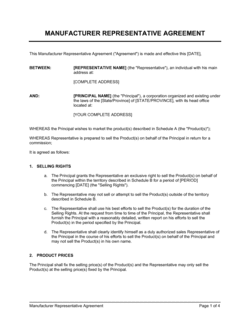
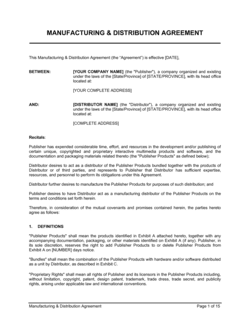
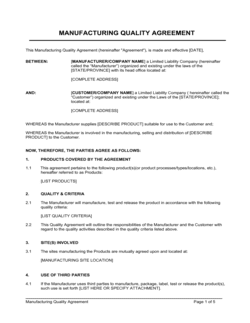
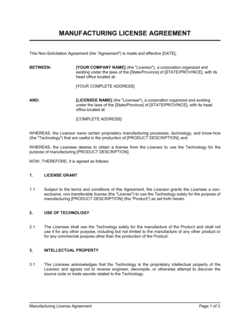
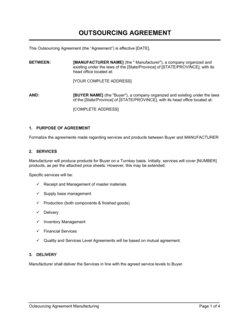
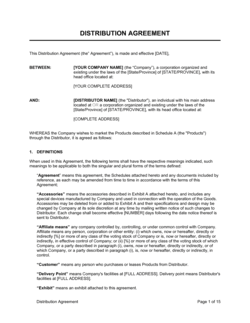
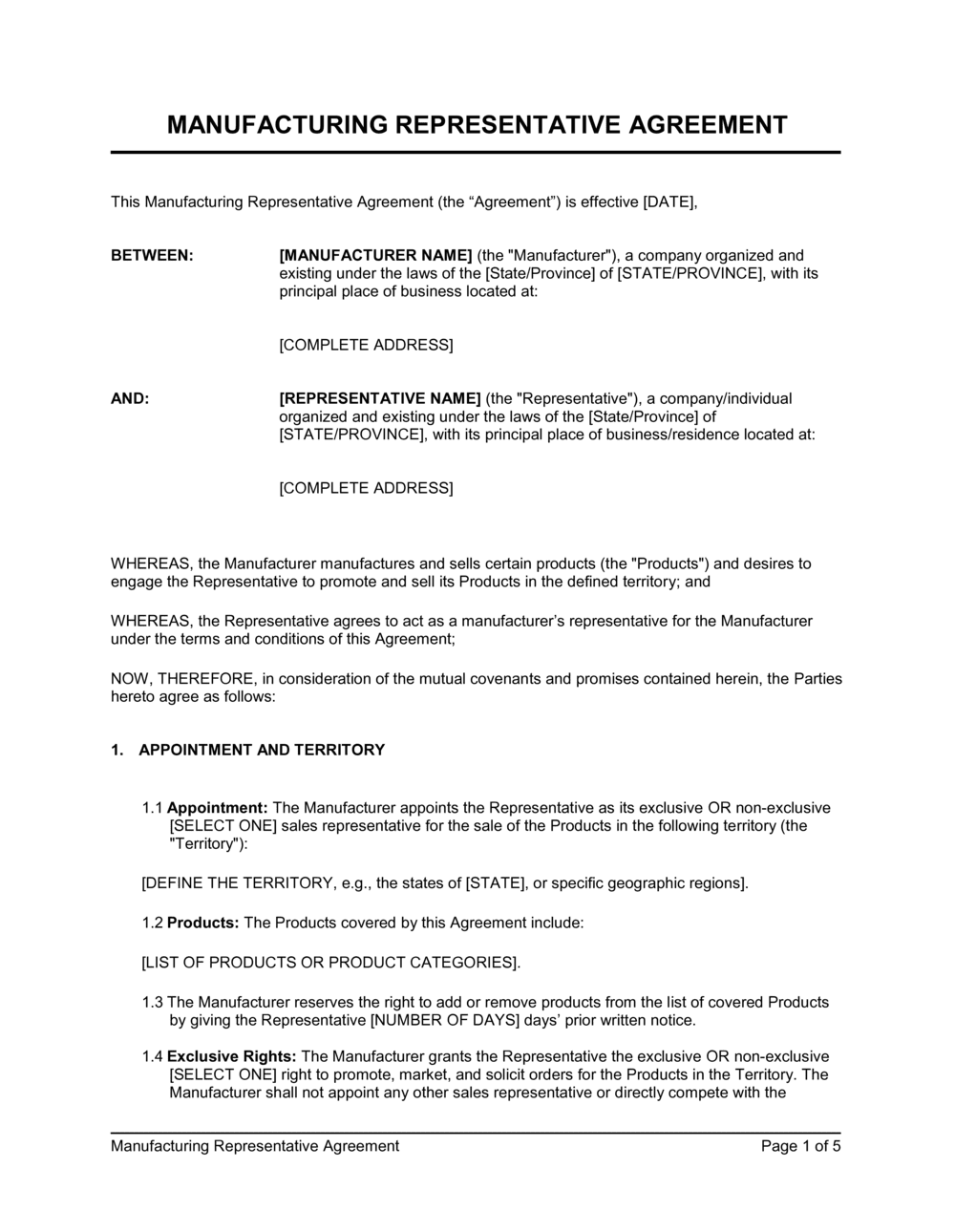
Manufacturing Representative Agreement Template

Free Word download • Edit online • Save & share with Drive • Export to PDF

5 pages25–35 min to fillDifficulty: ComplexSignature requiredLegal review recommended
Learn more ↓
FreeManufacturing Representative Agreement Template

At a glance

What it is
A Manufacturing Representative Agreement is a legally binding contract between a manufacturer and an independent sales representative — an individual or agency — that authorizes the rep to solicit orders for the manufacturer's products within a defined territory and on defined terms. This free Word download covers territory, commission rates, exclusivity, duties, IP protection, and termination in a single editable document you can export as PDF and execute before the rep makes their first sales call.
When you need it
Use it whenever you engage an independent rep firm or individual to sell your manufactured products in a specific region, channel, or vertical — before the rep begins contacting prospects or quoting your products to buyers. It is also required when expanding into new territories through rep networks rather than direct sales headcount.
What's inside
Appointment and territory clause, products and pricing authority, commission schedule and payment mechanics, rep duties and performance standards, exclusivity and house accounts, confidentiality and IP ownership, term and termination conditions, post-termination commission tail, indemnification, and governing law.

What is a Manufacturing Representative Agreement?

A Manufacturing Representative Agreement is a legally binding contract between a manufacturer — the principal — and an independent sales representative or rep firm that authorizes the rep to solicit orders for the manufacturer's products within a defined territory, in exchange for a commission on completed sales. Unlike a distributor, the rep never takes title to or physically handles the goods: the manufacturer invoices the customer directly, fulfills the order, and pays the rep a percentage of net sales once payment is collected. The agreement governs every material dimension of the relationship — territory rights, commission rates and payment timing, performance quotas, house accounts, confidentiality, IP ownership, and the conditions under which either party may end the arrangement.

Why You Need This Document

Operating a rep relationship without a written agreement exposes the manufacturer to commission disputes on every sale, every termination, and every account the rep ever contacted. At least 35 US states have enacted rep protection statutes that impose penalties of two to three times unpaid commissions — and those statutes apply regardless of what an informal arrangement says, or doesn't say. Without a written territory definition, a second rep appointment triggers dual commission claims with no contractual basis for resolution. Without a commission tail clause, every termination produces a pipeline dispute that courts routinely resolve in the rep's favor. Without a house account carve-out, a national account that places an order from within the rep's zip code may generate an unexpected commission obligation on business the manufacturer has serviced for years. This template gives manufacturers and reps a clear, enforceable starting point that addresses all of these risks — reducing the cost and uncertainty of a relationship that, at its best, drives significant revenue for both sides.

Which variant fits your situation?

If your situation is…Use this template
Rep sells exclusively in one territory with no competing linesExclusive Manufacturing Representative Agreement
Rep carries multiple manufacturer lines in the same territoryNon-Exclusive Manufacturing Representative Agreement
Engaging a rep who takes title to goods and resells themDistributor Agreement
Hiring a full-time internal sales employee instead of an independent repEmployment Contract (Sales)
Engaging a general independent contractor for project-based sales supportIndependent Contractor Agreement
Appointing a rep to solicit orders internationally across multiple countriesInternational Sales Representative Agreement
Rep is paid a flat fee per engagement rather than a commission on salesSales Consulting Agreement

Common mistakes to avoid

❌ Vague territory definition

Why it matters: When a second rep is appointed in an adjacent area and territories overlap, the manufacturer faces dual commission claims on the same orders with no contractual basis to resolve them.

Fix: Define territory by specific states, counties, or named account lists — and attach a signed exhibit so both parties acknowledge the exact scope at execution.

❌ No performance quota or minimum sales threshold

Why it matters: A rep who generates little activity cannot be terminated for non-performance if the contract only requires 'best efforts' — courts interpret that standard generously in the rep's favor.

Fix: Include an objective annual net sales minimum with a cure period and an automatic conversion from exclusive to non-exclusive if the quota is missed for two consecutive quarters.

❌ Ignoring state rep protection statutes

Why it matters: At least 35 US states have enacted sales representative protection acts that override contract terms — mandating timely commission payment, minimum notice of termination, and penalties of two to three times unpaid commissions.

Fix: Identify every state where the rep will work and review applicable rep protection laws before finalizing termination notice periods, commission payment timelines, and the governing-law clause.

❌ No post-termination commission tail

Why it matters: Without a defined tail period, every termination produces a dispute over open quotes and pipeline deals that the rep claims to have generated — disputes that typically end in the rep's favor under rep protection statutes.

Fix: Include a commission tail covering orders accepted before termination and quotes submitted within 90 days before termination that convert to orders within 60 days after — with a clear cutoff date for both.

❌ No house account clause

Why it matters: If national accounts or direct customers are not carved out explicitly, the rep may claim commissions on every order placed by any customer physically located in the territory, including accounts the manufacturer has serviced for years.

Fix: List all current house accounts in a signed exhibit at execution and reserve the right to designate additional national accounts with 30 days' written notice.

❌ Treating the rep as an employee in the agreement's language

Why it matters: Language like 'Rep shall work Monday through Friday' or 'Rep shall attend all company meetings' signals an employment relationship, which can trigger misclassification liability for payroll taxes, benefits, and workers' compensation.

Fix: Use language confirming the rep is an independent contractor who controls their own schedule, methods, and staffing — and include an explicit independent-contractor status clause.

The 10 key clauses, explained

Appointment and territory

In plain language: Identifies the rep by legal name, appoints them as the manufacturer's agent to solicit orders, and defines the exact territory — by state, zip code range, named accounts, or industry vertical.

Sample language
[MANUFACTURER NAME] hereby appoints [REP NAME / FIRM] as its [exclusive / non-exclusive] sales representative for the Territory defined as [GEOGRAPHIC AREA / NAMED ACCOUNTS] for the Products listed in Exhibit A.

Common mistake: Defining the territory vaguely as a region name rather than specific states, counties, or account lists — creating overlap disputes when a second rep is appointed nearby.

Products and pricing authority

In plain language: Lists the specific product lines the rep may sell and confirms whether the rep has authority to quote prices, offer discounts, or accept orders — or whether all pricing flows through the manufacturer.

Sample language
Rep is authorized to solicit orders for the Products listed in Exhibit A at the prices and terms set by [MANUFACTURER NAME] from time to time. Rep has no authority to modify pricing, offer discounts exceeding [X]%, or accept orders on [MANUFACTURER NAME]'s behalf without prior written approval.

Common mistake: Granting blanket pricing authority without a discount cap — allowing the rep to agree to terms the manufacturer cannot honor profitably.

Commission schedule and payment mechanics

In plain language: States the commission rate(s) by product line or account type, defines the base (net invoice value, gross sales, or collected cash), and sets the payment trigger and timing — typically within a set number of days after customer payment is received.

Sample language
[MANUFACTURER NAME] shall pay Rep a commission of [X]% of Net Sales on Products sold within the Territory. Commissions are earned upon receipt of full payment from the customer and shall be paid within [30] days of the close of the month in which payment is received.

Common mistake: Tying commission payment to shipment rather than customer payment — creating a situation where the rep is paid before the manufacturer collects, exposing the manufacturer to chargeback disputes.

Rep duties and performance standards

In plain language: Sets out the rep's core obligations — actively soliciting orders, maintaining product knowledge, attending sales meetings, submitting activity reports — and any minimum sales quotas tied to exclusivity or continuation of the agreement.

Sample language
Rep shall use commercially reasonable efforts to promote and solicit orders for the Products within the Territory, maintain adequate sales staff, provide monthly activity reports to [MANUFACTURER NAME], and achieve minimum annual Net Sales of $[AMOUNT] ('Performance Quota') commencing [DATE].

Common mistake: Omitting a specific performance quota and relying on 'best efforts' language — leaving the manufacturer with no contractual basis to terminate if the rep is inactive.

Exclusivity and house accounts

In plain language: States whether the appointment is exclusive within the territory and lists any house accounts the manufacturer retains regardless of location — accounts for which no commission is owed to the rep.

Sample language
The appointment is exclusive within the Territory, provided Rep meets the Performance Quota. The following accounts are designated House Accounts and are excluded from Rep's commission entitlement: [LIST]. [MANUFACTURER NAME] reserves the right to add House Accounts with [30] days' written notice.

Common mistake: No house account clause at all — leaving the manufacturer unable to retain direct relationships with national accounts or key customers without owing the territory rep a commission on every order.

Confidentiality and IP ownership

In plain language: Prohibits the rep from disclosing the manufacturer's pricing, customer data, product specifications, and trade secrets — and confirms that all IP, including customer contacts developed during the relationship, belongs to the manufacturer.

Sample language
Rep shall not disclose or use Confidential Information — including pricing, customer lists, product specifications, and technical data — for any purpose other than performing obligations under this Agreement. All customer relationships and data developed by Rep in connection with [MANUFACTURER NAME]'s Products remain the sole property of [MANUFACTURER NAME].

Common mistake: Not addressing customer list ownership — leaving the manufacturer exposed when a rep leaves and claims ownership of the accounts they developed.

Term, termination, and notice

In plain language: Sets the initial term, automatic renewal conditions, and the notice period required for either party to terminate — plus conditions that allow immediate termination for cause.

Sample language
This Agreement commences on [START DATE] and continues for an initial term of [ONE YEAR], renewing automatically for successive one-year periods unless either party provides [60] days' written notice of non-renewal. Either party may terminate immediately for Cause, defined as [MATERIAL BREACH / FRAUD / INSOLVENCY].

Common mistake: Setting a short notice period — such as 30 days — without accounting for rep protection statutes in the rep's state that mandate longer notice or severance-like commission continuation regardless of the contract.

Post-termination commission tail

In plain language: Defines the period after termination during which the rep remains entitled to commissions on orders placed before the termination date or on open quotes that convert to orders within a defined window.

Sample language
Following termination, Rep shall be entitled to commissions on (a) orders accepted by [MANUFACTURER NAME] prior to the effective termination date and (b) orders resulting from quotes submitted by Rep within [90] days before termination that are accepted within [60] days after termination.

Common mistake: No commission tail clause — creating a dispute on every termination over whether the rep is owed commissions on pending deals, which courts often resolve in the rep's favor under rep protection statutes.

Indemnification and limitation of liability

In plain language: Allocates risk between the parties: the rep indemnifies the manufacturer for claims arising from the rep's misrepresentations; the manufacturer indemnifies the rep for product liability claims. Caps total liability at a stated dollar amount or multiples of commissions paid.

Sample language
Rep shall indemnify [MANUFACTURER NAME] against claims arising from Rep's unauthorized representations or actions. [MANUFACTURER NAME] shall indemnify Rep against product liability claims arising from defects in the Products. Neither party's liability shall exceed the total commissions paid in the [12] months preceding the claim.

Common mistake: No liability cap — exposing the manufacturer to unlimited indemnity claims from a rep who makes an unauthorized representation to a major customer.

Governing law and dispute resolution

In plain language: Specifies which state or country's law governs the agreement and the mechanism for resolving disputes — arbitration, mediation, or courts — including venue.

Sample language
This Agreement is governed by the laws of the State of [STATE], without regard to conflict-of-law principles. Any dispute shall be resolved by binding arbitration administered by [AAA / JAMS] in [CITY, STATE], except either party may seek injunctive relief in any court of competent jurisdiction.

Common mistake: Choosing a governing state without considering whether that state's rep protection law applies regardless of the choice-of-law clause — California, Illinois, and several other states apply their statutes to protect reps working within those states even if the contract nominates a different state's law.

How to fill it out

  1. 1

    Identify both parties with full legal names

    Enter the manufacturer's registered legal entity name and the rep's legal name or firm name. Confirm whether the rep is an individual, a sole proprietor, or a corporate entity, and include the state of formation.

    💡 Confirm the rep's entity type before signing — a rep operating through an LLC has different indemnification exposure than an individual, which affects your insurance and liability analysis.

  2. 2

    Define the territory precisely

    List specific states, zip codes, named accounts, or industry verticals. Attach a map or account list as an exhibit if the territory is complex. Avoid regional descriptions like 'the Southeast' without naming the states.

    💡 If you use named accounts rather than geography, include a process for adding or removing accounts so you are not locked into an outdated list.

  3. 3

    List all products and confirm pricing authority

    Attach a product exhibit listing every line the rep may sell, along with current price lists. Specify whether the rep may quote prices directly or must route all quotes through your sales desk.

    💡 Reserve the right to update the product exhibit and price list by written notice without requiring a contract amendment — markets and product lines change frequently.

  4. 4

    Set the commission rate, base, and payment timing

    State the rate as a percentage of net sales for each product category or account type. Define net sales explicitly — gross invoice less returns, freight, and taxes. Set a specific payment date, such as the 30th day after the month in which customer payment is received.

    💡 If you have multiple product lines at different margin levels, use a tiered commission schedule in Exhibit B rather than a flat rate — this keeps high-margin lines from subsidizing low-margin ones.

  5. 5

    Set the performance quota and exclusivity conditions

    Enter the minimum annual net sales figure that triggers exclusivity. Include a cure period — typically 60 days — before exclusivity automatically converts to non-exclusive if the quota is missed.

    💡 Set the first-year quota at a level the rep can realistically achieve during the ramp period — an unreachable quota invites early termination disputes.

  6. 6

    List house accounts and reservation of rights

    Name every account the manufacturer will service directly, and include language allowing you to add national accounts with reasonable notice.

    💡 Review your current customer list before finalizing — a large account that expands into the rep's territory after signing could trigger an unexpected commission obligation if it is not listed.

  7. 7

    Set the term, notice periods, and termination triggers

    Choose an initial term of one or two years with automatic renewal. Set a notice period of at least 60 days for non-renewal. Define cause for immediate termination — material breach, fraud, insolvency, or conviction of a felony.

    💡 Check the rep protection statutes in the states where the rep will operate before finalizing notice periods — some states mandate 30, 60, or 90 days regardless of the contract.

  8. 8

    Execute before the rep contacts any prospects

    Both parties must sign the agreement before the rep makes any sales calls, quotes products, or represents the manufacturer to any buyer. Retroactive agreements are difficult to enforce and create ambiguity on commissions already earned.

    💡 Use a digital signature platform to timestamp execution and store the fully executed copy alongside the product and territory exhibits.

Frequently asked questions

What is a manufacturing representative agreement?

A manufacturing representative agreement is a legally binding contract between a manufacturer and an independent sales representative that authorizes the rep to solicit orders for the manufacturer's products within a defined territory, in exchange for a commission on completed sales. The rep does not take title to or inventory the products — they act as an agent who connects buyers to the manufacturer and earns a percentage of net sales when orders are accepted and paid.

What is the difference between a manufacturing rep and a distributor?

A manufacturing rep solicits orders on the manufacturer's behalf but never takes title to the goods — the manufacturer invoices the customer directly and pays the rep a commission. A distributor purchases the product outright, takes title, holds inventory, and resells at a margin. The distinction matters for pricing control, credit risk, tax treatment, and the applicable legal framework. If your partner takes title and holds stock, use a distribution agreement rather than a rep agreement.

Does a manufacturing representative agreement need to be in writing?

In many US states and Canadian provinces, a written agreement is legally required — and in states with sales representative protection acts, the absence of a written contract does not eliminate the manufacturer's commission obligation. Courts in those jurisdictions will imply commission terms from the parties' course of dealing. A written agreement protects both sides by making territory, rate, payment timing, and termination obligations unambiguous before any dispute arises.

What commission rate is typical for a manufacturing rep?

Commission rates typically range from 3% to 20% of net sales, depending on product category, margin levels, deal complexity, and whether the rep is exclusive. Industrial and capital equipment reps typically earn 5–10%, while consumer goods or commodity lines often pay 3–5%. High-margin or specialty products may justify 10–15%. The rate should reflect the rep's cost of coverage and the manufacturer's gross margin — a rate that leaves the manufacturer underwater on low-margin lines creates immediate friction.

What happens to commissions when the agreement is terminated?

The rep is generally entitled to commissions on orders accepted before the termination date, and in many states, on orders resulting from the rep's quotes or introductions that convert to sales within a defined period after termination — the commission tail. At least 35 US states have rep protection statutes that impose penalties of two to three times unpaid commissions for manufacturers who withhold earned commissions after termination. Always include an explicit post-termination commission tail clause to define the cutoff precisely.

Can a manufacturer terminate a rep agreement at will?

At-will termination clauses are common but not always enforceable as written. Many state rep protection laws require a minimum notice period — often 30 to 90 days — regardless of the contract, and some require the manufacturer to pay earned commissions through to the end of a reasonable notice period even if the contract says otherwise. Illinois, California, New York, and Massachusetts each have statutes that vary in their protections. Review the laws in every state where the rep operates before relying on a short notice period.

Should a manufacturing rep agreement include a non-compete clause?

Many manufacturers include a clause prohibiting the rep from carrying directly competing product lines during the term, which courts generally uphold as a reasonable restriction on an active business relationship. Post-termination non-competes for independent reps face the same enforceability challenges as those in employment contracts — they must be reasonable in duration and scope to survive judicial scrutiny, and California, Minnesota, and several other states restrict them significantly.

Who owns the customer relationships and contact data developed by the rep?

Without an explicit clause, this is a genuine dispute risk. Reps often argue they own the relationships they personally built; manufacturers argue the customers were acquired on the manufacturer's behalf and belong to the principal. Include a clause stating that all customer data, contact information, and business relationships developed in connection with the manufacturer's products are the manufacturer's property — and require the rep to return or delete that data upon termination.

Do I need a lawyer to prepare a manufacturing representative agreement?

For straightforward domestic rep arrangements with a single territory and a standard commission structure, a high-quality template is a solid foundation. Engage a lawyer when the rep operates in multiple states with varying rep protection laws, when significant exclusivity or minimum purchase obligations are involved, when the rep handles sensitive IP or proprietary product data, or when the commission potential is material enough that a dispute would be costly. A 1–2 hour template review typically costs $400–$800 and is worthwhile for any rep network generating over $500K in annual sales.

How this compares to alternatives

vs Distribution Agreement

A distribution agreement appoints a distributor who purchases inventory outright, takes title, and resells at a margin they control. A manufacturing representative agreement appoints an agent who solicits orders without taking title — the manufacturer invoices the customer and pays a commission. Use a rep agreement when you want to retain pricing control and direct customer relationships; use a distribution agreement when you want a partner to absorb inventory risk.

vs Independent Contractor Agreement

A general independent contractor agreement covers project-based or service-based work for a fee. A manufacturing representative agreement is purpose-built for commission-based product sales — with territory rights, commission schedules, performance quotas, house accounts, and rep protection law compliance. Using a generic contractor agreement for a rep relationship leaves commission terms, territory, and post-termination obligations dangerously vague.

vs Sales Employment Contract

An employment contract creates an employer-employee relationship with payroll tax obligations, benefit entitlements, workers' compensation coverage, and at-will termination rights. A manufacturing representative agreement creates an independent contractor relationship with no employment entitlements. Misclassifying a rep as an independent contractor when the working relationship resembles employment triggers IRS and state labor penalties — the level of behavioral and financial control the manufacturer exercises is the key distinction.

vs Agency Agreement

A general agency agreement grants an agent broad authority to act on behalf of a principal — potentially including the authority to bind the principal to contracts. A manufacturing representative agreement typically limits the rep to soliciting orders only, with no authority to accept orders or modify terms on the manufacturer's behalf. The narrower scope protects the manufacturer from unauthorized commitments made by the rep in the field.

Industry-specific considerations

Industrial and Capital Equipment

Long sales cycles and large deal sizes make commission tail provisions and house account carve-outs for national OEM accounts critical components of the agreement.

Consumer Products and FMCG

High-volume, low-margin lines require precise net sales definitions — excluding promotional allowances, freight, and slotting fees — to prevent commission erosion disputes with retail channel reps.

Medical Devices and Life Sciences

FDA regulatory constraints limit what reps may represent about product capabilities; confidentiality and IP clauses must extend to clinical data, and rep credentials and training requirements are often contractually required.

Electronics and Technology Components

Rapid product obsolescence and frequent price changes require the manufacturer to retain unilateral authority to update price lists and discontinue product lines without triggering commission entitlements on cancelled SKUs.

Building Materials and Construction Products

Project-based selling creates complex commission attribution questions when the same project is quoted by multiple parties; a clear order-of-introduction rule in the agreement prevents dual commission claims.

Food and Beverage

Distributor versus rep classification is frequently contested in this sector; the agreement must clearly confirm the rep never takes title or handles returns, and must address promotional fund obligations separately.

Jurisdictional notes

United States

At least 35 states have enacted sales representative protection statutes that override contract terms on commission payment timing and termination notice. Illinois, California, New York, and Michigan impose penalties of two to three times unpaid commissions for violations. California's choice-of-law rules mean that a California-based rep may be entitled to California protections regardless of the governing-law clause. Review the statutes in every state where the rep will physically work before finalizing notice periods and payment timing.

Canada

Canada does not have a unified federal rep protection statute, but provincial employment standards legislation may apply if the rep's working conditions resemble employment rather than independent contracting. Quebec requires that agreements with commercial agents working in the province be compatible with the Civil Code of Quebec, which imposes its own agency and mandate rules. Commission payment obligations and reasonable notice of termination are implied by common law even without a written contract.

United Kingdom

The Commercial Agents (Council Directive) Regulations 1993 govern manufacturers' representatives in the UK and cannot be contracted out of. Key protections include mandatory minimum notice periods (one month per year of service, up to three months), a right to compensation or indemnity on termination equivalent to one to two years' average annual commission, and a requirement that commissions be paid no later than the last day of the month following the quarter in which they are earned. These rights apply regardless of what the written agreement says.

European Union

The EU Commercial Agents Directive (86/653/EEC), implemented across all member states, grants commercial agents a mandatory right to indemnity or compensation on termination — typically one year's average annual remuneration. Member states vary in whether they default to the indemnity or compensation model; Germany applies indemnity, France applies compensation. Commission must be paid no later than the last day of the month following the quarter in which the transaction was completed. These protections cannot be waived by contract and apply to any agreement where the agent works within an EU member state.

Template vs lawyer — what fits your deal?

PathBest forCostTime
Use the templateSingle-territory domestic rep arrangements with a standard commission structure and no complex exclusivity termsFree30–45 minutes
Template + legal reviewMulti-state rep networks, arrangements with performance quotas tied to exclusivity, or reps operating in states with robust rep protection statutes$400–$800 for a 1–2 hour attorney review2–5 days
Custom draftedInternational rep arrangements, high-value capital equipment lines, or situations involving significant IP exposure or complex multi-tier commission structures$1,500–$4,000+1–3 weeks

Glossary

Manufacturing Representative
An independent agent or firm that solicits orders for a manufacturer's products in a defined territory, earning a commission on sales — without taking title to or physical possession of the goods.
Territory
The defined geographic area, named accounts, or industry vertical within which the rep is authorized to solicit orders on behalf of the manufacturer.
Commission Rate
The percentage of net sales or invoice value paid to the rep as compensation for orders that result in a completed, paid sale.
Exclusivity
A grant by the manufacturer that no other rep will be appointed within the same territory — typically contingent on the rep meeting minimum sales thresholds.
House Account
A customer or account that the manufacturer retains the right to service directly, with no commission owed to the territory rep regardless of location.
Commission Tail
Post-termination commissions owed to the rep on orders placed — or shipped — before or within a defined window after the agreement ends.
Performance Quota
A minimum annual or quarterly sales volume the rep must achieve to maintain exclusivity or the agreement itself.
Chargebacks
Reductions to commission already paid when a sale is reversed due to a return, cancellation, or non-payment by the customer.
Indemnification
A contractual obligation by one party to compensate the other for losses, claims, or legal costs arising from a defined category of conduct — typically the rep's misrepresentations or the manufacturer's product defects.
Rep Protection Laws
State or provincial statutes — such as Illinois' Sales Representative Act or California's commission protection rules — that impose mandatory payment timelines and penalties for late or unpaid commissions.
Principal
The manufacturer or vendor on whose behalf the rep acts; the party whose products are being solicited and sold.
Net Sales
Gross invoice value minus returns, allowances, freight charges, and taxes — the base typically used to calculate commissions.

Part of your Business Operating System

This document is one of 3,000+ business & legal templates included in Business in a Box.

  • Fill-in-the-blanks — ready in minutes
  • 100% customizable Word document
  • Compatible with all office suites
  • Export to PDF and share electronically

Create your document in 3 simple steps.

From template to signed document — all inside one Business Operating System.
1
Download or open template

Access over 3,000+ business and legal templates for any business task, project or initiative.

2
Edit and fill in the blanks with AI

Customize your ready-made business document template and save it in the cloud.

3
Save, Share, Send, Sign

Share your files and folders with your team. Create a space of seamless collaboration.

Save time, save money, and create top-quality documents.

★★★★★

"Fantastic value! I'm not sure how I'd do without it. It's worth its weight in gold and paid back for itself many times."

Managing Director · Mall Farm
Robert Whalley
Managing Director, Mall Farm Proprietary Limited
★★★★★

"I have been using Business in a Box for years. It has been the most useful source of templates I have encountered. I recommend it to anyone."

Business Owner · 4+ years
Dr Michael John Freestone
Business Owner
★★★★★

"It has been a life saver so many times I have lost count. Business in a Box has saved me so much time and as you know, time is money."

Owner · Upstate Web
David G. Moore Jr.
Owner, Upstate Web

Run your business with a system — not scattered tools

Stop downloading documents. Start operating with clarity. Business in a Box gives you the Business Operating System used by over 250,000 companies worldwide to structure, run, and grow their business.

Start free · No credit card required