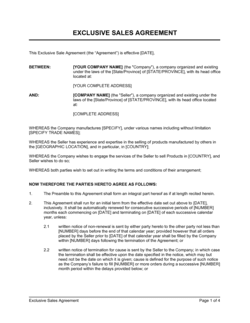
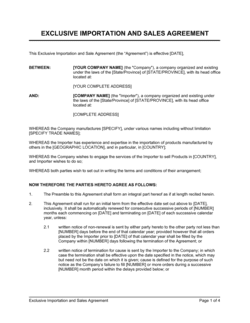
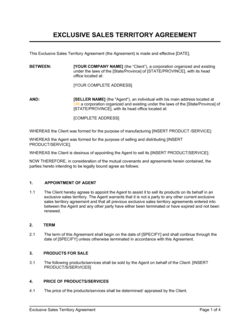
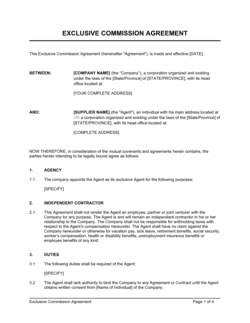
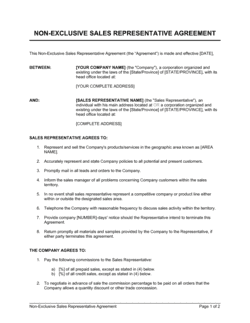
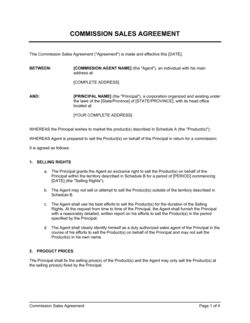
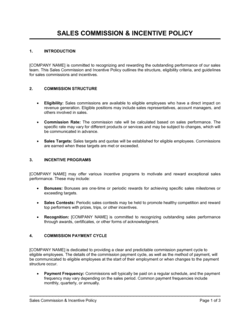
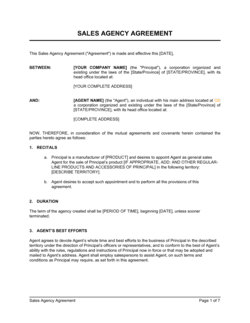
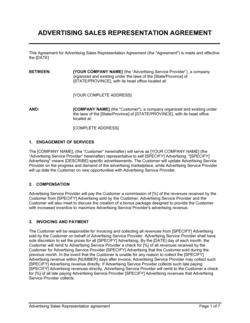
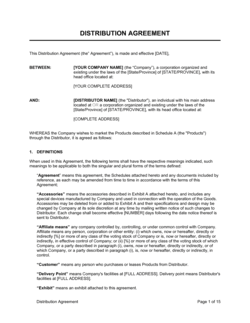
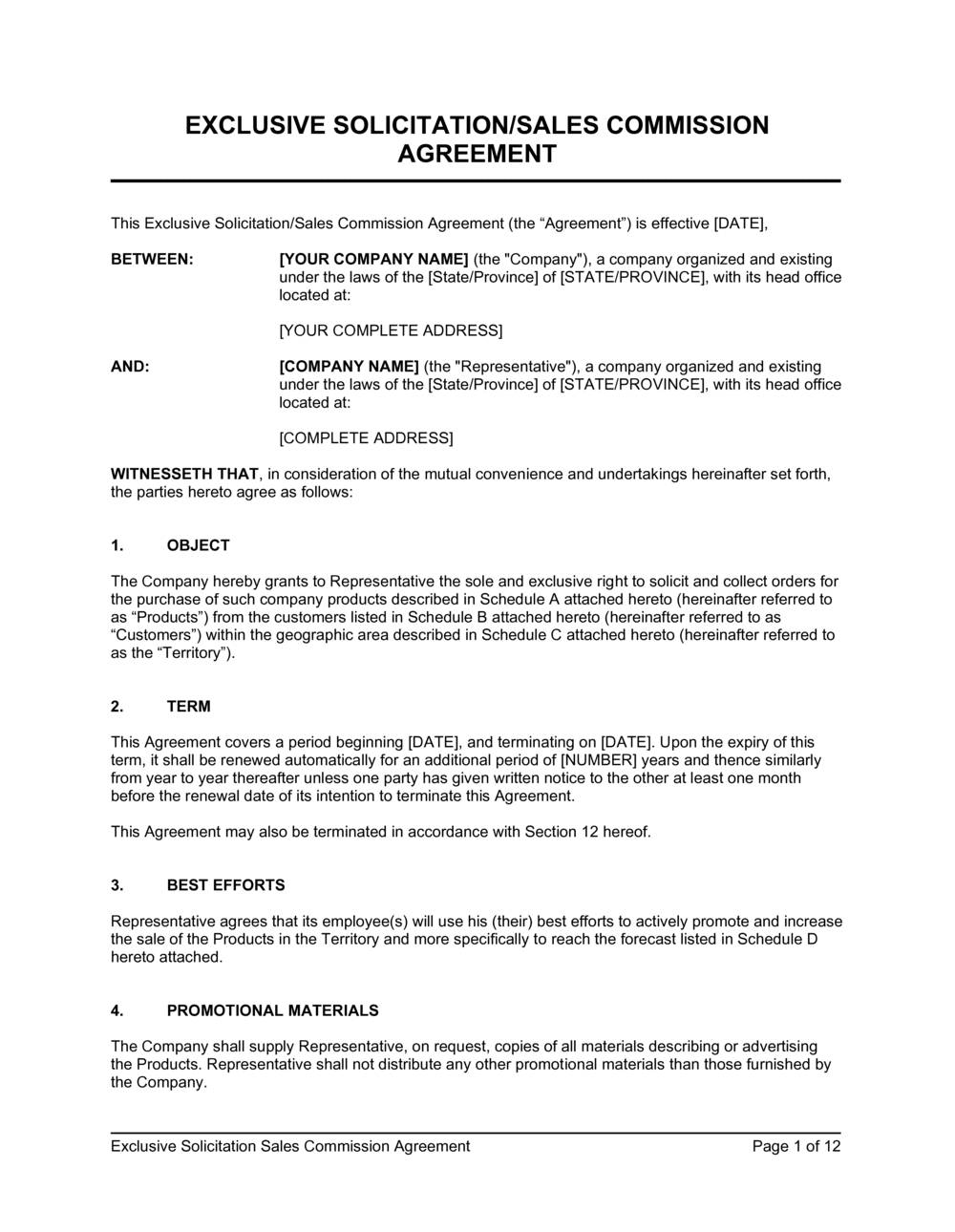
Exclusive Sollicitation Sales Commission Agreement Template

Free Word download • Edit online • Save & share with Drive • Export to PDF

12 pages30–40 min to fillDifficulty: ComplexSignature requiredLegal review recommended
Learn more ↓
FreeExclusive Sollicitation Sales Commission Agreement Template

At a glance

What it is
An Exclusive Solicitation Sales Commission Agreement is a legally binding contract between a company and a sales representative or agent that grants the representative the sole right to solicit customers within a defined territory or market segment in exchange for a commission on sales generated. This free Word download covers exclusivity scope, commission rates, payment schedules, performance benchmarks, and termination in a single document you can edit online and export as PDF.
When you need it
Use it when appointing an external sales agent, independent rep, or distributor with exclusive solicitation rights for a specific geography, product line, or customer segment — and when you need enforceable obligations around performance, non-compete, and commission payment in writing.
What's inside
Parties and appointment clause, exclusivity scope and territory definition, commission rate structure and calculation method, payment terms and reporting obligations, performance minimums, confidentiality, intellectual property restrictions, non-solicitation, term and termination, and governing law.

What is an Exclusive Solicitation Sales Commission Agreement?

An Exclusive Solicitation Sales Commission Agreement is a legally binding contract between a company (the principal) and a sales representative or agent that grants the representative the sole right to actively solicit and market the principal's products or services within a defined territory, product line, or customer segment, in exchange for a commission on qualifying sales generated. Unlike a general independent contractor agreement, it creates enforceable exclusivity obligations on both sides — the representative commits to meeting performance minimums, and the principal commits not to appoint competing agents or sell directly into the protected territory. The agreement governs the commission rate and calculation method, payment schedule, minimum performance thresholds, confidentiality, chargebacks, tail period, and termination — making it the foundational document for any exclusive external sales channel.

Why You Need This Document

Without a written exclusive solicitation commission agreement, both parties operate on conflicting assumptions. The representative invests time and resources building a market believing they are protected — only to find the principal has appointed a second agent or started selling directly. The principal assumes non-payment equals no obligation — and is then exposed to statutory penalties under sales representative protection laws in states like California, Illinois, and New York, or to mandatory indemnity claims under the EU Commercial Agents Directive. Commission disputes escalate quickly when there is no written definition of a qualified sale, no house-accounts list, and no tail period clause — leaving deal-by-deal arguments to be resolved in court rather than by reference to a signed document. This template closes all four gaps before a single prospect is contacted, giving both parties a clear, enforceable basis for the relationship from day one.

Which variant fits your situation?

If your situation is…Use this template
Engaging a non-exclusive sales agent with no territorial restrictionSales Commission Agreement
Appointing a distributor who buys and resells inventory independentlyDistribution Agreement
Hiring an internal salaried sales employee with commission componentEmployment Contract with Commission
Engaging a manufacturer's rep for a specific product line onlyManufacturer's Representative Agreement
Compensating a referral source with a flat finder's fee rather than ongoing commissionReferral Fee Agreement
Appointing an exclusive agent for international marketsInternational Sales Agency Agreement
Defining commission splits across multiple cooperating sales repsCo-Sales Commission Agreement

Common mistakes to avoid

❌ Vague or undefined territory boundaries

Why it matters: Overlapping territories between two sales reps — or between the rep and the principal's direct sales team — generate commission disputes on every shared deal and destroy the rep relationship.

Fix: Attach a signed Exhibit A defining territory by specific geography (states, postal codes, or named accounts) and update it only by written amendment. Never rely on verbal territory descriptions.

❌ No house-accounts exhibit at signing

Why it matters: Without a list fixed at signing, the principal can retroactively designate profitable customers as house accounts, eliminating commission liability on the most valuable deals the rep worked.

Fix: Attach a complete, dated house-accounts list as Exhibit A and require both parties to initial it. Additions after execution must be agreed in writing.

❌ Independent contractor label without independent-contractor substance

Why it matters: A rep classified as an independent contractor who is actually controlled like an employee creates payroll tax liability, benefits exposure, and regulatory penalties — sometimes retroactively for multiple years.

Fix: Review the agreement against the applicable jurisdiction's worker classification tests (IRS 20-factor test in the US; ABC test in California). If the rep fails the test, treat them as an employee from the start.

❌ Omitting the tail period clause

Why it matters: A principal who terminates the agreement days before a major deal closes owes nothing under a contract without a tail period — leaving the representative with no compensation for months of pipeline work.

Fix: Include a 60–180 day tail period for documented leads and require the representative to maintain a written deal log as the condition for earning tail commissions.

❌ Unlimited or undefined chargeback window

Why it matters: Chargebacks applied 12 or 18 months after commission payment expose the rep to clawbacks long after the sales cycle has closed, making commission income unpredictable and unbanking-friendly.

Fix: Set a hard chargeback deadline — typically 180 days from the original commission payment — and exclude chargebacks caused by the principal's own delivery failures.

❌ Setting minimum thresholds without specifying the consequence

Why it matters: Courts in multiple jurisdictions have treated an unmet minimum threshold as a material breach justifying immediate termination — when the principal only intended to remove exclusivity, not end the agreement.

Fix: State the exact consequence for missing the threshold (non-exclusive conversion, additional agent appointment, or termination) with a written notice and cure period before it triggers.

The 10 key clauses, explained

Appointment and exclusivity grant

In plain language: Names the parties, appoints the sales representative as the exclusive solicitation agent, and defines the precise scope of exclusivity — territory, product line, or customer segment.

Sample language
[PRINCIPAL COMPANY NAME] ('Principal') hereby appoints [SALES REP NAME / ENTITY] ('Representative') as its exclusive sales solicitation agent for [TERRITORY / PRODUCT LINE / CUSTOMER SEGMENT] effective [START DATE]. During the term, Principal shall not appoint any other agent or solicit orders directly within the exclusive scope without Representative's prior written consent.

Common mistake: Defining exclusivity only by geography while leaving the product line open — the principal then appoints a second agent for a related product line in the same territory, creating an overlap that triggers disputes.

Commission rate and calculation method

In plain language: States the commission percentage, the revenue base it applies to (gross revenue, net revenue, or gross margin), and any tiered or accelerated rates for exceeding targets.

Sample language
Principal shall pay Representative a commission of [X]% of Net Revenue on each Qualified Sale. Net Revenue means gross invoice value less returns, allowances, and applicable taxes. For monthly Net Revenue exceeding $[THRESHOLD], the rate increases to [Y]% on the incremental amount.

Common mistake: Using 'gross sales' as the base without defining whether it is pre- or post-discount, creating persistent calculation disputes when the principal applies promotional pricing.

Payment schedule and reporting

In plain language: Sets the commission payment frequency, the calculation period, the format of commission statements, and the deadline by which the principal must pay after the period closes.

Sample language
Principal shall pay commissions within [30] days after the close of each calendar month. Each payment shall be accompanied by a written commission statement itemizing Qualified Sales, applicable rates, and any chargebacks for the period. Representative may audit relevant sales records upon [10] days' written notice, no more than once per calendar year.

Common mistake: Omitting an audit right. Without one, the sales representative has no mechanism to verify commission statements, and underpayment disputes must proceed to litigation.

Minimum performance threshold and exclusivity condition

In plain language: Defines the minimum sales or revenue target the representative must achieve — quarterly or annually — to retain exclusive rights, and states what happens if the threshold is missed.

Sample language
Representative must generate Qualified Sales of not less than $[MINIMUM AMOUNT] during each [QUARTERLY / ANNUAL] period ('Minimum Threshold'). Failure to meet the Minimum Threshold for two consecutive periods gives Principal the right, upon [30] days' written notice, to convert the appointment to non-exclusive or appoint additional agents in the Territory.

Common mistake: Setting a Minimum Threshold without specifying the consequence — courts have interpreted a missed threshold as a material breach entitling the principal to terminate immediately, when the intent was only to remove exclusivity.

Qualified sale definition and exclusions

In plain language: Defines exactly which transactions earn a commission and which are excluded — such as sales to existing house accounts, government contracts, or orders sourced by the principal outside the territory.

Sample language
A 'Qualified Sale' means a binding purchase order or signed contract for [PRODUCTS / SERVICES] sourced by Representative from a customer located within the Territory and accepted by Principal. Excluded from Qualified Sales are: (a) sales to House Accounts listed in Exhibit A; (b) orders initiated by Principal's direct marketing campaigns; and (c) sales below $[MINIMUM ORDER VALUE].

Common mistake: No house-accounts list attached at signing. The principal later designates profitable customers as house accounts retroactively, depriving the representative of commissions they legitimately earned.

Chargeback and cancellation terms

In plain language: States when previously paid commissions must be returned — typically on customer cancellations, uncollectible invoices, or returns — and the time limit for applying a chargeback.

Sample language
If a customer cancels an order or returns goods within [90] days of delivery, Principal may deduct the corresponding commission from Representative's next payment statement. No chargeback may be applied more than [180] days after the original commission was paid. Chargebacks shall not apply to cancellations caused by Principal's failure to deliver.

Common mistake: Unlimited chargeback windows. A principal who delays collections for over a year and then charges back commissions from that period exposes the representative to financial clawbacks long after the underlying sales cycle has closed.

Confidentiality and IP restrictions

In plain language: Prohibits the representative from disclosing the principal's pricing, customer data, and proprietary information, and clarifies that all sales materials and IP remain the principal's property.

Sample language
Representative shall not disclose any Confidential Information of Principal to third parties during or after the term of this Agreement. 'Confidential Information' includes pricing schedules, customer lists, product roadmaps, and commission structures. All sales materials, trademarks, and product IP remain the sole property of Principal and are licensed to Representative solely for the purposes of this Agreement.

Common mistake: No definition of Confidential Information. Relying on 'all business information is confidential' has been found overbroad by courts, potentially voiding the entire confidentiality clause.

Term, termination, and tail period

In plain language: States the initial contract term, renewal conditions, notice periods for termination, grounds for immediate termination for cause, and the post-termination tail period during which the representative earns commissions on deals already in progress.

Sample language
This Agreement commences on [START DATE] and continues for [ONE YEAR], renewing automatically for successive [ONE-YEAR] terms unless either party provides [60] days' written notice of non-renewal. Either party may terminate for Cause immediately upon written notice. Following termination for any reason other than Cause by Representative, Principal shall pay commissions on Qualified Sales closed within [90] days of the termination date from leads documented in writing prior to termination ('Tail Period').

Common mistake: No tail period clause at all. Without one, a principal who terminates the agreement the day before a large deal closes owes the representative nothing — a structurally unfair outcome courts may not correct.

Non-solicitation and non-compete restrictions

In plain language: Prevents the representative from soliciting the principal's customers or employees for a defined period after termination, and, where enforceable, from working for direct competitors.

Sample language
For [12] months following termination, Representative shall not (a) solicit any customer of Principal that Representative contacted during the term, or (b) solicit or hire any employee of Principal. Representative shall not, for [6] months following termination, engage in the solicitation or sale of [COMPETING PRODUCTS] within the Territory.

Common mistake: Applying the same non-compete restriction to a commission-only independent rep as to a salaried employee. Courts scrutinize unpaid restrictions more rigorously — a broad non-compete on an independent rep with no compensation during the restriction period is frequently struck down.

Governing law, dispute resolution, and independent contractor status

In plain language: Specifies the governing jurisdiction, the dispute resolution mechanism (arbitration or court), and explicitly states that the representative is an independent contractor — not an employee — for tax and liability purposes.

Sample language
This Agreement is governed by the laws of [STATE / PROVINCE / COUNTRY]. Any dispute shall be resolved by binding arbitration under [AAA / JAMS] rules in [CITY], except claims for injunctive relief. Representative is an independent contractor. Nothing in this Agreement creates an employment, partnership, or joint-venture relationship. Representative is solely responsible for all taxes and benefits arising from commissions paid hereunder.

Common mistake: Labeling the representative as an independent contractor while exercising employee-level control over how they work — dictating hours, requiring daily check-ins, and providing exclusive tooling. Misclassification exposes the principal to payroll tax liability, benefits claims, and regulatory fines in most jurisdictions.

How to fill it out

  1. 1

    Identify both parties with legal entity names

    Enter the principal's full registered corporate name and the sales representative's legal name or business entity. If the representative operates through an LLC or corporation, use that entity name — not a trade name.

    💡 Match the entity name to the representative's W-9 or equivalent tax form before signing. Name mismatches cause payment and tax reporting problems.

  2. 2

    Define the exclusivity scope precisely

    Specify the territory by country, state, postal code range, or named-account list. If exclusivity is by product line, attach an exhibit listing the exact SKUs or service categories covered. Do not leave scope open to interpretation.

    💡 Attach a signed Exhibit A with the territory map or account list at execution — verbal descriptions of territory create the most common disputes in commission agreements.

  3. 3

    Set the commission rate and revenue base

    Enter the commission percentage and define exactly which number it applies to — gross invoice value, net revenue after returns, or gross margin. Add any tiered rates for volume above a threshold.

    💡 If you offer tiered commissions, include a worked example in a schedule so both parties are aligned on the calculation before disputes arise.

  4. 4

    Establish the payment schedule and audit rights

    Set the payment cycle (monthly is standard), the statement format, the payment deadline after period close, and the representative's audit right. Include the notice period and frequency limit for audits.

    💡 Monthly payments with a 30-day close window reduce commission disputes by keeping calculations current — quarterly cycles give principals too long to re-classify sales.

  5. 5

    Set minimum performance thresholds and consequences

    Define the quarterly or annual minimum revenue target and state explicitly what happens if it is missed — conversion to non-exclusive, right to appoint additional agents, or termination. Include a cure period before the consequence triggers.

    💡 A 30-day notice and cure period before exclusivity is removed keeps the relationship intact while giving the representative a fair chance to close pending deals.

  6. 6

    List house accounts and exclusions in Exhibit A

    Attach a complete list of existing customers, named accounts, and any sale categories excluded from commission calculations at the time of signing. Both parties should initial the exhibit separately.

    💡 Update the house accounts list only by written amendment signed by both parties — unilateral additions after signing are a leading cause of commission disputes and litigation.

  7. 7

    Draft the tail period and chargeback terms

    Set the tail period length (60–180 days is typical), define which leads qualify, and require written documentation of qualifying leads before termination. Set a hard deadline for chargebacks after commission payment.

    💡 Require the representative to maintain a current CRM or deal log as a condition of earning tail-period commissions — undocumented leads are nearly impossible to adjudicate.

  8. 8

    Execute before the representative begins soliciting

    Both parties must sign the agreement — and all exhibits — before the representative contacts any prospect on the principal's behalf. Post-start signatures may not bind the representative on non-compete and confidentiality terms.

    💡 Use a timestamped eSignature platform so you have indisputable evidence of the execution date relative to any sales activity.

Frequently asked questions

What is an exclusive solicitation sales commission agreement?

An exclusive solicitation sales commission agreement is a contract between a company (the principal) and a sales representative or agent that grants the representative the sole right to solicit and market the principal's products or services within a defined territory or segment in exchange for a commission on qualifying sales. It sets out the commission rate, payment schedule, exclusivity conditions, performance minimums, and termination terms in a binding document. It differs from a general sales commission agreement because the exclusivity grant creates enforceable territorial protections for the representative and corresponding restrictions on the principal.

What makes a commission agreement exclusive versus non-exclusive?

An exclusive agreement prevents the principal from appointing other sales agents or soliciting customers directly within the defined territory or segment during the contract term. A non-exclusive agreement allows the principal to appoint multiple agents or sell directly into the same territory simultaneously. Exclusivity is valuable to the representative because it protects the market they develop; it is a concession by the principal that is typically conditioned on the representative meeting minimum performance thresholds.

Is an exclusive sales commission agreement legally binding?

Yes — an exclusive solicitation sales commission agreement is generally enforceable as a binding contract when it contains the required elements: offer, acceptance, consideration (the exclusivity grant and the commission obligation), and mutual assent. The enforceability of specific clauses — particularly non-compete and non-solicitation restrictions — depends on the governing jurisdiction. In California and several other states, post-employment non-competes are banned even in independent-contractor contexts. Consult a lawyer for your specific jurisdiction before relying on restrictive covenants.

How should commission rates be structured in this agreement?

Most exclusive sales commission agreements use a flat percentage of net revenue (typically 5–20% depending on the industry and average deal size) or a tiered structure that increases the rate once the representative exceeds a monthly or quarterly threshold. The rate should be applied to a clearly defined revenue base — net invoice value after returns and discounts is the most common. Avoid applying commission to gross invoice value without defining what deductions apply, as this is the most frequent source of payment disputes.

What is a tail period and why does it matter?

A tail period is a post-termination window — typically 60 to 180 days — during which the sales representative continues to earn commissions on deals they initiated before the agreement ended. It matters because enterprise and B2B sales cycles often run 3–12 months, meaning a representative who is terminated mid-cycle would otherwise receive no compensation for significant pipeline work. Without a tail period, a principal can time a termination to capture a closing deal commission-free. Most courts will not imply a tail period — it must be written into the contract.

What is the difference between an exclusive solicitation agent and a distributor?

A solicitation agent secures orders on behalf of the principal but does not take title to the goods — the contract is between the principal and the end customer, and the agent earns a commission. A distributor buys inventory from the principal, takes title, and resells to end customers at a margin. The legal risk profile differs significantly: a distributor bears inventory and credit risk; an agent does not. If your arrangement involves the representative purchasing and holding stock, use a distribution agreement rather than a commission agreement.

Can a sales representative be classified as an independent contractor under this agreement?

Yes, and most exclusive solicitation commission agreements are structured as independent contractor relationships to avoid payroll tax withholding and employee benefit obligations. However, the label alone does not determine classification — tax authorities and courts apply behavioral and financial control tests. If the principal dictates work hours, requires exclusive availability, or provides the representative's primary tooling, many jurisdictions will reclassify the relationship as employment regardless of what the contract says. Review the applicable worker classification rules before execution.

What happens if the sales representative misses the minimum performance threshold?

The consequence depends entirely on what the contract specifies. Common outcomes include conversion of the appointment from exclusive to non-exclusive, the right to appoint additional agents in the territory, a reduction in commission rate, or termination of the agreement with notice. The minimum threshold clause should state the consequence, a written notice period, and a cure period before the consequence triggers. Agreements that state a minimum threshold without specifying the consequence create ambiguity that courts resolve inconsistently.

What should be included in the house-accounts exhibit?

The house-accounts exhibit should list every existing customer, named account, or prospect that is excluded from the representative's exclusive territory or commission eligibility at the time of signing. It should include company name, primary contact, and the date the account was established with the principal. Both parties should initial the exhibit at execution. Any additions after signing should require a written amendment — unilateral additions by the principal after the agreement is active are a common source of litigation.

How this compares to alternatives

vs Non-Exclusive Sales Commission Agreement

A non-exclusive commission agreement allows the principal to appoint multiple agents or sell directly in the same territory simultaneously. An exclusive agreement prohibits this, giving the representative protected market access in exchange for accepting performance minimums. Use an exclusive agreement when the representative is making a significant investment in market development; use non-exclusive when you need broad coverage with minimal principal risk.

vs Distribution Agreement

A distribution agreement gives the distributor the right to buy and resell the principal's goods, taking title and bearing inventory and credit risk. A solicitation commission agreement keeps the contract between the principal and the end customer — the agent earns a commission without taking title. Use a commission agreement when you want to retain customer relationships and pricing control; use a distribution agreement when the channel partner manages their own inventory and credit.

vs Independent Contractor Agreement

A general independent contractor agreement governs a wide range of service engagements without commission-specific mechanics. An exclusive solicitation commission agreement adds territory exclusivity, commission calculation and payment obligations, performance minimums, tail period, and chargeback terms that a general contractor agreement does not include. Use the commission agreement whenever ongoing sales solicitation and commission payment are the core of the engagement.

vs Referral Fee Agreement

A referral fee agreement compensates a party for introducing a potential customer with a one-time flat fee per qualified referral. An exclusive solicitation commission agreement covers active, ongoing sales solicitation activity with a percentage-based commission structure, exclusivity rights, and performance obligations. Use a referral fee agreement for passive introductions; use an exclusive solicitation commission agreement for a dedicated sales representative who actively manages and closes a pipeline.

Industry-specific considerations

Manufacturing and Wholesale

Regional manufacturer's reps appointed on exclusive territory bases; commission calculated on net invoice value after volume discounts and freight; chargeback clauses tied to return rates typical in the industry.

SaaS and Technology

Channel partners or VARs granted exclusive territory rights for software licenses; commission on annual contract value or MRR; performance minimums tied to qualified pipeline value rather than closed revenue alone.

Professional Services

Business development agents soliciting consulting or staffing engagements on an exclusive vertical or geographic basis; residual commission on contract renewals sourced by the agent during the tail period.

Real Estate and Property

Exclusive listing and solicitation rights for property sales or leasing within a defined area; commission rate tied to transaction value; tail period critical given the length of property sale cycles.

Medical Devices and Pharma

Independent medical device reps with exclusive territory appointments; commission on net sales to healthcare facilities; strict confidentiality covering clinical data and pricing agreements with hospital systems.

Financial Services

Insurance or investment product distribution through exclusive solicitation agents; regulatory licensing requirements as a condition precedent; commission structures subject to FINRA or FCA rules depending on jurisdiction.

Jurisdictional notes

United States

Several states — including California, Illinois, and New York — have specific Sales Representative Acts requiring written commission agreements and imposing penalties of two to three times the unpaid commission amount for willful non-payment. California broadly prohibits post-termination non-compete clauses even for independent contractors. The IRS applies a multi-factor behavioral and financial control test to determine worker classification; misclassifying an employee as an independent contractor triggers back payroll taxes, penalties, and interest.

Canada

Canada has no single federal sales representative statute, but several provinces — including Ontario and British Columbia — have enacted specific protections for independent sales representatives including mandatory written agreements and minimum notice periods on termination. Quebec requires all commercial contracts to be available in French for provincially regulated businesses. Non-compete clauses for independent contractors are scrutinized under a reasonableness standard similar to employment law in most provinces.

United Kingdom

The Commercial Agents (Council Directive) Regulations 1993 impose mandatory rights on commercial agents operating in the UK, including minimum notice periods, the right to compensation or an indemnity on termination, and mandatory commission payment within a defined period. These rights cannot be contracted out. Any exclusive solicitation agreement with a UK-based agent must be assessed against the Regulations — failure to comply entitles the agent to statutory compensation that can equal one to two years' average annual commission.

European Union

The EU Commercial Agents Directive (86/653/EEC) establishes baseline protections across all member states for self-employed commercial agents, including mandatory written contract rights, minimum notice periods, and indemnity or compensation on termination. Specific implementation and compensation formulas vary by member state — Germany applies the indemnity method (capped at one year's average commission), while France and several other states apply the compensation method (typically two years' average commission). Post-termination non-compete restrictions typically require financial compensation to the agent to be enforceable.

Template vs lawyer — what fits your deal?

PathBest forCostTime
Use the templateStandard exclusive territory appointments with straightforward commission structures and domestic representativesFree30–60 minutes
Template + legal reviewHigher-value appointments, multi-state or cross-provincial reps, tiered commission structures, or roles with material non-compete requirements$400–$8002–5 days
Custom draftedInternational or cross-border exclusive agreements, heavily regulated industries (financial services, medical devices), or agreements where the commission exposure exceeds $250,000 annually$1,500–$5,000+1–3 weeks

Glossary

Exclusive Solicitation Rights
The contractual grant giving the sales representative the sole right to actively market and solicit orders for the principal's products or services within a defined territory or segment.
Commission Rate
The percentage of a qualified sale's value — typically net revenue or gross margin — that the principal pays the sales representative as compensation.
Territory
The defined geographic area, industry vertical, or named-account list within which the exclusive solicitation rights apply.
Principal
The company or individual granting the exclusive solicitation rights and obligated to pay commissions on qualifying sales.
Sales Representative (Agent)
The individual or entity receiving exclusive solicitation rights, responsible for generating qualified orders within the defined territory.
Qualified Sale
A transaction that meets the contract's criteria for commission eligibility — typically an accepted order, signed contract, or paid invoice from a customer in the territory.
Minimum Performance Threshold
A specified revenue or order volume target the sales representative must achieve within a defined period to retain exclusivity rights.
Chargeback Clause
A provision requiring the sales representative to return previously paid commissions if a customer cancels, returns goods, or fails to pay within a defined window.
Residual Commission
Ongoing commission payable on renewal orders or repeat purchases from customers originally sourced by the sales representative, often continuing for a defined period after contract termination.
Non-Solicitation Clause
A post-termination restriction preventing the sales representative from soliciting the principal's customers or employees for a defined period after the agreement ends.
Tail Period
A post-termination window — typically 30 to 180 days — during which the sales representative remains eligible for commissions on deals they initiated before the agreement ended.

Part of your Business Operating System

This document is one of 3,000+ business & legal templates included in Business in a Box.

  • Fill-in-the-blanks — ready in minutes
  • 100% customizable Word document
  • Compatible with all office suites
  • Export to PDF and share electronically

Create your document in 3 simple steps.

From template to signed document — all inside one Business Operating System.
1
Download or open template

Access over 3,000+ business and legal templates for any business task, project or initiative.

2
Edit and fill in the blanks with AI

Customize your ready-made business document template and save it in the cloud.

3
Save, Share, Send, Sign

Share your files and folders with your team. Create a space of seamless collaboration.

Save time, save money, and create top-quality documents.

★★★★★

"Fantastic value! I'm not sure how I'd do without it. It's worth its weight in gold and paid back for itself many times."

Managing Director · Mall Farm
Robert Whalley
Managing Director, Mall Farm Proprietary Limited
★★★★★

"I have been using Business in a Box for years. It has been the most useful source of templates I have encountered. I recommend it to anyone."

Business Owner · 4+ years
Dr Michael John Freestone
Business Owner
★★★★★

"It has been a life saver so many times I have lost count. Business in a Box has saved me so much time and as you know, time is money."

Owner · Upstate Web
David G. Moore Jr.
Owner, Upstate Web

Run your business with a system — not scattered tools

Stop downloading documents. Start operating with clarity. Business in a Box gives you the Business Operating System used by over 250,000 companies worldwide to structure, run, and grow their business.

Start free · No credit card required