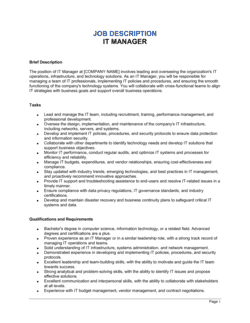
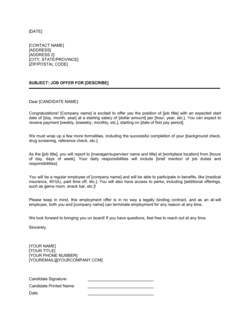
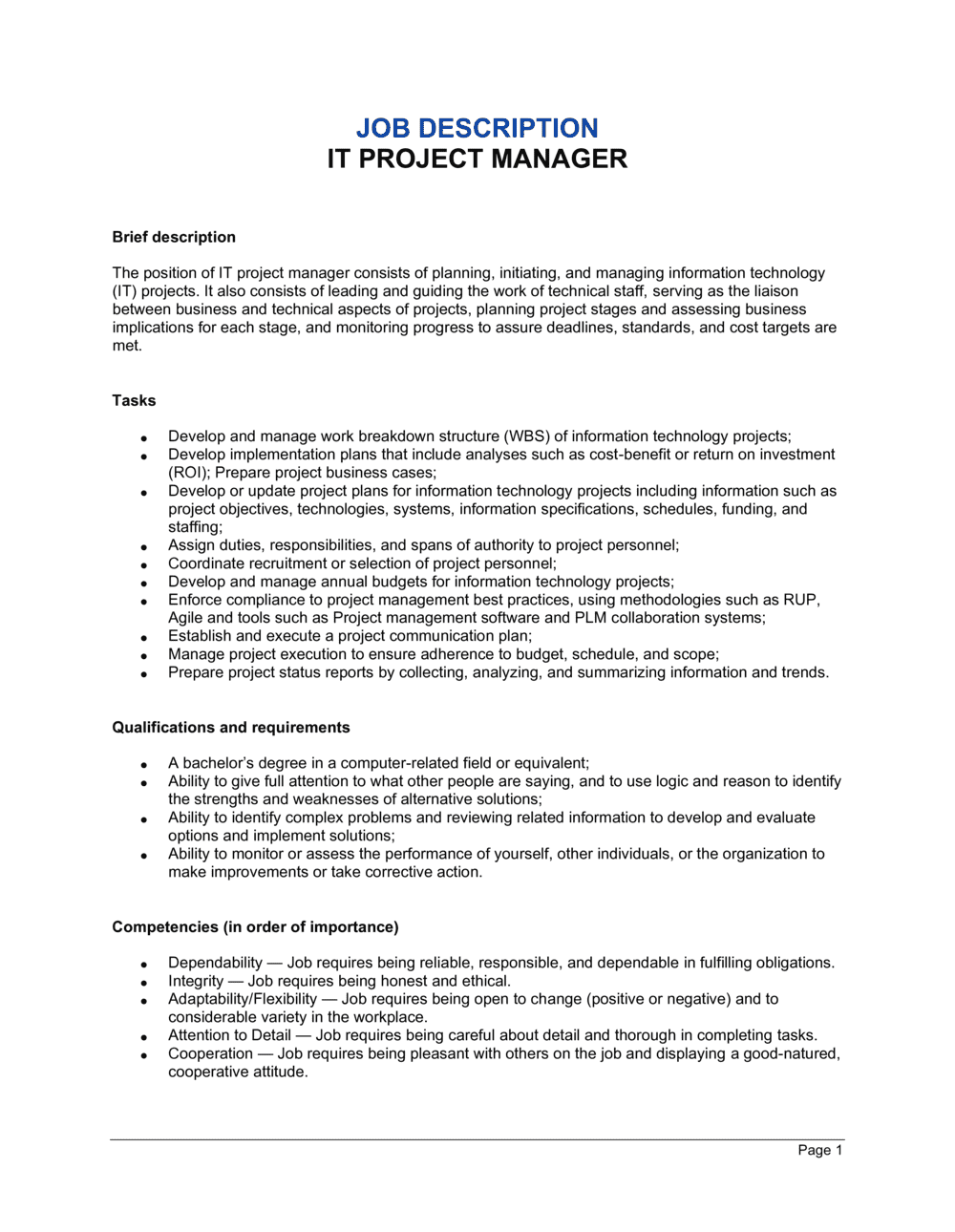
IT Project Manager Job Description Template

Free Word download • Edit online • Save & share with Drive • Export to PDF

2 pages20–30 min to fillDifficulty: StandardSignature requiredLegal review recommended
Learn more ↓
FreeIT Project Manager Job Description Template

At a glance

What it is
An IT Project Manager Job Description is a formal document that defines the scope of the IT PM role within an organization — outlining core duties, required technical and leadership qualifications, reporting relationships, compensation structure, and employment conditions. This free Word download gives you a structured, ready-to-edit template you can adapt for any technology team, then export as PDF for job postings or attach to an employment contract before signing.
When you need it
Use it when hiring a new IT Project Manager, reclassifying an existing employee into the role, or establishing written role boundaries before project delivery begins. It is also the reference document when conducting performance reviews or resolving disputes about scope of responsibilities.
What's inside
Role summary, core responsibilities, technical and soft-skill requirements, education and certification prerequisites, reporting structure, compensation and benefits overview, employment classification, and conditions of engagement including confidentiality and IP obligations.

What is an IT Project Manager Job Description?

An IT Project Manager Job Description is a formal document that defines the duties, qualifications, reporting relationships, performance expectations, compensation structure, and binding employment conditions for the IT PM role within an organization. It goes beyond a simple job posting — when signed by both the employer and the incoming employee, it functions as a legal record of agreed role boundaries and employment obligations, covering confidentiality of proprietary systems and project data, intellectual property assignment, and post-employment non-solicitation restrictions. Typically attached as a schedule to the employment contract, the job description is the primary reference document for onboarding, performance management, and — if disputes arise — termination proceedings.

Why You Need This Document

Without a documented and signed IT Project Manager job description, you are exposed on several fronts at once. Undefined duties create ambiguity that candidates and incumbent employees exploit when resisting new responsibilities or challenging performance reviews. Missing confidentiality language means an IT PM who leaves with architecture diagrams, project plans, or client system credentials faces no clear contractual obligation not to share them. No documented KPIs make performance-based termination difficult to defend before an employment tribunal or labor board, particularly in Canada, the UK, and EU member states where the burden of proof rests with the employer. In pay-transparency jurisdictions — including California, Colorado, and New York — posting a role without a disclosed salary range carries regulatory fines. This template gives you a structured, jurisdiction-aware starting point that closes all four gaps in under 30 minutes, with a legal review option for senior or cross-border hires where the stakes warrant it.

Which variant fits your situation?

If your situation is…Use this template
Hiring for a senior IT PM managing enterprise-wide infrastructure programsSenior IT Project Manager Job Description
Engaging a PM on a fixed-term basis for a single software rolloutFixed-Term IT Project Manager Job Description
Contracting an external PM rather than hiring an employeeIndependent Contractor Agreement
Hiring a general project manager outside the technology domainProject Manager Job Description
Defining the PM function within a Scrum or Agile teamScrum Master Job Description
Recruiting a business analyst who also performs PM dutiesBusiness Analyst Job Description
Hiring a program manager overseeing multiple IT project streamsProgram Manager Job Description

Common mistakes to avoid

❌ Omitting a signed acknowledgment block

Why it matters: Without a signed copy on file, an employer cannot demonstrate the employee was informed of their duties, KPIs, or restrictions — undermining performance reviews and termination defenses.

Fix: Add a signature block to every job description and collect it before or on day one. Store the executed copy in the employee's HR file alongside the employment contract.

❌ Publishing a salary range too wide to be meaningful

Why it matters: A range like '$65,000–$140,000' signals budget uncertainty and, in pay-transparency jurisdictions, may constitute non-compliance with disclosure requirements.

Fix: Narrow the range to reflect the actual budgeted band for the role — typically no wider than 30–40% from floor to ceiling — and confirm the range complies with any applicable state or provincial pay transparency law.

❌ Listing certifications as required when they are preferred

Why it matters: Mandating a PMP for a mid-level IT PM role without a genuine business necessity unnecessarily narrows the talent pool and may expose the employer to disparate-impact claims in some jurisdictions.

Fix: Reserve 'required' for qualifications that are genuinely non-negotiable. Move PMP, PRINCE2, and similar credentials to 'preferred' unless the role explicitly manages regulated programs that demand certified oversight.

❌ Writing duties so narrowly that minor role evolution triggers a contract amendment

Why it matters: Over-specified duties — including named tools, specific system versions, or granular task sequences — become inaccurate quickly, and courts in some jurisdictions have found that unilateral duty changes without amendment constitute constructive dismissal.

Fix: Draft duties at the outcome level rather than the task level, and include a clause granting the employer the right to reasonably adjust duties with appropriate notice.

❌ Relying on the job description alone to enforce confidentiality and IP

Why it matters: In common-law jurisdictions, a job description is not always a standalone binding contract. Confidentiality and IP clauses in a job description that is not incorporated by reference into the employment agreement may be unenforceable.

Fix: Repeat confidentiality and IP assignment language verbatim in the signed employment contract and include a cross-reference: 'as further set out in the Job Description dated [DATE], attached as Schedule A.'

❌ Using a non-compete clause with unlimited or global geographic scope

Why it matters: Courts in most common-law jurisdictions routinely void non-compete clauses that are not reasonably limited in geography and duration, and several US states and EU countries ban post-employment non-competes entirely.

Fix: Limit the geographic scope to the regions where the IT PM actually worked with clients or competitive systems, and cap the duration at 6–12 months for most roles.

The 10 key clauses, explained

Role title and reporting structure

In plain language: States the official job title, the department it sits within, and the direct reporting line — typically to a CIO, CTO, VP of Technology, or equivalent.

Sample language
Job Title: IT Project Manager | Department: Information Technology | Reports to: [CIO / CTO / VP of Technology] | Location: [CITY / REMOTE / HYBRID]

Common mistake: Listing only the name of a specific manager rather than the role title. When that manager leaves, the reporting line becomes ambiguous and may create a constructive dismissal risk if the successor's authority is disputed.

Role summary

In plain language: A 2–4 sentence overview of the position's purpose — what the IT PM is accountable for delivering and the level of authority they hold.

Sample language
The IT Project Manager is responsible for leading the full lifecycle of technology projects — from initiation and planning through execution, monitoring, and closure — ensuring delivery on time, within scope, and within budget. The role holds accountability for coordinating cross-functional teams, managing vendor relationships, and reporting project status to [EXECUTIVE SPONSOR].

Common mistake: Writing a role summary so broad it could describe any management role. If the summary does not mention IT, technology, or systems, it provides no useful boundary for performance review or dispute resolution.

Core duties and responsibilities

In plain language: An itemized list of the specific tasks the IT PM owns — project planning, risk management, stakeholder communication, budget oversight, and team coordination.

Sample language
Responsibilities include: (a) developing and maintaining detailed project plans using [TOOL]; (b) managing project budgets up to $[AMOUNT]; (c) conducting weekly status meetings with [STAKEHOLDER GROUPS]; (d) identifying, logging, and mitigating project risks; (e) coordinating with vendors and third-party integrators.

Common mistake: Over-specifying tool names (e.g., 'Microsoft Project version 2019'). When tooling changes, the description becomes inaccurate and creates grounds to argue the role has materially changed.

Technical qualifications and certifications

In plain language: Lists the minimum technical knowledge — programming familiarity, infrastructure understanding, SDLC exposure — and any required or preferred certifications such as PMP, PRINCE2, or Agile.

Sample language
Required: [X] years of experience managing IT projects; demonstrated knowledge of [SDLC / Agile / Waterfall]; proficiency with project management tools such as [JIRA / MS PROJECT / ASANA]. Preferred: PMP certification or PRINCE2 Practitioner.

Common mistake: Listing certifications as 'required' when they are genuinely preferred. Requiring a PMP for a junior-to-mid PM role narrows the talent pool without improving hire quality.

Education requirements

In plain language: States the minimum academic qualification — typically a bachelor's degree in computer science, information systems, or a related field — and any acceptable equivalents.

Sample language
Bachelor's degree in Computer Science, Information Systems, Business Administration, or equivalent. Equivalent combinations of education and [X] years of directly relevant experience will be considered.

Common mistake: Mandating a specific degree without an equivalency clause. Jurisdictions including the UK and Canada increasingly scrutinize degree requirements that exclude candidates with equivalent practical experience, particularly in technical roles.

Compensation, classification, and benefits

In plain language: States the salary range or pay grade, employment classification (exempt/non-exempt in the US; salaried/hourly elsewhere), and a reference to the applicable benefits program.

Sample language
Annual Salary: $[MIN]–$[MAX] depending on experience. Classification: Exempt (FLSA) / Salaried. Benefits: Employee is eligible for [COMPANY]'s standard benefits program, including health, dental, vision, and [X] days PTO, subject to plan terms as amended from time to time.

Common mistake: Publishing a salary range so wide it is meaningless (e.g., '$60,000–$150,000'). In jurisdictions with pay transparency laws — California, Colorado, New York, Illinois — ranges must reflect the actual budgeted compensation for the role.

Confidentiality and IP assignment

In plain language: Requires the IT PM to maintain confidentiality of all proprietary systems, data, and project information and assigns ownership of any work product to the employer.

Sample language
Employee agrees to maintain the confidentiality of all [COMPANY NAME] proprietary information, including system architecture, project plans, client data, and vendor contracts. All work product, deliverables, and process improvements created during employment are the sole property of [COMPANY NAME] and are hereby assigned to the Company.

Common mistake: Including confidentiality language in the job description but not repeating it in the employment contract. Job descriptions are not always treated as binding contracts — the obligation must appear in the signed agreement to be reliably enforceable.

Non-solicitation and non-compete

In plain language: Restricts the IT PM from soliciting the company's employees, clients, or vendors after departure, and may limit joining direct competitors for a defined period and geography.

Sample language
For [12] months following separation, Employee shall not: (a) solicit any employee, client, or vendor of [COMPANY NAME]; or (b) accept employment with a Competing Business operating in [GEOGRAPHIC AREA] in a substantially similar role.

Common mistake: Using a one-size-fits-all non-compete clause copied from a generic template, without calibrating the geographic scope or duration to the IT PM's actual level of access to competitive systems, client data, or strategic roadmaps.

Performance expectations and review cadence

In plain language: States the key performance indicators the IT PM will be evaluated against and the frequency of formal reviews — typically annual, with a mid-year check-in.

Sample language
Performance will be evaluated against the following KPIs: (a) on-time project delivery rate (target: [X]%); (b) budget variance (target: within [X]%); (c) stakeholder satisfaction score (target: [X]/5). Formal reviews occur [annually / semi-annually], with a 90-day probationary review following the start date.

Common mistake: Omitting performance expectations entirely. Without documented KPIs, performance-based termination claims are harder to defend, and the employee has no objective basis for understanding what success looks like.

Governing law and acknowledgment

In plain language: Specifies which jurisdiction's employment law governs the document and includes a signature block confirming the employee has received, read, and understood the job description.

Sample language
This Job Description is governed by the laws of [STATE / PROVINCE / COUNTRY]. By signing below, Employee acknowledges receipt of this Job Description and confirms their understanding of the duties and conditions described herein. | Employee Signature: ________ | Date: ________ | Employer Representative: ________ | Date: ________

Common mistake: Omitting the acknowledgment signature block. Without a signed copy on file, the employer cannot demonstrate the employee was aware of the defined duties, qualifications, or restrictions — undermining performance management and termination defenses.

How to fill it out

  1. 1

    Enter the role title, department, and reporting line

    Fill in the exact job title you will post, the IT department or sub-team the role belongs to, and the title — not the name — of the direct manager. Include the work location type: on-site, hybrid, or fully remote.

    💡 Use the same title everywhere — job posting, offer letter, employment contract, and payroll system — to prevent discrepancies that complicate background checks or future amendments.

  2. 2

    Write a focused role summary

    Draft 2–4 sentences describing what the IT PM owns, what they deliver, and the level of authority they hold. Reference the size of projects managed (budget, team size, or project count) to anchor expectations concretely.

    💡 A role summary that mentions a specific project type — e.g., 'ERP implementations' or 'cloud migration programs' — attracts more qualified applicants than a generic description.

  3. 3

    List core responsibilities with action verbs

    Use a bulleted list with action verbs (manage, coordinate, deliver, report, escalate). Cover planning, execution, stakeholder communication, budget oversight, risk management, and vendor coordination.

    💡 Keep the list to 8–12 bullets. Responsibilities lists exceeding 15 items signal a role that is poorly scoped and deter strong candidates.

  4. 4

    Define technical qualifications and certifications

    Separate required from preferred qualifications. Required items gate your candidate pool; preferred items attract candidates without eliminating others. Specify minimum years of IT PM experience and any methodology exposure (Agile, Waterfall, PRINCE2).

    💡 If PMP certification is preferred but not required, say 'PMP or equivalent demonstrated experience' — this keeps your pool broad while signaling professionalism.

  5. 5

    State the compensation range and classification

    Enter the budgeted salary range and confirm whether the role is classified as exempt or non-exempt under the FLSA (US) or equivalent classification in other jurisdictions. Reference the benefits program by category, not by specific plan terms.

    💡 In states with pay transparency laws (California, Colorado, New York, Illinois, Washington), you are legally required to disclose the compensation range — confirm the range reflects the actual budgeted figure before posting.

  6. 6

    Add confidentiality, IP assignment, and non-solicitation clauses

    Tailor the confidentiality scope to the actual data the IT PM will access — project plans, architecture diagrams, client data, vendor contracts. Set the non-solicitation period (typically 12 months) and geographic scope proportionate to the role's actual competitive exposure.

    💡 Repeat these clauses verbatim in the employment contract — job descriptions are not always treated as standalone binding agreements in common-law jurisdictions.

  7. 7

    Define KPIs and the performance review cadence

    List 3–5 specific, measurable KPIs — on-time delivery rate, budget variance, stakeholder satisfaction score. State the review frequency and whether a probationary review applies in the first 90 days.

    💡 Frame KPIs as targets rather than hard thresholds to preserve management discretion. 'Target: 90% on-time delivery' is more defensible than 'Must achieve 90% on-time delivery or face termination.'

  8. 8

    Obtain signatures before the start date

    Have both the hiring manager (or authorized HR representative) and the incoming IT PM sign the document before day one. File the signed copy in the employee record system.

    💡 In common-law jurisdictions, a job description signed after employment begins may lack the 'fresh consideration' needed to enforce restrictive covenants. Execute before day one.

Frequently asked questions

What is an IT Project Manager job description?

An IT Project Manager job description is a formal document that defines the duties, qualifications, reporting structure, compensation, and employment conditions for the IT PM role. It serves as the reference point for hiring decisions, performance reviews, and — when signed by both parties — as a legal record of agreed expectations. It is typically attached to or incorporated into the employee's employment contract.

What should an IT Project Manager job description include?

At minimum: role title and reporting line, a focused role summary, core duties and responsibilities, required and preferred technical qualifications and certifications, education requirements, compensation range and employment classification, confidentiality and IP assignment obligations, non-solicitation terms, performance KPIs and review cadence, and a governing law and signature block. Missing any of these creates gaps that complicate performance management and termination.

Is an IT Project Manager job description legally binding?

A job description is not automatically a standalone binding contract in most jurisdictions. However, when signed by both parties and incorporated by reference into an employment agreement, its terms — including confidentiality, IP assignment, and non-solicitation — become enforceable as part of that agreement. Always pair a signed job description with a formal employment contract to maximize enforceability.

What certifications should an IT Project Manager have?

The most widely recognized certification is the PMP (Project Management Professional) issued by PMI. PRINCE2 Practitioner is common in the UK, EU, and government sectors. Agile-specific credentials — Certified Scrum Master (CSM) or PMI-ACP — are increasingly required for roles in software-focused environments. ITIL 4 certification is relevant for IT service management projects. Whether to require or merely prefer these depends on the seniority of the role and the nature of the projects managed.

What is the difference between an IT Project Manager and a Program Manager?

An IT Project Manager leads a single project or a small cluster of related projects through defined phases — initiation, planning, execution, and closure — with a fixed scope, budget, and timeline. A Program Manager oversees a portfolio of interdependent projects aligned to a strategic business objective, managing dependencies and trade-offs across projects rather than delivering individual ones. Program Manager roles typically require an IT PM job description as a prerequisite or prior role.

What salary range should I list for an IT Project Manager?

As of 2025, mid-market IT Project Manager salaries in the US range from approximately $85,000 to $130,000 annually depending on industry, location, and project complexity. Senior or enterprise IT PMs in major metros can reach $150,000–$180,000. In the UK, ranges run £50,000–£85,000. In Canada, CAD $90,000–$130,000 is typical for major urban centers. In pay-transparency jurisdictions, disclose the actual budgeted range, not a wide placeholder.

Do I need a lawyer to create an IT Project Manager job description?

For a standard internal hire, a well-structured template is usually sufficient. Engage an employment lawyer when the role involves access to highly sensitive IP or competitive systems that require a carefully scoped non-compete, when hiring across multiple jurisdictions with different employment standards, or when the organization operates in a regulated sector such as healthcare or financial services. A 30–60 minute legal review typically costs $150–$400 and is worthwhile for senior IT PM roles.

Can I use the same IT PM job description for a contractor as for an employee?

No. An employee job description sets out employment terms including benefits, classification, IP assignment, and termination conditions. Using it for a contractor can contribute to misclassification — the contractor may be reclassified as an employee, triggering back taxes, benefits liability, and employment standards obligations. Use an Independent Contractor Agreement and a separate scope-of-work document for contracted IT PMs.

What KPIs should an IT Project Manager be evaluated against?

The most commonly used IT PM KPIs include: on-time project delivery rate (target 85–95%), budget variance (target within 5–10% of approved budget), stakeholder satisfaction score (measured via post-project survey), scope change frequency (number of approved change requests per project), and defect or issue resolution time. Frame KPIs as targets rather than hard thresholds to preserve management discretion in performance reviews.

How this compares to alternatives

vs Employment Contract

A job description defines the role — duties, qualifications, KPIs, and expectations. An employment contract governs the legal relationship — compensation obligations, termination rights, IP ownership, and restrictive covenants in full legal detail. The job description is typically attached as a schedule to the employment contract, with the contract's terms controlling in any conflict. Relying on the job description alone leaves the employer without enforceable termination and IP protections.

vs Independent Contractor Agreement

An IT PM job description is written for an employee — it establishes employment classification, benefits eligibility, and tax-withholding expectations. An Independent Contractor Agreement engages a self-employed IT PM for project-based work with no employment entitlements. Using an employee job description for a contractor contributes to misclassification risk, which triggers back taxes and benefit liabilities in most jurisdictions.

vs Job Offer Letter

A job offer letter confirms the role and compensation to secure acceptance from a candidate. A job description is the detailed operational and legal document that defines what the role entails day-to-day. Candidates review the offer letter to decide whether to accept; managers, HR, and legal teams reference the job description to manage, evaluate, and — if necessary — terminate the employee. Both documents are needed and serve different functions.

vs Project Charter

A project charter formally authorizes a specific IT project — defining its objectives, scope, budget, sponsor, and the PM's authority for that engagement. An IT PM job description defines the standing role and employment conditions for the person filling the PM function across all projects. The charter governs a project; the job description governs the role. Both should be in place before a PM begins work on any significant initiative.

Industry-specific considerations

Financial Services

IT PMs in financial services manage core banking, payments, or regulatory compliance system rollouts and must demonstrate familiarity with data security standards such as PCI-DSS and SOX controls.

Healthcare and MedTech

Healthcare IT PMs oversee EHR implementations, telehealth platforms, and medical device integration projects, requiring explicit HIPAA confidentiality obligations and change-control compliance in the job description.

Professional Services

Consulting and professional services firms deploy IT PMs to manage client-facing technology delivery, where non-solicitation clauses covering client contacts are particularly critical and must be scoped carefully.

Manufacturing and Logistics

Manufacturing IT PMs lead ERP, WMS, and automation system implementations across multi-site operations, requiring the job description to address cross-location authority, vendor coordination, and uptime-critical delivery windows.

Jurisdictional notes

United States

At-will employment is the default in 49 states, so a job description alone does not create tenure. Pay transparency laws in California, Colorado, New York, Illinois, and Washington require salary ranges to be published with job postings — ensure the range reflects the actual budgeted figure. Non-compete enforceability varies sharply: California, Minnesota, and Oklahoma ban most post-employment restrictions, so non-compete clauses should be reviewed for the employee's state of work, not the employer's state of incorporation. The FLSA exempt/non-exempt classification must appear explicitly for any salaried IT PM role.

Canada

At-will employment does not exist in Canada — every province requires reasonable notice or pay in lieu upon termination. Employment Standards Acts set minimum notice periods that the job description and accompanying employment contract must meet or exceed. Ontario common-law notice for a mid-to-senior IT PM can reach 1 month per year of service. In Quebec, the job description must be available in French for provincially regulated employers. Non-solicitation and non-compete clauses are enforceable only if reasonable in scope and duration — courts will not rewrite an overbroad clause.

United Kingdom

Employers must provide a written statement of employment particulars on or before day one, and the job description typically forms part of this written statement. Post-termination restrictive covenants — including non-solicitation and non-compete — must be reasonable to be enforceable, and UK courts apply a strict reasonableness standard calibrated to the employee's seniority and access to confidential information. PRINCE2 and ITIL certifications are more commonly specified as preferred qualifications for IT PM roles in UK public-sector and government-adjacent organizations.

European Union

The EU Transparent and Predictable Working Conditions Directive requires written employment terms to be provided within 7 days of hire, and the job description is typically incorporated into or attached to this statement. Post-employment non-competes in most EU member states require financial compensation to the employee — ranging from 25% to 100% of salary depending on the country — to be enforceable. GDPR obligations must be reflected in the confidentiality clause where the IT PM will have access to personal data of employees, clients, or end-users. French and German employment law impose some of the strictest notice and severance obligations in the region.

Template vs lawyer — what fits your deal?

PathBest forCostTime
Use the templateStandard domestic IT PM hires in a single jurisdiction with straightforward IP and confidentiality needsFree20–30 minutes
Template + legal reviewSenior IT PM roles with broad system access, cross-border hiring, or roles in regulated industries such as healthcare or financial services$150–$400 for a 30–60 minute employment lawyer review1–3 business days
Custom draftedEnterprise IT PM roles with equity, material non-compete requirements, multi-jurisdiction employment, or government-regulated program delivery$800–$2,500+1–2 weeks

Glossary

Job Description
A formal document defining the duties, qualifications, reporting relationships, and conditions of a specific role — used for hiring, performance management, and legal reference.
SDLC (Software Development Life Cycle)
The structured process an IT team follows to plan, design, build, test, and deploy software — a core framework IT PMs are expected to manage.
PMP (Project Management Professional)
A globally recognized certification issued by PMI that validates a project manager's knowledge of structured project delivery methodology.
PRINCE2
A process-based project management methodology widely used in the UK, EU, and government sectors, emphasizing defined stages and governance gates.
Agile / Scrum
An iterative project delivery approach in which work is broken into short sprints; the IT PM (or Scrum Master) facilitates sprint planning, daily standups, and retrospectives.
Stakeholder Management
The ongoing process of identifying, communicating with, and managing the expectations of everyone who has an interest in a project's outcome.
Change Management
A structured approach to transitioning individuals and teams from a current state to a desired future state, particularly during IT system rollouts.
KPI (Key Performance Indicator)
A measurable value used to evaluate how effectively an IT project or team is achieving defined objectives — e.g., on-time delivery rate or bug resolution time.
RACI Matrix
A responsibility assignment chart defining who is Responsible, Accountable, Consulted, and Informed for each task or decision in a project.
At-Will Employment
Employment that either party may end at any time for any lawful reason without advance notice or cause — the default in most US states but not in Canada, the UK, or the EU.
Confidentiality Clause
A contractual provision prohibiting the employee from disclosing or misusing the employer's proprietary information during and after employment.

Part of your Business Operating System

This document is one of 3,000+ business & legal templates included in Business in a Box.

  • Fill-in-the-blanks — ready in minutes
  • 100% customizable Word document
  • Compatible with all office suites
  • Export to PDF and share electronically

Create your document in 3 simple steps.

From template to signed document — all inside one Business Operating System.
1
Download or open template

Access over 3,000+ business and legal templates for any business task, project or initiative.

2
Edit and fill in the blanks with AI

Customize your ready-made business document template and save it in the cloud.

3
Save, Share, Send, Sign

Share your files and folders with your team. Create a space of seamless collaboration.

Save time, save money, and create top-quality documents.

★★★★★

"Fantastic value! I'm not sure how I'd do without it. It's worth its weight in gold and paid back for itself many times."

Managing Director · Mall Farm
Robert Whalley
Managing Director, Mall Farm Proprietary Limited
★★★★★

"I have been using Business in a Box for years. It has been the most useful source of templates I have encountered. I recommend it to anyone."

Business Owner · 4+ years
Dr Michael John Freestone
Business Owner
★★★★★

"It has been a life saver so many times I have lost count. Business in a Box has saved me so much time and as you know, time is money."

Owner · Upstate Web
David G. Moore Jr.
Owner, Upstate Web

Run your business with a system — not scattered tools

Stop downloading documents. Start operating with clarity. Business in a Box gives you the Business Operating System used by over 250,000 companies worldwide to structure, run, and grow their business.

Free Forever Plan · No credit card required