Inquiry on New Customer Credit Template

Free Word download β€’ Edit online β€’ Save & share with Drive β€’ Export to PDF

1 pageβ€’20–30 min to fillβ€’Difficulty: Standardβ€’Signature requiredβ€’Legal review recommended
Learn more ↓
FreeInquiry on New Customer Credit Template

At a glance

What it is
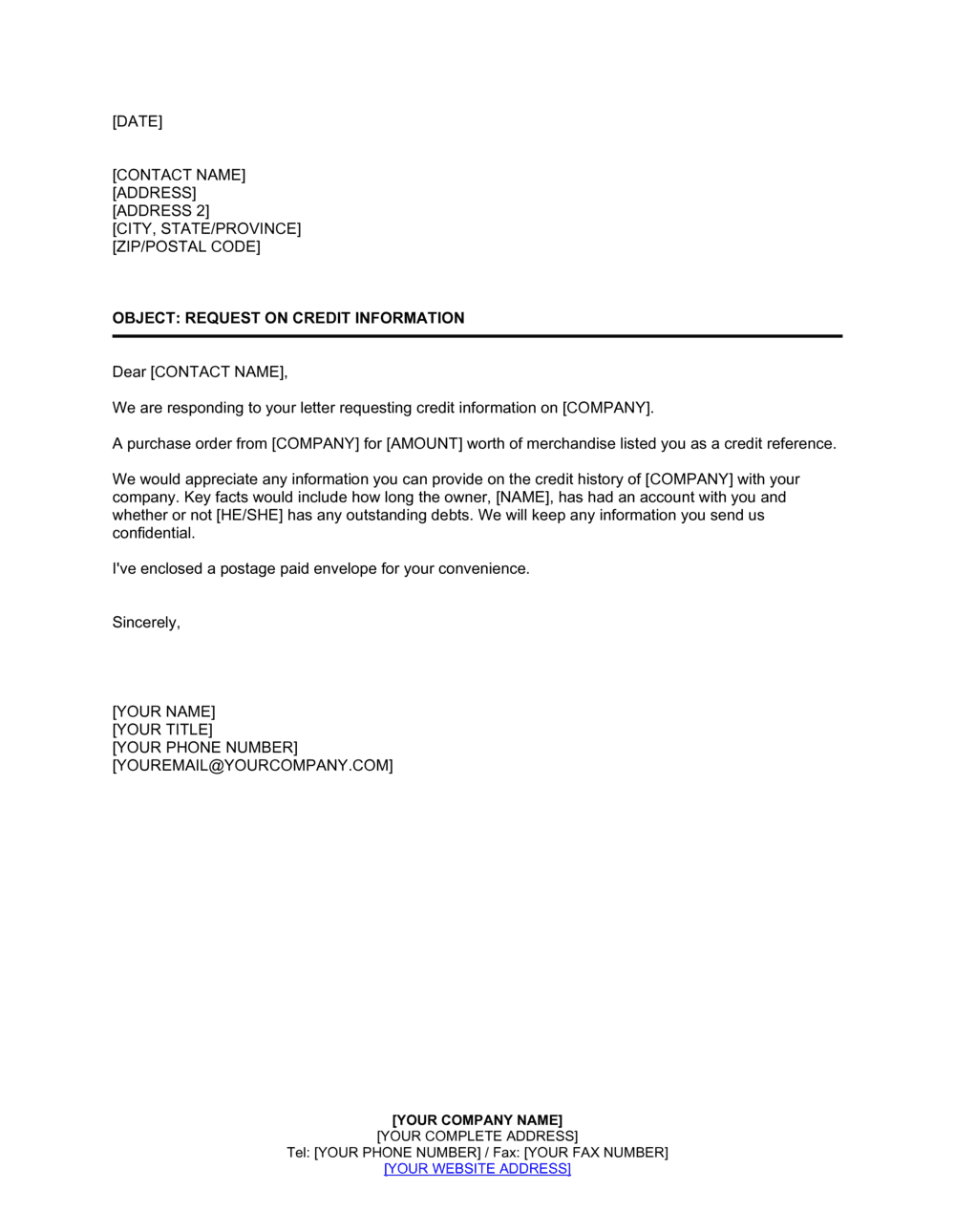
An Inquiry On New Customer Credit is a formal document a seller or supplier sends to a prospective customer to gather the financial and trade reference information needed before extending open-account or net-terms credit. This template is a free Word download you can edit online and export as PDF β€” covering authorization for credit checks, trade references, banking details, and acknowledgment of payment terms in a single structured form.
When you need it
Use it before approving a new customer for net-30, net-60, or any open-account trade credit arrangement. It is also appropriate when upgrading an existing cash-in-advance customer to credit terms or when a credit line review is triggered by a material change in order volume.
What's inside
Business identification and contact details, authorized representative information, trade and bank references, a credit authorization and consent clause, acknowledgment of proposed payment terms, and a signature block confirming the applicant's agreement to the information disclosure and terms review process.

What is an Inquiry On New Customer Credit?

An Inquiry On New Customer Credit is a formal due-diligence document a seller or supplier sends to a prospective business customer before extending open-account or net-terms trade credit. It collects the legal entity identification, trade references, banking information, and signed authorization needed to conduct a commercial credit check β€” creating a documented record of the seller's screening process and the applicant's consent to that process. Unlike a full credit application, which may include audited financials and a formal credit agreement, a customer credit inquiry is a targeted, standardized intake tool designed to capture the minimum information required to make a defensible credit decision quickly.

Why You Need This Document

Extending trade credit without a completed, signed credit inquiry is one of the most common β€” and costly β€” mistakes in B2B accounts receivable management. Without it, you have no documented authorization to pull a credit report, no independent references to verify payment behavior, no record of the customer's financial disclosures, and no signed acknowledgment of the payment terms and late-fee provisions that govern the account. When a customer goes delinquent, the absence of this documentation makes collection harder, legal action costlier, and the debt harder to prove in court or assign to a collection agency. A properly completed credit inquiry form takes 15 minutes to process and creates the paper trail that protects your receivables from the first order forward. This template gives you a ready-to-send Word document that covers every required element β€” so you can onboard new customers on credit terms with confidence rather than assumption.

Which variant fits your situation?

If your situation is…Use this template
Extending trade credit to a new business customer for the first timeInquiry On New Customer Credit
Formalizing the full credit application with financial disclosuresCredit Application Form
Confirming agreed payment terms in a binding written arrangementPayment Agreement
Following up on a past-due balance after credit has been extendedCollection Letter
Requesting a bank to confirm a customer's account standingBank Reference Request Letter
Formally limiting or revoking a customer's credit lineCredit Limit Reduction Letter
Documenting a personal guarantee for a business credit applicantPersonal Guarantee Agreement

Common mistakes to avoid

❌ Running a credit report before obtaining written authorization

Why it matters: In the US, obtaining a commercial credit report without a permissible purpose and documented consent can violate the Fair Credit Reporting Act, exposing the inquiring business to civil liability and regulatory penalties.

Fix: Always secure the signed credit check authorization clause before contacting any bureau. File the authorization with the customer's credit record as permanent documentation.

❌ Accepting related-party trade references

Why it matters: References from a parent company, subsidiary, or affiliated entity do not reflect arm's-length payment behavior and provide no meaningful information about how the applicant pays unrelated creditors.

Fix: Require all three trade references to be from unrelated, third-party suppliers. Reject references that appear affiliated and ask the applicant to substitute genuine independent references.

❌ Skipping the bank reference

Why it matters: Without a bank reference, you have no independent view of the applicant's liquidity β€” trade references only tell you they pay those specific vendors, not whether the applicant has cash to pay you.

Fix: Treat the bank reference as mandatory, not optional. Contact the account officer in writing and document the response in the credit file before approving any limit above $5,000.

❌ Approving credit without a defined credit limit

Why it matters: An open-ended credit line creates uncapped accounts-receivable exposure. If the customer ramps up orders dramatically and then fails to pay, the loss has no ceiling.

Fix: Always specify an approved credit limit in dollar terms and record it in your accounting system. Review and adjust the limit formally after each 90-day payment cycle.

❌ Not disclosing the annualized late-fee interest rate

Why it matters: Several US states, Canadian provinces, and EU member states require the annual equivalent interest rate to be stated clearly for the late-fee clause to be enforceable against a debtor.

Fix: State both the monthly and annualized rate explicitly in the payment terms acknowledgment: for example, '1.5% per month (18% per annum)' rather than '1.5% per month' alone.

❌ Filing the form without a dated signature

Why it matters: An undated authorization creates a factual dispute about when consent was given, which matters if a credit report is pulled weeks after form submission or if the customer later disputes the authorization's validity.

Fix: Require both a signature and a written date on the authorization line. If the form is submitted without a date, return it for completion before proceeding with any credit checks.

The 9 key clauses, explained

Applicant Identification

In plain language: Captures the legal name, trading name, business structure, registration number, and principal address of the company applying for credit.

Sample language
Legal Business Name: [COMPANY LEGAL NAME] | Trading As: [DBA NAME, IF ANY] | Entity Type: [CORPORATION / LLC / PARTNERSHIP] | Registration No.: [STATE/PROVINCE REG. NUMBER] | Principal Address: [STREET, CITY, STATE, ZIP]

Common mistake: Accepting a trade name without the registered legal entity name. If a collection action becomes necessary, you need the legal name to file suit or register a judgment.

Authorized Representative

In plain language: Identifies the individual signing the inquiry on behalf of the applicant company and confirms their authority to bind the company to the information and consents provided.

Sample language
The undersigned, [FULL NAME], in their capacity as [TITLE] of [COMPANY LEGAL NAME], is duly authorized to complete this inquiry and grant the consents contained herein.

Common mistake: Leaving the representative's title blank or accepting a signature from a person without documented signing authority. An unauthorized signature may render the credit authorization consent unenforceable.

Requested Credit Terms

In plain language: States the specific payment terms the applicant is requesting β€” net days, credit limit amount, and preferred billing cycle β€” so the seller can evaluate the request against the applicant's profile.

Sample language
Applicant requests: Net [30 / 60 / 90] day payment terms | Initial credit limit requested: $[AMOUNT] | Billing cycle: [Monthly / Per Order] | Preferred invoice delivery: [Email / Mail]

Common mistake: Omitting the credit limit request and evaluating an open-ended line. Without a stated limit, the seller has no benchmark against which to approve or counter-propose.

Trade References

In plain language: Requires the applicant to list at least three current suppliers or creditors who can speak to the applicant's payment history and reliability.

Sample language
Reference 1: Company: [NAME] | Contact: [NAME, TITLE] | Phone: [NUMBER] | Email: [ADDRESS] | Credit Limit Extended: $[AMOUNT] | Payment Terms: Net [X] | Account Open Since: [YEAR]

Common mistake: Accepting only one or two references, or allowing the applicant to list sister companies or related parties. Independent references from unrelated creditors are the only ones that provide meaningful risk information.

Bank Reference

In plain language: Requests the applicant's primary banking institution details so the seller can request a bank reference letter confirming the account standing and average balance range.

Sample language
Bank Name: [INSTITUTION NAME] | Branch: [CITY, STATE] | Account Officer: [NAME] | Phone: [NUMBER] | Account Type: [CHECKING / OPERATING] | Account No. (last 4 digits): [XXXX]

Common mistake: Skipping the bank reference because it feels intrusive. A bank reference is one of the most reliable indicators of liquidity and is standard practice in B2B trade credit.

Credit Check Authorization

In plain language: A signed consent from the applicant explicitly authorizing the seller to obtain a third-party commercial credit report from a credit bureau on the applicant company and, if applicable, its principals.

Sample language
By signing below, [COMPANY LEGAL NAME] authorizes [SELLER COMPANY NAME] to obtain commercial credit reports from one or more credit reporting agencies, and to contact the trade and bank references listed above, for the purpose of evaluating this credit application.

Common mistake: Running a credit bureau report without written authorization. In most jurisdictions, obtaining a credit report without a permissible purpose and written consent violates consumer and commercial credit reporting laws and can result in regulatory penalties.

Financial Information Disclosure

In plain language: Requests key financial indicators β€” years in business, annual revenue range, and whether the applicant has any outstanding judgments, liens, or bankruptcies β€” to supplement the reference check.

Sample language
Years in Business: [NUMBER] | Estimated Annual Revenue: [$X–$Y range] | Outstanding Judgments or Liens: [Yes / No] | Bankruptcy (past 7 years): [Yes / No] | If yes, explain: [DETAILS]

Common mistake: Not asking about prior bankruptcies or outstanding liens. A customer with an undisclosed recent bankruptcy presents a materially different risk profile β€” and the inquiry is the only standardized opportunity to capture this disclosure.

Acknowledgment of Payment Terms and Late Fees

In plain language: Confirms that the applicant has read and agrees to the seller's standard payment terms, late-payment interest rate, and collection cost provisions that will govern the account if credit is approved.

Sample language
Applicant acknowledges the following standard terms: Payment due Net [30] days from invoice date. Balances outstanding beyond [30] days accrue interest at [1.5%] per month ([18%] per annum). In the event of collection, applicant agrees to reimburse all reasonable collection costs and attorney's fees.

Common mistake: Stating the interest rate as a monthly figure only without disclosing the annualized rate. Several jurisdictions require the annual equivalent to be disclosed for the interest clause to be enforceable.

Certification and Signature

In plain language: A declaration by the authorized representative that all information provided is accurate and complete, followed by dated signatures from the applicant and, optionally, a personal guarantor.

Sample language
I/We certify that the information provided in this inquiry is true, accurate, and complete to the best of my/our knowledge. [AUTHORIZED REPRESENTATIVE SIGNATURE] | Date: [DATE] | Personal Guarantor (if applicable): [SIGNATURE] | Date: [DATE]

Common mistake: Not dating the signature. An undated authorization creates ambiguity about when consent was granted, which matters if the credit report is pulled weeks after the form was signed.

How to fill it out

  1. 1

    Enter your company's information as the inquiring seller

    Add your business's legal name, address, and the name of the credit manager or accounts receivable contact who will review the completed form. This information appears in the header so the applicant knows who is conducting the inquiry.

    πŸ’‘ Include a direct phone number for your credit department β€” applicants who have questions about the form are more likely to complete it promptly if a contact is easy to reach.

  2. 2

    Confirm the legal entity name and registration details

    Ask the applicant to provide the exact registered legal name, entity type, and state or provincial registration number. Cross-reference against the applicable corporate registry before approving credit.

    πŸ’‘ Search your state secretary of state database or provincial registry to confirm the legal name before the account is opened β€” a one-minute check that prevents collection headaches later.

  3. 3

    Record the requested credit limit and terms

    Have the applicant specify the credit limit they are requesting and the payment terms they need. Compare this against their trade reference feedback and credit bureau score before approving, reducing, or declining.

    πŸ’‘ Start new accounts at 50–60% of the requested limit and increase after 90 days of on-time payment β€” this is standard practice in trade credit management.

  4. 4

    Collect at least three independent trade references

    Require the applicant to list three suppliers with whom they currently have credit accounts. For each reference, capture the company name, contact name and phone number, credit limit extended, and approximate payment performance.

    πŸ’‘ Call references within 5 business days of receiving the form β€” credit reference contacts change frequently and delayed calls result in unanswered inquiries.

  5. 5

    Collect the bank reference details

    Record the applicant's primary business bank name, branch location, and account officer contact. Send a written bank reference request asking for confirmation of account standing, average balance tier, and any material negative indicators.

    πŸ’‘ Banks typically respond to written reference requests only β€” a phone call alone rarely produces a formal response suitable for your credit file.

  6. 6

    Obtain signed credit check authorization

    Ensure the authorized representative signs and dates the credit check authorization clause before you contact any reference or pull a bureau report. File the signed authorization with the customer's credit file.

    πŸ’‘ If the applicant submits the form electronically, require a typed full name and date in lieu of a wet signature β€” and note in your records that electronic authorization was obtained.

  7. 7

    Review financial disclosure responses

    Examine the applicant's answers to the outstanding judgment, lien, and bankruptcy questions. Any 'yes' answer should trigger a follow-up for documentation and an elevated credit review before any credit is approved.

    πŸ’‘ A prior bankruptcy disclosed honestly is not an automatic disqualifier β€” applicants who emerged from Chapter 11 two or more years ago with improved financials can be solid credit customers.

  8. 8

    Counter-sign and file the completed form

    Once reviewed and approved, have the credit manager or authorized representative on your side sign the acceptance block, note the approved credit limit and terms, and place the signed original in the customer's permanent credit file.

    πŸ’‘ Store a digital copy in your accounts receivable system tagged to the customer account β€” this makes it immediately retrievable if a dispute or collection action arises.

Frequently asked questions

What is an inquiry on new customer credit?

An inquiry on new customer credit is a formal document a seller sends to a prospective business customer to collect the financial and reference information needed to evaluate a trade credit application. It captures business identity, trade references, banking details, and a signed authorization to conduct a credit check. It is the first step in a structured credit-approval process and creates a documented record of due diligence before any open-account terms are extended.

Why do businesses require a credit inquiry before extending trade credit?

Extending trade credit without a credit inquiry creates unquantified accounts-receivable exposure. The inquiry process allows the seller to verify the customer's legal identity, assess payment history through independent references, obtain a commercial credit bureau report, and confirm liquidity through a bank reference β€” all before shipping goods or delivering services on open-account terms. It is the primary mechanism for controlling bad-debt losses in B2B trade.

Is a credit inquiry form legally binding?

The inquiry itself is not a credit agreement, but the signed clauses within it β€” particularly the credit check authorization, the financial information certification, and the payment terms acknowledgment β€” are generally enforceable as written consents and representations. The authorization to pull a credit report is legally significant in most jurisdictions and must be signed before a bureau report is obtained. Consult a lawyer if you intend to rely on the form's provisions in a collection or dispute context.

How many trade references should I require?

Three independent trade references is the standard minimum in commercial credit practice. All three should be from unrelated, arm's-length suppliers β€” not sister companies, subsidiaries, or affiliated entities. For larger credit limits (above $25,000), four to five references are common. Each reference should include the contact name, phone number, credit limit extended, payment terms, and approximate payment performance.

Can I run a personal credit check on a business owner as part of this inquiry?

You may request a personal guarantee and, with separate written authorization from the individual, obtain a personal credit report β€” but only if the individual explicitly consents in writing to a personal credit check. Business credit and consumer credit are governed by different legal frameworks. In the US, personal credit reports are strictly regulated by the Fair Credit Reporting Act; pulling one without specific written consent from the individual is a violation regardless of whether a business credit authorization has been signed.

What credit limit should I approve for a new customer?

A widely used starting point is to approve 10–15% of the customer's stated annual revenue or the average credit limit their trade references report extending β€” whichever is lower. For a brand-new relationship with limited reference data, starting at 50% of the requested limit and increasing after 90 days of on-time payment is a conservative approach that limits initial exposure while building payment history.

What happens if a customer refuses to complete the credit inquiry?

A customer who declines to provide references, authorize a credit check, or disclose basic financial information is signaling elevated risk. In that situation, the standard options are to require cash-in-advance or prepayment for all orders, offer a secured credit line backed by a personal guarantee, or decline to extend credit entirely. Extending open-account terms to a customer who will not cooperate with standard due diligence is rarely justified by the potential revenue.

Does this form need to be notarized?

Notarization is not required for a credit inquiry form in most jurisdictions. A dated wet signature from an authorized representative is sufficient for the credit check authorization and payment terms acknowledgment to be valid. If you are also requiring a personal guarantee from a business owner, some jurisdictions or lenders may prefer β€” but do not legally require β€” notarized guarantees for larger credit exposures.

How long should I retain completed credit inquiry forms?

Best practice is to retain completed credit inquiry forms for the life of the customer account plus a minimum of seven years after the account is closed. This aligns with standard commercial record-retention guidelines and provides documentation for any collection action, audit, or regulatory inquiry that arises after the account is closed. Store digital copies linked to the customer record in your accounting or ERP system.

How this compares to alternatives

vs Credit Application Form

A credit application form is a more comprehensive document that includes full financial statements, ownership disclosure, and a formal credit agreement. An inquiry on new customer credit is a lighter, preliminary step focused on references, bank confirmation, and authorization β€” typically completed before a full credit application is required for larger lines. Use the inquiry for initial screening and the full application when approving credit above your threshold.

vs Payment Agreement

A payment agreement is a binding contract that documents a customer's obligation to pay an existing balance under specific terms β€” often used when a customer is already past due. A credit inquiry is a pre-approval due-diligence tool used before credit is extended, not after a payment problem has arisen. The two documents serve opposite points in the credit lifecycle.

vs Personal Guarantee Agreement

A personal guarantee agreement makes a business owner personally liable for the company's credit obligations. A credit inquiry gathers information to decide whether to extend credit at all. For smaller or higher-risk customers, the credit inquiry and a personal guarantee are often used together β€” the inquiry informs the risk decision; the guarantee is the mitigation mechanism if credit is approved despite elevated risk.

vs Collection Letter

A collection letter is sent after credit has been extended and a balance has gone unpaid past its due date. A credit inquiry is sent before any credit is extended to prevent collection problems from arising. These documents are separated by the entire credit lifecycle β€” the inquiry reduces the likelihood you will ever need the collection letter.

Industry-specific considerations

Wholesale and Distribution

High-volume, recurring orders make formal credit screening essential β€” a single large shipment on open-account terms to an unchecked customer can represent weeks of net receivables exposure.

Manufacturing

Manufacturers ship goods before payment under trade terms; credit inquiries protect against carrying finished-goods costs for customers who cannot pay within the agreed cycle.

Professional Services

Firms billing monthly retainers or milestone invoices use credit inquiries to confirm new corporate clients have the liquidity to sustain ongoing payment obligations before engagement begins.

Construction and Building Materials

Material suppliers extending credit to contractors face layered risk β€” contractor payment depends on the project owner paying; credit inquiries often include lien rights disclosure alongside standard reference checks.

Jurisdictional notes

United States

Commercial credit reports are regulated under the Fair Credit Reporting Act (FCRA) β€” a permissible business purpose and documented written authorization are required before pulling any report. Late-fee interest rates are subject to state usury laws; California, New York, and several other states cap permissible rates, and the annualized rate must be disclosed. Some states require specific language in personal guarantee provisions for them to be enforceable.

Canada

Commercial credit inquiries are governed provincially; Quebec's Act Respecting the Protection of Personal Information in the Private Sector (Law 25) imposes stricter consent requirements than other provinces. Late-fee interest provisions must comply with the Interest Act, and the annual rate must be expressed in the agreement. Ontario and Alberta have additional consumer protection considerations when the applicant is a sole proprietor rather than a corporation.

United Kingdom

Credit checks on business applicants are governed by the UK GDPR and the Data Protection Act 2018. Written authorization is required before obtaining any report that includes information about individuals connected to the business. The Late Payment of Commercial Debts (Interest) Act 1998 provides a statutory interest rate of 8% above the Bank of England base rate on overdue B2B invoices β€” contractual rates must be 'substantial' to override the statutory rate.

European Union

Under EU GDPR, any processing of personal data in connection with a credit inquiry β€” including data about company directors or sole traders β€” requires a lawful basis and clear disclosure. In most member states, legitimate interest is the applicable basis, but the inquiry form must include a GDPR-compliant data-processing notice. The EU Late Payments Directive (2011/7/EU) sets a default interest rate of 8% above the ECB reference rate for B2B transactions; member states may set higher contractual rates but must disclose them clearly.

Template vs lawyer β€” what fits your deal?

PathBest forCostTime
Use the templateSmall and mid-size businesses extending standard trade credit with limits under $25,000 to domestic customersFree15–20 minutes per new customer
Template + legal reviewBusinesses extending larger credit lines, adding personal guarantee provisions, or operating in multiple states or provinces$200–$500 for a lawyer or credit consultant review2–5 business days
Custom draftedEnterprises with complex credit programs, international customers, regulated industries, or material bad-debt exposure requiring a fully integrated credit policy$1,000–$3,500+1–3 weeks

Glossary

Trade Credit
An arrangement where a seller allows a buyer to receive goods or services and pay at a later agreed date, rather than at the time of purchase.
Net-30 / Net-60 Terms
Payment terms requiring the full invoice balance to be paid within 30 or 60 calendar days from the invoice date.
Trade Reference
An existing supplier or creditor a credit applicant names so the inquiring company can verify the applicant's payment history and creditworthiness.
Credit Authorization
A signed consent from the applicant permitting the inquiring company to contact references, request bank confirmations, and obtain credit bureau reports.
Open Account
A credit arrangement in which the buyer receives goods or services and the balance is recorded as an account receivable, due under agreed payment terms with no formal promissory note.
Days Sales Outstanding (DSO)
The average number of days it takes a company to collect payment after a sale β€” a key metric for assessing how effectively credit terms are being managed.
Credit Limit
The maximum outstanding balance a seller will allow a specific customer to carry at any one time under open-account terms.
Credit Bureau Report
A third-party report from an agency such as Dun & Bradstreet, Experian Business, or Equifax Business summarizing a company's borrowing and payment history.
Personal Guarantee
A clause or separate agreement making a business owner personally liable for a company's credit obligations if the company fails to pay.
Accounts Receivable (AR)
Money owed to a company by customers for goods or services already delivered but not yet paid β€” recorded as a current asset on the balance sheet.
Credit Risk
The probability that a customer will fail to pay an outstanding balance on time or in full, resulting in a bad-debt loss for the seller.

Part of your Business Operating System

This document is one of 3,000+ business & legal templates included in Business in a Box.

  • Fill-in-the-blanks β€” ready in minutes
  • 100% customizable Word document
  • Compatible with all office suites
  • Export to PDF and share electronically

Create your document in 3 simple steps.

From template to signed document β€” all inside one Business Operating System.
1
Download or open template

Access over 3,000+ business and legal templates for any business task, project or initiative.

2
Edit and fill in the blanks with AI

Customize your ready-made business document template and save it in the cloud.

3
Save, Share, Send, Sign

Share your files and folders with your team. Create a space of seamless collaboration.

Save time, save money, and create top-quality documents.

β˜…β˜…β˜…β˜…β˜…

"Fantastic value! I'm not sure how I'd do without it. It's worth its weight in gold and paid back for itself many times."

Managing Director Β· Mall Farm
Robert Whalley
Managing Director, Mall Farm Proprietary Limited
β˜…β˜…β˜…β˜…β˜…

"I have been using Business in a Box for years. It has been the most useful source of templates I have encountered. I recommend it to anyone."

Business Owner Β· 4+ years
Dr Michael John Freestone
Business Owner
β˜…β˜…β˜…β˜…β˜…

"It has been a life saver so many times I have lost count. Business in a Box has saved me so much time and as you know, time is money."

Owner Β· Upstate Web
David G. Moore Jr.
Owner, Upstate Web

Run your business with a system β€” not scattered tools

Stop downloading documents. Start operating with clarity. Business in a Box gives you the Business Operating System used by over 250,000 companies worldwide to structure, run, and grow their business.

Start freeΒ Β·Β No credit card required